Tepezza (teprotumumab-trbw) is an insulin-like growth factor-1 receptor (IGF-1R) inhibiting antibody and the first FDA-approved treatment for thyroid eye disease (TED). Originally approved in January 2020 for active TED, the label has since been expanded to cover TED regardless of disease activity or duration — encompassing both active (moderate-to-severe) and chronic, inactive disease. Over 25,000 patients have been treated with Tepezza since launch.
TED is a progressive, vision-threatening autoimmune condition most commonly associated with Graves' disease. It causes inflammation and expansion of orbital tissues, leading to proptosis (eye bulging), diplopia (double vision), pain, and potential optic nerve compression. Before Tepezza, treatment options were limited to systemic glucocorticoids, orbital radiation, and surgery — none of which directly address the underlying IGF-1R–driven pathogenesis.
Tepezza is administered as an intravenous infusion in a medical setting, billed through the medical benefit, and requires prior authorization from virtually all commercial and Medicare Advantage plans. Access is complicated by a strict 8-infusion lifetime limit, hearing loss risk that now carries an FDA warning and has generated multidistrict litigation, a competitive bid and buy-and-bill reimbursement model, and evolving payer criteria for the expanded chronic/inactive TED population.
This guide covers Tepezza's formulary positioning, PA criteria, coding, documentation requirements, hearing risk management, re-treatment considerations, site-of-care dynamics, and patient support.
Short answer
| Tepezza (teprotumumab-trbw) | |
|---|---|
| Drug class | IGF-1R inhibiting monoclonal antibody |
| Manufacturer | Amgen (originally Horizon Therapeutics) |
| FDA indication | Treatment of thyroid eye disease (TED) regardless of activity or duration |
| Dosing | IV infusion: 10 mg/kg first dose, then 20 mg/kg every 3 weeks for 7 additional infusions (8 total) |
| Benefit channel | Medical benefit — always |
| HCPCS code | J3241 (injection, teprotumumab-trbw, 10 mg) |
| WAC list price | ~$14,900 per vial; approximately 8 vials per course (weight-dependent), totaling ~$119,000–$200,000+ per treatment course |
| PA required | Yes — all major plans |
| Maximum lifetime doses | 8 infusions per course; re-treatment requires separate authorization |
| Key trials | OPTIC (Phase 3), OPTIC-X (extension), Phase 2 (Smith 2017), Phase 4 (chronic TED) |
| Manufacturer support | Amgen By Your Side |
FDA indication evolution
The Tepezza label has expanded significantly since initial approval:
January 21, 2020: Approved for the treatment of active thyroid eye disease (TED) based on the Phase 2 (Smith et al., NEJM 2017) and Phase 3 OPTIC (Douglas et al., NEJM 2020) trials. Both trials enrolled patients with moderate-to-severe active TED, defined by a Clinical Activity Score (CAS) of 4 or more.
Expanded indication: The FDA subsequently broadened the label to cover TED regardless of disease activity or duration, supported by the Phase 4 trial in chronic (inactive) TED. This expansion means Tepezza is now approved for both active and chronic/inactive disease, a significant access milestone because many TED patients present with longstanding, stable disease that was previously considered untreatable pharmacologically.
July 2023: FDA updated the prescribing information to add a warning for hearing impairment, including hearing loss, which may be permanent.
This expanded label has forced payers to update their coverage criteria. UnitedHealthcare's commercial medical benefit drug policy (effective March 2025) now covers Tepezza for both active and inactive TED with specific documentation requirements for each population.
Prior authorization criteria
UnitedHealthcare commercial criteria (March 2025)
UHC's updated policy illustrates the current payer framework:
For active TED, all of the following must be met:
Moderately-to-severe disease with symptomatic active presentation.
At least one of: lid retraction ≥2 mm, moderate or severe soft tissue involvement, proptosis ≥3 mm above normal values for race and sex, or diplopia.
Prescribed by or in consultation with an ophthalmologist or endocrinologist.
For chronic, inactive TED (new), all of the following:
Presence of moderately-to-severe disease with stable, chronic (inactive) status.
Either: ≥3 mm increase in proptosis from before TED diagnosis, or proptosis ≥3 mm above normal values for race and sex (White female: 19 mm, White male: 21 mm, Black female: 23 mm, Black male: 24 mm).
Either significant proptosis or diplopia, or both absence of significant proptosis/diplopia with other documented functional impairment.
Both populations may require:
Trial and failure, contraindication, or intolerance to at least one oral or IV glucocorticoid (minimum 4 weeks).
Total treatment not to exceed 8 infusions.
Common payer requirements across commercial and Medicare Advantage
Most major plans — including BCBS, Aetna, Cigna, Molina, and Prime Therapeutics-managed plans — impose similar criteria:
Diagnosis: Documented TED with Graves' disease or thyroid-associated orbitopathy. ICD-10 codes: H05.831–H05.839 (thyroid orbitopathy), E05.00 (thyrotoxicosis with diffuse goiter), H05.241–H05.249 (constant exophthalmos due to thyrotoxicosis).
Steroid step therapy: Many plans require documented trial and failure, contraindication, or intolerance to systemic glucocorticoids (e.g., prednisone, methylprednisolone) for at least 4 weeks before Tepezza is approved.
Proptosis documentation: Measured proptosis ≥3 mm above normal values for race and sex, or ≥3 mm increase from patient's pre-TED baseline. Exophthalmometry or CT/MRI measurement is typically required.
Specialist requirement: Prescribed by or in consultation with an ophthalmologist, neuro-ophthalmologist, oculoplastic surgeon, or endocrinologist.
Authorization length: Typically 6 months (covering the full 8-infusion course at every-3-week dosing).
Maximum doses: 8 infusions per treatment course. Requests for additional infusions require separate authorization with clinical justification.
HCPCS coding and billing
Drug coding
HCPCS: J3241 — Injection, teprotumumab-trbw, 10 mg
Billing units: Calculated based on patient weight and dose. For a 70 kg patient: first dose = 10 mg/kg = 700 mg = 70 units of J3241; subsequent doses = 20 mg/kg = 1,400 mg = 140 units per infusion.
NDC: Tepezza 500 mg/10 mL single-dose vial.
Modifiers: JZ (no discarded drug) or JW (discarded drug amount); RT/LT not applicable (systemic drug).
Administration coding
CPT: 96413 (chemotherapy infusion, first hour) + 96415 (each additional hour). Tepezza infusions typically run 60–90 minutes.
Site-of-care: Hospital outpatient, ambulatory infusion center, physician office, or home infusion (with SS modifier).
ICD-10 codes
| Code | Description |
|---|---|
| H05.831 | Thyroid orbitopathy, right orbit |
| H05.832 | Thyroid orbitopathy, left orbit |
| H05.833 | Thyroid orbitopathy, bilateral orbit |
| H05.839 | Thyroid orbitopathy, unspecified orbit |
| E05.00 | Thyrotoxicosis with diffuse goiter without thyrotoxic crisis |
Hearing loss risk and documentation
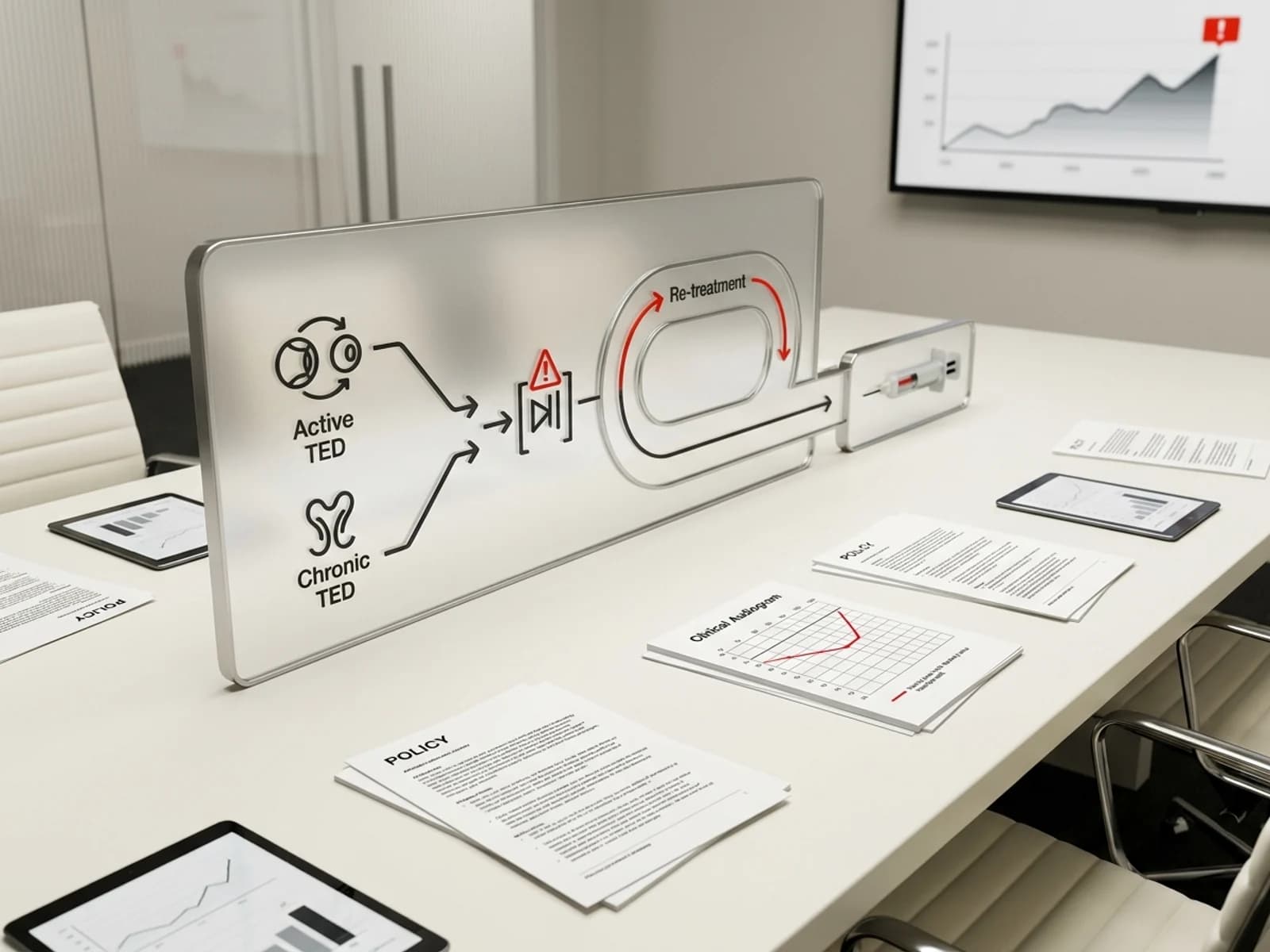
In July 2023, the FDA updated Tepezza's label to include a warning for hearing impairment, including hearing loss, which in some cases may be permanent. This has become the most significant safety concern for Tepezza access:
Label guidance: Assess patients' hearing before, during, and after treatment with Tepezza. Consider the benefit-risk of treatment with patients.
Clinical trial data: Hearing impairment was reported as an adverse reaction in Tepezza trials, with some cases being permanent.
MDL litigation: A multidistrict litigation (MDL) was established in the Northern District of Illinois, centralizing Tepezza hearing loss claims. Bellwether trials are scheduled starting August 3, 2026, with subsequent trials on September 28 and November 30, 2026, and February 1, 2027. Plaintiffs allege Horizon Therapeutics (now Amgen) failed to provide adequate warnings before the July 2023 label update.
Access implications for prescribers
Baseline audiometry is now standard practice before initiating Tepezza, even if not explicitly required by every payer's PA criteria. Documentation of baseline hearing protects both the patient and the prescriber.
Payers may request hearing monitoring documentation at reauthorization or re-treatment. Document any changes in hearing during and after the infusion course.
Informed consent should explicitly address hearing loss risk, including the possibility of permanent impairment, given the ongoing litigation.
Re-treatment access
The OPTIC-X extension study demonstrated that Tepezza can be effective in re-treatment for patients who relapse after an initial course. Key findings:
Patients who received a second course of Tepezza showed meaningful proptosis reduction and diplopia improvement.
Re-treatment was evaluated in patients with longer-duration TED.
However, payer coverage for re-treatment is not automatic:
The standard PA covers only 8 infusions per lifetime. A second course requires a new authorization.
Payers typically require documentation of initial clinical response followed by relapse, and a new clinical rationale for re-treatment.
Some plans may deny re-treatment as not medically necessary, particularly if the initial course achieved a "complete" response.
Prescribers should proactively include relapse documentation, imaging, and proptosis measurements in re-treatment PA submissions. Amgen By Your Side can assist with re-treatment authorization support.
Upcoming subcutaneous formulation
In April 2026, Amgen announced positive topline results from a Phase 3 trial of Tepezza administered by subcutaneous injection via an on-body injector (OBI) in patients with moderate-to-severe active TED. The subcutaneous formulation demonstrated comparable efficacy to IV Tepezza. If approved, this would:
Eliminate the need for IV infusion infrastructure.
Reduce infusion chair time and enable administration in a broader range of clinical settings.
Potentially shift site-of-care economics, as the drug would no longer require an infusion center.
Create a new billing pathway (likely a new HCPCS code) distinct from IV J3241.
Launch timing and payer coverage criteria for the subcutaneous formulation are not yet established. Market access teams should monitor Amgen's regulatory filings and begin early payer engagement.
Site-of-care considerations
Tepezza infusions can be administered in multiple settings, and payer site-of-care policies significantly affect reimbursement:
Hospital outpatient: Highest facility fees; payers may impose site-of-care edits directing patients to lower-cost settings.
Ambulatory infusion center: Mid-range reimbursement; preferred by many commercial plans.
Physician office (buy-and-bill): Practice purchases drug and bills J3241 + administration. Most common for ophthalmology and endocrinology practices with infusion capability.
Home infusion: Available with SS modifier; may be required for patients with mobility limitations.
Some commercial payers and Medicare Advantage plans apply site-of-care edits that require Tepezza infusions to be administered at specific preferred sites. Practices should verify site-of-care requirements before scheduling.
Medicare coverage
Medicare Part B covers Tepezza as a physician-administered drug when medically necessary. After the annual Part B deductible, Medicare pays 80% of the approved amount, and the patient is responsible for 20% coinsurance. Medicare Advantage plans cover Tepezza under their medical benefit but impose prior authorization and may have preferred site-of-care or step therapy requirements.
Medicaid coverage varies by state. Some state Medicaid programs (e.g., Oregon, Louisiana) have published specific PA criteria for Tepezza. Molina Healthcare's criteria, for example, require documented Graves' disease with active TED and specific proptosis thresholds.
Manufacturer support: Amgen By Your Side
Amgen By Your Side is the patient support program for Tepezza, offering:
Benefits investigation: Verification of insurance coverage and PA requirements.
Prior authorization support: Assistance with PA submission and appeals.
Commercial copay program: Eligible commercially insured patients may pay as little as $0 out-of-pocket for both Tepezza and the IV infusion process (terms and conditions apply; not valid for government-insured patients).
Patient assistance: For uninsured or underinsured patients who qualify.
Reimbursement support: Claims advisory, denial management, and appeals assistance.
Nurse educator access: Patient education on the infusion process and what to expect during treatment.
Contact: Visit Amgen By Your Side website or call the number listed on Tepezza.com.
Key access considerations for prescribers
Document proptosis precisely. Payers require objective measurement (exophthalmometry or imaging-based), and specific thresholds (≥3 mm above normal or from baseline) must be documented. Race- and sex-specific normal values matter for meeting PA criteria.
Steroid step therapy is common. Most plans require a documented trial of oral or IV glucocorticoids before Tepezza. Begin documenting steroid use, response, and intolerance early to avoid PA delays.
Baseline audiometry is essential. Even if not required by the payer's PA criteria, pre-treatment hearing assessment is critical given the FDA warning and ongoing litigation.
Plan for re-treatment authorization. If a patient relapses after the initial 8-infusion course, gather relapse documentation (proptosis measurements, CAS scores, imaging) promptly. Re-treatment PA requires a fresh clinical narrative.
Site-of-care can be a payer lever. Verify the payer's preferred infusion setting before scheduling. Site-of-care edits can delay treatment if the practice is not in-network at the preferred site.
Monitor the subcutaneous formulation. If approved, the OBI delivery system could transform Tepezza access. Market access teams should begin preparing for formulary positioning, coding, and site-of-care implications.
Sources
Tepezza prescribing information. Amgen Inc. September 2025. https://www.accessdata.fda.gov/drugsatfda_docs/label/2020/761125s000lbl.pdf
Douglas RS, Kahaly GJ, Patel A, et al. Teprotumumab for the treatment of active thyroid eye disease. N Engl J Med. 2020;382(4):341-352. https://pubmed.ncbi.nlm.nih.gov/31971680/
Smith TJ, Kahaly GJ, Ezra DG, et al. Teprotumumab for thyroid-associated ophthalmopathy. N Engl J Med. 2017;376:1748-1761. https://pubmed.ncbi.nlm.nih.gov/28423298/
Douglas RS, Kahaly GJ, Ugradar S, et al. Teprotumumab efficacy, safety, and durability in longer-duration thyroid eye disease and re-treatment: OPTIC-X study. Ophthalmology. 2022;129(4):438-449.
UnitedHealthcare Commercial Medical Benefit Drug Policy: Tepezza (teprotumumab-trbw). Policy 2025D0089K. Effective March 1, 2025. https://www.uhcprovider.com/content/dam/provider/docs/public/policies/comm-medical-drug/tepezza.pdf
HCPCS J3241 — Injection, teprotumumab-trbw, 10 mg. CMS. https://www.cms.gov/Medicare/Coding/HCPCSReleaseCodeSets
Amgen By Your Side. Tepezza billing and coding guide. https://www.amgenbyyourside.com/tepezza/hcp/authorization/-/media/Themes/Horizon/Amgenbyyourside/Amgenbyyourside/Documents/tepezza/hcp/TEPEZZA-Billing-and-Coding-Guide.pdf
Prime Therapeutics. Medication insights: teprotumumab-trbw (Tepezza). August 2025. https://www.primetherapeutics.com/expert-clinical-network-insights-august-2025
Amgen. Amgen announces positive topline Phase 3 results for subcutaneous Tepezza. Press release. April 6, 2026. https://www.amgen.com/newsroom/press-releases/2026/04/amgen-announces-positive-topline-phase-3-results-for-subcutaneous-tepezza-in-adults-living-with-moderate-to-severe-active-thyroid-eye-disease
FDA. Tepezza label update: hearing impairment warning. July 2023. https://www.fda.gov/drugs/postmarket-drug-safety-information-patients-and-providers