On September 19, 2025, the FDA approved Keytruda Qlex (pembrolizumab and berahyaluronidase alfa-pmph), a subcutaneous formulation of pembrolizumab, for adult and pediatric patients aged 12 years and older with all solid tumor indications already approved for IV Keytruda. The approval covers 38 indications spanning non-small cell lung cancer, melanoma, head and neck squamous cell carcinoma, triple-negative breast cancer, urothelial carcinoma, renal cell carcinoma, endometrial carcinoma, and many others.
Keytruda Qlex is administered as a subcutaneous injection into the abdomen or thigh over 1–2 minutes — compared to the 30-minute IV infusion required for standard Keytruda. It uses berahyaluronidase alfa, a hyaluronidase enzyme that temporarily degrades hyaluronic acid in the subcutaneous matrix, enabling rapid dispersion and absorption of the large monoclonal antibody molecule.
For oncology practices and health systems, the subcutaneous formulation creates a distinct set of access, coding, billing, and operational considerations alongside the existing IV product. This guide compares the two formulations and covers payer coverage, coding, pathway positioning, operational economics, and patient support.
Short answer
| IV Keytruda (pembrolizumab) | Keytruda Qlex (pembrolizumab + berahyaluronidase alfa) | |
|---|---|---|
| Route | IV infusion over 30 minutes | Subcutaneous injection over 1–2 minutes |
| Formulation | 100 mg/4 mL single-dose vial | 165 mg + 2,000 units/mL single-dose vials (2.4 mL or 4.8 mL) |
| Dosing (adults >40 kg) | 200 mg q3w or 400 mg q6w | 395 mg/4,800 units q3w (2.4 mL, 1 min) or 790 mg/9,600 units q6w (4.8 mL, 2 min) |
| Administration site | Infusion center; requires IV access | Clinic; no IV access or port needed |
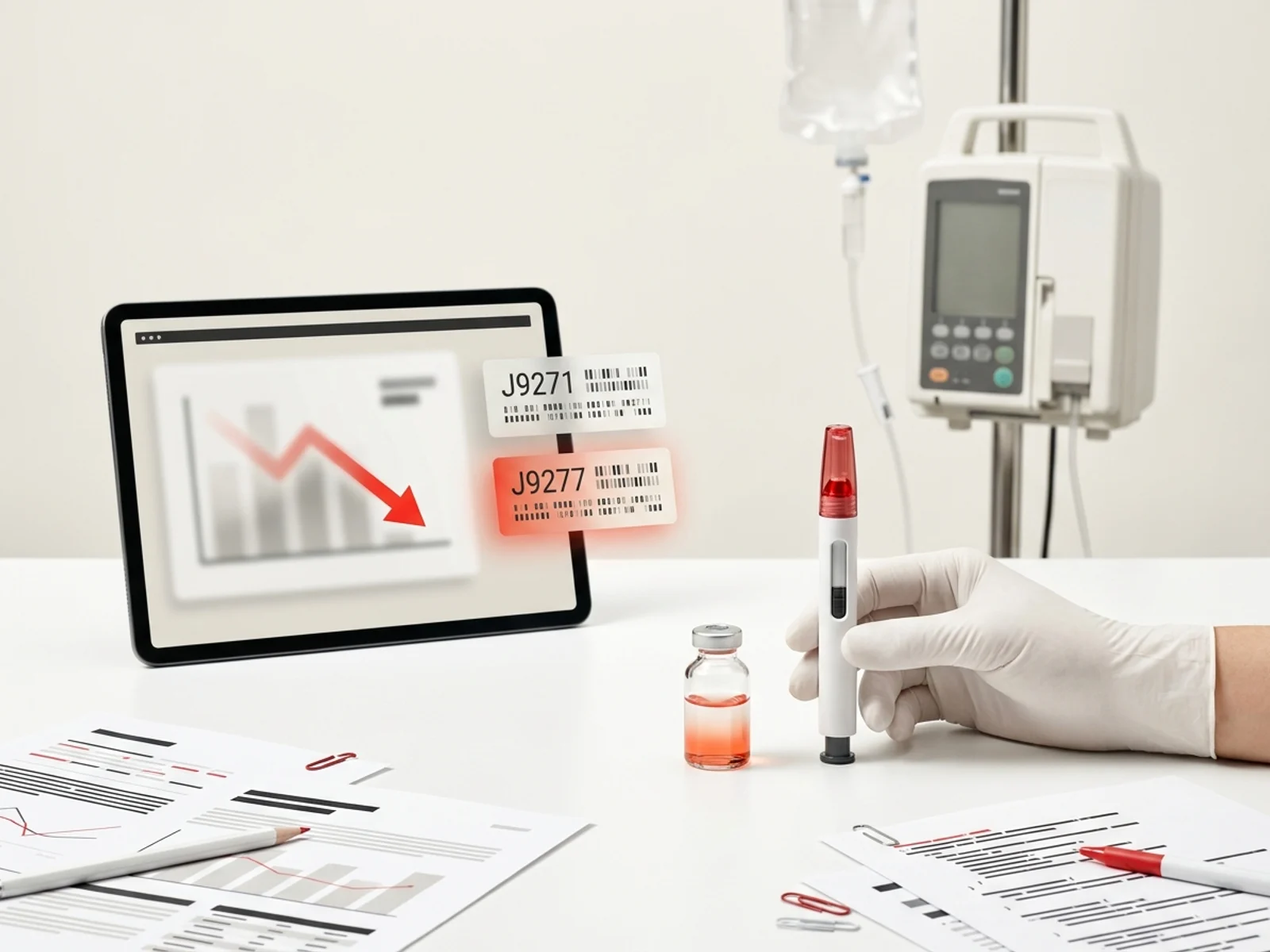
| HCPCS code | J9271 (injection, pembrolizumab, 1 mg) | J9277 (injection, pembrolizumab, 1 mg and berahyaluronidase alfa-pmph) |
| Benefit channel | Medical benefit — always | Medical benefit — always |
| FDA approval date | September 2014 (initial) | September 19, 2025 |
| Indications | All current pembrolizumab indications (solid tumors, some hematologic) | All solid tumor indications of IV Keytruda (38 indications); excludes classical Hodgkin lymphoma and primary mediastinal large B-cell lymphoma in initial approval |
| PA required | Yes — all plans | Yes — all plans |
| Manufacturer support | Merck Access Program | Merck Access Program |
FDA approval basis: MK-3475A-D77 trial
The FDA approval was based on MK-3475A-D77, a randomized, multicenter, open-label Phase 3 trial in patients with previously untreated metastatic NSCLC without EGFR, ALK, or ROS1 genomic alterations. A total of 377 patients were randomized 2:1 to receive either Keytruda Qlex (790 mg/9,600 units q6w) with platinum doublet chemotherapy or IV Keytruda (400 mg q6w) with platinum doublet chemotherapy.
Primary endpoints (pharmacokinetic comparability)
The trial met predefined PK acceptance margins:
Cycle 1 AUC₀₋₆ weeks: lower boundary of the 96% CI for the geometric mean ratio was above 0.80.
Cycle 3 (steady state) Ctrough: lower boundary of the 94% CI for the geometric mean ratio was above 0.80.
Efficacy (descriptive)
ORR: 45% (95% CI: 39, 52) for Keytruda Qlex + chemo vs 42% (95% CI: 33, 51) for IV Keytruda + chemo.
Median PFS: 8.1 months (95% CI: 6.3–8.3) vs 7.8 months (95% CI: 6.2–9.7) (HR=1.05, 95% CI: 0.78–1.43).
Median OS: Not reached in either arm (HR=0.81, 95% CI: 0.53–1.22).
Safety
The most common adverse reactions (≥20%) with Keytruda Qlex + chemotherapy were nausea (25%), fatigue (25%), and musculoskeletal pain (21%). Immune-mediated adverse reactions were consistent with the known profile of IV pembrolizumab. Subcutaneous injection-site reactions were reported but not a dominant safety signal.
Oncology pathway and formulary positioning
IV Keytruda is the dominant PD-1 inhibitor in US oncology pathways, with extensive NCCN guideline recommendations across dozens of tumor types and treatment settings. Keytruda Qlex enters a market where IV pembrolizumab is already the standard of care.
Pathway adoption considerations
Equivalence is pharmacokinetic, not clinical. The MK-3475A-D77 trial demonstrated PK comparability with descriptive efficacy supporting similar outcomes. Oncology pathways typically require robust efficacy data for formulary inclusion; the descriptive (non-powered) efficacy comparison means some pathway committees may initially classify Qlex as "comparable but not preferred."
No head-to-head monotherapy data yet. The D77 trial tested both arms with chemotherapy. Merck is conducting the 3475A-F84 Phase 3 trial evaluating Keytruda Qlex monotherapy vs IV Keytruda monotherapy in first-line metastatic NSCLC with high PD-L1 expression (TPS ≥50%), and 3475A-F65 Phase 2 in relapsed/refractory classical Hodgkin lymphoma and primary mediastinal large B-cell lymphoma.
NCCN inclusion. As of early 2026, NCCN guidelines list pembrolizumab and berahyaluronidase alfa-pmph as an available formulation alongside IV pembrolizumab for applicable indications. Specific pathway recommendations are expected to evolve as monotherapy data mature.
Oncology benefit managers (OBMs) and pathway vendors. Companies like Carelon Medical Benefits Management, eviCore, and NCCN-affiliated pathways are updating criteria documents to include Keytruda Qlex. Carelon's clinical criteria (CC-0124) already reference Keytruda Qlex, and prior authorization workflows are being configured. Some OBMs may initially prefer IV Keytruda where existing pathways are well-established and may require additional documentation for Qlex.
HCPCS coding and billing
IV Keytruda
HCPCS: J9271 — Injection, pembrolizumab, 1 mg
Billing units: Based on mg administered. For 200 mg dose: 200 units. For 400 mg dose: 400 units.
CPT: 96413 (IV chemotherapy infusion, first hour) + 96415 (additional hours) for drug administration.
Keytruda Qlex
HCPCS: J9277 — Injection, pembrolizumab, 1 mg and berahyaluronidase alfa-pmph
Billing units: Based on pembrolizumab mg component. For 395 mg dose: 395 units. For 790 mg dose: 790 units.
CPT: Since this is a subcutaneous injection (not an IV infusion), the administration code is likely 96372 (therapeutic, prophylactic, or diagnostic injection, subcutaneous or intramuscular) rather than IV chemotherapy infusion codes. Confirm with payer-specific billing guidance.
Coding evolution
Keytruda Qlex initially used temporary codes (C9399, J9999) before receiving the permanent J9277 code. Florida Blue added J9277 and removed J9999 effective April 1, 2026. Practices should verify that their clearinghouse and billing systems recognize J9277 and that the correct code is used for dates of service after its effective date.
Infusion-chair economics
The operational economics of Keytruda Qlex differ meaningfully from IV Keytruda:
IV Keytruda operational costs
IV access required (port, PICC, or peripheral IV) — nursing time and supplies.
30-minute infusion plus pre-medication and monitoring time.
Total chair time: typically 60–90 minutes per visit.
Facility overhead tied to infusion suite capacity.
Keytruda Qlex operational savings
No IV access needed — subcutaneous injection administered into abdomen or thigh over 1–2 minutes.
No port surgery required for patients whose only IV therapy is pembrolizumab (though ports may still be needed for other treatments in the regimen, such as chemotherapy).
Reduced chair time enables higher patient throughput per infusion chair.
Lower nursing time per administration.
For high-volume oncology practices and health systems, the chair-time savings are significant. A clinic administering 100 pembrolizumab doses per week could reclaim substantial infusion-suite capacity by converting a portion of patients to the subcutaneous formulation. However, the drug acquisition cost, reimbursement, and margin structure for J9277 may differ from J9271 — practices should model the buy-and-bill economics carefully.
Payer coverage and prior authorization
Coverage status
As of early 2026, major payers are incorporating Keytruda Qlex into their coverage criteria:
Aetna: Clinical policy bulletin 0890 covers pembrolizumab products (Keytruda and Keytruda Qlex) with the same indication-specific criteria. No distinction between formulations for medical necessity determination, but PA is required.
UnitedHealthcare / Optum: Policies being updated. Keytruda Qlex is expected to be covered under existing pembrolizumab medical benefit criteria with formulation-specific PA requirements.
Carelon (Anthem/BCBS): Clinical Criteria CC-0124 references Keytruda Qlex with prior authorization requirements.
Florida Blue: Added HCPCS J9277 effective April 1, 2026, replacing temporary codes.
Superior HealthPlan (Medicaid/CHIP): Policy CP.PHAR.322 covers both Keytruda and Keytruda Qlex, with initial approval durations extended to 12 months for maintenance therapy.
Payer preferred/non-preferred positioning by indication
UnitedHealthcare Community Plan's oncology medication clinical coverage policy (effective April 1, 2026) reveals early payer differentiation between formulations by indication:
| Indication | Keytruda Qlex status | IV Keytruda status |
|---|---|---|
| NSCLC (advanced/metastatic, first-line + chemo) | Preferred | Non-preferred |
| Head and neck cancers | Non-preferred | — |
| Squamous cell skin cancer | Non-preferred | Non-preferred |
| Hepatocellular carcinoma (combination) | Listed | Listed |
This is significant because it means UHC is already creating preferred-product designations that favor Qlex in some settings (NSCLC) and disfavor it in others. Practices should check the specific indication's preferred status before selecting the formulation, as non-preferred products may face higher cost-sharing or additional PA hurdles.
PA considerations
Indication-specific documentation: PA criteria are driven by the underlying cancer diagnosis and treatment line, not the formulation. The same biomarker, histology, and prior-therapy documentation required for IV Keytruda applies to Qlex.
Formulation selection justification: Some payers may request documentation of why the subcutaneous formulation was chosen over IV. Acceptable justifications may include patient preference, poor venous access, infusion-chair capacity constraints, or operational efficiency.
Companion chemotherapy: If Keytruda Qlex is used with chemotherapy, the chemotherapy component is still administered IV. Payers may question why the pembrolizumab component is subcutaneous while chemotherapy remains IV. Document clinical rationale.
Patient population considerations
Keytruda Qlex is particularly relevant for:
Patients with difficult venous access: Those who require multiple attempts for IV access, have small or fragile veins, or have experienced IV complications.
Patients on q6w dosing: The 790 mg/9,600 units q6w dosing option aligns with the existing IV 400 mg q6w schedule and reduces visit frequency while also eliminating IV time at each visit.
High-volume practices: Where infusion-chair throughput is a bottleneck and subcutaneous administration can free capacity.
Community oncology settings: Where infusion infrastructure may be limited and a quick-injection model improves operational efficiency.
Keytruda Qlex is not appropriate for:
Patients with classical Hodgkin lymphoma or primary mediastinal large B-cell lymphoma (not yet covered by the FDA approval; Merck is conducting 3475A-F65).
Patients who require a port for other IV treatments in their regimen (the port would still be placed regardless).
Manufacturer support: Merck Access Program
Both IV Keytruda and Keytruda Qlex are supported through the Merck Access Program:
Benefits investigation: Verify insurance coverage and PA requirements for the specific formulation.
Prior authorization support: Assistance with PA submission and appeals for both formulations.
Patient assistance program: For uninsured or underinsured patients who qualify.
Coding and billing resources: KeytrudaBillingCodes.com provides formulation-specific HCPCS, NDC, and billing guidance updated as of February 2026.
Field reimbursement managers: Available to assist with coverage and claims issues.
Nurse educators: Available for patient education on both IV and subcutaneous administration.
Contact: 855-257-3932 (Merck Access Program).
Key access considerations for oncology practices
Verify payer PA pathways for Qlex. While many payers are covering Qlex, the PA infrastructure is still maturing. Confirm that the payer's system recognizes J9277 and that the indication-specific criteria are the same as for J9271.
Model buy-and-bill economics for J9277. The ASP for Keytruda Qlex may differ from IV Keytruda, and the administration reimbursement (96372 vs 96413) is different. Run the margin calculation before committing to inventory.
Educate patients on the injection experience. Patients accustomed to IV Keytruda may have questions about the subcutaneous switch. Merck's patient preference study (3475A-F11) is evaluating patient-reported preferences for the subcutaneous vs IV route.
Coordinate with chemotherapy scheduling. If pembrolizumab is given subcutaneously but chemotherapy remains IV, the workflow must accommodate both administration types in the same visit.
Track pathway committee decisions. As NCCN, ASCO, and payer pathway committees update their guidelines, the positioning of Qlex relative to IV Keytruda will evolve. Practices with pathway-aligned prescribing should monitor these updates.
Do not automatically switch all patients. Some patients and providers may prefer IV for clinical or logistical reasons. Formulary decisions should be patient-centered and operationally appropriate, not purely driven by chair-time savings.
Sources
FDA. FDA approves pembrolizumab and berahyaluronidase alfa-pmph for subcutaneous injection. September 19, 2025. https://www.fda.gov/drugs/resources-information-approved-drugs/fda-approves-pembrolizumab-and-berahyaluronidase-alfa-pmph-subcutaneous-injection
Merck. FDA approves Merck's Keytruda Qlex (pembrolizumab and berahyaluronidase alfa-pmph) injection for subcutaneous use. Press release. September 2025. https://www.merck.com/news/fda-approves-mercks-keytruda-qlex-pembrolizumab-and-berahyaluronidase-alfa-pmph-injection-for-subcutaneous-use-in-adults-across-most-solid-tumor-indications-for-keytruda-pem
Keytruda Qlex prescribing information. Merck Sharp & Dohme Corp. September 2025. https://www.accessdata.fda.gov/drugsatfda_docs/label/2025/761115s000lbl.pdf
Aetna Clinical Policy Bulletin 0890: Pembrolizumab products (Keytruda and Keytruda Qlex). https://www.aetna.com/cpb/medical/data/800_899/0890.html
Florida Blue Medical Coverage Guideline 09-J2000-22: Pembrolizumab (Keytruda, Keytruda Qlex). Updated April 1, 2026. http://mcgs.bcbsfl.com/MCG?mcgId=09-J2000-22
CMS HCPCS code J9277 (injection, pembrolizumab, 1 mg and berahyaluronidase alfa-pmph). https://www.cms.gov/Medicare/Coding/HCPCSReleaseCodeSets
Merck Access Program. KeytrudaBillingCodes.com. Updated February 2026. https://www.keytrudabillingcodes.com
UnitedHealthcare Community Plan Oncology Medication Clinical Coverage Policy. Effective April 1, 2026. https://www.uhcprovider.com/content/dam/provider/docs/public/policies/index/comm-plan/oncology-medication-clinical-coverage-policy-cs-04012026.pdf