Spravato (esketamine) CIII nasal spray (Janssen Pharmaceuticals) is a non-competitive NMDA receptor antagonist indicated for two psychiatric uses in adults: treatment-resistant depression (TRD), as monotherapy or with an oral antidepressant; and depressive symptoms in major depressive disorder (MDD) with acute suicidal ideation or behavior, in conjunction with an oral antidepressant. It is the second FDA-approved medication for TRD (after Symbyax) and the first rapid-acting treatment for MDD with acute suicidality.
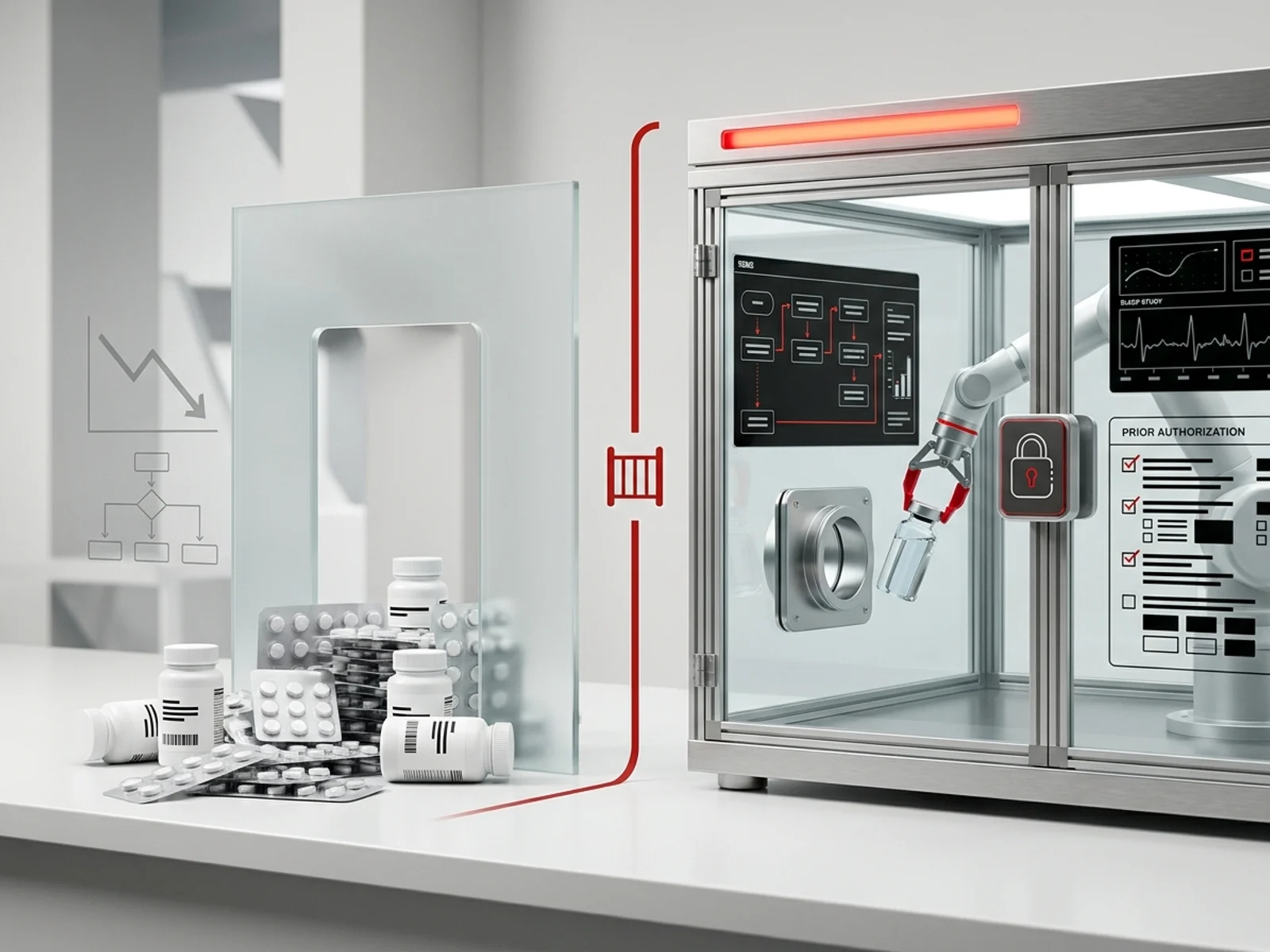
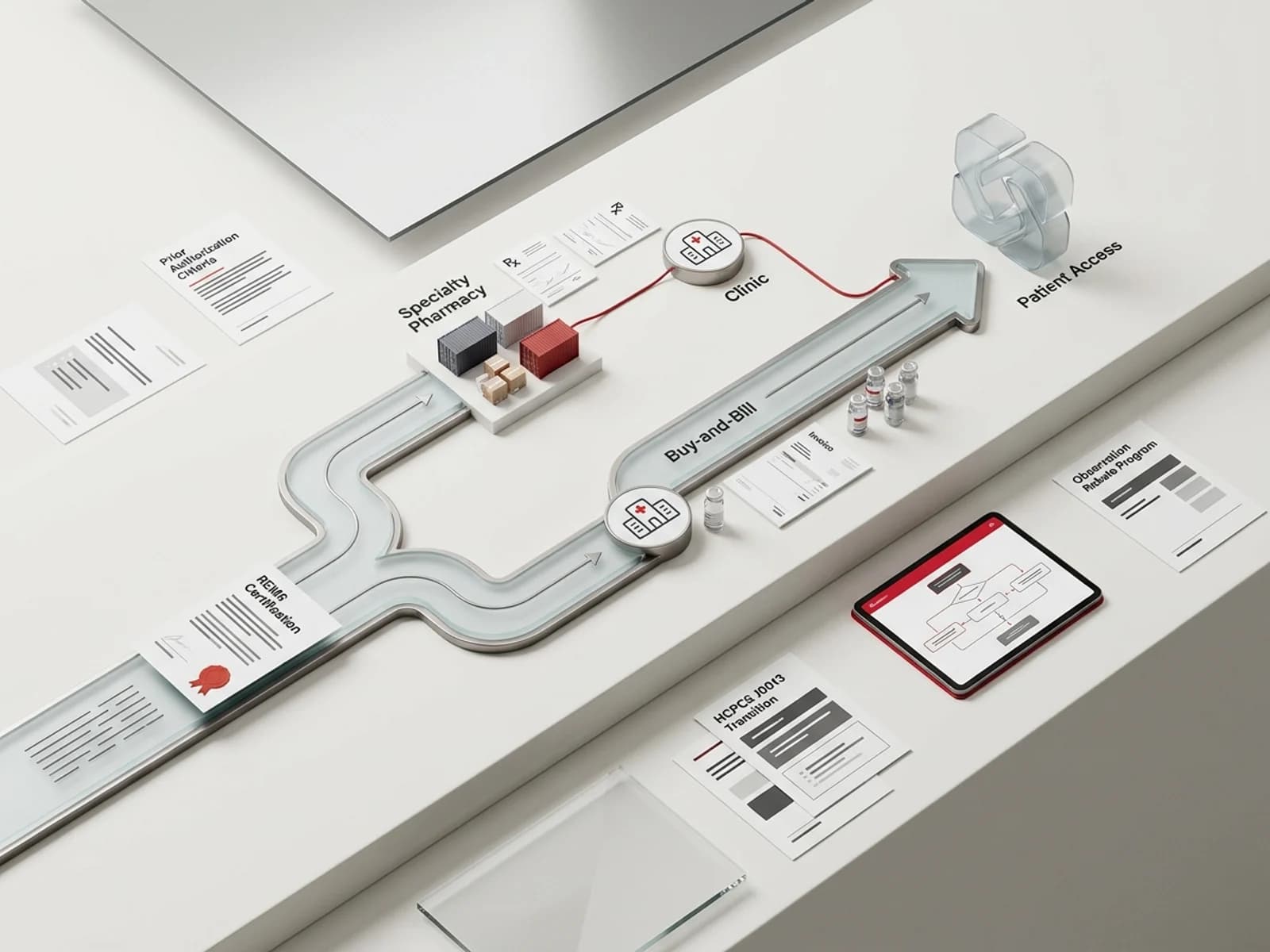
Spravato is not dispensed at retail pharmacies and cannot be self-administered at home. The FDA requires administration under a closed REMS (Risk Evaluation and Mitigation Strategy) program. That REMS structure — plus the split between buy-and-bill and specialty pharmacy acquisition models — creates a unique access workflow that differs from most specialty drugs.
This guide covers REMS certification, payer PA criteria, billing and coding (including the 2026 HCPCS transition from S0013 to J0013), observation period documentation, and patient support programs.
Short answer
| Spravato (esketamine) CIII | |
|---|---|
| Drug class | Non-competitive NMDA receptor antagonist (S-enantiomer of ketamine) |
| Manufacturer | Janssen Pharmaceuticals (Johnson & Johnson) |
| FDA indications | Treatment-resistant depression (TRD); MDD with acute suicidal ideation or behavior |
| Administration | Patient self-administers nasal spray under direct HCP observation in a REMS-certified setting |
| Dosing (TRD induction) | 56 mg or 84 mg twice weekly for first 4 weeks |
| Dosing (TRD maintenance) | 56 mg or 84 mg weekly or every 2 weeks |
| Benefit channel | Medical benefit for most plans; pharmacy benefit in some |
| HCPCS drug code (2026) | J0013 (esketamine, nasal spray, 1 mg) — replaced S0013 effective January 1, 2026 |
| Medicare billing codes | G2082 (≤56 mg, includes drug + administration + 2-hour observation); G2083 (>56 mg) |
| REMS required | Yes — Spravato REMS |
| PA required | Yes, virtually all commercial and Medicare plans |
| WAC list price | ~$775 per 56 mg device; ~$1,163 per 84 mg device (estimated) |
REMS certification and site requirements
The Spravato REMS is a mandatory restricted distribution program. It exists because of three documented risks: sedation, dissociation, and potential for abuse and misuse.
Healthcare setting certification
Every outpatient or inpatient site that administers Spravato must be REMS-certified. Certification requires:
Site enrollment at SPRAVATOrems.com. The healthcare setting (not individual providers) enrolls.
Healthcare provider training: each prescriber and observing clinician must complete the REMS training module.
Patient enrollment: each patient must be enrolled in the REMS program before their first dose.
Direct observation: the patient self-administers the nasal spray under direct observation by a certified healthcare provider.
Post-administration monitoring: the patient must be monitored by a healthcare provider for at least 2 hours after each dose, assessed for readiness to leave, and discharged with instructions not to drive for the rest of the day.
Pharmacy certification: pharmacies dispensing Spravato must be REMS-certified and may only dispense to REMS-certified healthcare settings.
REMS and payer coverage
REMS certification is a prerequisite for insurance authorization. A payer will not cover Spravato administered at a non-certified site. However, REMS compliance alone does not guarantee coverage — payers layer their own clinical criteria (failed antidepressant trials, depression rating scale scores, specialist prescriber) on top of the REMS requirements.
Two procurement models: buy-and-bill vs specialty pharmacy
The way a practice obtains Spravato determines the billing pathway and the payer codes used.
Buy-and-bill
The practice purchases Spravato directly from an authorized specialty distributor (SD), maintains inventory on-site, administers it to the patient, and bills the payer for both the drug and administration/observation.
For Medicare Advantage: bill G2082 (dose ≤ 56 mg) or G2083 (dose > 56 mg). These G codes are bundled and include the drug cost, administration, and the 2-hour observation period. Do not bill J0013 separately for Medicare patients.
For commercial payers that accept G codes: bill G2082/G2083 per payer guidance.
Key consideration: the practice bears inventory cost and financial risk until payer reimbursement is received. Proper coding is critical — coding errors are a leading cause of Spravato claim denials.
Assignment of benefits / specialty pharmacy
A REMS-certified specialty pharmacy ships Spravato directly to the treatment site for a specific patient. The pharmacy bills the drug; the practice bills only for administration, observation, and monitoring.
Drug billing: the specialty pharmacy bills J0013 (esketamine, nasal spray, 1 mg) — 56 units for a 56 mg dose, 84 units for an 84 mg dose.
Administration/observation billing: the practice bills E/M codes (99213–99215 for established patients), possibly with prolonged service codes (99415, 99416, or G2212).
Do not bill G2082/G2083 for commercial members when the drug is supplied by a pharmacy — those codes include the drug cost.
2026 HCPCS code transition
Effective January 1, 2026, CMS deleted S0013 and created J0013 (esketamine, nasal spray, 1 mg) as the new drug-specific code. This is a critical change:
S0013: no longer valid after December 31, 2025.
J0013: effective January 1, 2026, for all payers. Bill 56 units for a 56 mg dose kit; 84 units for an 84 mg dose kit.
G2082/G2083: remain valid for Medicare claims. These bundled codes already include the drug cost and should not be paired with J0013.
Payer-specific guidance varies: some commercial payers have not yet updated their systems. Practices should verify payer acceptance of J0013 before submitting claims.
Payer prior authorization criteria
Treatment-resistant depression (TRD)
TRD is the primary Spravato indication and the most common PA pathway. Payer criteria are remarkably consistent across major plans:
Common requirements (Cigna, Blue Shield of California, Capital Blue Cross, Regence, CarePartners CT):
Age 18+
Diagnosis: DSM-5 major depressive disorder, confirmed as treatment-resistant. TRD is defined as failure to respond to at least two adequate trials of antidepressant medications (different classes, adequate dose, adequate duration — typically 6–8 weeks each) in the current episode.
Specialist prescriber: a psychiatrist, or a prescriber in consultation with a psychiatrist. Some plans accept psychiatric nurse practitioners or psychiatric clinical nurse specialists.
Baseline depression rating scale: documented score from a validated instrument:
MADRS (Montgomery-Åsberg Depression Rating Scale)
HAMD-17 (Hamilton Rating Scale for Depression)
QIDS-C16 (Quick Inventory of Depressive Symptomatology)
PHQ-9 (Patient Health Questionnaire-9)
REMS certification attestation: the treatment site is REMS-certified.
Concurrent oral antidepressant: required for the suicidality indication; optional for TRD per the label, but many payers require it.
ICD-10 codes: F33.1 (MDD, recurrent, moderate), F33.2 (MDD, recurrent, severe), or F32.x series.
MDD with acute suicidal ideation or behavior
The suicidality indication has fewer antidepressant-failure requirements but has its own documentation needs:
ICD-10 code R45.851 (suicidal ideation) alongside the MDD diagnosis
Clinical documentation of acute suicidal ideation or behavior
Concurrent oral antidepressant required
Most plans limit authorization to the acute treatment period (typically 4 weeks), with transition to TRD criteria for ongoing maintenance
Reauthorization criteria
Continuation of Spravato requires documented clinical improvement:
** depression rating scale reassessment**: most payers require a follow-up MADRS, PHQ-9, QIDS, or CUDOS score demonstrating improvement from baseline.
Initial authorization: typically 28 days (induction phase) for TRD; up to 12 months for plans with broader criteria.
Reauthorization: up to 12 months with documented sustained improvement.
Quantity limits: Regence limits induction to 12 dose kits in 8 weeks and maintenance to 48 dose kits in 48 weeks.
Observation period billing and reimbursement
The 2-hour post-administration observation period is a distinguishing billing challenge:
Medicare Advantage
G2082 and G2083 already include the observation period. Do not bill separately.
Commercial payers (buy-and-bill)
If using J0013 for the drug separately, bill the observation with:
E/M service: 99213–99215 (established patient visit)
Prolonged services: 99415 (first hour of prolonged clinical staff services), 99416 (each additional 30 minutes), or G2212 (prolonged office visit)
Some payers accept the G codes for commercial members; verify with each plan.
Janssen Observation Rebate Program
For commercially insured patients, Janssen offers an Observation Rebate Program that can reduce out-of-pocket observation costs to zero for eligible patients. This program is not available for Medicare, Medicaid, TRICARE, or VA patients.
Payer-specific policies (selected)
Blue Cross Blue Shield of Michigan (March 2026 update)
Buy-and-bill for both Medicare Advantage and commercial members
Commercial: bill J0013 (56 or 84 units) plus E/M codes for administration and observation. Do not bill G2082/G2083 for commercial members.
Medicare Advantage: bill G2082/G2083 only. Do not bill J0013.
Blue Shield of California (effective January 2026)
Medical benefit drug policy for Spravato
TRD criteria: age 18+, psychiatrist prescriber, inadequate response to 2 antidepressants, baseline depression score (MADRS, HAMD17, QIDS-C16)
HCPCS: J0013
Cigna National Formulary
PA recommended for prescription benefit coverage
TRD: documented failure of 2 antidepressants at adequate dose and duration
Suicidality indication: acute treatment with concurrent oral antidepressant
Approvals for 12 months at a time
Site of Care utilization management policy applies for specialty drug infusions
Regence / Prime Therapeutics
Medical benefit only
Quantity limits: 12 dose kits in 8 weeks (induction), 48 dose kits in 48 weeks (maintenance)
ICD-10: F33.1, F33.2 for TRD; R45.851 for suicidality indication
Horizon NJ Health (February 2026 update)
Updated UM requirements for Spravato administration and facility charges
PA required for Spravato-related services rendered on or after February 18, 2026
Patient support programs
SPRAVATO withMe (Janssen)
Savings Program: commercially insured patients may pay as little as $10 per treatment for Spravato medication costs. Maximum annual program benefits apply. Not available for government-insured patients (Medicare, Medicaid, TRICARE, VA).
Benefit investigation: SPRAVATO withMe can help determine whether a patient's plan processes Spravato through pharmacy or medical benefit and identify the appropriate pathway.
PA support: the program offers prior authorization toolkit resources and appeal assistance.
Website: spravato.com
Phone: 1-844-772-1336
Key eligibility note for savings programs
The SPRAVATO withMe Savings Program does not cover the cost of treatment observation. The separate Janssen Observation Rebate Program addresses observation costs for eligible commercially insured patients.
Key documentation checklist for PA submission
DSM-5 diagnosis of MDD with treatment resistance or acute suicidality
Documentation of failure of at least 2 prior antidepressant trials (drug name, dose, duration, reason for discontinuation)
Prescriber specialty documentation (psychiatrist or psychiatric NP/CNS)
Baseline depression rating scale score (MADRS, HAMD-17, QIDS-C16, or PHQ-9)
REMS site certification confirmation
Patient REMS enrollment confirmation
ICD-10 codes: F33.1/F33.2 (TRD) or R45.851 (suicidal ideation) plus F32.x
Concurrent oral antidepressant attestation
Confirmation of correct benefit channel (medical vs pharmacy) and procurement model (buy-and-bill vs specialty pharmacy)
Sources
FDA. Spravato REMS Program. https://www.accessdata.fda.gov/drugsatfda_docs/nda/2019/211243Orig1s000REMS.pdf
Janssen Pharmaceuticals. Spravato (esketamine) Prescribing Information. April 2025. https://www.spravatohcp.com
Janssen Pharmaceuticals. Drug and Procedure Coding Overview for SPRAVATO. https://www.spravatohcp.com/files/spravato_coding_overview_brochure_digital_version.pdf
Janssen Pharmaceuticals. Prior Authorization Toolkit. https://www.spravatohcp.com/files/Prior_Authorization_Toolkit.pdf
Janssen Pharmaceuticals. Billing Codes & Reimbursement. https://www.spravatohcp.com/payer-coverage-and-reimbursement
Blue Cross Blue Shield of Michigan. Spravato: Purchasing and Billing Information. Revised March 2026. https://authorizations.bcbsm.com/docs/spravato-purchasing-billing.pdf
Blue Shield of California. Esketamine (Spravato) Commercial Medical Benefit Drug Policy. Effective January 2026. https://www.blueshieldca.com/content/dam/bsca/en/provider/docs/bsc-med-benefit-drug-policy/esketamine-Spravato-COMM-UMRx-provider.pdf
Cigna Healthcare. Psychiatry – Spravato Prior Authorization Policy. https://static.cigna.com/assets/chcp/pdf/coveragePolicies/cnf/cnf_606_coveragepositioncriteria_psychiatry_spravato_pa.pdf
Regence / Prime Therapeutics. Spravato (esketamine) Medication Policy dru605. https://regence.myprime.com/content/dam/prime/memberportal/forms/AuthorForms/Cambia/Program_Summaries/dru605reg.pdf
Capital Blue Cross. Esketamine (Spravato) Medical Policy MP 2.367. Effective January 2026. https://www.capbluecross.com/wps/wcm/connect/prod_nws.capblue.com29556/073f8ac7-1af5-417e-b932-3dee96e62ce9/medical-policy-esketamine.pdf
CarePartners of Connecticut. Spravato Medical Necessity Guideline. Effective January 2026. https://www.carepartnersct.com/documents/cpct-pdoc-spravato