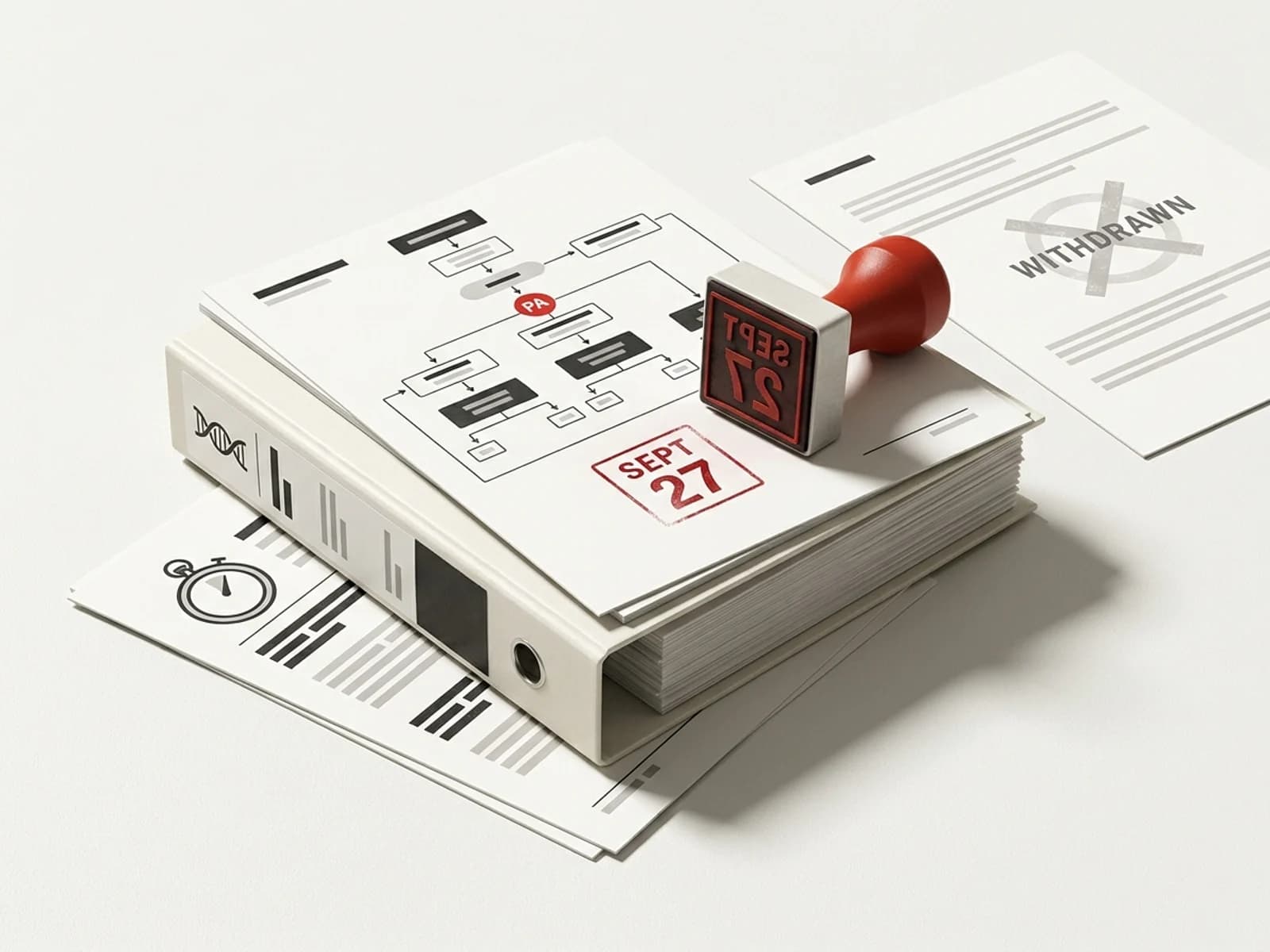
When a Medicare Part D beneficiary enrolls in a new plan — or when a plan changes its formulary mid-year — the drug they were taking may suddenly require prior authorization, step therapy, or may not be on the formulary at all. CMS requires Part D sponsors to provide a temporary supply of the drug through a transition fill, giving the beneficiary time to work with their prescriber to resolve coverage.
Separately, many specialty drug manufacturers offer bridge programs that provide free or heavily subsidized drug to patients who face a coverage denial or delay. These two mechanisms serve overlapping but distinct purposes, and the gap between them can create therapy interruptions for patients on high-cost specialty medications.
This article is written for manufacturer hub teams, field reimbursement specialists, specialty pharmacy access coordinators, and market access professionals who need to understand exactly where CMS-mandated transition fills end, where manufacturer bridge programs operate, and how to prevent patients from falling into the gap between them.
What the Medicare Part D transition fill requires
Under 42 CFR § 423.120(b)(3), every Part D sponsor must maintain a transition process that provides a temporary supply of non-formulary Part D drugs — including drugs that are on the formulary but require prior authorization or step therapy. The regulation specifies five populations eligible for transition fills:
New enrollees into Part D plans following the annual coordinated election period.
Newly eligible Medicare enrollees transitioning from other coverage.
Individuals who switch from one plan to another after the start of the contract year.
Current enrollees remaining in the plan but affected by formulary changes across contract years.
Enrollees residing in or entering long-term care facilities.
In the retail setting, the plan must provide at least a one-time temporary fill of a minimum one-month supply. If the prescription is written for less than a month's supply, the plan must allow multiple fills to total at least one month's supply. This must be available anytime during the first 90 days of enrollment, beginning on the beneficiary's effective date of coverage.
For long-term care residents, the transition fill must also be at least one month's supply, dispensed incrementally as applicable under 42 CFR § 423.154, with multiple fills provided if needed during the first 90 days. After the 90-day transition window expires, plans must provide a 31-day emergency supply of non-formulary Part D drugs while an exception or prior authorization request is pending.
What the transition fill notice must include
Within three business days of adjudicating the temporary transition fill, the plan must send the enrollee a written notice that includes:
An explanation of the temporary nature of the transition supply.
Instructions for working with the plan and prescriber to satisfy utilization management requirements or identify formulary alternatives.
An explanation of the enrollee's right to request a formulary exception.
A description of the procedures for requesting a formulary exception, including expected timeframes and appeal rights.
Plans must also make reasonable efforts to notify the prescriber of affected enrollees, typically via a cover letter and confidential patient profile identifying the drug dispensed and the transition status.
What the transition fill does not cover
The transition fill policy has important exclusions that access teams must track:
Part D excluded drugs: Drugs excluded from Part D coverage by statute (such as drugs used for weight loss, when not covered for another Part D indication) are not eligible for transition fills.
New prescriptions: The transition policy applies to ongoing drug therapy, not to new starts. If a beneficiary has no prior claim history for the drug within a designated look-back period (typically 108 days or more), the plan may deny the transition fill as a new prescription.
Drugs removed for safety: Products removed from the formulary due to FDA safety recalls are not eligible.
Beyond the 90-day window: After the initial 90-day transition period, the one-time fill obligation ends. Plans shift to the 31-day emergency supply standard for pending exceptions.
Where manufacturer bridge programs operate
Manufacturer bridge programs exist outside the Part D benefit entirely. They are product-support programs operated by the drug's sponsor, typically through a contracted hub, that provide free drug to patients who are experiencing a coverage delay or denial. These programs are not regulated by CMS in the same way as transition fills, and their design varies significantly by manufacturer.
Common bridge program structures include:
| Feature | Typical Design |
|---|---|
| Eligibility | Patient has a valid prescription and a coverage denial or pending PA |
| Duration | Usually 30–90 days of free drug, sometimes extendable |
| Benefit requirement | Most require commercial insurance; Medicare Part D eligibility varies by program |
| Dispensing channel | Shipped through the manufacturer's specialty pharmacy or limited distribution network |
| Cost to patient | $0 for the bridge supply |
| Application | Provider or hub submits enrollment on behalf of the patient |
CMS treats manufacturer bridge programs as patient assistance programs. Under CMS guidance, assistance provided by a manufacturer PAP "outside the Part D benefit" does not count toward a beneficiary's true out-of-pocket (TrOOP) costs. This means that while a bridge program fills a therapy gap, the drug supplied does not advance the patient toward the $2,100 out-of-pocket cap that triggers catastrophic coverage in 2026.
The access gap between transition fill and manufacturer bridge
The critical access risk occurs at the seam between the two mechanisms. Several scenarios can create a therapy gap:
Scenario 1: Transition fill expires before PA is resolved
A specialty drug prescribed to a new Part D enrollee requires prior authorization. The plan provides a one-month transition fill. The PA submission takes two to three weeks, but the plan denies the PA. The patient now has no transition supply remaining, no PA approval, and must either appeal (which can take additional weeks) or switch therapies. If the manufacturer bridge program requires a documented denial — not just a pending PA — the patient may not yet qualify for bridge assistance during the appeal.
Scenario 2: Transition fill not triggered because drug is excluded
GLP-1 drugs prescribed for weight management are statutorily excluded from Part D. The transition fill obligation does not apply. A beneficiary switching plans cannot receive a transition fill for Wegovy prescribed solely for obesity. The manufacturer's bridge program may or may not serve Medicare patients — many bridge programs explicitly exclude government-insured patients, though the new Medicare GLP-1 Bridge demonstration (launching July 1, 2026) may address this for qualifying beneficiaries.
Scenario 3: Look-back window rejects ongoing therapy as "new"
Plans use paid-claim look-back windows (typically 108 days or more) to verify that the beneficiary was previously taking the drug. If the patient's prior claims are not visible to the new plan — because they were covered under a different Part D sponsor, a commercial plan, or a Medicaid program that does not share claims data — the plan may classify the drug as a new prescription and deny the transition fill. The patient has a documented history of therapy, but the plan's system cannot confirm it.
Scenario 4: Bridge program excludes the patient's insurance type
Many manufacturer bridge programs are designed for commercially insured patients. When a patient transitions from commercial insurance to Medicare Part D, the bridge program's eligibility criteria may no longer be met. If the Part D transition fill has already been used (or was not available because the patient was mid-year), the patient has no short-term supply mechanism.
Scenario 5: LTC incremental dispensing creates timing gaps
In long-term care settings, transition fills are dispensed in increments — often 14-day supplies under short-cycle-fill requirements. If the 90-day window approaches and the PA or exception request has not been resolved, the patient may receive a partial supply that does not cover the full adjudication period. The 31-day emergency supply kicks in after the transition window, but only while an exception or PA is actively pending.
Operational checklist for access teams
Manufacturer hub teams and specialty pharmacy access coordinators should track the following for each patient transitioning into or between Part D plans:
| Checkpoint | Action |
|---|---|
| Enrollment effective date | Confirm the Part D plan effective date and calculate the 90-day transition window end date |
| Transition fill eligibility | Verify whether the drug is formulary, non-formulary, or PA/ST-restricted; confirm the drug is not a Part D excluded category |
| Prior claim history | Obtain documentation of prior claims or dispensing records to support "ongoing therapy" status if the plan's look-back window is empty |
| Transition fill dispensed | Confirm the fill date, days' supply, and expected fill expiration |
| PA submission timing | Submit the PA as early as possible within the transition window; do not wait for the fill to expire |
| Bridge program enrollment | If the bridge program serves Part D patients, initiate enrollment concurrent with the PA submission rather than waiting for denial |
| TrOOP impact | Explain to the patient and provider that bridge-supplied drug does not count toward the $2,100 out-of-pocket cap |
| Appeal timeline | If the PA is denied, file the appeal immediately and request an expedited review; track the number of remaining therapy days |
| LTC incremental fills | For LTC patients, confirm the dispensing schedule aligns with the transition window and does not create coverage gaps between increments |
How the $2,100 OOP cap interacts with transition and bridge
Starting in 2026, the Medicare Part D redesign caps annual out-of-pocket spending at $2,100 for covered Part D drugs. This cap is reached through TrOOP accumulation — the sum of the beneficiary's deductible, copayments, and coinsurance for covered drugs.
Transition fills are processed through the Part D claims system and do count toward TrOOP. Manufacturer bridge supplies are not processed through Part D and do not count toward TrOOP. This distinction matters for patients on high-cost specialty drugs who may reach the catastrophic phase mid-year. A patient who receives two months of free drug through a manufacturer bridge program has not advanced toward the $2,100 cap and will face the same cost-sharing structure once bridge supplies end and Part D coverage resumes.
What to monitor
CMS transition fill guidance updates: The Medicare Prescription Drug Benefit Manual (Chapter 6) and the annual transition fill attestation requirements may evolve with IRA implementation.
Manufacturer bridge program eligibility changes: Several manufacturers have adjusted Medicare eligibility criteria in response to the GLP-1 Bridge demonstration and Part D redesign. Track program terms quarterly.
State-level transitions: Some states have additional transition requirements for dual-eligible beneficiaries or Medicaid-to-Medicare transitions that go beyond the federal minimum.
Electronic prior authorization timing: The CMS ePA mandate for Part D plans (effective January 1, 2027) may compress PA turnaround times and reduce the gap between transition fill expiration and PA resolution.
This article is for informational purposes only and does not constitute medical, legal, or reimbursement advice. Coverage policies vary by plan and are subject to change. Consult the specific Part D plan's Evidence of Coverage and formulary documents for authoritative guidance.
Sources
42 CFR § 423.120(b)(3) — Access to covered Part D drugs, transition process requirements. https://www.ecfr.gov/current/title-42/chapter-IV/subchapter-B/part-423/subpart-C/section-423.120.
CMS Medicare Prescription Drug Benefit Manual, Chapter 6 — Part D Drugs and Formulary Requirements. https://www.cms.gov/medicare/prescription-drug-coverage/prescriptiondrugcovcontra/downloads/part-d-benefits-manual-chapter-6.pdf.
CMS Part D Transition Policy overview. National Council on Aging (NCOA), referencing CMS guidance.
PrimeTime Health Plan Medicare Part D 2026 Transition Supply Policy. Published per 42 CFR § 423.120(b)(3).
Mutual of Omaha Prescription Drug Plan Transition Policy. Published per CMS attestation requirements.
CDPHP 2026 Medicare Transition Management Policy. Capital District Physicians' Health Plan.
Horizon Blue Cross Blue Shield of New Jersey 2026 Medicare Formulary Transition Policy.
CMS Pharmaceutical Manufacturer Patient Assistance Program Information. https://www.cms.gov/medicare/coverage/prescription-drug-coverage/patient-assistance-program.
Drug Channels Institute. "Exposing the Facts About Voucher and Bridge Pricing." Drug Channels, June 2022.
Reed Smith. "CMS Provides Details for Medicare GLP-1 Bridge Coverage for Eligible Part D Beneficiaries." Health Industry Washington Watch, 2026.
BMS Access Support. "A Guide to 2026 Medicare Part D Coverage for Specialty Drugs." Bristol-Myers Squibb.