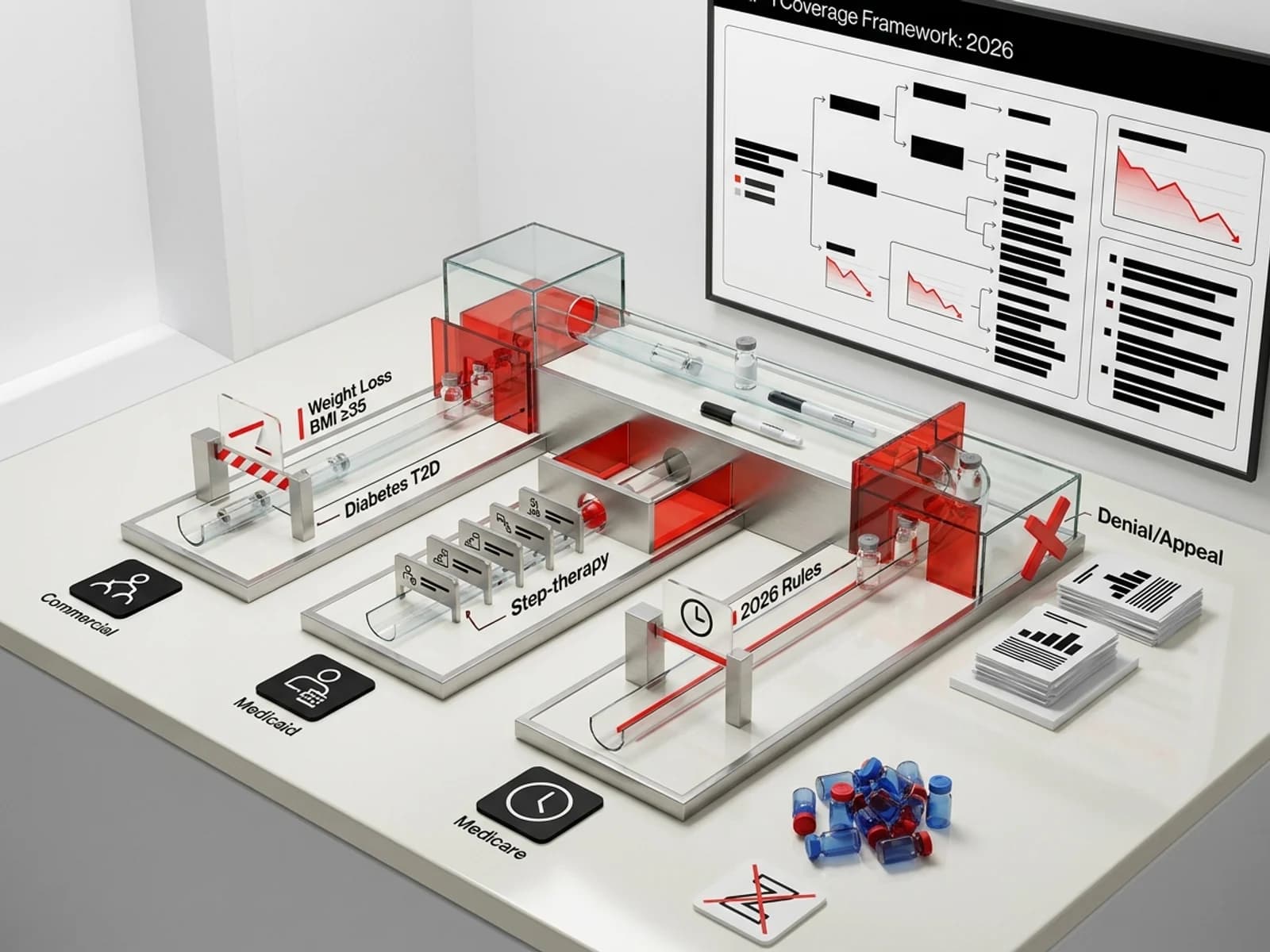
GLP-1 receptor agonists — Ozempic, Wegovy, Mounjaro, Zepbound, and their biosimilar and generic equivalents — are among the most frequently prior-authorized drug classes in the United States. Most payers approve GLP-1 coverage for 6 to 12 months, after which the prescriber must submit a reauthorization request demonstrating continued medical necessity. When that reauthorization is denied, patients face an abrupt gap in therapy that can erase months of clinical progress.
Reauthorization denials for GLP-1s are a distinct category from initial PA denials. They carry different denial reasons, require different documentation, and follow different appeal strategies. This guide maps the five most common GLP-1 reauthorization denial types, the evidence needed to overturn each one, and the step-by-step appeal workflow. It is independent information and not medical advice or reimbursement guidance for a specific patient or plan.
Quick answer
| Reauthorization Denial Type | Frequency | Root Cause | Key Appeal Evidence |
|---|---|---|---|
| Insufficient weight-loss response | Very common | Patient did not meet the plan's ≥5% body weight loss threshold | Document metabolic improvement, comorbidity response, and clinical benefit beyond weight alone |
| BMI dropped below threshold | Common | Continued GLP-1 therapy reduced BMI below the plan's eligibility cutoff | Cite weight-regain risk, comorbidity data, and published discontinuation-trial evidence |
| Plan-year formulary or exclusion change | Common | Drug moved to nonformulary or weight-loss benefit excluded at plan renewal | Request formulary exception; document treatment continuity need and prior response |
| Missing response documentation | Common | Prescriber did not submit weight, A1C, or metabolic data with the reauthorization | Gather and resubmit complete documentation; request peer-to-peer review |
| Step therapy or preferred-drug switch | Moderate | Plan now requires a different preferred GLP-1 or demands step therapy | Document contraindication, intolerance, or superior response on current agent |
Who this is for
Patients whose GLP-1 reauthorization was denied and who need to understand their appeal options
Prescribers and clinical staff who manage GLP-1 reauthorization submissions
Benefit verification specialists and hub teams handling GLP-1 renewal denials
Market access teams tracking reauthorization denial patterns and payer behavior
Source standard
Every fact in this guide is sourced from published payer policy documents, CMS Medicare appeal regulations, state Medicaid PA criteria (including Pennsylvania and California), manufacturer denial-and-appeal guides, and published clinical evidence dated 2025–2026. Coverage rules vary by plan, state, and employer. Always verify current rules with the specific payer.
Why GLP-1 reauthorizations fail
Most GLP-1 prior authorizations are approved for a fixed period — typically 6 or 12 months — after which the prescriber must submit a reauthorization request. Unlike initial PAs, which focus on eligibility criteria (BMI threshold, diagnosis code, prior treatment history), reauthorization reviews focus on treatment response.
Payers use reauthorization as a utilization management tool to confirm that the expensive therapy is producing measurable clinical benefit. The specific metrics vary by payer:
Weight-loss GLP-1s (Wegovy, Zepbound): Most payers require ≥5% body weight loss from baseline. UnitedHealthcare specifies ≥5% for Zepbound and a different threshold for Wegovy injection. Some payers require ≥10% for continuation at higher doses.
Other anti-obesity medications: UnitedHealthcare requires ≥3% for Qsymia and ≥4% for Saxenda at reauthorization.
Diabetes GLP-1s (Ozempic, Mounjaro, Trulicity): Payers may require maintained A1C improvement or documented metabolic benefit.
CVD/OSA GLP-1s (Wegovy for SELECT, Zepbound for SURMOUNT-OSA): Reauthorization may require continued qualifying diagnosis documentation.
Guidelines from the American Association of Clinical Endocrinology recommend assessing for a 5% loss of initial body weight after 3 months to warrant continued use, and many insurers tie their reauthorization timelines to this milestone. Scheduling a weight check at 3 months after medication initiation helps prevent lapses in coverage.
A PMC study published in 2026 found that prior authorization requirements for GLP-1s rose from below 15% in Q3 2023 to over 80% in Q4 2024 across Medicare Advantage and standalone Part D plans, and that reauthorization denials have increased proportionally.
Denial type 1: Insufficient weight-loss response
What happens
The payer denies reauthorization because the patient's documented weight loss does not meet the plan's threshold — typically ≥5% of baseline body weight. This is the single most common reauthorization denial for Wegovy and Zepbound.
Why it happens
The patient lost weight but fell short of the 5% threshold (e.g., 3–4% loss)
Baseline weight was not documented at the start of therapy, making response measurement impossible
The patient had a strong early response followed by a plateau
Documentation was submitted with outdated or incomplete weight records
Evidence to submit on appeal
Weight trajectory over the full treatment period — not just the most recent measurement. A downward trend, even if the total loss is below 5%, may be accepted with clinical context.
Metabolic improvements: A1C reduction, blood pressure improvement, lipid panel changes, or reduction in other medications (e.g., insulin dose reduction)
Comorbidity response: Improvement in obstructive sleep apnea severity, reduction in cardiovascular risk markers, or resolution of prediabetes
Peer-reviewed evidence that weight loss continues beyond the initial period with continued therapy. SURMOUNT-1 (Jastreboff et al. 2022, NEJM) showed weight loss continuing through 72 weeks.
Clinical rationale for continuation: Letter of medical necessity explaining why discontinuation would risk weight regain and metabolic deterioration
Key argument
The 5% threshold is a plan utilization-management metric, not a clinical standard. The American Association of Clinical Endocrinology (AACE) and the Obesity Medicine Association (OMA) support continued treatment regardless of whether a specific percentage threshold is met, if the patient is experiencing clinical benefit.
Denial type 2: BMI dropped below threshold
What happens
The patient's GLP-1 therapy was so effective that their BMI dropped below the plan's eligibility threshold (typically BMI 30, or BMI 27 with comorbidities). The payer reasons that the patient no longer meets the clinical criteria for coverage.
Why it happens
The GLP-1 worked as intended and reduced the patient's weight significantly
The plan's criteria are binary: you either meet the BMI threshold or you don't
This creates a paradox where successful treatment disqualifies the patient from continued treatment
Evidence to submit on appeal
Weight-regain risk: Cite published evidence that GLP-1 discontinuation leads to rapid weight regain. A 2022 study published in Diabetes, Obesity and Metabolism found that patients who stopped semaglutide regained approximately two-thirds of lost weight within one year.
Chronic disease model: GLP-1s treat obesity as a chronic condition. The American Medical Association classifies obesity as a disease. Discontinuing treatment because the disease improved is clinically inappropriate — analogous to stopping antihypertensives because blood pressure normalized.
Comorbidity documentation: Even if BMI has dropped below 30, the patient may still have qualifying comorbidities (hypertension, dyslipidemia, OSA, prediabetes) that maintain eligibility under the BMI ≥ 27 with comorbidity pathway
Clinical guidelines: Reference AACE, OMA, and Endocrine Society guidelines supporting long-term pharmacotherapy for obesity
Key argument
Eligibility should be assessed at the time of initial diagnosis, not at reauthorization. The patient was eligible when treatment started; the treatment's success should not become grounds for denial.
Denial type 3: Plan-year formulary or exclusion change
What happens
At the start of a new plan year (typically January 1), the payer changes the formulary — moving a GLP-1 to nonformulary status, adding new step therapy requirements, or excluding the weight-loss benefit entirely. The patient's reauthorization is denied not because of clinical response but because of a plan design change.
Why it happens
PBMs update their national formularies annually. Express Scripts excluded Wegovy pens and Zepbound pens from its National Preferred Formulary effective January 1, 2026
Employers may drop GLP-1 weight-loss coverage during annual enrollment to control costs
Some plans implement mid-year formulary changes when generic alternatives become available
The KFF 2024 Employer Health Benefits Survey found that only about 18% of large employer plans cover GLP-1 weight-loss medications
Evidence to submit on appeal
Formulary exception request: Ask the payer to cover the excluded drug despite the formulary change, with documentation of medical necessity
Treatment continuity: Document the patient's clinical stability on the current drug and the risk of disruption from a forced switch
Prior response evidence: Submit weight-loss, A1C, and comorbidity improvement data from the current treatment period
Contraindication to preferred alternatives: If the plan requires a switch to a preferred GLP-1, document why the current drug is clinically necessary (e.g., intolerance to alternatives, superior response, specific dose titration needs)
Key argument
A forced switch during stable treatment creates a disruption-to-care argument. CMS guidance for Medicare plans requires transition-of-care policies; many state insurance commissioners apply similar principles to commercial plans.
Denial type 4: Missing response documentation
What happens
The reauthorization is denied because the prescriber's submission did not include the required treatment response data — weight measurements, A1C values, or other metabolic markers.
Why it happens
The prescriber's office submitted a standard reauthorization without attaching updated clinical data
Weight was measured at office visits but not documented in the format the payer requires
The patient used a telehealth provider who may not have documented in-office weight measurements
The reauthorization was submitted late, and required data from specific time points is missing
Evidence to submit on appeal
Complete clinical data package: Gather all weight, A1C, blood pressure, and metabolic measurements from the treatment period
Pharmacy fill records: Document that the patient has been consistently filling prescriptions, confirming medication adherence
Prescriber notes: Include clinical notes documenting the patient's response to therapy in the prescriber's own words
Resubmission with complete data: In many cases, simply resubmitting with complete documentation resolves this denial type
Key argument
This is the most fixable denial type. The issue is administrative, not clinical. Resubmission with complete documentation should resolve the denial in most cases. Request a peer-to-peer review if the resubmission is denied again.
Denial type 5: Step therapy or preferred-drug switch required
What happens
At reauthorization, the payer informs the prescriber that the patient must now try a different (usually cheaper or preferred) GLP-1 before the current drug will be covered. This can happen when the payer updates its preferred drug list mid-year.
Why it happens
Formulary preference changes (e.g., a payer moves Wegovy to non-preferred and Zepbound to preferred)
The patient started on a non-preferred drug during the initial PA period and the payer enforces step therapy at renewal
New generic or biosimilar GLP-1s enter the market and the payer adds step therapy to drive utilization toward cheaper options
Evidence to submit on appeal
Treatment stability: Document that the patient is stable on the current drug and that a switch risks clinical regression
Prior trial documentation: If the patient previously tried and failed the preferred alternative, submit those records
Side effect or intolerance history: Document adverse events with the preferred alternative if applicable
Dose titration status: If the patient is at a therapeutic dose on the current drug, document that restarting titration on a new drug would delay treatment and risk regression
Key argument
Forcing a stable patient to switch medications for cost reasons — when the current treatment is effective — creates a disruption-to-care risk that may not be in the patient's clinical interest. Document the specific clinical harm that would result from a forced switch.
Step-by-step reauthorization appeal workflow
Step 1: Read the denial notice carefully
The denial letter must specify:
The exact reason for denial (not just "criteria not met")
The specific policy or criteria the payer is applying
The deadline for filing an appeal (typically 60 days for commercial plans, 60 days for Medicare)
Instructions for how to file an appeal
Copy the specific denial reason verbatim. Your appeal must directly address that reason.
Step 2: Identify the denial type
Match the denial reason to one of the five types above. Each type requires different evidence and a different appeal strategy.
Step 3: Gather documentation
For every reauthorization appeal, assemble:
Baseline data: BMI, weight, A1C, and comorbidity status at treatment start
Current data: Most recent BMI, weight, A1C, and metabolic markers
Treatment trajectory: Weight and metabolic data points over the full treatment period
Pharmacy fill history: Proof of medication adherence
Comorbidity documentation: ICD-10 codes and clinical notes for all qualifying comorbidities
Letter of medical necessity: From the prescriber, addressing the specific denial reason
Step 4: Write the letter of medical necessity
A strong GLP-1 reauthorization letter should:
State the patient's qualifying diagnosis with ICD-10 code
Document the treatment duration and current dose
Present the clinical response data (weight loss, A1C improvement, comorbidity changes)
Address the specific denial reason directly
Cite relevant clinical guidelines (AACE, OMA, Endocrine Society)
Explain the clinical risk of discontinuation (weight regain, metabolic deterioration)
Request continued coverage with a clear treatment plan
Step 5: Submit the appeal
Commercial plans: Submit within 60 days via the payer's provider portal, fax, or certified mail
Medicare: Submit a redetermination request within 60 days to the Part D plan
Medicaid: Follow the state's specific appeal process; most states allow 30–90 days
Always request a peer-to-peer review if available — this gives the prescriber a direct conversation with the payer's medical reviewer
Step 6: Escalate if denied
Commercial: Request external review by an independent medical reviewer
Medicare: Follow the 5-level appeal process (redetermination → IRE → ALJ → Appeals Council → federal court)
Medicaid: Request a state fair hearing
Data from the field
According to Understood Care, a patient advocacy organization, over 60% of GLP-1 appeal cases are reversed at the first or second level when patients submit complete documentation. Medicare denies roughly 1 in 5 Part D drug requests on the first submission, and GLP-1 medications are among the most contested prescriptions in 2026.
Novo Nordisk's Denials and Appeals Guide identifies the most common reasons for Wegovy PA denial as:
Patient does not meet clinical criteria required for approval
Wegovy is not covered or is nonformulary
Patient did not try and fail a formulary alternative
Missing documentation (BMI, lifestyle modifications, prior treatments)
Incorrect ICD-10 diagnosis codes
Key takeaways
GLP-1 reauthorization denials are different from initial PA denials — they focus on treatment response, not eligibility. The appeal strategy must match the denial type.
The most common reauthorization denial is insufficient weight-loss response (below the 5% threshold). Appeal with full metabolic data, comorbidity improvement, and clinical guidelines supporting continued treatment.
The BMI paradox — successful treatment disqualifying continued coverage — is increasingly common as GLP-1s drive significant weight loss. Appeal with weight-regain evidence and the chronic disease treatment model.
Missing documentation is the most fixable denial — resubmission with complete clinical data resolves many cases without needing a formal appeal.
Plan-year formulary changes can abruptly end coverage for stable patients. Request a formulary exception with treatment continuity and disruption-to-care arguments.
Sources
Kominski A, et al. "Coverage and Prior Authorization Policies for Semaglutide, Tirzepatide, and Oral Semaglutide." PMC. Published 2026. https://pmc.ncbi.nlm.nih.gov/articles/PMC12397888
Novo Nordisk. "Navigating Appeals and Denials." novomedlink.com. US25SEMO02476.
Understood Care. "Medicare Denied Your GLP-1 Prescription? Here's the 5-Step Appeal a Patient Advocate Uses." understoodcare.com. 2026.
Counterforce Health. "Example Sample Appeal Letter for Ozempic, Wegovy & GLP-1 Denials." counterforcehealth.org. 2025.
Navigate Weight MD. "A Practical Guide to GLP-1 Prior Authorizations (2026)." navigateweightmd.com. 2026.
Health Bill Central. "GLP-1 Insurance Denial? How to Appeal Ozempic, Wegovy, and Mounjaro." healthbillcentral.com. 2026.
IntuitionLabs. "The ePA Process for GLP-1 Drugs: A Workflow Guide." intuitionlabs.ai. 2026.
Pennsylvania Department of Human Services. "Medical Assistance Handbook: Prior Authorization of Pharmaceutical Services — GLP-1 Receptor Agonists." pa.gov. Updated March 2, 2026.
Jastreboff AM, et al. "Tirzepatide Once Weekly for the Treatment of Obesity." NEJM. 2022;387(3):205-216.
Lincoff AM, et al. "Semaglutide and Cardiovascular Outcomes in Obesity without Diabetes." NEJM. 2023;389(24):2221-2232.
Wilding JPH, et al. "Weight Regain and Cardiometabolic Effects After Withdrawal of Semaglutide: The STEP 1 Trial Extension." Diabetes, Obesity and Metabolism. 2022.
UnitedHealthcare. "Prior Authorization/Notification — Plans with Weight Loss/Appetite Suppression Medication Coverage." uhcprovider.com. 2026 P 1114-20.
Penn LDI. "Patients Face New Barriers for GLP-1 Drugs Like Wegovy and Ozempic." ldi.upenn.edu. 2026.
Aronne LJ, et al. "Navigating Cost and Access Barriers for Medications in the Treatment of Obesity." PMC. Published 2026. https://pmc.ncbi.nlm.nih.gov/articles/PMC12547054