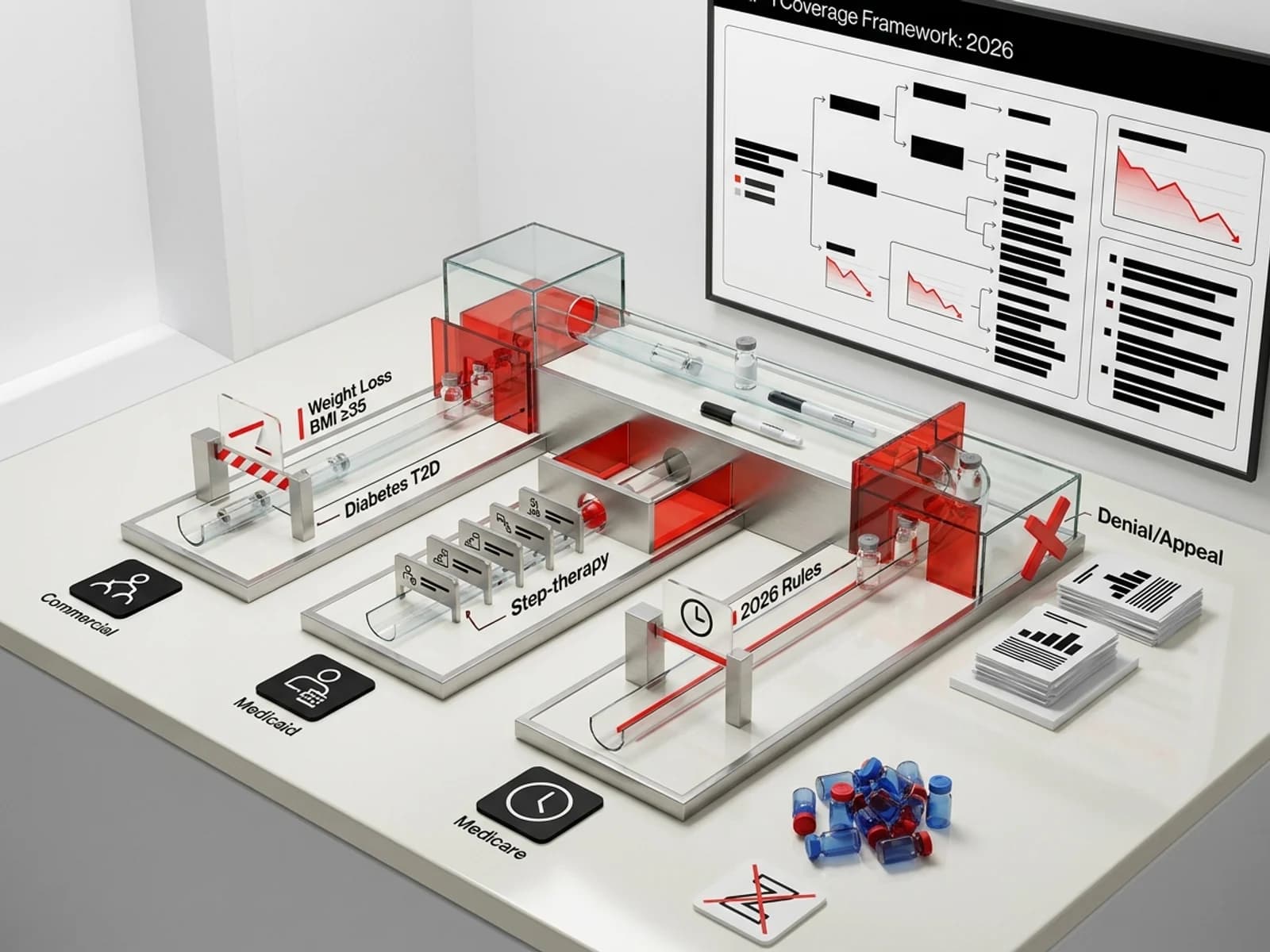
Aetna — now a CVS Health company — covers GLP-1 receptor agonists across commercial, Medicaid, and Medicare Advantage plans, but the rules differ sharply by line of business, plan tier, and employer benefit design. In 2025–2026, Aetna tightened weight-loss GLP-1 criteria on several formularies, dropped Zepbound from some standard commercial plans, and introduced updated prior authorization (PA) policies that raise the BMI bar for new starts while grandfathering existing members at lower thresholds.
This guide maps which GLP-1 medications Aetna covers under which diagnoses, details PA criteria and step therapy requirements for each line of business, explains common denial reasons, and provides a plan-by-plan coverage summary. It is independent information and not medical advice or reimbursement guidance for a specific patient or plan.
Quick answer
| GLP-1 Drug | Aetna Commercial | Aetna Medicaid (select states) | Aetna Medicare HIDE (HMO D-SNP) |
|---|---|---|---|
| Ozempic (semaglutide injection) | Covered — T2D with PA | Covered — T2D with PA | Covered — T2D with PA |
| Mounjaro (tirzepatide injection) | Covered — T2D with PA | Covered — T2D with PA (step therapy may apply) | Covered — T2D with PA |
| Rybelsus (semaglutide tablets) | Covered — T2D with PA | Covered — T2D with PA | Covered — T2D with PA |
| Trulicity (dulaglutide) | Covered — T2D with PA | Non-preferred; step therapy through Ozempic/liraglutide | Covered — T2D with PA |
| Wegovy (semaglutide 2.4 mg) | Covered for weight loss on select plans with PA (BMI ≥35 or ≥30 with comorbidity); covered for MACE/MASH | Covered for weight loss with PA (morbid obesity criteria); covered for MACE/MASH | Covered for MACE and MASH with PA; weight loss coverage expanding per CMS rule |
| Zepbound (tirzepatide) | Dropped from several 2026 standard formularies; still covered on some plans with PA | Covered for weight loss with PA (morbid obesity criteria); covered for OSA | Covered for OSA with PA |
| Saxenda (liraglutide 3 mg) | Covered on select plans with PA | Non-preferred GLP-1; PA required | PA required |
Key policy dates:
2025 (mid-year): Aetna announced some plans would no longer cover Zepbound, while continuing Wegovy, Saxenda, and oral weight-loss medications
January 1, 2026: Updated PA criteria took effect for Aetna Medicare HIDE and Medicaid plans; new BMI thresholds for initial and renewal authorization
July 1, 2026: Aetna Medicare Advantage plans expected to expand GLP-1 weight-loss coverage per CMS Medicare GLP-1 Bridge demonstration
Who this is for
Aetna commercial members and their prescribers navigating GLP-1 prior authorization
Aetna Better Health Medicaid members in covered states (Florida, Illinois, Maryland, Michigan, New Jersey, Pennsylvania, Virginia, Kentucky)
Benefit verification specialists and hub teams handling Aetna pharmacy claims
Market access teams at GLP-1 manufacturers tracking payer policy changes
Employer benefits administrators evaluating Aetna GLP-1 coverage options
Source standard
Every fact in this guide is sourced from Aetna Clinical Policy Bulletins, Aetna Medicaid coverage policies, Aetna Medicare formulary documents, Express Scripts National Formulary data, and CMS publications dated 2025–2026. Aetna coverage rules vary by plan, state, and employer. Always verify current coverage by calling the member services number on your Aetna card or checking the Aetna provider portal at aetna.com.
Aetna program overview and GLP-1 relevance
Aetna is a CVS Health subsidiary serving approximately 23 million medical members. Key structural features relevant to GLP-1 coverage:
Pharmacy benefit manager: CVS Caremark manages pharmacy benefits for most Aetna commercial and Medicare plans. Aetna Better Health Medicaid plans may use different PBM arrangements by state
Formulary structure: Aetna uses multiple formularies — Advanced Control, Standard Control, and exchange/marketplace formularies — with different GLP-1 tier placements
Self-funded vs. fully insured: Self-funded employer plans choose their own GLP-1 benefit design. Aetna's standard GLP-1 PA criteria apply to fully insured plans; self-funded plans may exclude GLP-1s entirely or set different BMI thresholds
Aetna Funding Advantage (AFA): AFA (level-funded) plans typically exclude weight-loss GLP-1s. This exclusion is explicit in the AFA plan documents
GLP-1 coverage by line of business
Aetna commercial plans — diabetes GLP-1s (Ozempic, Mounjaro, Rybelsus, Trulicity)
Aetna covers GLP-1 receptor agonists prescribed for type 2 diabetes with prior authorization on most commercial plans. Standard PA criteria:
Documented diagnosis of type 2 diabetes mellitus (A1c ≥6.5%, or fasting plasma glucose ≥126 mg/dL, or 2-hour OGTT ≥200 mg/dL)
Trial and failure of, or contraindication to, metformin at maximum tolerated dose for at least 3 months (some plans require 60 days of metformin fill within the past 180 days)
Prescriber attestation that the medication will be used as an adjunct to diet and exercise
Step therapy hierarchy for some commercial plans:
First-line: Liraglutide (Victoza generic) and Ozempic are typically preferred
Second-line: Mounjaro may require trial and failure of a preferred GLP-1
Third-line: Trulicity may require trial and failure of both Ozempic and liraglutide
Aetna commercial plans — weight-loss GLP-1s (Wegovy, Zepbound, Saxenda)
Coverage for anti-obesity GLP-1s on Aetna commercial plans depends on the specific formulary and whether the employer has opted into weight-loss medication coverage.
PA criteria for Wegovy (chronic weight management):
Patient age ≥18 years (pediatric patients ≥12 years may be covered on some plans for Wegovy)
Baseline BMI ≥35 kg/m² for adults (some plans use BMI ≥30 with comorbidity threshold)
Participation in a comprehensive weight management program — including behavioral modification, reduced-calorie diet, and increased physical activity — for at least 6 months prior to starting drug therapy
Prescriber attestation that metabolic or other causes of obesity have been ruled out or treated
No personal or family history of medullary thyroid carcinoma (MTC) or MEN 2
For pediatric patients (Wegovy only): BMI ≥95th percentile per CDC growth charts
PA criteria for Wegovy (cardiovascular risk reduction — MACE):
Patient has established cardiovascular disease (prior MI, stroke, or symptomatic peripheral arterial disease)
Baseline BMI ≥27 kg/m²
Patient does not have type 2 diabetes (patients with T2D and CVD should use Ozempic for this indication)
Used with reduced-calorie diet and increased physical activity
Zepbound availability in 2026:
In mid-2025, Aetna announced that some plans would no longer cover Zepbound. Multiple Aetna 2026 formularies — including Aetna Advanced Control Choice, Aetna Advanced Control Plan, Aetna Standard Control, and Aetna Standard Plan — now list Zepbound as an excluded drug. Members on these plans cannot access Zepbound even with PA, unless a formulary exception is granted.
Zepbound remains available on some Aetna plans (particularly employer-sponsored plans that have elected GLP-1 weight-loss coverage) with PA criteria similar to Wegovy, plus the OSA indication approved in December 2024.
Aetna Better Health Medicaid — GLP-1 coverage
Aetna Better Health operates Medicaid managed care plans in multiple states. GLP-1 coverage is state-specific, but common features across Aetna Medicaid plans include:
Diabetes GLP-1s (Ozempic, Mounjaro, Trulicity, liraglutide, Rybelsus):
Step therapy: 60 days of metformin within the past 180 days required
PA required with documented T2D diagnosis (A1c ≥6.5%)
Trulicity is non-preferred; requires trial and failure of both Ozempic and liraglutide
Approval duration: 12 months
Weight-loss GLP-1s (Wegovy, Zepbound, Saxenda/liraglutide 3 mg):
Aetna Medicaid weight-loss GLP-1 criteria are significantly stricter than commercial criteria:
Patient must be classified as morbidly obese (BMI ≥40 kg/m², or BMI ≥35 with serious comorbidities)
Documented failure of all other clinically appropriate weight-loss interventions
GLP-1 considered only as a measure to avert the need for higher-cost bariatric surgery
Patient cannot use GLP-1 concurrently with a DPP-4 inhibitor
Non-preferred GLP-1 agents (Wegovy, Zepbound, Saxenda) require trial and failure of all five preferred non-GLP-1 weight-loss medication classes (benzphetamine, diethylpropion, orlistat products, phendimetrazine, phentermine products)
Renewal criteria:
Patients age ≥18 years: must maintain ≥5% weight loss from baseline
Patients age ≥12 to <18 years: must maintain or improve BMI percentile per CDC growth charts
Initial and renewal authorization duration: 6 months
Wegovy for MACE and MASH; Zepbound for OSA:
Covered with PA when specific clinical criteria are met
Wegovy MACE: established cardiovascular disease, BMI ≥27, no T2D
Zepbound OSA: moderate-to-severe OSA confirmed by sleep study, BMI ≥30
Aetna Medicare HIDE (HMO D-SNP)
Aetna Medicare HIDE is a Highly Integrated Dual Eligible Special Needs Plan. GLP-1 coverage follows Medicaid-influenced criteria with the following specifics:
Anti-obesity GLP-1s require PA with criteria similar to the Medicaid weight-loss policy
BMI thresholds: ≥27 kg/m² with comorbidity or ≥30 kg/m²
Renewal requires ≥5% weight loss maintenance
Wegovy covered for MACE and MASH indications
Zepbound covered for OSA indication
Starting July 2026, CMS Medicare GLP-1 Bridge demonstration may provide expanded access pathways
Formulary tier placement
GLP-1 tier placement varies by Aetna formulary. Typical placements:
| Drug | Typical Tier | PA Required | Quantity Limits |
|---|---|---|---|
| Ozempic | Tier 2–3 (preferred specialty) | Yes | 4 pens per 28 days |
| Mounjaro | Tier 2–3 | Yes | 4 pens/vials per 28 days |
| Rybelsus | Tier 2–3 | Yes | Per label |
| Trulicity | Tier 3 (non-preferred) | Yes | Per label |
| Wegovy | Tier 3–4 (specialty) | Yes | 4 pens per 28 days (by strength) |
| Zepbound | Excluded on some plans; Tier 3–4 where available | Yes | 4 pens/vials per 28 days (by strength) |
| Saxenda/liraglutide 3 mg | Tier 3–4 | Yes | 5 pens per 30 days |
Common denial scenarios and how to address them
Denial: "Weight-loss medication exclusion — plan does not cover anti-obesity drugs"
This is the most common Aetna GLP-1 denial for weight-loss prescriptions. Many Aetna commercial plans — particularly AFA plans, individual marketplace plans, and self-funded plans with weight-loss exclusions — do not cover GLP-1s prescribed for weight loss regardless of medical necessity.
Options:
Check for qualifying comorbid indications: If the patient also has established CVD, submit for Wegovy under the MACE indication instead of weight loss
Formulary exception request: The prescriber can submit a formulary exception with supporting clinical documentation, though success is not guaranteed on plans with explicit exclusions
Employer plan amendment: For employer-sponsored plans, the employer's benefits team can choose to add GLP-1 weight-loss coverage mid-year or during annual enrollment
Denial: "Step therapy not met — patient has not tried preferred alternatives"
Aetna Medicaid and some commercial plans require trial and failure of preferred agents before approving non-preferred GLP-1s. For weight-loss GLP-1s on Medicaid, this can mean documented trial and failure of five separate non-GLP-1 medication classes.
Options:
Document prior trials: Gather records of all prior weight-loss medication trials, including dates, dosages, durations, and reasons for discontinuation
Request step therapy override: Submit a clinical rationale if the patient has a contraindication or documented adverse reaction to all preferred agents
Appeal with specialist support: A letter from an endocrinologist or bariatric medicine specialist supporting the medical necessity of the requested GLP-1 can strengthen the appeal
Denial: "BMI does not meet threshold"
Aetna's 2026 criteria for weight-loss GLP-1s on many plans require BMI ≥35 for adults (or BMI ≥30 with qualifying comorbidities). If the patient's BMI has dropped below the threshold due to previous GLP-1 use or other weight loss, the renewal may be denied.
Options:
Confirm baseline BMI: Ensure the PA references the patient's baseline BMI before weight loss, not their current BMI. Aetna's renewal criteria focus on whether the patient meets the initial BMI threshold at the time of first authorization
Grandfathering provisions: For established members initially approved before January 1, 2026 criteria changes, Aetna Medicaid plans include specific renewal criteria that consider the patient's original classification
Denial: "Zepbound is excluded from your plan's formulary"
In mid-2025, Aetna removed Zepbound from several standard formularies.
Options:
Switch to Wegovy: If the patient meets Wegovy criteria, Wegovy remains covered on most Aetna plans where Zepbound was removed
Formulary exception: Submit a request documenting why Wegovy is not appropriate (e.g., prior Wegovy failure, contraindication to semaglutide)
Manufacturer support: Eli Lilly's Zepbound savings program and patient assistance program may provide access outside of insurance
How to verify Aetna GLP-1 coverage
Step 1: Identify your plan type
Determine whether you are on a fully insured commercial plan, self-funded employer plan, AFA plan, Aetna Better Health Medicaid, or Aetna Medicare plan. This determines which formulary and PA criteria apply.
Step 2: Check formulary coverage
Use the Aetna "Find a Medication" tool at aetna.com/individuals-families/find-a-medication.html to search for your specific GLP-1 drug on your plan's formulary.
Step 3: Review PA requirements
Visit the Aetna Clinical Policy Bulletins page at aetna.com/health-care-professionals/clinical-policy-bulletins.html and search for "GLP-1" or "weight loss" to find the current PA criteria document.
Step 4: Submit PA
Prescribers can submit PA through:
Aetna provider portal at aetna.com (select "Physician Self-Service")
Phone: Aetna Pharmacy Management Precertification Unit at 800-414-2386
Fax: Check the specific PA form for the correct fax number
CoverMyMeds platform (for some plan types)
Step 5: Appeal if denied
If PA is denied:
Request the specific denial reason in writing
Gather supporting clinical documentation (BMI records, lab results, prior medication trials, specialist letters)
Submit a first-level appeal within 60 days of the denial
If the first-level appeal is denied, request a second-level appeal or external review
Aetna vs. CVS Caremark vs. Express Scripts: how GLP-1 coverage relates
Because Aetna is a CVS Health subsidiary, members may encounter confusion between Aetna medical coverage, CVS Caremark pharmacy benefits, and Express Scripts (a Cigna/Evernorth company that manages some self-funded plan pharmacy benefits). Key distinctions:
Aetna: Sets medical coverage policy and PA criteria for Aetna-branded plans
CVS Caremark: Administers pharmacy benefits for many Aetna commercial and Medicare plans, including formulary management and specialty pharmacy routing
Express Scripts National Preferred Formulary: Some Aetna plans use the Express Scripts National Preferred Formulary, which excludes Wegovy injection, Wegovy tablets, Zepbound pens, and Saxenda from its weight-loss GLP-1 class; Zepbound vials are the preferred alternative. Members who need an excluded medication must use the non-formulary exception process
What to monitor
Zepbound formulary changes: Aetna's removal of Zepbound from some 2026 formularies may expand to additional plans. Monitor your plan's annual formulary update for changes
Medicare GLP-1 expansion: CMS's July 2026 Bridge demonstration and potential broader Medicare GLP-1 coverage rules will affect Aetna Medicare Advantage formularies
State Medicaid mandates: Several states are considering legislation requiring Medicaid GLP-1 coverage for obesity. These mandates would affect Aetna Better Health plans in those states
Employer plan redesign: For Aetna plans whose pharmacy benefit uses Express Scripts, the Evernorth GLP-1 weight-loss benefit option capping patient cost at $200/month may be available; employers adopting this option would change GLP-1 access for their members. Aetna plans using CVS Caremark have their own formulary and copay structures
New GLP-1 approvals: Orforglipron (Foundayo), FDA-approved in April 2026, and other oral GLP-1s may shift Aetna's formulary strategy and step therapy hierarchies
Sources
Aetna. "Anti-Obesity/Weight Loss Agents — Aetna Medicare HIDE (HMO D-SNP) Medicaid Weight Loss Prior Authorization Criteria." Updated December 12, 2025. https://www.aetna.com/content/dam/aetna/medicaid/pdfs/formulary-updates/2026/Anti_Obesity_Agents_MI_HIDE_2026_updated_criteria122025_WF_approved_remediated.pdf
Aetna Better Health. "Liraglutide, Ozempic, and Trulicity Coverage Policy/Guideline." Effective February 4, 2025. https://www.aetnabetterhealth.com/content/dam/aetna/medicaid/pdfs/formulary/guidelines/Liraglutide-Ozempic-and-Trulicity-Aetna-Medicaid-Policy-ua.pdf
Aetna Better Health. "Wegovy Cardiovascular and Zepbound OSA Coverage Policy/Guideline." Effective January 23, 2026. https://www.aetnabetterhealth.com/content/dam/aetna/medicaid/pdfs/formulary/guidelines/Wegovy-CV-MASH_Zepbound-OSA-Aetna-FLMMA-FHK-IL-PENNCHIP-Medicaid-Policy-ua.pdf
Aetna. "Weight Loss (BMI 35) GIP-GLP-1 GLP-1 Agonists PA." Pharmacy Clinical Policy Bulletins, Aetna Non-Medicare Prescription Drug Plan. https://www.aetna.com/products/rxnonmedicare/data/2024/Weight_Loss_(BMI%2035)_GIP-GLP-1_GLP-1_Agonists_PA_with_Limit_6450-C_UDR_05-2024.html
Aetna. "Wegovy PA with Limit." Pharmacy Clinical Policy Bulletins. https://www.aetna.com/products/rxnonmedicare/data/2025/Wegovy_PA_with_Limit_4774-C_UDR_08-2023_v2.html
Express Scripts. "2026 National Preferred Formulary." https://www.express-scripts.com/pdf/formulary/NPE1702_204612.pdf
Evernorth Health Services. "Evernorth Launches New Benefit Option That Drives Lower Net Cost for Weight Loss Medicines." May 21, 2025. https://www.evernorth.com/articles/evernorth-launches-new-benefit-option-drives-lower-net-cost-weight-loss-medicines
CMS.gov. "Coming Soon: CMS to Provide $50 Monthly Access to GLP-1 Medications for Medicare Beneficiaries." 2026. https://www.cms.gov/newsroom/press-releases/coming-soon-cms-provide-50-monthly-access-glp-1-medications-medicare-beneficiaries
Word & Brown General Agency. "Weight Loss Drugs (GLP-1) Insurance Coverage Breakdown By Carrier." Updated May 1, 2026. https://www.wordandbrown.com/NewsPost/Weight-Loss-Drugs-(GLP-1)-Coverage