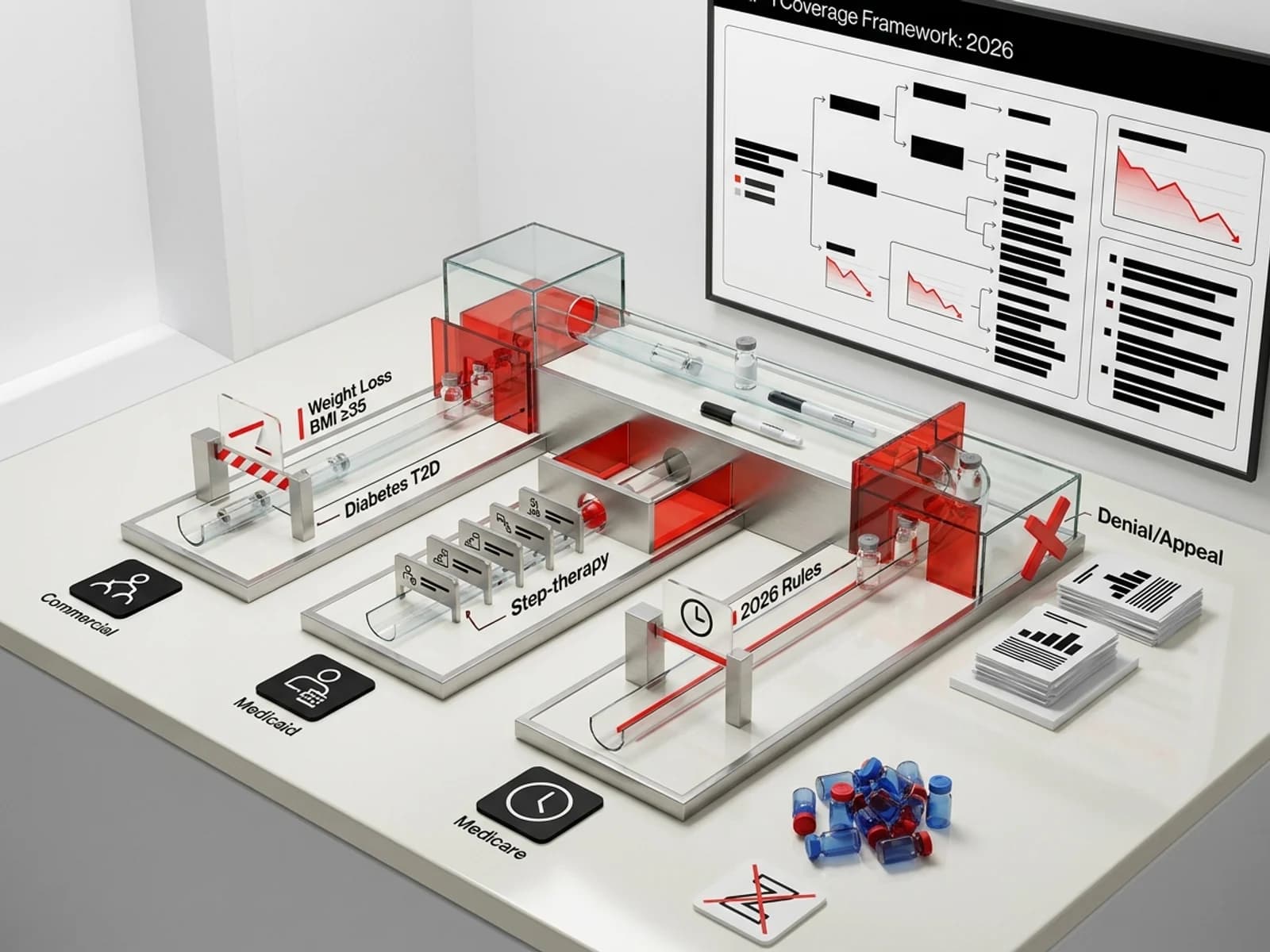
Kaiser Permanente — the nation's largest integrated health plan and delivery system, serving approximately 12.5 million members — takes a fundamentally different approach to GLP-1 coverage than most commercial payers. Because Kaiser combines insurance, medical practice, and pharmacy under one roof, GLP-1 coverage decisions are made through a criteria-based consultation (CBC) process managed by Kaiser's regional Clinical Oversight Review Boards (CORB), not through a traditional external PBM prior authorization workflow.
This guide explains how Kaiser Permanente covers GLP-1 receptor agonists, maps the step therapy hierarchy for diabetes and weight-loss indications, details the critical distinction between plans that include weight-loss drug coverage and those that do not, and provides regional variation notes. It is independent information and not medical advice or reimbursement guidance for a specific patient or plan.
Quick answer
| GLP-1 Drug | Kaiser Permanente Coverage | Formulary Status | Key Requirement |
|---|---|---|---|
| Ozempic (semaglutide injection) | Covered for T2D; covered for weight loss/CV/OSA only with weight-loss rider | Formulary (Tier 2, PA + QL) | T2D diagnosis; or CBC approval for CV risk reduction, OSA, or weight management |
| Mounjaro (tirzepatide injection) | Covered for T2D; covered for weight loss only with weight-loss rider | Non-formulary (Tier 3, PA + QL) | T2D with allergy to liraglutide and Ozempic; or CBC approval for weight loss |
| Rybelsus (semaglutide tablets) | Covered for T2D | Tier 3, PA + QL | T2D diagnosis |
| Trulicity (dulaglutide) | Covered for T2D | Tier 3, PA + QL | T2D diagnosis |
| Victoza (liraglutide) | Covered for T2D | Tier 1, PA + QL | T2D diagnosis |
| Wegovy (semaglutide 2.4 mg) | Covered for weight loss only with rider; covered for MACE/MASH with PA | Non-formulary | Failed Ozempic trial; must have weight-loss benefit |
| Zepbound (tirzepatide) | Covered for weight loss only with rider; covered for OSA with PA | Non-formulary | Failed 6-month semaglutide trial + bariatric review; must have weight-loss benefit |
| Saxenda (liraglutide 3 mg) | Limited coverage | Non-formulary | CBC approval required |
Key policy context:
Weight-loss drugs are automatically excluded from all Kaiser Permanente pharmacy plans unless the employer or member has purchased a specific weight-loss drug rider
Kaiser Permanente Northwest publishes the most detailed CBC criteria documents; other regions (California, Mid-Atlantic, Georgia, etc.) follow similar but not identical criteria
Members without a weight-loss rider who qualify for Ozempic under cardiovascular risk reduction or OSA may still access it through the CBC process, but not for obesity alone
Who this is for
Kaiser Permanente members considering GLP-1 therapy for diabetes, weight loss, cardiovascular risk reduction, MASH, or OSA
Prescribers — including Kaiser Permanente staff physicians and affiliated community providers — navigating the CBC process
Benefit verification teams handling Kaiser Permanente pharmacy claims
Market access teams at GLP-1 manufacturers tracking the largest integrated delivery network's coverage policies
Employer benefits administrators evaluating whether to add Kaiser's weight-loss drug rider
Source standard
Every fact in this guide is sourced from Kaiser Permanente formulary documents, criteria-based consultation criteria sheets published on healthy.kaiserpermanente.org, Kaiser Permanente Plus prescription drug riders, and CMS publications dated 2025–2026. Kaiser Permanente coverage rules vary by region and plan. Always verify current coverage by calling the Pharmacy Services number for your Kaiser Permanente region or checking kp.org/formulary.
Kaiser Permanente structure and GLP-1 relevance
Kaiser Permanente operates in eight regions (Northern California, Southern California, Colorado, Georgia, Hawaii, Mid-Atlantic States, Northwest, and Washington). Each region maintains its own formulary and CBC criteria, guided by a regional Pharmacy and Therapeutics committee. Key structural differences from other payers:
Integrated model: Kaiser employs its own physicians and operates its own pharmacies. GLP-1 prescriptions are written by Kaiser physicians, filled at Kaiser pharmacies, and reviewed by Kaiser clinical pharmacists — all within the same system
No external PBM: Unlike Aetna/CVS Caremark or UHC/OptumRx, Kaiser does not delegate pharmacy benefit management to an external PBM. All formulary decisions are made internally
Weight-loss drug exclusion: Kaiser Permanente's standard pharmacy plans automatically exclude weight-loss drugs. Coverage requires a specific rider — typically an employer buy-up — that adds weight-loss medication to the pharmacy benefit
Criteria-Based Consultation (CBC): Instead of a traditional PA workflow, Kaiser uses a CBC process where a clinical pharmacist reviews the prescribing criteria and either approves coverage or recommends an alternative. This is done through Kaiser's internal electronic health record system
GLP-1 coverage by indication
Type 2 diabetes GLP-1s — formulary status
Kaiser Permanente covers GLP-1 receptor agonists for type 2 diabetes as part of its standard pharmacy benefit across all regions. The formulary hierarchy for diabetes GLP-1s typically follows this structure:
Preferred (first-line):
liraglutide (Victoza generic) — Tier 1, PA + quantity limits
Ozempic (semaglutide injection) — Tier 2 (formulary), PA + quantity limits
Non-preferred (second-line, requires step therapy):
Mounjaro (tirzepatide) — Non-formulary, Tier 3, PA + quantity limits. Requires documented allergic reaction to both liraglutide (Victoza) and Ozempic
Trulicity (dulaglutide) — Tier 3, PA + quantity limits
Rybelsus (semaglutide tablets) — Tier 3, PA + quantity limits
Initiation criteria for T2D (Ozempic example — Northwest region):
Diagnosis of type 2 diabetes mellitus
On maximum tolerated dose of metformin (or documented contraindication/intolerance)
No personal or family history of medullary thyroid carcinoma (MTC) or MEN 2
For Mounjaro specifically: documented allergy to both liraglutide and Ozempic
Weight-loss GLP-1s — the rider question
The single most important factor in Kaiser Permanente GLP-1 weight-loss coverage is whether the member's plan includes a weight-loss drug rider. Without this rider:
Wegovy, Zepbound, and Saxenda are not covered for weight management
Members pay the full cash price at Kaiser pharmacies
The CBC process cannot override a plan-level exclusion
With the rider:
Wegovy and Zepbound are covered as non-formulary medications through the CBC process
Standard cost-sharing applies (typically Tier 3 or higher)
Step therapy and CBC criteria apply
Wegovy criteria (chronic weight management — Northwest region)
Kaiser Permanente Northwest's CBC criteria for Wegovy (effective November 6, 2025) require all of the following:
Weight-loss rider: Patient has a prescription drug insurance benefit that covers medications used to lose weight
No thyroid history: No personal or family history of MTC or MEN 2
Diagnosis: Chronic weight management diagnosis
Age: ≥18 years
BMI: Current weight and BMI documented
Step therapy — failed prior medications: Patient has failed adequate trials of, or has allergy/intolerance/contraindication to, ALL of the following:
phentermine
diethylpropion
topiramate
phentermine/topiramate (Qsymia)
naltrexone/bupropion (Contrave)
AND: Patient has then failed an adequate trial of semaglutide (Ozempic) — defined as 3-month treatment duration
Approval duration: 12 months
Continuation criteria: At 12-month review, patient must demonstrate ≥5% weight loss from baseline and have updated weight/BMI documented.
Wegovy criteria (cardiovascular risk reduction)
For members who do not have diabetes but have established cardiovascular disease, Ozempic (not Wegovy) is the formulary drug for MACE risk reduction. Criteria (Northwest region, effective February 5, 2026):
No personal or family history of MTC or MEN 2
Patient does not have diabetes
BMI ≥27
Patient is currently following a diet and exercise program
Patient is 55–74 years of age
Patient has a history of STEMI or Type 1 NSTEMI
For Wegovy specifically for MACE: Requires prior occurrence of STEMI or Type 1 NSTEMI while on semaglutide (Ozempic) 2 mg.
Wegovy criteria (MASH)
Kaiser Permanente Northwest covers Wegovy for metabolic dysfunction-associated steatohepatitis (MASH) with the following criteria:
No personal or family history of MTC or MEN 2
Confirmed MASH diagnosis (excluding patients with fibrosis stage F4, liver cirrhosis, significant alcohol consumption, or active serious medical disease with life expectancy <2 years)
Used with reduced-calorie diet and increased physical activity
Continuation criteria for MASH: No progression of liver disease (increased fibrosis stage from baseline) while on semaglutide.
Zepbound criteria (chronic weight management — Northwest region)
Kaiser Permanente Northwest's CBC criteria for Zepbound (effective June 4, 2026) require all of the following:
Weight-loss rider: Patient has a prescription drug benefit that covers medications used to lose weight
No thyroid history: No personal or family history of MTC or MEN 2
Step therapy: Failed adequate trials of ALL of the following:
phentermine
diethylpropion
topiramate
phentermine/topiramate (Qsymia)
naltrexone/bupropion (Contrave)
AND: Patient has then failed a minimum 6-month trial of semaglutide (Ozempic/Wegovy) followed by a bariatric medicine chart review to determine necessity to switch to tirzepatide (Zepbound)
OR: Allergy, intolerance, or contraindication to semaglutide (Ozempic/Wegovy)
Approval duration: 12 months
Continuation criteria: ≥5% weight loss maintained; updated weight/BMI documented.
Zepbound criteria (obstructive sleep apnea)
For members with OSA but no diabetes, Zepbound is covered with these criteria (Northwest region):
No personal or family history of MTC or MEN 2
Patient does not have central or complex apnea
Sleep study within the last 3 years (patient has not lost >5% body weight since the study)
Diagnosis of severe sleep apnea (AHI ≥30)
Patient is ≥18 years of age
BMI ≥30
Positive airway pressure (PAP) therapy has been offered
Step therapy criteria met (same weight-loss medication hierarchy as above, then failed semaglutide trial)
Regional variation
Kaiser Permanente's formularies and CBC criteria vary by region. Key regional differences relevant to GLP-1 coverage:
| Region | Notable GLP-1 Differences |
|---|---|
| Northwest (OR/WA) | Most detailed published CBC criteria; Ozempic as formulary for T2D and CV risk reduction; Wegovy/Zepbound non-formulary |
| Northern California | Largest Kaiser region; 2026 Commercial HMO formulary lists Ozempic as Tier 2 with PA/QL; separate Medicare formulary |
| Southern California | Separate formulary; similar GLP-1 tier placement; formulary search available at healthy.kaiserpermanente.org/southern-california |
| Mid-Atlantic (VA/MD/DC) | Uses a PA form for weight-loss agents with specific BMI thresholds (BMI ≥40 or ≥37 with comorbidities); Wegovy for CV protection requires cardiologist prescriber |
| Washington (Medicare) | 2026 Medicare step therapy requirements do not include GLP-1 step therapy edits for diabetes drugs |
| FEHB Options | 2026 FEHB formulary lists Zepbound at Tier 3 (PA/QL) for some strengths and Tier 5 (PA/QL) for higher strengths |
Kaiser Permanente Medicare — GLP-1 coverage
Kaiser Permanente offers Medicare Advantage (Part D) plans in most regions. GLP-1 coverage under Kaiser Medicare plans follows CMS rules:
Diabetes GLP-1s (Ozempic, Mounjaro, Trulicity, Rybelsus): Covered under Part D with PA and quantity limits. Formulary tier placement varies by region
Wegovy for MACE: Covered under Part D when criteria are met, following the FDA's March 2024 expanded cardiovascular indication
Wegovy for weight loss: Starting July 1, 2026, CMS is launching a Medicare GLP-1 Bridge demonstration that will provide $50/month GLP-1 access for eligible Medicare beneficiaries. Kaiser Medicare plans will participate
Weight-loss drug exclusion: Medicare Part D generally does not cover drugs for weight loss, but the MACE and OSA indications create coverage pathways
Common denial scenarios and how to address them
Denial: "Weight-loss drugs are not covered under your plan"
This is by far the most common Kaiser Permanente GLP-1 denial for weight management. Without a weight-loss drug rider, GLP-1s prescribed for weight loss are excluded from the pharmacy benefit.
Options:
Check for qualifying comorbid indications: If the patient has established CVD, sleep apnea, or MASH, the CBC process may approve Ozempic or Wegovy under those indications — even without a weight-loss rider
Contact employer benefits: For employer-sponsored plans, ask whether a weight-loss drug rider is available. Kaiser offers this as a buy-up option for employer groups
Kaiser Permanente Plus rider: For some plan types, Kaiser offers a "Plus" prescription drug rider that includes weight-loss drug coverage. The 2026 Kaiser Permanente Plus rider document states: "Weight loss drugs are automatically excluded from all pharmacy plans. Weight loss drug riders are available for buy-up."
Denial: "Step therapy criteria not met — patient has not tried preferred alternatives"
Kaiser's step therapy for weight-loss GLP-1s is among the most stringent in the industry. Patients must demonstrate trial and failure of five separate non-GLP-1 weight-loss medications before Wegovy can be considered, and then must fail Ozempic before Zepbound.
Options:
Document prior trials comprehensively: Gather records from all prior weight-loss medication trials, including start dates, durations, dosages, and reasons for discontinuation. Kaiser's definition of adequate trial is 3 months
Document contraindications: If the patient has a true contraindication (not just mild side effects) to a specific medication class, document this clearly. Kaiser's criteria distinguish between expected adverse reactions and true intolerance
Bariatric medicine referral: For Zepbound, Kaiser requires a bariatric medicine chart review after semaglutide failure. Request this referral early in the process
Denial: "Member transferred from another insurer — criteria not met"
New Kaiser members already taking a GLP-1 prescribed by a non-Kaiser provider may face coverage denial if they don't meet Kaiser's CBC criteria. Kaiser's criteria for new members already taking the medication require:
For T2D: Diagnosis of type 2 diabetes and documented allergy to preferred GLP-1s (for non-preferred drugs like Mounjaro)
For weight loss: Patient must have a weight-loss rider AND meet all initiation criteria including step therapy documentation from the previous provider
Options:
Transfer all medication records: Provide Kaiser with complete documentation from the previous prescriber, including initial diagnosis, BMI at start, all prior medication trials, and response to current therapy
Request a CBC review: The CBC process can consider documentation from outside providers, but the criteria must still be met
Interim supply: Ask whether Kaiser can provide a transition supply while the CBC review is pending
How to verify Kaiser Permanente GLP-1 coverage
Step 1: Confirm your plan type and region
Log in to kp.org and navigate to your pharmacy benefits. Your plan type (commercial HMO, Medicare, Medicaid, FEHB) and region determine which formulary and CBC criteria apply.
Step 2: Check whether you have a weight-loss drug rider
Contact Kaiser Permanente Customer Service for your region and ask specifically: "Does my plan include coverage for weight-loss medications?" If the answer is no, GLP-1s for weight management will not be covered regardless of medical necessity.
Step 3: Search the formulary
Use the formulary search at kp.org/formulary for your region. Search for the specific GLP-1 drug name to check tier, PA requirements, and quantity limits.
Step 4: CBC submission
If you are a Kaiser member and your Kaiser physician prescribes a GLP-1, the CBC review is initiated internally by the prescribing physician and Kaiser's clinical pharmacy team. Members generally do not submit CBC requests themselves — the physician does.
If you are a non-Kaiser provider treating a Kaiser member (e.g., a specialist at a non-Kaiser facility), contact Kaiser Permanente Pharmacy Services for your region to initiate the CBC review. The Mid-Atlantic region PA form fax number is 1-866-331-2104.
What to monitor
Weight-loss rider adoption: As GLP-1 costs stabilize and employer demand increases, Kaiser may make weight-loss drug riders more broadly available or lower the rider cost
Regional formulary harmonization: Kaiser regions currently operate with different formularies and CBC criteria. Pressure from large employer groups may drive greater consistency
New GLP-1 approvals: Orforglipron (Foundayo) and other oral GLP-1s may be added to Kaiser's formulary at lower tiers due to potentially lower cost, changing the step therapy hierarchy
Medicare GLP-1 Bridge: The July 2026 CMS demonstration will create a new pathway for Kaiser Medicare members to access GLP-1s for weight management at $50/month
Kaiser Permanente 2026 formulary updates: Several Kaiser regions update their formularies on a rolling basis; check kp.org/formulary for the most current version
Sources
Kaiser Permanente Northwest. "Criteria for Drug Coverage: Injectable semaglutide (Ozempic)." Revised December 11, 2025; effective February 5, 2026. https://healthy.kaiserpermanente.org/content/dam/kporg/final/documents/formularies/nw/kp-criteria-ozempic-nw-en-commercial.pdf
Kaiser Permanente Northwest. "Criteria for Coverage: semaglutide (Wegovy)." Revised September 11, 2025; effective November 6, 2025. https://healthy.kaiserpermanente.org/content/dam/kporg/final/documents/formularies/nw/kp-wegovy-nw-en.pdf
Kaiser Permanente Northwest. "Criteria for Drug Coverage: tirzepatide (Mounjaro)." Revised June 12, 2025; effective August 7, 2025. https://healthy.kaiserpermanente.org/content/dam/kporg/final/documents/formularies/nw/kp-mounjaro-nw-en.pdf
Kaiser Permanente Northwest. "Criteria for Coverage: tirzepatide (Zepbound)." Revised April 9, 2026; effective June 4, 2026. https://healthy.kaiserpermanente.org/content/dam/kporg/final/documents/formularies/nw/kp-criteria-zepbound-nw-en-commercial.pdf
Kaiser Permanente. "2026 California Commercial HMO Formulary." https://healthy.kaiserpermanente.org/content/dam/kporg/final/documents/formularies/ca/commercial-hmo-formulary-scal-en.pdf
Kaiser Permanente. "2026 Drug Formulary — Large Group Tier 3 (Washington)." https://healthy.kaiserpermanente.org/content/dam/kporg/final/documents/formularies/wa/largegroup-tier3-formulary-wa-en.pdf
Kaiser Permanente. "2026 FEHB Options Plan Drug Formulary (Washington)." https://healthy.kaiserpermanente.org/content/dam/kporg/final/documents/formularies/wa/fehb-options-drug-formulary-wa-en-2026.pdf
Kaiser Permanente. "Kaiser Permanente Plus Prescription Drugs Rider (Northwest, 2026)." https://business.kaiserpermanente.org/business/shared/nw/plans/2026/lbg-kp-plus-rx-4tplans-rider-sell-sheet-nw-en.pdf
Kaiser Permanente Mid-Atlantic States. "Prior Authorization (PA) Form for Weight Loss Agent." https://prescriberpoint.com/api/documents/f253aee5758e444e873f6000972537d0_04_02_2024_15_41_54.pdf
CMS.gov. "Coming Soon: CMS to Provide $50 Monthly Access to GLP-1 Medications for Medicare Beneficiaries." 2026. https://www.cms.gov/newsroom/press-releases/coming-soon-cms-provide-50-monthly-access-glp-1-medications-medicare-beneficiaries