Almost half of patients starting certain oral oncology drugs discontinue therapy within 90 days, according to an Optum Rx analysis. The medication waste is substantial: a full 30-day supply abandoned after two weeks represents thousands of dollars in unused drug. Payers have responded by mandating split-fill programs that limit new-to-therapy patients to 14- or 15-day supplies during the initial months of treatment, with the clinical rationale that shorter dispensing intervals allow earlier identification of adverse events and reduce waste from discontinued therapy.
But split-fill programs create operational friction. They collide with manufacturer patient-support programs that are built around 30-day dispensing cycles, they complicate rare-disease therapies where interruption carries clinical risk, and they add administrative burden for specialty pharmacies that must process twice as many fills for the same patient. This article explains how split-fill programs work, where the evidence supports and challenges them, and how access teams should manage the tension.
This article is for specialty pharmacy operations teams, manufacturer hub and access teams, payer strategy staff, and provider-office coordinators who encounter split-fill requirements in prior authorization or benefits investigation.
How split-fill programs work
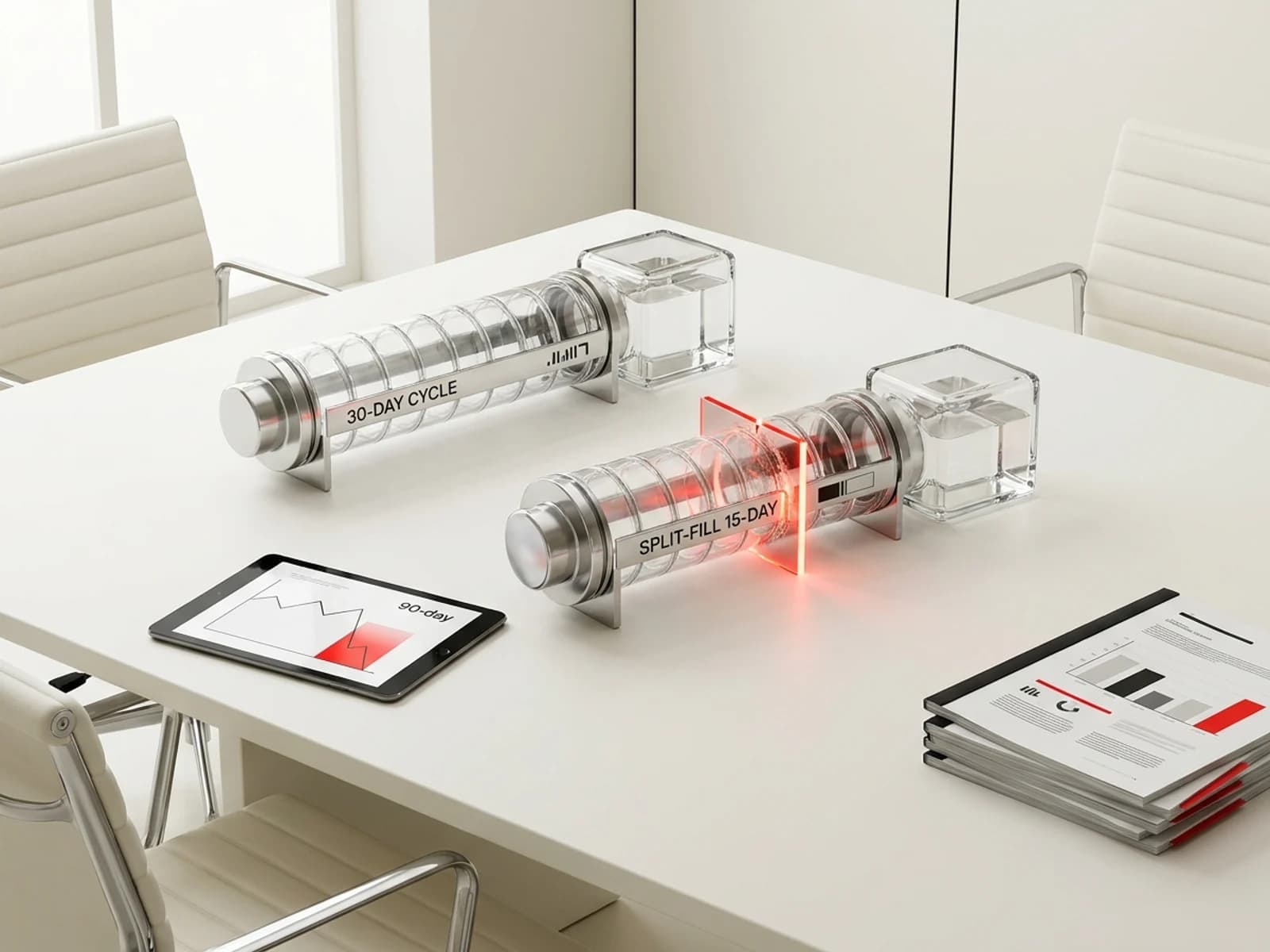
A split-fill program (also called a monitored-dispense program) limits the initial dispensing quantity for a new-to-therapy specialty drug. Instead of a 30-day supply, the patient receives a 14- or 15-day supply. After the first fill, the specialty pharmacy contacts the patient to assess tolerability before dispensing the second half of the month. After the initial period (typically 90 days), the patient transitions to standard 30-day dispensing.
Typical program structure
| Element | Common design |
|---|---|
| Initial fill quantity | 14–15 days |
| Split-fill period | First 90 days (approximately 6 fills) |
| New-to-therapy definition | No fill for the same drug (at GPI-10 level) in the past 180 days |
| Transition point | After 90 days, standard day supply |
| Copay structure | Half-copay per fill (total copay unchanged across the month) |
| Clinical touchpoint | Pharmacist call between fills to assess tolerability |
Pennsylvania Health Wellness (Centene) published its oncology split-fill program policy (v1.2025) covering over 40 oral oncolytics including imatinib, erlotinib, enzalutamide, abiraterone, ibrutinib, and palbociclib. The policy limits new-to-therapy patients to a maximum 15-day supply per fill for the first 90 days, with standard dispensing thereafter.
Payer adoption
Split-fill programs are most common in:
Commercial plans administered by PBMs (Optum Rx, CVS Caremark, Express Scripts)
Medicaid managed care organizations (several Centene and Molina plans)
Some Medicare Advantage plans with pharmacy benefit carve-outs
The Optum Specialty Pharmacy split-fill flyer (2025) reports that the program covers oral oncology medications and splits each prescription into two fills per month for the first three months. The stated goals are reducing medication intolerance and waste. While split-fill programs originated in oral oncology, MMIT Network's analysis of payer strategies notes that the approach has expanded to hepatitis C direct-acting antivirals, anti-inflammatory biologics, and multiple sclerosis disease-modifying therapies—any category where early discontinuation rates are high and per-fill costs are significant.
The evidence for split fills
Cost savings
A study published in the Journal of Oncology Practice (Staskon et al., 2019) compared patients with and without split-fill options. Key findings:
Higher persistence: Split-fill patients had a significantly higher persistency rate at month two (71.6% vs. 67.0%, P < .001)
Payer savings: Plans with split-fill programs had mean AWP savings of $2,147.60 at 1 month and $928.60 at 6 months per patient
Modeled waste reduction: Plans without split-fill programs could expect to save $2,646.74 AWP monthly per patient by moving to split fills
The Optum Specialty Pharmacy program reports saving an average of $7,035 per discontinuation-avoidance instance and providing 428 additional hours of pharmacist-patient engagement annually.
Clinical benefits
The clinical argument for split fills rests on:
Earlier adverse event identification: More frequent pharmacist touchpoints between fills allow earlier detection of side effects, enabling dose adjustment or supportive-care intervention before the patient abandons therapy
Reduced waste: If a patient discontinues after two weeks, only 15 days of medication are wasted instead of 30
Copay alignment: Half-copay per fill means the patient is not penalized financially for the split
Adverse events and tolerability
Both split-fill and standard-dispensing cohorts have similar rates of adverse effects (55.3% vs. 56.4% in the Staskon study). The time to first adverse event was not significantly different. The benefit is not in preventing adverse events but in catching them earlier through more frequent clinical contact.
Where split fills collide with access workflows
Manufacturer adherence programs
Many manufacturer patient-support programs are designed around 30-day cycles. Nurse-call schedules, refill-reminder algorithms, copay-assistance disbursements, and digital adherence tools all assume a monthly dispensing cadence. When a payer mandates split fills:
Copay-assistance cards may not be programmed for half-month fills, causing rejection at the pharmacy counter
Refill-reminder programs may fire at the wrong interval, confusing patients or generating unnecessary calls
Nurse-support scheduling may not align with the biweekly fill cycle
Adherence tracking (MPR/PDC calculations) may be affected by the altered fill pattern
Manufacturer hub teams should verify whether the patient's plan requires split fills during benefits investigation and adjust program enrollment accordingly.
Rare disease therapies
Split fills are designed for oncology, where early discontinuation rates are high and alternative therapies are often available. For rare-disease therapies, the calculus is different:
Interruption risk: For enzyme replacement therapies, CFTR modulators, and other rare-disease drugs, even brief treatment interruptions can cause clinical deterioration. A Shields Health Solutions study (2026) reported 93% treatment efficacy and 89% on-time medication receipt among cystic fibrosis patients in an integrated specialty pharmacy program—results that assume consistent monthly dispensing
Limited alternatives: When a rare-disease drug is the only approved therapy, the cost-saving rationale for split fills (preventing waste from switching to an alternative) is weaker
Adherence monitoring is already intensive: Rare-disease specialty pharmacies typically provide high-touch patient engagement that exceeds what split-fill programs add
Access teams for rare-disease products should document why split fills are clinically inappropriate when payer mandates conflict with the therapeutic plan.
Specialty pharmacy operations
Split fills double the dispensing workload for the first 90 days of each new therapy start. For a specialty pharmacy processing thousands of oral oncolytic prescriptions, this means:
Twice as many fills to process, ship, and track
Twice as many patient contacts for clinical assessment
Twice as many copay-assistance transactions
Twice as many prior authorization renewal checks (if the PA duration is tied to fill quantity rather than days of therapy)
A 2026 PSG (Pharmaceutical Strategies Group) report found that payers generally view the clinical and care management support provided by specialty pharmacies positively but perceive only moderate differentiation across specialty pharmacies. This means payers are unlikely to waive split-fill requirements based on a specialty pharmacy's existing adherence programs.
The 90-day cliff
A structural issue with split-fill programs is the transition from biweekly to monthly dispensing after 90 days. If the patient's prior authorization expires at 90 days (a common duration for initial PA approvals), the transition coincides with the PA renewal. If the renewal is delayed, the patient may experience a gap in therapy at exactly the point where the split-fill safety net is removed.
Access teams should:
Submit PA renewal requests at least 14 days before the split-fill period ends
Confirm that the renewal authorization covers 30-day dispensing
Alert the specialty pharmacy to the transition so the dispensing schedule adjusts
Oncology utilization management trends
Split fills exist within a broader trend of increasing utilization management for oncology therapies. A 2026 Tufts Medical Center analysis of the SPEC database, covering 5,400 policies for 363 drug-indication pairs from 2017 to 2024, found:
UM for oncology therapies increased from 14.5% of policies in 2017 to 22.9% in 2024
Step therapy grew from 4.3% to 16.5% of oncology policies
75% of step therapy policies required biosimilars or generics before branded products
35% of oncology policies included UM, compared with 73% for non-oncology policies
Split fills are a distinct UM tool that does not require clinical criteria review (unlike step therapy or prior authorization). They are applied at the dispensing level and are less visible to prescribers than PA or step therapy requirements.
Navigating split-fill friction: operational recommendations
For manufacturer hub teams
Screen for split-fill requirements during benefits investigation: Add a field to the BI checklist for split-fill status
Adjust copay-assistance program parameters: Ensure the copay card can process half-month fills and that the monthly maximum covers two fills
Align nurse-call schedules: If the patient is on split fills, schedule clinical touchpoints at biweekly intervals for the first 90 days
Document clinical objections: For rare-disease or critical-therapy patients where split fills pose clinical risk, prepare documentation for payer exception request
For specialty pharmacies
Automate new-to-therapy identification: Use 180-day lookback at the GPI-10 level to determine split-fill eligibility
Build split-fill workflow into the dispensing queue: Flag split-fill patients for additional clinical outreach between fills
Monitor the 90-day transition: Alert the access team when a patient is approaching the transition from split fills to standard dispensing
Track discontinuation and waste metrics: Document the cost savings from split fills to support payer reporting requirements
For provider-office access coordinators
Set patient expectations: Explain to patients that they will receive a half-month supply for the first three months and that the specialty pharmacy will call them between fills
Coordinate with the specialty pharmacy: Ensure the pharmacy has current contact information and the patient has consented to clinical outreach
Monitor refill timing: If the patient reports not receiving the second half of a split fill, intervene with the specialty pharmacy before a gap develops
What to monitor
CMS-0062-P (proposed rule): If finalized, electronic prior authorization for drugs could enable more granular dispensing controls at the payer level, potentially expanding split-fill mandates
Rare-disease split-fill policies: As payers extend UM from oncology to rare-disease drugs, watch for split-fill mandates on therapies where interruption risk is high
Integrated specialty pharmacy outcomes: Health-system specialty pharmacies are publishing adherence and persistence data that may support exceptions to payer-mandated split fills
Split-fill and adherence metric interaction: PDC/MPR calculations may be affected by split-fill dispensing patterns; monitor for any payer or quality-program implications
This article is for informational purposes only and does not constitute medical advice, legal advice, or reimbursement guidance for any specific patient or plan. Coverage and dispensing policies vary by payer, plan, and state.
Last updated: May 31, 2026.
Sources
Staskon FC, et al. "Estimated Cost and Savings in a Patient Management Program for Oral Oncolytic Medications With a Split-Fill Dispensing Model." Journal of Oncology Practice. 2019;15:e856-e862. ascopubs.org
Optum Specialty Pharmacy. "Reduce Medication Intolerance and Waste: Split Fill Program." 2025. aultcare.com
Pennsylvania Health Wellness (Centene). "Oncology Split Fill Program Policy (PA.PHARM.10)." v1.2025. pahealthwellness.com
Tufts Medical Center CEVR. "Trends in Utilization Management for Oncology Therapies Amongst US Commercial Health Plans: 2017-2024." May 2026. cevr.tuftsmedicalcenter.org
Pharmaceutical Strategies Group (PSG). "2026 Trends in Specialty Drug Benefits Report." April 2026. psgconsults.com
Pharmacy Times. "Synergies in Specialty: The 3 P's of Specialty Pharmacy—Pharmacy, Payer, and Product." 2026. pharmacytimes.com
Pharm Exec. "Forging a Brighter Future for Rare Disease Outcomes with Specialty Pharmacy Utilization." 2026. pharmexec.com
Biologics by McKesson. "The Value of an Expert Specialty Pharmacy in Treating Rare and Orphan Diseases." White paper. 2025. biologics.mckesson.com
Fairview Health Services. "Specialty Pharmacy Outcomes Slide Deck." March 2026. fairview.org
Staskon FC, et al. PMC full text. "Estimated Cost and Savings in a Patient Management Program." pmc.ncbi.nlm.nih.gov
NASP. "Analysis of Oral Oncolytic Waste for Patients Filling at a Health-System Specialty Pharmacy." Poster. 2025. naspnet.org
HOPA. "Leveraging Integrated Specialty Pharmacy Programs to Optimize Oncology Practice Management." Spring 2026. hoparx.org