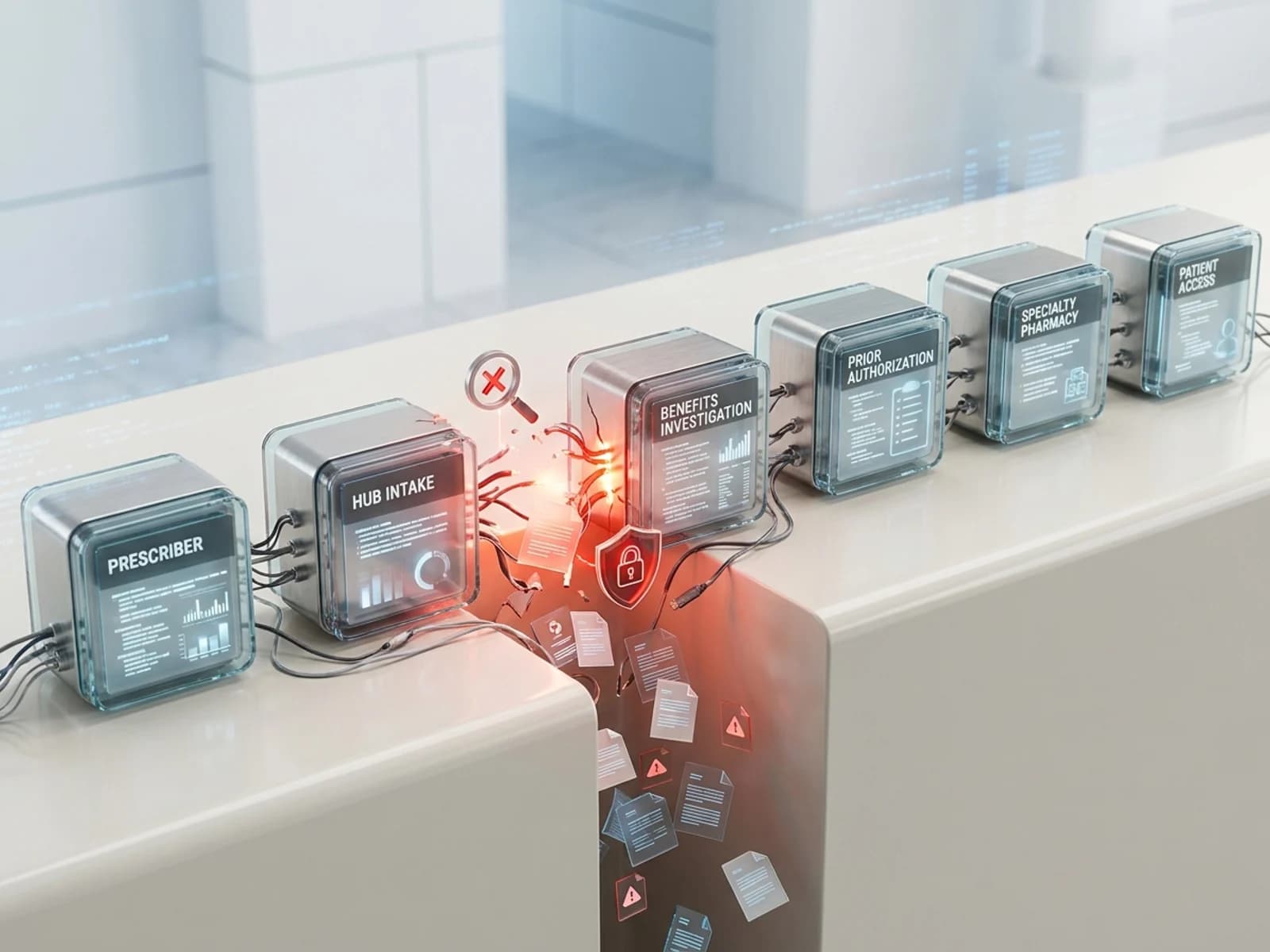
A Surescripts survey of specialty prescribers and pharmacists found that 80% of prescribers say accelerating speed to therapy is a "very important" benefit of the specialty enrollment process, yet more than 80% also say it should take two weeks or less to start a patient on a new specialty therapy—and only 20–30% report that it actually does. The rest describe three-to-four-week timelines. The gap between expectation and reality is driven in large part by handoff failures at the boundaries between provider offices, manufacturer patient-support hubs, specialty pharmacies, and payer adjudication systems.
This article is for manufacturer hub operators, specialty pharmacy intake teams, field reimbursement specialists, and provider-office access coordinators who need to understand where the handoff breaks, why the failure is often silent, and what to fix to reduce time-to-therapy.
The hub handoff chain and where it breaks
A specialty drug prescription passes through a chain of handoffs before the patient receives the medication:
Prescriber → Hub: The provider sends a prescription or referral form (fax, e-referral portal, or EHR integration) to the manufacturer's patient-support hub.
Hub intake → Consent capture: The hub contacts the patient and/or provider to obtain HIPAA authorization, program consent, and financial-assistance enrollment documents.
Hub → Benefits investigation (BI): The hub verifies the patient's insurance coverage, formulary status, prior authorization requirements, and out-of-pocket costs.
Hub → Prior authorization: The hub (or a contracted vendor) submits PA to the payer.
Hub → Specialty pharmacy fulfillment: The hub routes the prescription to the appropriate specialty pharmacy (limited-distribution network, payer-mandated pharmacy, or patient-preferred pharmacy).
Specialty pharmacy → Patient: The pharmacy dispenses and ships or delivers the medication.
At each boundary, information can be lost, delayed, or entered incorrectly. The handoff failures fall into four categories: consent and authorization gaps, benefits-investigation data errors, enrollment field problems, and specialty pharmacy routing failures.
Consent and HIPAA authorization gaps
The problem
Patient-support hubs cannot operate without proper consent. Two consent types are required:
Program consent: The patient agrees to participate in the manufacturer's support program, including receiving communications from the hub, being contacted for adherence follow-up, and sharing data with the manufacturer.
HIPAA authorization: The patient authorizes the hub to receive, use, and share protected health information (PHI) for program purposes. This is distinct from the provider's general Treatment, Payment, and Operations (TPO) consent. Under HIPAA, disclosures of PHI for non-TPO purposes—including manufacturer analytics, marketing restrictions, and patient-support services—require a separate, specific authorization.
As IntuitionLabs documents in its guide to patient-support hub programs, a hub cannot forward pharmacy dispense data or patient contact information to the manufacturer without patient consent, because those uses fall outside routine treatment or payment. The enrollment form must include a signed HIPAA authorization that complies with 45 CFR §164.508. If the authorization is missing, incomplete, incorrectly executed, or difficult for the individual to understand, it is invalid, and any subsequent use or disclosure of PHI made in reliance on that authorization is impermissible.
Where the handoff breaks
Paper consent delays. Many provider offices still rely on paper enrollment forms faxed to the hub. If a signature is missing, the hub must follow up with the office—a cycle that can add days. HIPAA authorization forms must be stored for a minimum of six years, and workforce members responsible for obtaining them must be trained on implementation specifications, but practice compliance is uneven.
Verbal consent documentation gaps. Some hubs accept verbal consent by phone, but the consent must be documented contemporaneously. If the hub agent fails to record the verbal authorization properly, or if the recording system does not capture all required elements, the consent is invalid and the case is blocked.
Consent scope mismatch. The HIPAA authorization must cover the specific uses the hub intends. An authorization that permits "treatment coordination" but not "sharing data with the manufacturer for program analytics" creates a compliance gap that may surface only during an audit.
eConsent adoption is incomplete. Modern hubs increasingly use eConsent systems—sending patients a secure link by text or email for digital signature. IntuitionLabs reports that this approach raises signed-consent rates dramatically compared to fax-and-mail cycles. AssistRx reported in its 2024 Digital Intake Progress Report that technology-first enrollment reduced missing information for enrollments by 50% within 30 days. However, many provider offices still use paper workflows, creating a mixed-channel problem where some patients are consented within minutes and others wait days.
What to fix
Build validation checks into hub intake software that block order release until both program consent and HIPAA authorization checkboxes are marked.
Default to eConsent workflows for all new referrals. Offer paper consent only when electronic methods fail.
Audit consent records quarterly for completeness, proper execution, and scope coverage.
Benefits investigation data errors
The problem
Benefits investigation (BI)—also called benefits verification (BV)—is the process of determining a patient's insurance coverage, formulary tier, prior authorization requirements, step-therapy obligations, out-of-pocket costs, and specialty pharmacy routing before therapy begins. It is the foundation for every downstream access decision.
Where the handoff breaks
Incorrect or stale insurance information. The hub receives the patient's insurance card or information at intake, but the data may be outdated. Plan changes at the start of a calendar year, employer group changes, Medicare enrollment transitions, and Medicaid redeterminations all create windows where the hub's BI data does not match the patient's current coverage. If the BI is run against the wrong plan, the prior authorization is submitted to the wrong payer and denied.
Dual-benefit confusion. Many specialty drugs can be covered under either the pharmacy benefit or the medical benefit, depending on the route of administration, the site of care, and the plan design. If the hub routes the BI to the wrong benefit, the PA is submitted on the wrong track, and the prescription may be rejected at the pharmacy counter or the buy-and-bill claim denied.
Formulary status not verified. A hub may complete BI but fail to verify the drug's current formulary tier and coverage status. If the plan has moved the drug to a higher tier, added new step-therapy requirements, or excluded it entirely, the PA submission will fail regardless of clinical documentation quality.
Prior authorization requirements not identified. Some plans require PA for the drug itself, while others require PA for the diagnosis, the dose, or the site of administration. If the hub identifies only the drug-level PA requirement and misses the diagnosis-level or site-level requirement, the PA will be partially approved but not sufficient for dispensing.
A Surescripts survey found that two-thirds of prescribers and three-fourths of specialty pharmacists report that improperly filled-out forms are an issue when obtaining prior authorization—the leading cause of delays that impact speed to therapy. The root cause is often a BI that was incomplete, inaccurate, or based on stale data.
What to fix
Run BI in real time or near-real time, not from cached data. Use electronic eligibility verification (e-BV) that checks current coverage, PA requirements, and out-of-pocket costs before initiating the PA process.
For dual-benefit drugs, verify routing under both pharmacy and medical benefit before choosing a path.
Cross-reference formulary status against the specific plan's current formulary document, not a generic database.
Flag cases where PA requirements have changed since the last BI was run—especially at calendar-year transitions.
Enrollment field errors
The problem
Hub enrollment forms require a specific set of patient and prescription data fields to be populated correctly: patient name, date of birth, address, phone number, insurance ID, group number, BIN/PCN, drug name, strength, dose, diagnosis code, prescriber NPI, and prescriber DEA number (for controlled substances). Any missing or incorrect field can block downstream processing.
Where the handoff breaks
Missing diagnosis code. California's Department of Health Care Services announced in early 2026 that Medi-Cal Rx will require ICD-10 diagnosis codes on all pharmacy claims beginning in fall 2026. The California Medical Association warned that this requirement could increase administrative burden, trigger claim denials for missing codes, and disrupt prescribing workflows. If the hub's enrollment form does not capture the diagnosis code at intake, the specialty pharmacy cannot adjudicate the claim.
Wrong drug or formulation. A referral that lists "Humira" but does not specify the concentration (40 mg/0.4 mL vs. 80 mg/0.8 mL) or the device (pen vs. prefilled syringe) creates fulfillment ambiguity. The specialty pharmacy may dispense the wrong product, requiring a return and reship.
Incorrect patient demographics. A transposed digit in the date of birth, a misspelled name, or an outdated address causes eligibility verification failures. The BI returns a "member not found" result, and the hub must circle back to the provider office for correction.
Missing prescriber information. If the prescriber's NPI is missing or incorrect, the pharmacy cannot verify the prescriber's eligibility to order the drug. Beginning June 2026, Medi-Cal Rx will begin denying claims and prior authorizations if the prescribing provider is not enrolled in Medi-Cal—compounding this field-level requirement.
NDC format mismatches. A Pharmaceutical Commerce analysis documented that the upcoming NDC-12 transition (from 10-digit to 12-digit National Drug Codes) will create identifier resolution failures at specialty pharmacy handoff points. A patient enrolled in a hub program before the transition may have a legacy 10-digit NDC in their enrollment record; after the transition, the specialty pharmacy processes the dispense with a 12-digit NDC, and the hub platform cannot resolve the two as the same drug, causing silent enrollment failures.
What to fix
Build mandatory-field validation into the enrollment form. Do not allow submission of incomplete forms.
Validate insurance information electronically against the payer's eligibility system before proceeding to BI.
Implement duplicate-patient detection to prevent multiple enrollment records for the same patient.
Prepare for NDC-12 format changes by ensuring the hub's database supports both 10-digit and 12-digit NDC formats.
Specialty pharmacy routing failures
The problem
After PA approval, the hub must route the prescription to the correct specialty pharmacy. This routing depends on the drug's distribution network (limited, exclusive, or open), the payer's preferred pharmacy network, and sometimes the patient's geographic location.
Where the handoff breaks
Payer-mandated pharmacy outside the manufacturer's network. If the payer requires the patient to use a specific specialty pharmacy that is not part of the manufacturer's limited-distribution network, the prescription cannot be routed. This creates a "pharmacy lockout" that requires intervention from the manufacturer's access team to negotiate an exception or find an alternative coverage pathway.
Wrong pharmacy for the benefit type. Pharmacy-benefit drugs are dispensed by specialty pharmacies that bill under the pharmacy benefit using NDC codes. Medical-benefit drugs are often purchased and administered by the provider (buy-and-bill) or dispensed through a specialty pharmacy that bills under the medical benefit using J-codes. Routing a pharmacy-benefit prescription to a medical-benefit pharmacy—or vice versa—results in claim rejection.
Hub-to-pharmacy data transfer errors. The hub sends the approved prescription to the specialty pharmacy via electronic transmission (NCPDP SCRIPT, fax, or portal). If the transmission is incomplete—missing the PA approval number, the approved quantity, or the approved dates—the pharmacy cannot process the order. The hub and pharmacy may not discover the gap until the patient calls to ask why their medication has not arrived.
What to fix
Verify the payer's preferred specialty pharmacy at the BI stage, before PA submission, to identify routing conflicts early.
Build automated confirmation loops: the hub's system should confirm that the specialty pharmacy received the prescription, the PA approval, and all required clinical documentation.
Track the fulfillment pipeline from hub routing to pharmacy receipt to patient delivery, not just from PA approval to fulfillment initiation.
Measuring handoff quality
Manufacturer hub teams should track these metrics to quantify handoff failures:
| Metric | Target | Red flag |
|---|---|---|
| Time from referral to consent completion | ≤ 48 hours | > 5 business days |
| BI accuracy rate (first-pass) | ≥ 95% | < 85% |
| PA submission completeness (no missing fields) | ≥ 98% | < 90% |
| Prescription routing accuracy | ≥ 99% | < 95% |
| Time from PA approval to dispensing | ≤ 3 business days | > 7 business days |
| Patient-reported gap between expected and actual delivery | ≤ 2 days | > 5 days |
What to monitor
HL7 FHIR Specialty-Rx Implementation Guide. This IG, a collaboration between HL7 and NCPDP, defines standardized data exchange for specialty medication fulfillment, including clinical data, consent information, and coverage verification. As adoption spreads, it could reduce handoff friction between hubs, specialty pharmacies, and payer systems.
Medi-Cal Rx diagnosis code requirement. Enforcement expected fall 2026. Will increase the number of required enrollment fields for California Medicaid patients.
Medi-Cal prescriber enrollment enforcement. Beginning June 2026, unenrolled prescribers will trigger claim denials.
NDC-12 transition timeline. The NDC format change will create identifier resolution failures across hub platforms and specialty pharmacy systems. Monitor FDA guidance on implementation dates.
CMS-0062-P final rule. If finalized, will extend electronic PA to all drugs by October 2027, potentially reducing some handoff friction but also increasing the structured-data requirements that cause field-level failures.
Hub technology consolidation. The industry is moving toward integrated platforms that combine eConsent, BI, PA, and fulfillment tracking in a single workflow. Monitor adoption rates and their impact on handoff metrics.
Last updated: May 31, 2026. This article is for informational purposes only and does not constitute medical, legal, or reimbursement advice. It is not intended for individual patient treatment decisions.
Sources
PMC. "Exploring Information Chaos in Community Pharmacy Handoffs." PubMed Central, September 2013. https://pmc.ncbi.nlm.nih.gov/articles/PMC3766497/
PMC. "Re-Evaluating Access in Healthcare: Focus on Quality of Care." PubMed Central, 2025. https://pmc.ncbi.nlm.nih.gov/articles/PMC12604675/
Surescripts. "Inaccurate and Incomplete Data Delays Specialty Treatment for Patients and Is Top Stressor for Health Care Providers." https://surescripts.com/press-releases/inaccurate-and-incomplete-data-delays-specialty-treatment-patients-and-top-stressor-health-care-providers
IntuitionLabs. "Patient Support Hub Programs: An End-to-End Guide." 2026. https://intuitionlabs.ai/articles/guide-patient-support-hub-programs
AssistRx. "Digital Intake for Specialty Drug Support Programs: 2024 Progress Report." https://www.assistrx.com/wp-content/uploads/2025/04/Digital-Intake-for-Specialty-Drug-Support-Programs-2024-Progress-Report_Q2-2024.pdf
Pharmaceutical Commerce. "The NDC-12 Revenue Risk." 2025. https://www.pharmaceuticalcommerce.com/view/the-ndc-12-revenue-risk
Frier Levitt. "Specialty Pharmaceutical Manufacturers and Hub Utilization—Balancing Reward and Risk." https://www.frierlevitt.com/articles/specialty-pharmaceutical-manufacturers-and-hub-utilization-balancing-reward-and-risk
HIPAA Journal. "HIPAA Updates and HIPAA Changes in 2026." https://www.hipaajournal.com/hipaa-updates-hipaa-changes
Accountable HQ. "HIPAA Compliance for Specialty Pharmacy Services: Requirements, Safeguards, and Best Practices." https://www.accountablehq.com/post/hipaa-compliance-for-specialty-pharmacy-services-requirements-safeguards-and-best-practices
California Medical Association. "CMA Warns Medi-Cal Rx Diagnosis Code Requirement Could Disrupt Patient Access." April 2026. https://www.cmadocs.org/newsroom/news/view/ArticleId/51157/DHCS-to-require-diagnosis-codes-on-all-pharmacy-claims-beginning-fall-2026
Rx Almanac. "Hub Services & Patient Support Program Vendors." https://rxalmanac.com/category/hub-services
Pharmacy Times. "Navigating Prior Authorization Denials: A Clinical Pharmacist's Approach to Appeals." https://www.pharmacytimes.com/view/navigating-prior-authorization-denials-a-clinical-pharmacists-approach-to-appeals