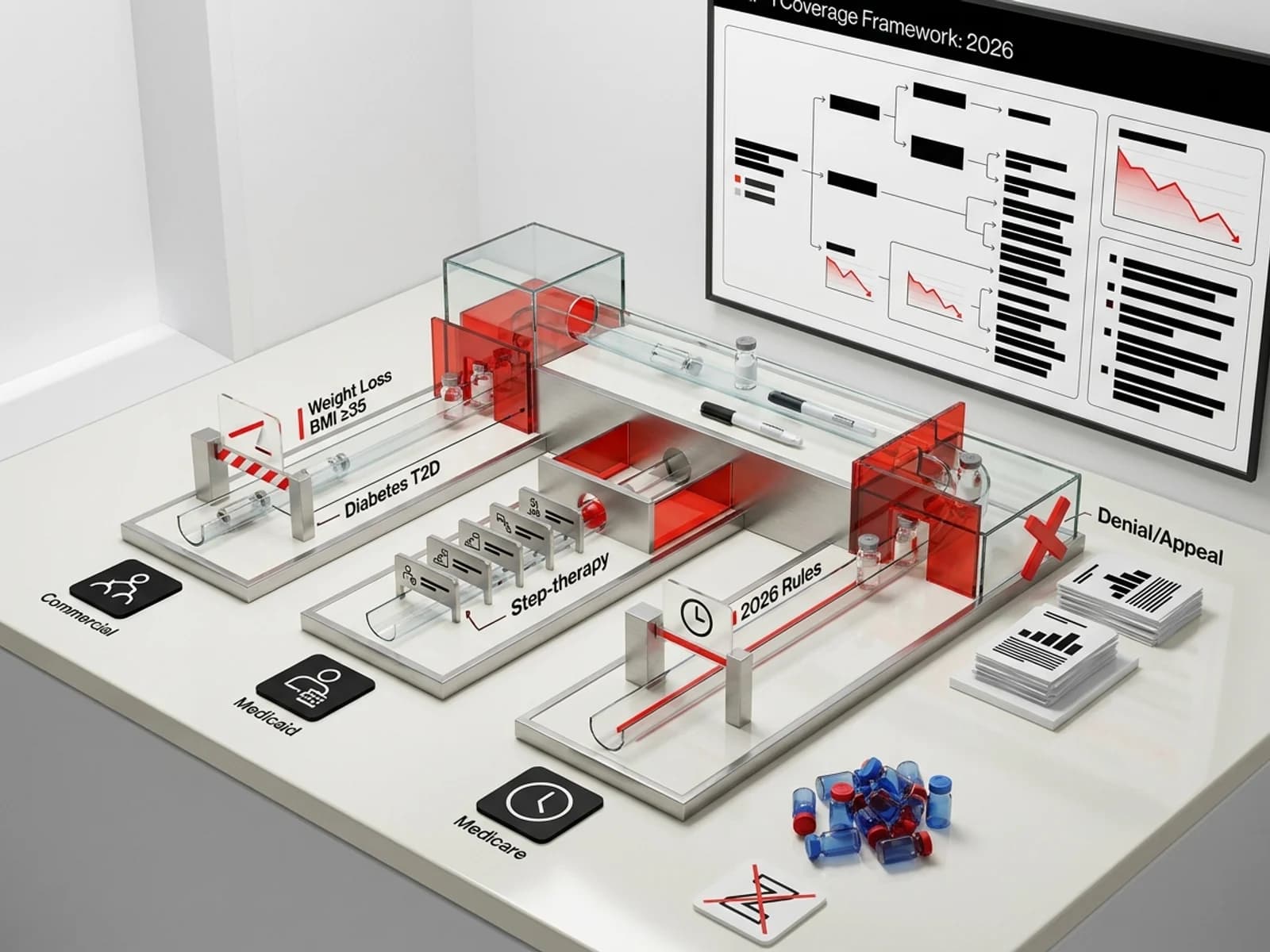
Checking whether an insurance plan covers GLP-1 receptor agonists — and under what conditions — is one of the most time-consuming steps in the prescribing and access workflow. Coverage rules vary by drug, indication (type 2 diabetes versus weight loss versus cardiovascular prevention), formulary tier, employer benefit design, payer policy, and state regulation. Prior authorization requirements, step therapy protocols, specialty pharmacy mandates, and reauthorization timelines add further complexity.
This guide provides a structured, step-by-step workflow for verifying GLP-1 insurance coverage, drawn from payer policies, pharmacy benefit management practices, and specialty pharmacy operations current for 2026. It is designed for prescribers, benefit verification specialists, hub intake teams, and patients navigating the coverage process. It is independent information and not medical advice or reimbursement guidance for a specific patient or plan.
Why a GLP-1 coverage checker workflow matters
The GLP-1 coverage landscape in 2026 is more fragmented than ever:
Multiple payer exclusions: BCBS of Massachusetts, Blue Cross Blue Shield of Michigan, Harvard Pilgrim, Blue Cross Vermont, and other plans dropped weight-loss GLP-1 coverage on most formularies starting January 2026
Indication-dependent coverage: Many plans cover Ozempic and Mounjaro for type 2 diabetes but exclude Wegovy and Zepbound for weight loss on the same plan
Employer variation: Self-funded employer plans may include or exclude GLP-1 weight-loss benefits independently of the carrier's standard formulary
Medicare expansion: CMS's GLP-1 Bridge demonstration (July 2026 – December 2027) is expanding GLP-1 access for Medicare beneficiaries; the longer-term BALANCE model's Part D launch is uncertain
State Medicaid variation: As of January 2026, only 13 state Medicaid programs cover GLP-1s for obesity; four states (California, New Hampshire, Pennsylvania, South Carolina) recently eliminated coverage
New products: Orforglipron (Foundayo), Wegovy tablets, Wegovy HD 7.2 mg, and other new GLP-1 formulations are entering formularies with different tier placement and PA criteria
A systematic coverage check — done before prescribing — reduces PA denials, avoids patient frustration, and speeds time to therapy.
Step 1: Collect insurance information
Before any coverage investigation, gather:
| Information | Where to Find It |
|---|---|
| Insurance carrier name | Member ID card (front) |
| Member ID number | Member ID card (front) |
| Group number | Member ID card (front) |
| Plan type (HMO, PPO, POS, EPO, HDHP) | Member ID card or enrollment materials |
| Pharmacy benefit manager (PBM) | Member ID card (back) or carrier website |
| Rx BIN, PCN, and group numbers | Member ID card (back) |
| Whether plan is fully insured or self-funded | HR department or carrier member services |
| Formulary name or drug list version | Carrier website or member portal |
Why the self-funded distinction matters
Self-funded employer plans are not subject to state insurance mandates and can customize formulary coverage independently. Two members on the same "Anthem" or "UHC" plan may have completely different GLP-1 weight-loss coverage if one is fully insured and the other is self-funded. Always confirm plan funding type during the intake call.
Step 2: Identify the formulary and check GLP-1 status
Online formulary lookup
Most carriers and PBMs offer online drug lookup tools:
| Carrier/PBM | Drug Lookup Tool |
|---|---|
| CVS Caremark | caremark.com drug lookup |
| Express Scripts | express-scripts.com formulary search |
| Optum Rx | optumrx.com drug pricing tool |
| UnitedHealthcare | uhc.com member portal — pharmacy section |
| Aetna | aetna.com member portal — pharmacy section |
| Cigna | my.cigna.com — pharmacy and drug coverage |
| Anthem/Elevance | anthem.com — pharmacy and drug list |
| BCBS (varies by plan) | bcbs.com or local plan website |
Search for each GLP-1 drug by name: Ozempic, Wegovy, Mounjaro, Zepbound, Rybelsus, Trulicity, Saxenda. Record the tier, PA requirement, step therapy flag, quantity limits, and specialty pharmacy designation for each.
What to look for
Tier placement: Tier 2 (preferred brand) through Tier 5 (specialty) — higher tiers mean higher cost-sharing
PA required: "PA" or "Prior Authorization" flag
Step therapy: "ST" or "Step Therapy" flag — typically requires trial of metformin, then an older GLP-1, before newer agents
Quantity limits: "QL" — usually one pen or one month's supply at a time
Specialty pharmacy: "SP" or "SPS" — must be filled through designated specialty pharmacy
Not covered / excluded: "NC" or "Not Covered" — drug is excluded from the formulary entirely
Key distinction: indication-specific coverage
Many formulary tools show drug-level status without distinguishing by indication. A drug may show as "covered with PA" but only for T2D — not for weight loss. Call the carrier to confirm indication-specific coverage.
Step 3: Determine coverage by indication
GLP-1 drugs have multiple FDA-approved indications, and most plans cover them differently by indication:
| Drug | FDA-Approved Indications | Common Coverage Pattern |
|---|---|---|
| Ozempic | T2D, cardiovascular risk reduction | Covered on most plans with PA |
| Wegovy | Chronic weight management, MACE prevention, MASH | Weight loss: plan-dependent. MACE/MASH: more commonly covered |
| Mounjaro | T2D | Covered on most plans with PA |
| Zepbound | Chronic weight management, OSA | Weight loss: plan-dependent. OSA: expanding coverage |
| Rybelsus | T2D | Covered on most plans with PA |
| Trulicity | T2D, cardiovascular risk reduction | Covered on most plans with PA |
| Saxenda | Chronic weight management | Weight loss: limited commercial coverage; often excluded |
| Foundayo | T2D | New-to-market; coverage expanding mid-2026 |
The dual-indication strategy
For patients who have both T2D and obesity, prescribing the diabetes-indicated formulation (Ozempic instead of Wegovy, Mounjaro instead of Zepbound) may encounter fewer coverage barriers while achieving the same clinical effect. This is a clinical decision between prescriber and patient, but from a coverage standpoint, T2D-indicated GLP-1s face fewer plan exclusions and PA hurdles than weight-loss-indicated GLP-1s.
Step 4: Call the insurance carrier — the 7-question coverage verification
After completing online formulary research, call the carrier's pharmacy member services line (number on the back of the insurance card). Ask these seven questions:
"Is [drug name] covered under this plan's pharmacy benefit?" Get a clear yes/no. If no, ask why (formulary exclusion, weight-loss benefit exclusion, not medically necessary).
"Is weight-loss medication excluded by this plan's benefit design?" Some employers exclude all weight-loss medications regardless of formulary. This is a benefit-level exclusion, not a formulary decision, and it cannot be appealed through standard PA.
"What are the specific prior authorization criteria for [drug name] for [indication]?" Ask for the BMI threshold, comorbidity requirements, prior medication trials, and documentation requirements.
"Is step therapy required? If so, which medications must be tried first?" Common step therapy sequences: metformin → older GLP-1 → newer GLP-1; or Contrave/Qsymia → Wegovy/Zepbound.
"Is there a preferred GLP-1 on this formulary?" Plans may prefer one GLP-1 over another based on contracting. Knowing the preferred option can avoid unnecessary denials.
"Which specialty pharmacy is in-network for this medication?" Many plans require GLP-1s to be dispensed through a specific specialty pharmacy (CVS Specialty, Optum Specialty, AllianceRx Walgreens Prime, etc.). Filling at the wrong pharmacy results in a denied claim.
"What is the expected copay or coinsurance at the member's current tier?" Get an estimated out-of-pocket cost for a one-month supply. Ask whether manufacturer copay assistance is accepted and whether copay accumulator/maximizer programs apply.
Document the call
Record the date, time, representative name, reference number, and answers to each question. This documentation is critical if a claim is later denied and you need to appeal.
Step 5: Use online GLP-1 coverage checker tools
Several digital tools can supplement or accelerate the coverage check:
| Tool | How It Works | Cost |
|---|---|---|
| Ro GLP-1 Insurance Coverage Checker | Patient enters insurance card info; Ro contacts the insurer and returns a personalized coverage report for each GLP-1 | Free |
| Dr. B GLP-1 Benefit Checker | Online form verifies whether the patient's plan covers GLP-1 medications and estimates copay | Free |
| PrescriberPoint | Provider-facing tool showing coverage by carrier and plan for specific GLP-1 drugs | Free (provider registration) |
| Manufacturer cost/coverage tools | NovoCare (Wegovy/Ozempic), Lilly (Mounjaro/Zepbound) offer plan-specific cost estimators | Free |
| Carrier member portals | Most carriers offer drug pricing tools with member-specific cost estimates | Free (login required) |
Limitations of automated tools
Coverage checkers may not distinguish between T2D and weight-loss coverage for the same drug
Employer-level exclusions may not be reflected in automated results
Real-time PA status and specialty pharmacy requirements may require a phone call
Copay estimates may not account for deductibles or out-of-pocket maximums
Step 6: Prepare and submit prior authorization
Common PA documentation requirements
Most GLP-1 PA submissions require:
| Documentation | Typical Requirement |
|---|---|
| BMI documentation | Current BMI within 30–90 days; some plans require baseline BMI |
| Diagnosis code | ICD-10 code for T2D (E11.x), obesity (E66.x), or relevant comorbidity |
| Prior medication trials | Pharmacy fill records showing trial of step therapy medications (metformin, older GLP-1, Contrave, etc.) |
| Lifestyle modification documentation | Evidence of participation in diet, exercise, or behavioral program for 3–6 months |
| Lab results | HbA1c, fasting glucose, lipid panel (varies by plan and indication) |
| Prescriber attestation | Statement confirming medical necessity, screening for contraindications, and prescribing in accordance with FDA labeling |
PA submission channels
Electronic PA (ePA): Through CoverMyMeds, Surescripts, or carrier-specific ePA platforms — fastest route
Carrier provider portal: Direct submission through the payer's online portal
Phone: Call the pharmacy PA line on the back of the member's ID card
Fax: Use the carrier-specific PA fax form
PA decision timelines
Standard: 72 hours to 14 calendar days depending on carrier and state law
Expedited: 24 hours when delay would jeopardize patient health
CMS rule (January 2027): Payers must implement FHIR-based PA APIs with mandatory response within 7 days for standard decisions
Step 7: Handle common denial reasons
| Denial Reason | Frequency | Response Strategy |
|---|---|---|
| "Not medically necessary" | Most common | Request the specific criteria used; gather supporting documentation; submit appeal with letter of medical necessity |
| "Step therapy not met" | Very common | Document prior trial of required medications; submit pharmacy fill records; if no prior trial, explain clinical contraindication |
| "Weight-loss benefit exclusion" | Increasing in 2026 | Determine if exclusion is plan-level (cannot appeal) or PA-level (can appeal); explore MACE or OSA pathway if applicable |
| "Drug not on formulary" | Common | Request formulary exception with medical necessity documentation; identify preferred alternative |
| "Incomplete documentation" | Common | Gather complete clinical records and resubmit; include BMI, labs, medication history, and prescriber attestation |
| "BMI below threshold" | Common | Submit most recent BMI; confirm the plan's specific threshold (some plans require BMI ≥30, others ≥27 with comorbidity, others ≥35) |
Appeal success rates
Studies and industry data suggest approximately 40–50% of initially denied weight-loss medication authorizations are overturned on appeal when supported by detailed clinical documentation. The key is addressing the specific denial reason with targeted evidence rather than resubmitting the same PA packet.
Step 8: Understand specialty pharmacy routing
Most GLP-1 medications are designated as specialty drugs and must be dispensed through specific specialty pharmacies:
| PBM/Carrier | Primary Specialty Pharmacy |
|---|---|
| CVS Caremark (Aetna, CareFirst, some BCBS) | CVS Specialty (1-800-237-2767) |
| Express Scripts (Cigna, some Anthem) | Accredo Specialty Pharmacy |
| Optum Rx (UHC, Harvard Pilgrim) | Optum Specialty Pharmacy |
| Prime Therapeutics (BCBS plans) | Prime Specialty Pharmacy |
| AllianceRx Walgreens Prime | AllianceRx Walgreens Prime |
Specialty pharmacy lock-in
When a plan designates a specialty pharmacy for GLP-1 dispensing, the prescription must be routed to that pharmacy. Filling at a retail pharmacy or a non-network specialty pharmacy will result in a denied claim. During the coverage check, confirm the designated specialty pharmacy and ensure the prescription is routed accordingly.
Bridge programs and transition supply
Some specialty pharmacies and manufacturer programs offer bridge supplies — a limited amount of free medication — while PA is being processed. Check with the specialty pharmacy and the manufacturer's patient assistance program for bridge supply availability.
Step 9: Factor in manufacturer copay assistance
Most GLP-1 manufacturers offer copay assistance programs for commercially insured patients:
| Drug | Manufacturer Program | Typical Benefit |
|---|---|---|
| Wegovy | NovoCare | As low as $0/month for eligible commercially insured patients; maximum annual benefit applies |
| Ozempic | NovoCare | As low as $0/month for eligible commercially insured patients |
| Zepbound | Lilly | As low as $0/month for eligible commercially insured patients |
| Mounjaro | Lilly | As low as $0/month for eligible commercially insured patients |
| Foundayo | Lilly | Savings program available for eligible patients |
Copay accumulator and maximizer programs
Some employer plans use copay accumulator adjustment programs (CAAPs) or copay maximizer programs that prevent manufacturer copay assistance from counting toward the patient's deductible and out-of-pocket maximum. As of 2026, several states have banned accumulator programs. Check whether the member's plan uses an accumulator or maximizer, as this affects the true out-of-pocket cost.
Step 10: Reauthorization and renewal planning
GLP-1 prior authorizations are not permanent. Most plans require reauthorization every 3–12 months:
Initial PA duration: Typically 3–6 months for weight loss; 6–12 months for T2D
Renewal criteria: Documented weight loss (usually ≥5% of baseline body weight), continued adherence to maintenance dose, and ongoing lifestyle modification
Renewal timing: Submit renewal PA 30–60 days before current authorization expires to avoid therapy gaps
Reauthorization denials: Common if weight loss plateau is documented without evidence of maintained benefit; appeal with clinical rationale for continued therapy
Calendar the reauthorization
Build a reauthorization tracking system that alerts the prescriber and care team 60 days before each PA expiration date. Include in the alert:
Current authorization end date
Renewal documentation requirements
Patient's most recent weight and BMI
Time since last PA submission
Quick-reference: GLP-1 coverage check by payer type
| Payer Type | Likely GLP-1 Coverage | Key Consideration |
|---|---|---|
| Commercial (large employer) | Varies — 43% of firms with 5,000+ employees cover GLP-1s for weight loss | Self-funded plans decide independently; check employer benefit election |
| Commercial (small employer/individual) | Limited — ACA marketplace plans rarely cover GLP-1s for obesity | State EHB requirements may affect coverage |
| Medicare Advantage Part D | T2D covered; weight loss expanding via Bridge/BALANCE | Bridge program July 2026 – December 2027; BALANCE model launch uncertain |
| Medicaid (13 covering states) | Limited — obesity coverage varies by state; T2D generally covered | Check specific state Medicaid PDL and PA criteria |
| TRICARE | T2D covered with PA; weight loss covered on select plans | Express Scripts manages TRICARE pharmacy benefits |
| CHAMPVA | T2D covered; weight loss coverage expanding | Optum Rx manages CHAMPVA pharmacy benefits |
| FEHB/FEP Blue | T2D covered; weight loss varies by plan option | FEP Blue Focus, Standard, and Basic have different formularies |
Sources
KFF. "Medicaid Coverage of and Spending on GLP-1s." Updated 2026. https://www.kff.org/medicaid/medicaid-coverage-of-and-spending-on-glp-1s
CNBC. "Ro launches GLP-1 insurance coverage checker." August 13, 2024. https://www.cnbc.com/2024/08/13/ro-launches-glp-1-insurance-coverage-checker.html
IntuitionLabs. "The ePA Process for GLP-1 Drugs: A Workflow Guide." 2026. https://intuitionlabs.ai/articles/epa-glp-1-prior-authorization
Healthline. "GLP-1 Insurance Coverage for Weight Loss: 2026 Guide." https://www.healthline.com/health/drugs/will-my-insurance-cover-glp-1-for-weight-loss
Health Bill Central. "GLP-1 Insurance Denial? How to Appeal Ozempic, Wegovy, and Mounjaro Coverage." https://healthbillcentral.com/blog/glp1-insurance-denial-appeal
AAOPM. "What Insurance Plans Cover Weight Loss Medication in 2026?" https://aaopm.com/blog/insurance-cover-weight-loss-medication
Word & Brown General Agency. "Weight Loss Drugs (GLP-1) Insurance Coverage Breakdown By Carrier." Updated May 1, 2026. https://www.wordandbrown.com/NewsPost/Weight-Loss-Drugs-(GLP-1)-Coverage
CMS.gov. "Coming Soon: CMS to Provide $50 Monthly Access to GLP-1 Medications for Medicare Beneficiaries." 2026. https://www.cms.gov/newsroom/press-releases/coming-soon-cms-provide-50-monthly-access-glp-1-medications-medicare-beneficiaries
Claimable. "What to Do When Your Insurance Plan Excludes Coverage for Your Condition." January 26, 2026. https://www.getclaimable.com/post/glp-1-insurance-plan-exclusion
Dr. B. "How to get insurance to cover weight loss medication." https://drb.ai/resources/how-to-get-insurance-to-cover-weight-loss-medication