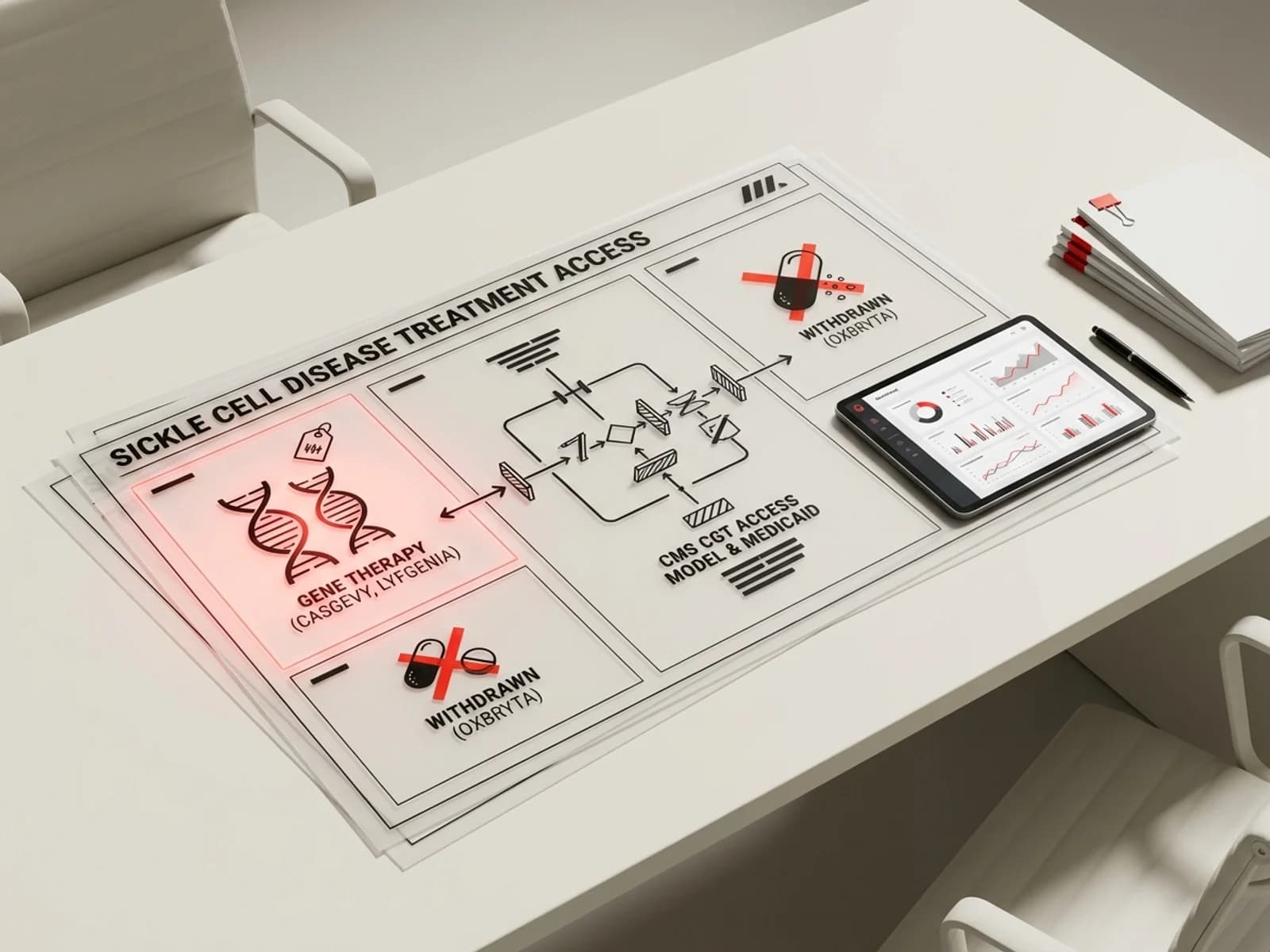
Sickle cell disease (SCD) is undergoing a structural transition in clinical care and market access. Historically managed through chronic supportive therapy and oral disease modifiers, the therapeutic options for SCD now encompass six FDA-approved agents spanning three distinct drug classes—ranging from low-cost oral generics to multi-million-dollar one-time curative gene therapies. However, access is defined as much by regulatory withdrawals and reimbursement bottlenecks as by clinical innovation.
On September 25, 2024, Pfizer voluntarily withdrew Oxbryta (voxelotor) from global markets after real-world registries and postmarketing data revealed an increased rate of vaso-occlusive crises (VOCs) and fatal events, removing a primary oral hemoglobin S polymerization inhibitor. Concurrently, the commercial rollout of two landmark one-time gene therapies approved on December 8, 2023—Casgevy ($2.2 million WAC) and Lyfgenia ($3.1 million WAC)—has concentrated attention on the Centers for Medicare & Medicaid Services (CMS) Cell and Gene Therapy (CGT) Access Model, designed to establish multi-state outcomes-based Medicaid agreements for a disease population where 50% to 60% of patients are Medicaid-insured.
This decision-grade landscape provides hematologists, Medicaid program directors, health system access teams, and specialty pharmacy leaders with a consolidated analysis of every approved SCD therapy, the clinical and regulatory rationale for the Oxbryta withdrawal, a comparative access matrix, and the procedural mechanics of gene therapy reimbursement under CMS oversight.
Executive Summary & Direct Answer
Across all FDA-approved sickle cell disease therapies, treatment options fall into three distinct classes:
One-Time Curative Gene Therapies (FDA Approved Dec 8, 2023):
Casgevy (exagamglogene autotemcel / exa-cel): Developed by Vertex Pharmaceuticals and CRISPR Therapeutics. First-in-class CRISPR-Cas9 gene-edited autologous CD34+ cell therapy targeting the BCL11A erythroid enhancer to reactivate fetal hemoglobin (HbF). Priced at $2.2 million WAC.
Lyfgenia (lovotibeglogene autotemcel / lovo-cel): Developed by Bluebird Bio. Lentiviral vector-mediated gene addition therapy introducing an engineered anti-sickling hemoglobin variant ($\text{HbA}^{T87Q}$). Priced at $3.1 million WAC. Includes a boxed warning for hematologic malignancy.
Targeted Biologic Therapy:
Adakveo (crizanlizumab-tmca): Developed by Novartis (FDA approved Nov 15, 2019). Monoclonal antibody targeting P-selectin to prevent cell adhesion in microvasculature. Administered via monthly IV infusion at
$2,357 per 100 mg vial ($85,000–$113,000 annually). The Phase 3 SUSTAIN trial demonstrated a 45% reduction in median annual VOC rate (1.63 vs 2.98).
Small-Molecule Disease Modifiers:
Hydroxyurea: Approved in 1998 (Droxia/generic). Ribonucleotide reductase inhibitor inducing HbF production. Anchors baseline therapy as an oral generic supported by 7 approved ANDAs in the FDA Orange Book.
Endari (L-glutamine oral powder): Developed by Emmaus Medical (FDA approved Jul 7, 2017). Reduces oxidative stress in sickled red blood cells. Priced at ~$1,110–$1,154 per 60-packet carton.
Oxbryta (voxelotor): Approved in Nov 2019 by Global Blood Therapeutics (acquired by Pfizer). Voluntarily withdrawn worldwide on September 25, 2024 following post-approval registry signals of increased VOC frequency and imbalance in total deaths.
Because approximately 50% to 60% of the estimated 100,000 U.S. individuals with SCD are covered by Medicaid, commercial uptake of $2.2M–$3.1M gene therapies depends on state participation in the CMS Cell and Gene Therapy (CGT) Access Model. Launched in January 2025 and named for its first cohort in July 2025, the model now includes approximately 33 participating states (plus the District of Columbia and Puerto Rico) — covering roughly 84% of Medicaid beneficiaries with SCD — implementing standardized, outcomes-based financial agreements to manage state Medicaid budget risk.
The Sickle Cell Disease Treatment Landscape
To compare mechanisms, administrative requirements, pricing structures, and access channels across all six disease-modifying therapies, the table below synthesizes the complete FDA-approved inventory:
| Drug Name (Generic / Code) | Sponsor / Developer | Modality & Mechanism | FDA Approval Status / Date | Wholesale Acquisition Cost (WAC) | Primary Access Channel & Billing |
|---|---|---|---|---|---|
| Casgevy (exagamglogene autotemcel) | Vertex / CRISPR Tx | Autologous CRISPR-Cas9 gene editing (BCL11A enhancer disruption $\rightarrow$ HbF induction) | Approved (Dec 8, 2023) | $2,200,000 one-time | Medical Benefit / Inpatient (Authorized Treatment Centers via CMS CGT Model) |
| Lyfgenia (lovotibeglogene autotemcel) | Bluebird Bio | Autologous lentiviral gene addition ($\text{HbA}^{T87Q}$ anti-sickling hemoglobin) | Approved (Dec 8, 2023) | $3,100,000 one-time | Medical Benefit / Inpatient (Authorized Treatment Centers; Boxed Warning) |
| Adakveo (crizanlizumab-tmca) | Novartis | Humanized anti-P-selectin monoclonal antibody (inhibits vaso-occlusion) | Approved (Nov 15, 2019) | Medical Benefit / Outpatient Infusion (Buy-and-Bill, J-code J0791) | |
| Endari (L-glutamine oral powder) | Emmaus Medical | Amino acid precursor (increases NAD ratio, reduces oxidative stress) | Approved (Jul 7, 2017) | ~$1,110–$1,154 / carton (oral) | Pharmacy Benefit (Retail / Specialty Mail Order, NDC 42457-420-60) |
| Hydroxyurea (Droxia / Siklos / generic) | Multiple Generic ANDAs | Ribonucleotide reductase inhibitor (stimulates HbF synthesis) | Approved (1998; 7 generic ANDAs) | Low-cost generic (NADAC ~$0.30–$1.50/cap) | Pharmacy Benefit (Retail Pharmacy, multiple generic sources) |
| Oxbryta (voxelotor) | Pfizer / GBT | HbS polymerization inhibitor (stabilizes oxygenated hemoglobin state) | WITHDRAWN (Sep 25, 2024) | Withdrawn ($10,500/mo prior) | Market Withdrawal (Global recall of all commercial lots) |
For deeper operational context on the single-brand Casgevy access pathway and state Medicaid structures, consult our detailed analysis on Casgevy sickle cell gene therapy access and the CMS CGT model.
Why Was Oxbryta (Voxelotor) Withdrawn?
The voluntary worldwide withdrawal of Oxbryta on September 25, 2024, marked a major setback for chronic oral SCD management. Voxelotor was granted Accelerated Approval by the FDA in November 2019 based on Phase 3 HOPE trial data demonstrating statistically significant increases in hemoglobin levels ($\ge 1.0\text{ g/dL}$ increase in 51.1% of patients on 1,500 mg vs 6.5% on placebo). However, the approval was contingent on confirmatory clinical trials establishing that hemoglobin elevation translated into tangible clinical benefit, such as reduced vaso-occlusive crises or improved organ function.
Safety Signals and Registry Data
Post-approval real-world surveillance and two ongoing postmarketing confirmatory trials—HOPE-KIDS 2 (NCT04218084) and an extension registry—revealed alarming clinical divergence:
Increased Rate of Vaso-Occlusive Crises: Patients receiving voxelotor experienced a higher annualized rate of severe pain crises requiring hospitalization compared to placebo arms in postmarketing studies.
Imbalance in Mortality: Postmarket safety assessments identified an imbalance in total deaths across clinical trials, with 8 deaths recorded in voxelotor-treated cohorts versus 2 in control arms during specific monitoring periods.
FDA Safety Alert & Global Recall: Following preliminary data reviews, Pfizer initiated a voluntary recall of all lot numbers of Oxbryta (100 mg, 300 mg, and 500 mg tablets and oral suspension) and suspended all clinical trials globally. The FDA subsequently issued a Drug Safety Communication advising prescribers to immediately discontinue Oxbryta and transition patients to alternative disease-modifying therapies.
Analysis of the Federal Adverse Event Reporting System (FAERS) dataset (covering 20.3 million reports through mid-2026) highlights the magnitude of postmarket reporting. Voxelotor accumulated approximately 21,991 FAERS reports (any reporting role) through mid-2026, with annual volume peaking in 2022 (≈9,210 reports) and declining to ≈1,409 in 2024 and ≈136 in 2025 — meaning the reporting surge preceded, rather than followed, the September 2024 worldwide withdrawal. By comparison, Novartis’s anti-P-selectin biologic crizanlizumab (Adakveo) accumulated approximately 1,395 FAERS reports over a comparable window.
FAERS Adverse Event Reporting Volume Comparison (SCD Targeted Agents)
----------------------------------------------------------------------
Voxelotor (Oxbryta)   : [========================================] ~21,991 reports (Withdrawal Surge)
Crizanlizumab (Adakveo): [==] ~1,395 reports
Clinical Transition Protocols & Therapeutic Re-Evaluation
With Oxbryta removed from formularies, clinical consensus guidelines recommend a structured re-evaluation protocol for all affected patients:
Hydroxyurea Optimization: Re-evaluate patients for baseline hydroxyurea optimization, escalating to the maximum tolerated dose while maintaining strict blood cell monitoring (absolute neutrophil count and platelet thresholds). Hydroxyurea remains the foundational pharmacotherapy with proven mortality reduction.
Biologic Transition: Transition patients with recurrent vaso-occlusive crises despite oral therapy to monthly crizanlizumab (Adakveo) IV infusions or introduce oral L-glutamine (Endari).
Curative Evaluation: Evaluate patients with severe, refractory disease (defined by recurrent VOCs, acute chest syndrome episodes, stroke history, or progressive end-organ damage) for curative evaluation under Casgevy or Lyfgenia at certified treatment centers.
This market withdrawal mirrors regulatory dynamics observed in other hematology sectors, such as the withdrawal of Roctavian in hemophilia A detailed in our hemophilia access landscape and gene-therapy withdrawal.
Casgevy vs. Lyfgenia: Clinical Evidence, Pricing, and Eligibility
The simultaneous approval of Casgevy and Lyfgenia on December 8, 2023, introduced two distinct curative paradigms for severe SCD patients aged 12 years and older with a history of recurrent VOCs. While both therapies eliminate sickling through genetic modification of autologous hematopoietic stem cells, their molecular mechanisms, manufacturing platforms, safety profiles, and commercial list prices differ substantially.
                         AUTOLOGOUS STEM CELL HARVEST (CD34+)
                                          |
                 +------------------------+------------------------+
                 |                                                 |
       CRISPR-Cas9 Editing                               Lentiviral Gene Addition
       (BCL11A Enhancer Disruption)                      (HbA-T87Q Gene Insertion)
                 |                                                 |
         CASGEVY (exagamglogene)                           LYFGENIA (lovotibeglogene)
                 |                                                 |
      Induces Fetal Hb (HbF)                           Expresses Anti-Sickling HbA-T87Q
       WAC Price: $2.2M                                   WAC Price: $3.1M
       No Boxed Warning                                   BOXED WARNING: Malignancy
                 |                                                 |
                 +------------------------+------------------------+
                                          |
                      MYELOABLATIVE CONDITIONING (Busulfan)
                                          |
                      INPATIENT INFUSION & ENGRAFTMENT (AAT)
1. Mechanism of Action and Genetic Targets
Casgevy (exa-cel): Uses CRISPR-Cas9 ribonucleoprotein complexes to perform targeted double-strand breaks in the erythroid-specific enhancer region of the BCL11A gene. Disruption of this enhancer downregulates BCL11A transcription factor expression, unleashing endogenous production of fetal hemoglobin ($\text{HbF}$). $\text{HbF}$ prevents red blood cell sickling by disrupting HbS polymer chain formation.
Lyfgenia (lovo-cel): Uses a LentiGlobin BB305 lentiviral vector to insert a functional copy of a modified human $\beta$-globin gene ($\beta^{T87Q}$) into patient CD34+ stem cells. The resulting $\text{HbA}^{T87Q}$ anti-sickling hemoglobin acts similarly to normal adult hemoglobin A, inhibiting HbS polymerization.
2. Clinical Trial Efficacy
Casgevy (CLIMB-121 Trial): In the primary efficacy analysis (median follow-up of roughly 19 months), 93.5% (29 of 31) of evaluable severe SCD patients remained free of severe VOCs for at least 12 consecutive months, and 100% (31 of 31) were free of VOC-related hospitalizations over the same ≥12-month window.
Lyfgenia (HGB-206 / HGB-210 Trials): In the primary efficacy cohort, 88% (28 of 32) of patients achieved complete resolution of severe vaso-occlusive events (VOEs) between 6 and 18 months post-infusion. Mean $\text{HbA}^{T87Q}$ production represented $\ge 40%$ of total adult hemoglobin levels.
3. Safety Profiles & Boxed Warning Differentiation
A major commercial differentiator is Lyfgenia's Boxed Warning for Hematologic Malignancy. During clinical trials, two patients treated with an earlier formulation of lovo-cel developed acute myeloid leukemia (AML) attributed to insertional oncogenesis or pre-existing somatic mutations stressed by myeloablative conditioning. As a result, Lyfgenia labeling requires lifetime monitoring for hematologic malignancies (including annual blood counts and integration site analysis if persistent cytopenias occur).
Casgevy carries no boxed warning, though both therapies share risks inherent to myeloablative busulfan conditioning, including severe neutropenia, mucositis, prolonged thrombocytopenia, risk of infection, and irreversible infertility (requiring pre-conditioning fertility preservation counseling).
4. Financial & List Price Comparison
Vertex/CRISPR Therapeutics established Casgevy’s WAC at $2.2 million, positioning it below market expectations for gene therapies. Bluebird Bio set Lyfgenia’s WAC at $3.1 million, reflecting value-based assessments derived from lifetime medical cost avoidance in severe SCD. However, the $900,000 price premium for Lyfgenia, combined with its Boxed Warning, has created significant reimbursement friction among state Medicaid P&T committees.
The CMS Cell and Gene Therapy (CGT) Access Model
Because Medicaid finances care for over half of all U.S. sickle cell disease patients, state budgets face severe fiscal exposure from $2.2M–$3.1M upfront drug costs, inpatient conditioning expenditures ($300,000–$500,000 per admission), and fertility preservation services. To address this structural access barrier, the CMS Innovation Center established the Cell and Gene Therapy (CGT) Access Model.
                   CMS CGT ACCESS MODEL (MEDICAID)
                   -------------------------------
     Participating States (~33 States in 2025/2026)
                           |
            +--------------+--------------+
            |                             |
   CMS-Negotiated Multi-State     Outcomes-Based Rebates
   Access Framework               & Annuity-Style Options
            |                             |
            v                             v
  Standardized PA Criteria      Mandatory Manufacturer Rebates
  - Age >= 12                    - VOC-Freedom Milestones (12-36 mo)
  - Confirmed SCD (HbSS, HbS0)   - Hospitalization Offset Credits
  - >= 2 Severe VOCs/yr          - Failure Refund Terms
  - AAT-Qualified Center
Operational Architecture & State Participation
The CGT Access Model operates as a voluntary state Medicaid partnership framework focused initially on sickle cell gene therapies. Launched in January 2025 and named for its first cohort in July 2025, the model encompasses approximately 33 participating states (plus the District of Columbia and Puerto Rico), representing roughly 84% of the Medicaid-enrolled SCD population.
Under the model architecture:
CMS Multi-State Negotiation: CMS negotiates standardized, outcomes-based rebate agreements directly with gene therapy manufacturers (Vertex and Bluebird Bio) on behalf of participating state Medicaid agencies.
Outcomes-Based Rebate Structures: Manufacturers must refund a substantial portion of the net drug cost if a patient fails to achieve predefined clinical milestones—such as freedom from severe VOCs or resolution of hospitalizations—at 12, 24, and 36 months post-infusion.
Annuity and Multi-Year Payment Terms: States gain access to multi-year payment structures that spread drug costs over several fiscal years, mitigating single-year Medicaid budget spikes.
Standardized Prior Authorization: Participating states commit to implementing uniform coverage criteria, eliminating arbitrary prior authorization denials based solely on single-year budget constraints.
For broader context on how state certificate-of-need regulations and health system facility requirements affect specialty infusion access, review our analysis of certificate-of-need and specialty gene-therapy site-of-care access.
Access Workflows: One-Time Gene Therapies vs. Chronic Therapies
The operational workflow required to deliver a $2.2M–$3.1M autologous gene therapy differs fundamentally from administering outpatient biologics or dispensing oral small molecules.
GENE THERAPY ACCESS WORKFLOW (Casgevy / Lyfgenia)
[Center Selection (AAT)] --> [Prior Auth & Financial Clearance] --> [Apheresis & CD34+ Collection] --> [Central Manufacturing (6-16 Wks)] --> [Myeloablative Busulfan Conditioning] --> [Inpatient Infusion & Engraftment (4-8 Wks)]

CHRONIC BIOLOGIC ACCESS WORKFLOW (Adakveo)
[Prescription / PA Approval] --> [Buy-and-Bill Specialty Order] --> [Outpatient Infusion Center (Monthly IV)] --> [Medical Benefit Claims Submission (J0791)]

ORAL GENERIC ACCESS WORKFLOW (Hydroxyurea)
[Retail Prescription] --> [Pharmacy Benefit Real-Time Claim] --> [Retail Pharmacy Dispensing]
1. Gene Therapy Delivery Pipeline (Casgevy & Lyfgenia)
The clinical journey for gene therapy requires 6 to 9 months and involves multiple specialized stages:
Authorized Treatment Center (ATC) Network: Infusions are restricted to designated ATCs certified by manufacturers and accredited by the Foundation for the Accreditation of Cellular Therapy (FACT).
Prior Authorization & Financial Clearance: Requires documented history of $\ge 2$ severe VOCs per year despite hydroxyurea adherence, genetic confirmation of SCD (HbSS, $\text{HbS}\beta^0$-thalassemia), baseline organ function verification (hepatic, renal, cardiac), and single-patient prior authorization approval across drug and inpatient hospital codes.
Apheresis & CD34+ Stem Cell Collection: Patients undergo stem cell mobilization (using plerixafor) followed by apheresis to harvest CD34+ cells, which are shipped to central manufacturing facilities.
Myeloablative Conditioning & Inpatient Stay: Upon successful cell manufacturing and release (taking 6 to 16 weeks), patients enter the ATC hospital unit for myeloablative busulfan conditioning to eradicate unedited bone marrow stem cells, followed by autologous cell infusion and a 4- to 8-week inpatient engraftment monitoring period.
2. Targeted Biologic Delivery Pipeline (Adakveo)
Clinical Indication: Approved to reduce the frequency of VOCs in patients aged 16 and older, administered as an IV infusion according to approved labeling schedule.
Billing & Prior Authorization: Reimbursed under the Medical Benefit via buy-and-bill or specialty pharmacy procurement using Healthcare Common Procedure Coding System (HCPCS) code J0791 (Injection, crizanlizumab-tmca, 5 mg). Prior authorization typically requires failure or intolerance to hydroxyurea.
3. Oral Small-Molecule Pipeline (Hydroxyurea & Endari)
Generic Hydroxyurea: Reimbursed under the Pharmacy Benefit with minimal prior authorization friction. Supported by 7 approved generic ANDAs in the FDA Orange Book, maintaining low National Average Drug Acquisition Cost (NADAC) benchmarks ($0.30 to $1.50 per capsule).
Endari (L-glutamine): Administered orally twice daily. Requires pharmacy benefit prior authorization demonstrating diagnosis of SCD and persistent pain crises.
4. Health-System Revenue Cycle and Financial Toxicity Considerations
From a health-system finance perspective, managing $2.2M–$3.1M cellular therapies presents extreme working-capital challenges:
Inpatient Prospective Payment System (IPPS) Limits: Standard Medicare and Medicaid MS-DRG payments for stem cell transplantation (MS-DRG 016/017) fall vastly short of covering a $2.2M–$3.1M drug acquisition cost. ATCs must secure single-case agreements (SCAs) or Medicaid carve-out payments before initiating apheresis.
Financial Clearance Bottlenecks: Commercial and Medicaid payers often take 60 to 90 days to issue formal SCAs for inpatient gene therapy admissions. During this window, patients must remain on bridging management.
Outcomes Tracking Infrastructure: Under the CMS CGT model, ATCs and specialty hubs must establish longitudinal patient registries to track 12-month, 24-month, and 36-month VOC-freedom milestones, ensuring that mandatory manufacturer outcome rebates can be processed seamlessly.
For comparison with adjacent rare-disease access frameworks in neuromuscular and metabolic fields, see our analysis of the Duchenne muscular dystrophy access landscape.
Adverse Event Signals: FAERS Analysis for Crizanlizumab and Voxelotor
Understanding postmarket safety reporting is essential for evaluating long-term drug durability and regulatory risk. When inspecting the openFDA FAERS database, analysts must apply proper cohort-definition discipline. In FAERS, drug roles are assigned per report (Primary Suspect, Secondary Suspect, Concomitant, Interacting); analyzing only primary suspect roles underestimates overall signal volume in complex rare-disease populations receiving multiple supportive therapies.
FAERS Signal Analysis (Data through Mid-2026 Export)
FAERS Safety Signal Overview
----------------------------------------------------------------------------------
Therapy        FAERS Report Volume   Primary Adverse Event Clusters
----------------------------------------------------------------------------------
Voxelotor      ~21,991 reports       Vaso-occlusive crises surge, acute chest syndrome,
(Oxbryta)                            pyrexia, fatal outcome reports (withdrawal surge)
----------------------------------------------------------------------------------
Crizanlizumab  ~1,395 reports        Infusion-related reactions, severe pain crises
(Adakveo)                            post-infusion, arthralgia, headache
----------------------------------------------------------------------------------
Voxelotor (Oxbryta) Signal Dynamics:
Total any-role reports: ~21,991.
Dominant reaction terms: Vaso-occlusive crisis, acute chest syndrome, pain, pyrexia, condition aggravated, and death.
Chronology: Report volume rose sharply from 2020 (≈3,319) to a 2022 peak (≈9,210), then declined through 2023 (≈4,452) and 2024 (≈1,409) — so the reporting spike preceded the September 2024 withdrawal rather than following it.
Crizanlizumab (Adakveo) Signal Dynamics:
Total any-role reports: ~1,395.
Dominant reaction terms: Infusion-related reactions, severe pain events occurring during or within 24 hours of infusion, nausea, pyrexia, and headache.
Regulatory Context: In May 2023, the European Medicines Agency (EMA) recommended revoking Adakveo’s conditional marketing authorization following results from the Phase 3 STAND trial, which failed to demonstrate a statistically significant reduction in VOCs; the European Commission confirmed the revocation in August 2023. However, Adakveo remains FDA-approved in the U.S. under its original 2019 approval, though prescribers monitor infusion reactions closely.
For pipeline context on how cell and gene therapy trial volumes are evolving globally across all therapeutic areas, review our comprehensive summary of cell and gene therapy clinical trials by the numbers.
Frequently Asked Questions (FAQ)
When were Casgevy and Lyfgenia approved, and how much do they cost?
Both Casgevy and Lyfgenia received FDA approval on December 8, 2023, for the treatment of severe sickle cell disease in patients aged 12 years and older. Casgevy carries a Wholesale Acquisition Cost (WAC) of $2.2 million per one-time treatment, while Lyfgenia is priced at $3.1 million WAC.
Is Oxbryta still available, and why was it withdrawn?
No, Oxbryta (voxelotor) is no longer available. Pfizer voluntarily withdrew all commercial lots of Oxbryta worldwide on September 25, 2024. Postmarketing data and clinical registries demonstrated an increased rate of vaso-occlusive crises and an imbalance in total deaths among voxelotor-treated patients compared to control groups.
Does Medicaid cover sickle cell gene therapy, and what is the CMS CGT Access Model?
Yes, state Medicaid programs cover Casgevy and Lyfgenia for eligible beneficiaries. To manage financial risk, CMS established the Cell and Gene Therapy (CGT) Access Model, which began in January 2025 and expanded in July 2025. Over 30 states participate in the model, which establishes standardized prior authorization criteria and outcomes-based rebate agreements with manufacturers.
Who is eligible for Casgevy or Lyfgenia?
Eligible patients must be 12 years of age or older with a genetically confirmed diagnosis of severe sickle cell disease (such as $\text{HbSS}$ or $\text{HbS}\beta^0$-thalassemia) and a documented history of recurrent severe vaso-occlusive crises (typically $\ge 2$ severe crises per year despite hydroxyurea therapy). Patients must be cleared for myeloablative busulfan conditioning and receive treatment at an accredited Authorized Treatment Center.
Sources
U.S. Food and Drug Administration (FDA): FDA Approves First Gene Therapies to Treat Patients with Sickle Cell Disease. FDA Press Release, Dec 8, 2023. https://www.fda.gov/news-events/press-announcements/fda-approves-first-gene-therapies-treat-patients-sickle-cell-disease
Pfizer Inc.: Pfizer Voluntarily Withdraws All Lots of Sickle Cell Disease Medicine Oxbryta (voxelotor) From All Markets. Press Release, Sep 25, 2024. https://www.pfizer.com/news/press-release/press-release-detail/pfizer-voluntarily-withdraws-all-lots-sickle-cell-disease
Centers for Medicare & Medicaid Services (CMS): Cell and Gene Therapy (CGT) Access Model Frequently Asked Questions. CMS Innovation Center Documentation. https://www.cms.gov/priorities/innovation/cgt-access-model-frequently-asked-questions
Novartis AG: New Novartis Medicine Adakveo (crizanlizumab) Approved by FDA to Reduce Frequency of Pain Crises in Sickle Cell Disease. Press Release, Nov 15, 2019. https://www.novartis.com/news-releases/new-novartis-medicine-adakveo-crizanlizumab-approved-fda-reduce-frequency-pain-crises
U.S. Food and Drug Administration (FDA): FDA Approves New Treatment for Sickle Cell Disease (Endari / L-glutamine). FDA Press Release, Jul 7, 2017. https://www.fda.gov/news-events/press-announcements/fda-approves-new-treatment-sickle-cell-disease
U.S. National Institutes of Health / ClinicalTrials.gov: Study of Exagamglogene Autotemcel (ex-cel) in Severe Sickle Cell Disease (CLIMB-121). NCT03745287.
Official Datasets & Registries (FDA & CMS Mirrors):
openFDA FAERS Database: Adverse Event Reporting System, 20.3 million report mirror (data export through June 2026).
FDA Orange Book: Approved Drug Products with Therapeutic Equivalence Evaluations (Hydroxyurea ANDAs, July 2026 export).
FDA Purple Book: Database of Licensed Biological Products (Casgevy, Lyfgenia, Adakveo BLA records, July 2026 export).