An Inspector's Pass Certifies Three Artifacts, Not a Guarantee
When a contract development and manufacturing organization (CDMO) or an internal fill-finish line reports that every vial, pre-filled syringe or cartridge in a batch passed 100% visual inspection, the statement is easy to read as a guarantee. It is not. In an August 2026 warning letter, FDA described visual detection of particulates as "a probabilistic process." Detection depends on the inspection conditions, the product and its container, the size and type of the defect, and the inspector's capability and training. No single detection rate carries over from one product, container or line to another. A supplier that quotes one is answering a different question from the one a sponsor should be asking.
What a pass can certify is narrower and more useful: that a qualified inspection system sorted the batch. That system is only as defensible as three documented artifacts:
The defect set. A product- and container-specific defect library, with actual images where they exist, that defines each known defect and assigns it a risk-based category (critical, major, minor or cosmetic). EU GMP Annex 1 (2022), clause 8.30, expects a defect library that "captures all known classes of defects" and is used to train production and quality assurance personnel.
The measured detection capability. Qualification results from kits seeded with representative defects drawn from that library. The kits should be run under conditions that match routine inspection, including illumination, background, time per unit, container type and fatigue, and sized to the particles the product can actually contain.
The periodic qualification record. A dated, traceable history for each inspector: initial qualification, requalification at least annually under Annex 1 clause 8.31, eyesight checks, and enough detail for a reviewer to see what each person was challenged with and how they performed.
These records answer a question that other release evidence does not. Water-system results and sterility or endotoxin passes measure different attributes. The same logic, that one in-specification result is not evidence of control, runs through our note on pharmaceutical water results. A quality agreement that assigns visual inspection to the CDMO allocates responsibility, but it does not show capability. That gap is covered in CDMO quality agreement red flags that become FDA inspection findings. The sections below take each artifact in turn, then set out the US regulatory basis, a question list for sponsors, and the limits of what a pass proves.
| Artifact | Where the expectation comes from | What the record should show | Common deficiency |
|---|---|---|---|
| 1. Defect set | EU GMP Annex 1 clause 8.30; USP <1790> and Ph. Eur. 5.17.2 informational chapters (as described by Mahler et al.) | Product- and container-specific library with images or drawings; risk-based categories linked to AQL limits; a route for adding new defects found in production | No written risk rationale for categories; generic platform library reused without justification; new production defects never added |
| 2. Detection capability | 21 CFR 211.100(a), as applied in FDA's 2026 Fresenius warning letter; Annex 1 clause 8.31; FDA Compliance Program 7356.002A | Kit composition (defect types, sizes, share of good units), inspection conditions, time limits, detection and false-reject results | Kit particles not representative of smaller particles the product may contain; unlimited inspection time during qualification |
| 3. Periodic qualification record | Annex 1 clause 8.31 (at least annual qualification, eyesight checks, breaks); 21 CFR 211.100(b) (procedures followed and documented) | Dated results per inspector, kit identification, eyesight-check status, requalification due dates, break regime | Records too thin to show what each inspector was qualified on (the Fresenius finding); lapsed requalification |
Artifact 1 — The Defect Set: A Product-Specific, Image-Backed Defect Library
The defect library is the working definition of "defect" for one presentation. Without it, a reject decision rests on each inspector's impression. Annex 1 clause 8.30 says defect classification and criticality should be determined during qualification, based on risk and historical knowledge, and should consider factors such as the potential impact on the patient and the route of administration. The clause also expects batches with unusual defect levels to be investigated against routine and trend data. That comparison is meaningless unless defect definitions stay stable from batch to batch.
Mahler et al. describe how the defects identified for each product configuration are documented in a product-specific library or, for platform-based products, a generic library. Libraries should include actual pictures or, where real examples are lacking, schematic drawings, so it is clear what each defect covers. The ECA Foundation's good practice guide (Version 5, October 2025) adds the operational side. Training kits should contain all kinds of defects, be specific to the dosage form, and be updated with new defects as they appear in production. Photos or artificial defects can stand in for defects that are unstable or unavailable, and bracketing across products is acceptable when process equivalence is scientifically justified.
Particle origin is one input to the library. As summarized by Mahler et al., USP <1787> and <1790> use three origin categories:
Extrinsic: materials that are not part of the formulation, package or assembly process but are foreign and unexpected, such as material from the environment, equipment or personnel.
Intrinsic: materials arising from within the formulation ingredients, the assembly process or the packaging, such as process residuals or material from production equipment or primary packaging.
Inherent: materials that are expected, representing a characteristic of the product itself rather than a fault.
Origin does not settle severity. Mahler et al. argue that these categories "do not suffice to attribute a defect classification based on risk," because the same particle can arrive by different routes. A fiber, for example, may have contaminated the container during its manufacture or entered during filling. So the library needs a documented risk rationale, not just an origin label. In the authors' own scoring method, any defect that could affect sterility or container closure integrity is always classified as critical.
Industry practice is not uniform. Mahler et al. report a BioPhorum cross-industry survey of 13 manufacturers: 38% classify all visible particles as critical defects, 38% classify all of them as major, and 23% split particles between critical and major, likely depending on particle type. Thirteen companies is a small sample, but the result means two CDMOs could inspect the same product, find the same particle and apply different acceptance limits. The authors' example categories show where the AQL ranges sit:
| Category | Definition (Mahler et al.) | Example AQL and typical range | Example defect |
|---|---|---|---|
| Critical | Can jeopardize patient health, indicate inadequate sterility, or indicate a non-integral container | 0.040 (typically 0.01–0.1 per USP <1790>/ANSI/ASQ Z1.4 or ISO 2859-1; 0.010–0.065 in the BioPhorum survey) | Crack in the sidewall in the liquid-contact or stopper area |
| Major | No influence on patient health but can change usability, function or content | 0.65 (typically 0.1–0.65; 0.25–1.00 in the BioPhorum survey) | Mobile, non-biological visible particle in contact with product |
| Minor | No influence on product quality but caused by the production process | 2.5 (typically 1.0–4.0) | Particle or fiber on or under the needle shield, without product contact |
| Cosmetic imperfection | Purely visual imperfection of the packaging material, usually caused outside drug-product manufacturing | Not applicable (monitored, not necessarily rejected) | Small color variation on the stopper |
Treat the table as a map of where companies disagree, not as limits to adopt. Note that the major-category example is a visible particle, while 38% of surveyed companies would call any visible particle critical. For a sponsor, the question is whether the CDMO's library states, for this product and container, which category each particle type and container defect falls into, why, and which AQL applies. The ECA guide expects at least two product-specific defect classes. As a typical release minimum for the AQL inspection of accepted units, it gives zero critical defects in the AQL sample, ≤0.65 AQL for major defects and ≤4.0 AQL for minor defects. Those figures are industry good practice, not regulation.
Artifact 2 — Detection Capability: Qualify Against Representative Defects Under Routine Conditions
A library defines defects. It does not show that a particular inspector can find them in moving liquid at production pace; that is the job of the qualification kit. The ECA guide describes a kit of product-specific containers filled with real product, in which 10–20% of units (always fewer than 30%) carry randomly distributed defects. All known defects should be represented, and new defects added once identified. Defect units should be marked or encoded invisibly rather than with readable numbers or letters. Kits should be checked at least every six months, and each kit should have its own logbook.
A kit built only from obvious defects measures recognition, not capability. The ECA guide's own definition shows why size matters. It treats a "readily visible" particle as one with a diameter or span of 150 µm or more, which allows reliable detection (70% probability or higher) in a clear solution. It adds that smaller particles, for example coloured or shiny ones, may be visible down to 50 µm or smaller. Around those sizes, detection is a matter of probability, not certainty, and a kit that stays well above them says little about routine performance.
FDA's August 25, 2026 warning letter to Fresenius Medical Care AG & Co. KGaA (Warning Letter 320-26-119) shows how this becomes an enforcement finding. The letter followed a March 2026 inspection of the company's Ogden, Utah plant, which makes large-volume parenteral products in bags. Citing 21 CFR 211.100(a), FDA found the visual inspection program inadequate to ensure that sterile injectable products were essentially free of visible particulates. According to the letter, the firm "failed to appropriately qualify personnel who performed visual inspections"; its qualification kit "did not include adequately representative visible particulates (e.g., size)"; and its qualification records "lacked sufficient detail to determine the qualifications of staff who perform visual inspection."
The firm had responded that its kit already contained representative particles, and that it would build a new kit and periodically review production and post-market data. FDA called that response inadequate. It did not show that inspectors "can detect visible particles at a level that meets the appropriate standard," and the kit's example particles "may not be representative of smaller particles" in the products. The letter goes on to say that kits should challenge inspectors across the range of particle sizes that may be present, and should be qualified for the specific product and container/closure system. FDA added that kits "should typically contain particles in the range of 100-150 microns." The requested remediation included better qualification protocols and records, incorporating USP <790> standards into procedures, and qualification studies with an appropriate range of particle types and sizes, including particles of approximately 100–150 microns.
Size is one dimension of a kit; conditions are the other. Annex 1 clause 8.31 expects manual inspection under suitable and controlled illumination and background, with inspection rates that are controlled and qualified. Qualification should consider worst-case scenarios such as inspection time, line speed where a conveyor presents the product, container size and fatigue. The ECA guide and ECA Academy's June 2026 Q&A turn this into practice:
Illumination and background. The ECA guide recommends at least 2,000 lux at the inspection point (10,000 lux for blow-fill-seal products) and a colour rendering index of Ra above 90. It also recommends checking illumination at least every six months at a fixed point close to where the operator inspects. USP <790> and Ph. Eur. 2.9.20 define compendial conditions. Mahler et al. note that the two methods are highly comparable but not identical, so confirm the current official text before quoting numerical parameters in a protocol.
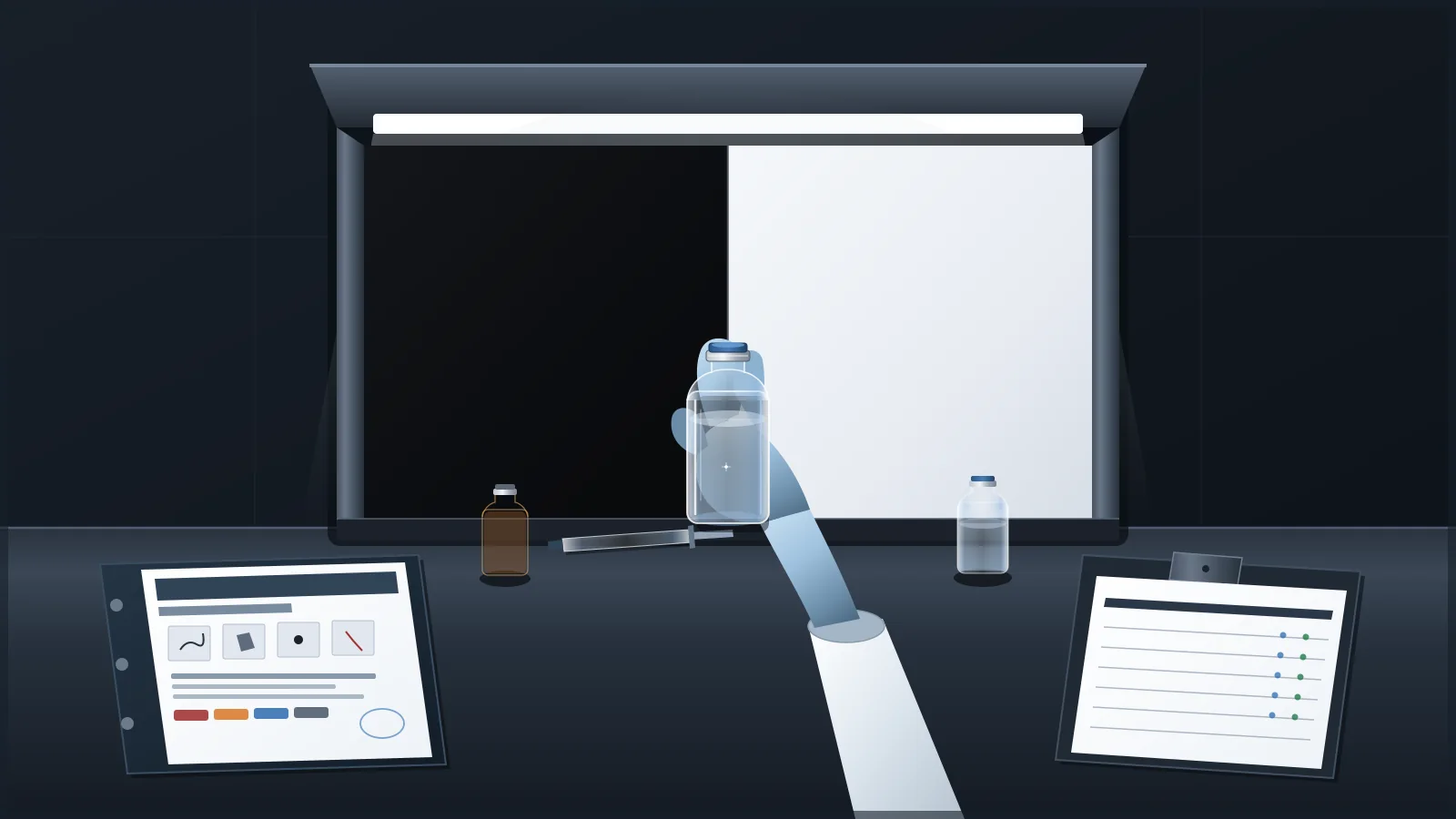
Time per unit. Both the ECA guide and the Q&A describe routine inspection as about 5 seconds against a white background and 5 seconds against a black background. The container is gently swirled or rotated to lift particles without forming air bubbles.
Kit size and time limits. The ECA guide sizes the qualification kit to the number of units an inspector handles between eye breaks. The Q&A recommends time limits during qualification: if inspectors normally work in, for example, 30-minute periods, the qualification should run within the same time frame. Unlimited time during qualification produces a result that routine inspection will not reproduce.
Difficult-to-inspect products. For lyophilized powders, suspensions and products that are not fully clear after resuspension, the Q&A accepts extended inspection time if it stays controlled and defined. The extension should rest on a risk-based assessment of detectability, validation of the inspection time during qualification, and monitoring of reject rates, complaints and trends. The ECA guide treats amber, coloured, opaque or plastic containers and small fill volumes as potentially difficult to inspect, and Mahler et al. note that very turbid, viscous or very low-volume syringe products may need an adapted compendial method. For lyophilized product, the ECA guide points out that particles can be seen only on the cake during 100% inspection, so reconstituted samples are examined separately.
Artifact 3 — The Periodic Qualification Record: Requalification, Fatigue, and Traceability
A qualification result describes one person on one date with one kit. Eyesight, attention and technique drift over time, and products and defect libraries change. The record therefore has to be periodic, and specific enough that a reviewer can reconstruct what was tested.
Annex 1 clause 8.31 is direct. Operators performing manual inspection "should undergo visual inspection qualification (whilst wearing corrective lenses, if these are normally worn) at least annually." Qualification should use appropriate samples from the manufacturer's defect library sets, take worst-case scenarios into account, and "include consideration of eyesight checks." Operator distractions should be minimized, and "frequent breaks, of an appropriate duration, should be taken from inspection." Annex 1 does not set a specific break interval.
The ECA guide supplies good-practice numbers. Industry practice is 20–60 minutes of continuous inspection. The current good-practice goal is 30 minutes followed by a break of at least five minutes, with a total maximum of no more than four hours, and "all maximum uninterrupted inspection activity should be qualified." Routine requalification should take place at least every 12 months. After a second significant inspection failure, the operator should repeat an eye test, retrain with the training kit and requalify. The guide also recommends regular eye tests that include colour vision. For an auditor, the practical check is whether area or batch records show the actual inspection periods and breaks, so the routine regime can be compared with the one that was qualified.
For the qualification event itself, the ECA guide describes this pattern:
Sequenced training. Initial qualification follows training with training kits, then side-by-side work with an experienced operator who inspects the same units in parallel. The qualification kit then focuses on critical and major defects with a limited number of minor defects. Qualification is specific to each dosage form, such as a syringe, vial or ampoule.
Predefined acceptance criteria. In initial qualification, all critical defects and a predefined level of major defects should be found. A limit for false rejects (good units rejected) should also be set in advance; the guide gives 5–10% as an example. Good units matter: an inspector who finds every defect by rejecting a large share of good containers has not demonstrated a usable capability.
Traceable documentation. A record that can answer a Fresenius-type question identifies the kit and its logbook status, the defect types and sizes it contains, the inspection conditions and time limit, the inspector and date, detection results by defect category, the false-reject count, eyesight-check status and the next requalification date. In the Fresenius letter, FDA treated records that "lacked sufficient detail to determine the qualifications of staff" as part of the CGMP violation.
Not every question is settled. Asked how many qualification runs are needed, one answer in ECA Academy's 2026 Q&A says that after standardized training a single qualification run is sufficient. That is a view on the number of runs per qualification event; it does not replace Annex 1's annual requalification. The same compilation recommends requalifying on the defined qualification kit rather than on a "worst-case product." The kit should be designed to represent worst-case detectability (smallest or lowest-contrast particles, borderline defects) so performance can be trended. It calls end-of-shift requalification a realistic approach, while noting that the regulation does not explicitly require it. The ECA guide goes further: it doubts that end-of-shift fatigue can be meaningfully simulated in an examination and suggests handling the question through quality risk management. Sponsors do not need to settle these debates, but they should see the CDMO's documented position on each one.
The US Regulatory Spine: 21 CFR 211.100(a), the 2021 Draft Guidance, and Why USP <790> Alone Is Not Enough
21 CFR 211.100(a) requires written procedures for production and process control designed to assure that drug products have the identity, strength, quality and purity they purport or are represented to possess. Those procedures, and any changes to them, must be drafted, reviewed and approved by the appropriate organizational units, and reviewed and approved by the quality control unit. Section 211.100(b) requires the procedures to be followed and documented at the time of performance, with any deviation recorded and justified. The regulation does not mention visual inspection by name; the Fresenius letter shows FDA applying it to an inspector-qualification program.
FDA's Compliance Program 7356.002A for sterile drug process inspections (revised September 2015) tells investigators what to examine. For 100% inspection of injectable products for cracks, visible particles and other significant defects, investigators are to verify written procedures that define the defects to be removed and the action to take if critical defects exceed a pre-determined level. They also check that defect categories and action levels are established and justified, observe the inspection process, and evaluate personnel qualification and requalification, including the use of reference samples. For manual inspection, they determine whether employees are trained and qualified to recognize and remove defects "under actual or simulated production conditions." Among examples of practices that CDER believes could warrant regulatory or administrative action, the program lists inadequate training of staff who perform 100% inspection and failure to perform adequate 100% inspections. It also notes that physical samples found to comply "are not a barrier to pursuing action under CGMP charges."
That last point answers a common defense. Some programs point to compendial conformance under USP <790>, Visible Particulates in Injections, as proof of inspection performance. The compendial chapter matters (FDA asked Fresenius to incorporate it into procedures), but it is a subscription text, and its current parameters should be checked in the official USP–NF before anyone quotes them.
FDA's December 2021 draft guidance, Inspection of Injectable Products for Visible Particulates (docket FDA-2021-D-0241), sets out a holistic, risk-based approach. It covers product development, manufacturing controls, visual inspection techniques, particulate identification, investigation and corrective action. It also states that "meeting an applicable United States Pharmacopeia (USP) compendial standard alone is not generally sufficient for meeting the current good manufacturing practice (CGMP) requirements for the manufacture of injectable products." FDA's guidance page still lists the document as a draft, "not for implementation" and containing non-binding recommendations. Cite it as FDA's proposed position, not a final requirement.
In practice, this means a passing compendial sample does not show that the 100% inspection before it was performed by qualified people under qualified conditions. The CGMP question is about the system, and the compendial result is only one output of that system.
The draft guidance also limits its own scope. It does not cover:
Subvisible particulates. These are addressed by separate compendial tests and fall outside this article.
Container integrity flaws. This exclusion holds even though visible cracks are among the defects removed during 100% inspection. The ECA guide likewise places container closure integrity outside its scope.
Fill volume and the appearance of lyophilized cake or suspension solids. Products are typically inspected for these alongside visible particles, but they are excluded from the guidance.
Visual inspection sits inside a broader sterile-manufacturing control framework. For how Annex 1's contamination control strategy relates to FDA's aseptic processing guidance, see Annex 1 CCS, FDA's packaging CCS and the 2004 aseptic guidance. When particulate complaints or returns raise disposition questions, the qualification records described here become part of the evidence; see returned drug lots under CGMP.
Questions to Put to a CDMO — or to Your Own Line
Whether you are auditing a CDMO or reviewing your own line, these ten questions map to the three artifacts and to the records that answer them. None of them asks for a detection rate; each asks for evidence.
| Topic | Question | Record that answers it | Red flag |
|---|---|---|---|
| 1. Defect library | Is there a product- and container-specific defect library, with actual images or drawings, that captures all known defect classes and is used for training? | Approved defect library and change history; training-kit contents | Generic platform library with no documented bracketing justification; no route for adding new defects from production |
| 2. Defect categories | How is each particle type and container defect categorized, on what risk rationale, and which AQL applies to each category? | Defect categorization procedure with rationale; AQL sampling plan | Categories without a patient-risk rationale; acceptance limits not tied to categories |
| 3. Kit particle range | Which particle types and sizes does the qualification kit contain, and how were they justified against the particles this product and container can plausibly contain? | Kit specification, kit logbook and periodic kit checks | No justification of particle sizes; nothing near the lower range of visibility, including the 100–150 µm range FDA cited in 2026 |
| 4. Routine conditions | Was qualification run at routine illumination, background and time per unit, within a time limit that matches routine inspection periods? | Qualification protocol with measured illumination and timing controls | Unlimited inspection time during qualification; illumination not verified |
| 5. Breaks and fatigue | What are the maximum uninterrupted inspection time, the break regime and the daily maximum, and were they qualified? | Inspection SOP; records of actual inspection periods and breaks | No defined maximum; a break regime in the SOP that cannot be traced in records |
| 6. Kit design | Are defect units invisibly coded and mixed with good units, and is a false-reject limit set in advance? | Qualification worksheets; predefined acceptance criteria | Readable unit numbers; no good units; no false-reject criterion |
| 7. Requalification | How often are inspectors requalified, and what triggers earlier requalification, such as repeated failure or a product or kit change? | Training and qualification matrix with dates and due dates | No requalification within 12 months; inspectors with lapsed status on executed batches |
| 8. Eyesight | How are eyesight checks, including colour vision, documented, and is qualification performed with corrective lenses if normally worn? | Eyesight-check records linked to each qualification | No eyesight check; lens status not recorded |
| 9. Difficult products | For powders, suspensions, amber or low-fill presentations, how was any extended inspection time justified and validated? | Risk assessment; inspection-time validation; reject-rate and complaint trending | Standard timing applied without assessment, or open-ended time without control |
| 10. Trending and claims | Are defect types and reject levels trended, how are adverse trends investigated, and does any document claim a fixed detection rate? | Batch reject trending (Annex 1 clause 8.33); investigation records | Claims of a universal detection rate or zero-defect output; no trending of reject levels |
A credible supplier will describe detection as probabilistic and show data broken down by defect category, kit and conditions. A claim that inspection removes 100% of defects, or one detection percentage applied across products, is a reason to look harder at the three artifacts. Annex 1 clause 8.30 makes the same point from the other direction: a critical defect found during later sampling of accepted containers should trigger an investigation, because it indicates a possible failure of the original inspection.
What a Visual Inspection Pass Does Not Prove
Read narrowly, a documented pass shows two things: the batch was 100% inspected by qualified personnel or equipment under controlled conditions against a defined defect set, and any post-inspection sampling met its predefined acceptance criteria. It does not show:
Sterility. Visual inspection cannot detect microbial contamination or endotoxin. Sterility assurance rests on the aseptic or terminal sterilization process and its controls.
Subvisible particulate conformance. Subvisible particles are outside the draft guidance's scope and require separate compendial testing.
Container closure integrity. Inspectors remove visible cracks and gross closure defects, but integrity assurance is a separate program, outside the scope of both the FDA draft guidance and the ECA guide.
Fill volume or lyophilized cake quality. Many programs inspect for both alongside particles, but they are excluded from the guidance's visible-particulate scope and need their own controls.
A zero-defect batch. Because detection is probabilistic, accepted units may still include defects at low frequency. For that reason, the ECA guide notes that sampling plans with a zero limit for non-critical defects are not practical as an assessment tool.
Keep the source hierarchy straight. 21 CFR 211.100 is a binding US CGMP regulation, and the Fresenius letter shows FDA applying it to inspector qualification. FDA's 2021 guidance remains a draft, and CP 7356.002A is an inspection program written for FDA staff. EU GMP Annex 1 sets expectations for manufacturers operating under EU GMP; do not merge its clauses with US requirements. The ECA guide and Q&A are industry good practice and commentary. None of these sources needs to converge before a sponsor asks for the three artifacts.
Sources
Fresenius Medical Care AG & Co. KGaA - MARCS-CMS 730319 - August 25, 2026 (Warning Letter 320-26-119) — US Food and Drug Administration. Cites an inadequate visual inspection program under 21 CFR 211.100(a): inspectors not appropriately qualified, a kit without adequately representative particulates (e.g., size), and insufficiently detailed qualification records; states kits should typically contain particles of 100–150 microns.
Inspection of Injectable Products for Visible Particulates — Draft Guidance for Industry (December 2021) — US Food and Drug Administration (CDER, CBER, CVM). Draft, non-binding guidance describing a holistic, risk-based approach; states that meeting a USP compendial standard alone is not generally sufficient for CGMP; excludes subvisible particulates, container integrity flaws, fill volume and lyophilized cake appearance.
21 CFR 211.100 — Written procedures; deviations — Electronic Code of Federal Regulations. US CGMP regulation requiring written, quality-unit-approved production and process control procedures that are followed and documented at the time of performance.
Compliance Program 7356.002A — Sterile Drug Process Inspections — US Food and Drug Administration (revised September 2015). Inspection program directing investigators to evaluate 100% inspection procedures, defect categories, action levels, and personnel qualification and requalification.
EU GMP Annex 1: Manufacture of Sterile Medicinal Products (2022) — European Commission, EudraLex Volume 4. Clauses 8.30–8.33 on defect libraries, risk-based classification, at least annual inspector qualification, eyesight checks, breaks and trending.
Science-Based Risk Assessment for the Categorization of Visual Inspection Defects of Sterile Dosage Forms (Pharmaceutics 2025, 17(9):1121) — Mahler et al., peer-reviewed open-access article. Covers probabilistic detection factors, defect categories and AQL ranges, product-specific defect libraries, and BioPhorum survey data on inconsistent particle classification (13 manufacturers).
Visual Inspection of Medicinal Products for Parenteral Use — Good Practice Guide, Version 5 (October 2025) — ECA Foundation industry good practice guide (not a regulation). Covers illumination, inspection time, qualification and training kits, false-reject criteria, requalification and break regimes.
Questions & Answers on Manual Visual Inspection (MVI) — GMP News, June 3, 2026 — ECA Academy conference Q&A (interpretive commentary). Covers qualification-kit design for worst-case detectability, time limits during qualification, requalification timing, and inspection time for difficult-to-inspect products.