Two clocks, two claims: what each hold time asserts
A dirty equipment hold limit needs evidence that residue aged for the proposed delay can still be removed to the acceptance criteria by the routine cleaning procedure. A clean equipment hold limit needs evidence that the cleaned state remains acceptable during the proposed storage period under defined protection. A bulk-product hold study establishes neither claim. The practical decision is to match each proposed equipment delay to the conditions actually challenged in the validation file, rather than infer support from a passing cleaning report or a product-stability result.
Consider a hypothetical Friday production shift that wants to leave a soiled vessel until Monday. Planning also asks QA to extend a cleaned tank’s use-by interval from 7 to 14 days. The file contains a 30-day bulk-granule study and a successful cleaning-validation report, but neither report challenged delayed cleaning or extended clean storage. Those illustrative durations are scheduling requests, not recommended limits. On the information given, the reports do not support either extension. The next task is to identify the missing equipment evidence and review the proposed change through the site’s quality system.
What the US and EU texts say
The cited texts provide no universal numerical dirty or clean hold limit. Their roles also differ: 21 CFR 211.67 is a US regulation for finished pharmaceuticals; EU GMP Annex 15 provides qualification and validation guidance in the EU framework; the FDA Q&A contains nonbinding recommendations; and the 1993 FDA inspection guide is nonbinding reference material for investigators. They support a shared evidence question without becoming one worldwide rule.
EU GMP Annex 15, clause 10.8, addresses both the manufacture-to-cleaning interval and the cleaning-to-use interval when defining the two holds. Clause 10.9 links campaign cleaning validation to maximum campaign length in time and/or number of batches. These provisions support separate assessment of the intervals; they do not demand two standalone reports or prescribe the same experimental design for every site.
21 CFR 211.67, requires cleaning and maintenance at appropriate intervals, with sanitization and/or sterilization as appropriate for the drug. Its written-procedure requirements include schedules, protection of clean equipment before use, and inspection for cleanliness immediately before use. Paragraph (c) requires records of maintenance, cleaning, sanitizing and inspection as specified in the referenced recordkeeping sections. The regulation does not itself name dirty or clean hold-time validation.
FDA Equipment Q&A, Question 8, says validation should represent routine use. Extra pre-cleaning or an artificially easy production challenge cannot establish routine effectiveness. It also recommends sampling equipment stored uncleaned longer than the validated interval to demonstrate cleaning effectiveness. Importantly, Q8 answers that firms need not quantify the total chemical residue present before cleaning. Sampling to demonstrate effective cleaning is a different question from measuring the initial dirty residue load.
The same Q&A explains that surfaces cleaned by validated procedures generally need not undergo analytical examination after every cleaning, with manual cleaning a possible exception. FDA recommends a residue-monitoring program with methods and frequency determined by risk assessment. That distinction matters: checking compliance with a time limit, inspecting immediately before use, and analytically testing every cleaned surface are different controls.
FDA’s July 1993 cleaning-validation inspection guide, identifies time between processing and each cleaning step as an important documentation issue because residue drying affects cleaning efficiency. Although its stated scope is chemical residues, it also discusses preventing microbial proliferation during cleaning and storage, drying equipment before storage, and avoiding stagnant water. It does not validate a particular sanitization or sterilization cycle.
The 1993 guide also describes a visibly-clean approach without validation for cleaning strictly between batches of the same product. Keep that dated statement within its limited context. FDA Q&A Q6 addresses adequate residue removal at changeovers and/or between campaigns, depending on materials and surfaces, while Annex 15 addresses product-contact equipment. The historical allowance is not a blanket exemption from assessing campaign conditions, microbial risks or clean storage.
Annex 15’s glossary distinguishes reproducible cleaning performance established through validation from chemical verification after a batch or campaign. A satisfactory verification result can inform the disposition of that event; it does not automatically establish a longer routine hold window. Conversely, it is too broad to say verification can never form part of a validation strategy: clause 10.3 recognizes verification during completion of validation for some products, subject to sufficient supporting data.
Dirty hold time: proving aged residue still cleans
The study question concerns the condition of the residue when cleaning begins. A successful wash immediately after production may say little about a wash delayed across a shutdown. The FDA inspection guide specifically highlights topicals, suspensions and bulk-drug operations when discussing the effect of drying. Avoid assuming a particular failure mechanism, however: the site must establish which changes are relevant to its product, equipment and storage conditions.
Design the challenge around routine use
A useful protocol links the proposed maximum delay to the routine manufacturing scale, residue, equipment configuration, cleaning procedure and acceptance criteria. Where operating variables affect cleaning, the worst credible conditions within the intended operating range need consideration. A challenge should represent the planned delay, including the time before any relevant cleaning step, rather than an idealized laboratory wait on a conveniently accessible surface.
Routine gross-soil removal must be described and represented consistently. FDA’s warning against pre-cleaning concerns making a validation challenge easier than routine production. It is not a general prohibition on manual scraping or rinsing when those are approved, routinely performed steps of the process being evaluated. If a study used an extra intervention that routine operators will not perform, its apparent success does not support the intended procedure.
The main evidence of cleanability is the result after cleaning following the defined dirty hold. The protocol should explain the residue targets, sampling locations, recovery and method sensitivity needed to judge that result. FDA Q&A Q12 cautions that rinse samples alone are insufficient for cleaning-validation residue determinations and calls for direct surface measurement where feasible. The sampling plan should fit the equipment; neither every conceivable test nor an unsupported rinse-only shortcut supplies a sound rationale.
Microbial and endotoxin risks also need consideration when relevant to the process. That does not establish a universal growth timeline or require identical microbiological tests for every dirty hold. A dry oral-solid residue and a moist process residue are different challenges; the risk assessment should explain the distinction rather than import an assumed number of hours for biofilm formation.
A failed challenge is evidence that the proposed combination of residue age and cleaning procedure has not met its criteria. Investigate the cause and revise the supported operating window or procedure as appropriate. Additional washing may be necessary to recover equipment, but repeated washing and testing until a result passes must not be presented as successful validation. Annex 15, clause 10.2 expressly rejects that approach.
Clean hold time: proving stored equipment stays acceptable
The clean-hold question begins with a demonstrated acceptable cleaned state. It asks whether that state remains acceptable under the defined storage and handling conditions until reuse. Previous-product and cleaning-agent residues still have to meet their criteria at the start; successful cleaning does not mean absolute absence of every molecule. FDA Q&A Q7 describes a documented safe residue limit without product-quality concerns or visible residues, rather than the lowest concentration any instrument could detect.
Describe protection as part of the claim
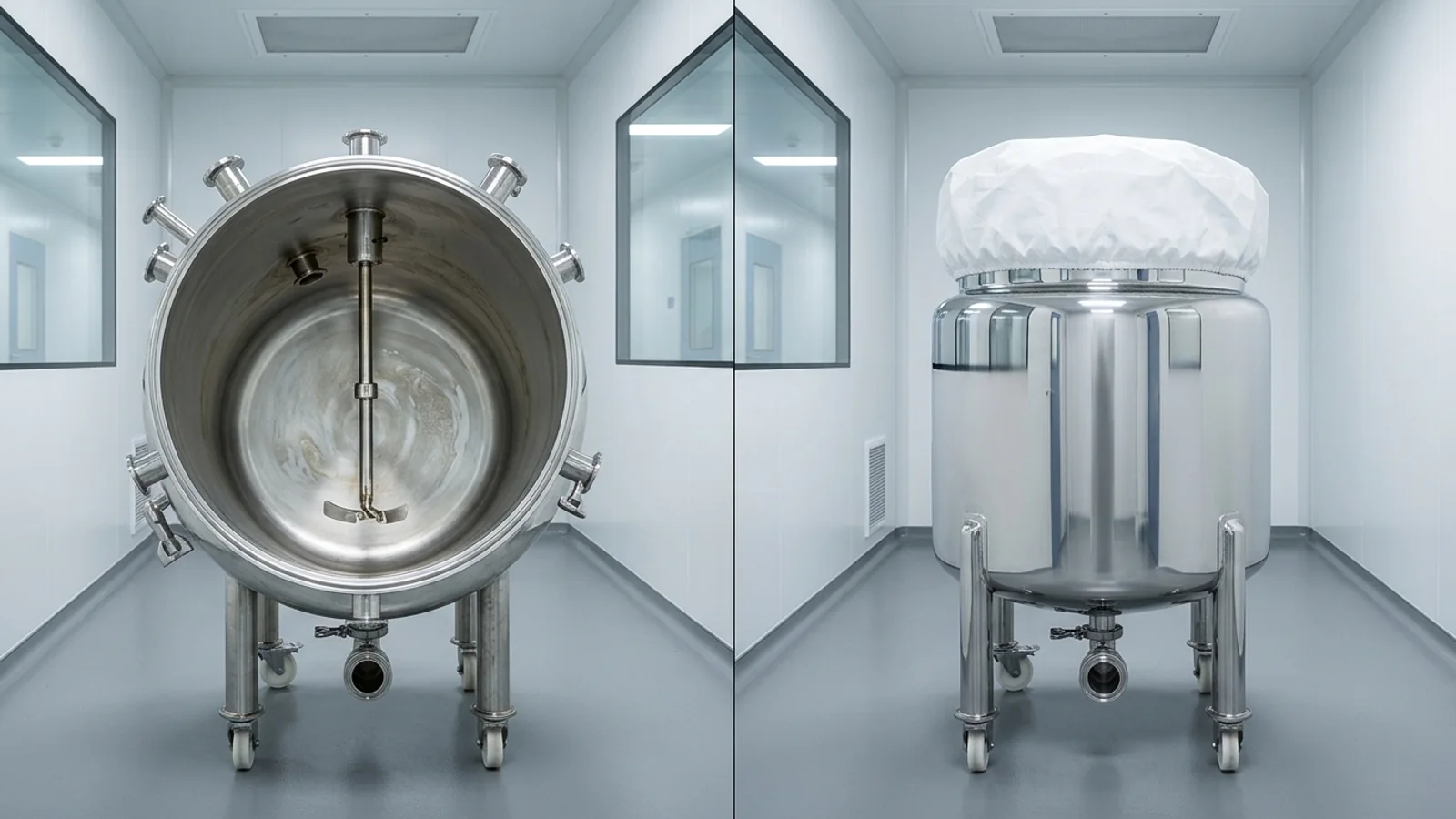
A statement such as “clean for fourteen days” is incomplete without the equipment configuration and storage conditions. Describe drying and drainage, how openings are protected, where equipment is stored, and what handling or movement occurs. The FDA inspection guide’s dry-storage discussion and the protection requirement in 21 CFR 211.67(b)(5) explain why those conditions matter. Neither text prescribes a particular cover brand, gas supply, filter size or room classification for every vessel.
For the evidence review, distinguish a protected condition from a visual impression. A vessel that looks closed may have other openings or handling exposures. A study of one covered arrangement does not, by itself, establish a claim for another arrangement. The article’s comparison of the two states is conceptual; it is not an engineering specification for sealing equipment.
Connect end-of-hold measurements to the hazards
A clean-hold protocol should connect the proposed duration and storage conditions to a defined assessment at the end of that period. Visual inspection is relevant, and US CGMP separately requires cleanliness inspection immediately before use. Microbial or endotoxin testing should follow the applicable risk assessment and justified methods. Annex 15 clause 10.7 calls for considering those risks; it does not prescribe one assay, limit or sampling schedule for all products.
The evidence should show what was checked, which surfaces or locations the samples represent, and why the acceptance criteria address the identified storage risk. A result without its conditions can be misleading: an acceptable count on readily accessible external metal does not necessarily address the product-contact location that drove the study. Equally, a storage study is not a substitute for evidence supporting cleaning at the beginning of storage.
This distinction also marks the scope boundary for sterile processing. Chemical cleaning, sanitization, sterilization and maintenance of a sterile state are different claims. The sources cited here support the equipment-cleaning comparison here, not a complete sterile-equipment storage or release program. No multi-year storage observation from non-sterile equipment establishes a sterile hold limit.
The evidence comparison: pre-cleaning residue versus post-cleaning storage
The following matrix is an evidence-review framework synthesized from the cited texts. It distinguishes the questions a protocol must answer; it is not a regulator-issued template or a universal sampling recipe. A combined protocol may address both equipment holds, provided its evidence and conclusions remain separable.
| Evidence dimension | Dirty equipment hold | Clean equipment hold | Bulk-product hold boundary |
|---|---|---|---|
| Clock | End of manufacture to beginning of cleaning, with relevant intervening steps defined. | Completion of cleaning to next use, with drying and handling accounted for. | A defined intermediate or bulk-material storage stage. |
| Claim | Aged residue still cleans to the criteria under the routine procedure. | The cleaned state remains acceptable under specified protection and storage. | Material quality remains acceptable under its specified holding conditions. |
| Main risk question | Does the delay change cleanability or other relevant contamination risks? | Can storage, moisture or handling compromise the cleaned state? | Does holding affect the material’s relevant quality attributes? |
| Study condition | Representative manufacture and residue, proposed delay, then routine cleaning. | Acceptably cleaned equipment stored in the defined configuration for the proposed duration. | Representative material, container and storage conditions. |
| Evidence timing | Cleaning outcome after the dirty-hold challenge; not merely initial dirty residue quantity. | Assessment at the end of clean storage, with pre-use inspection separately addressed. | Material testing at justified time points. |
| Sampling rationale | Residues and locations selected to assess cleaning effectiveness; direct surface sampling where feasible. | Locations and tests justified by the storage and contamination risks. | Samples of the held material answer the material question. |
| Acceptance basis | Scientifically justified product and cleaning-agent residue criteria; visual cleanliness. | Defined acceptable cleaned state, including microbial or endotoxin criteria where justified. | Predefined material-quality criteria, not equipment surface criteria. |
| What a pass supports | The challenged delay and cleaning conditions within the justified scope. | The challenged storage interval and protection conditions within the justified scope. | The tested material hold within its justified scope. |
| What a pass cannot supply | The clean-storage window after washing. | The delay permitted before washing. | Either equipment hold-time claim. |
| Exceedance question | What evidence demonstrates cleaning effectiveness beyond the established delay? | What approved, supported action restores or demonstrates an acceptable state before reuse? | A material disposition decision does not resolve an equipment hold exceedance. |
When reviewing a report against this matrix, read the actual execution records. A title mentioning “cleaning validation” is insufficient if the report never records the relevant elapsed time. Likewise, a claimed maximum hold cannot be inferred from a shorter observed delay without a documented scientific justification. The useful output is a traceable conclusion linking each proposed interval to the tested conditions and the limits of the inference.
Why a bulk hold-time study supports neither equipment claim
WHO TRS 992, Annex 4, primarily addresses hold studies during non-sterile solid-dosage manufacture and notes that many principles also apply to other dosage forms. It explicitly excludes cleaning-validation holds, API manufacture and biologicals. That scope boundary is why a satisfactory material hold result is not equipment-cleaning evidence.
A bulk-granule study asks whether material remains acceptable while held in its defined container and environment. It does not challenge aged residue followed by a wash, or cleaned equipment followed by empty storage. The same physical vessel could appear in both studies while the measured claim remains different. The container’s presence in a product report does not transform that report into a validation of its dirty or clean interval.
For the opening scenario, keep the 30-day material study as evidence for its own material stage. Review the cleaning report for an actual dirty-hold challenge and the storage records for an actual clean-hold challenge. If those conditions were not studied or otherwise scientifically justified, extending an equipment label would exceed the supplied evidence. A material hold study also should not be described as establishing the finished product’s shelf life.
The adjacent article on tablet bulk hold-time studies addresses the material-side decision. Its purpose differs from choosing how long soiled equipment may wait for cleaning or how long cleaned equipment may wait for reuse.
Campaigns, grouping and revalidation triggers
Campaign length and the delay after a campaign are separate dimensions of the challenge. Annex 15 clause 10.9 identifies maximum campaign length in time and/or number of batches as the basis for cleaning validation. It does not invariably require both limits to be imposed. A site should explain which dimensions control its campaign and how the cleaning evidence represents the intended maximum, including any relevant delay after its end.
A single-batch challenge therefore cannot automatically support a longer campaign merely because the same detergent and vessel are used. The reviewer should ask whether campaign conditions change the residue burden or cleanability represented by the original study. Conversely, an appropriate justification may support a representative challenge; the rule is not that every possible combination must be tested independently.
Equipment grouping also needs a rationale. Annex 15 clause 10.1 addresses selection within similar equipment groups, while clause 10.5 addresses variable factors and worst cases. FDA Q&A Q11 cautions against transferring cleaning performance merely because equipment shares a construction material. Design, conditions of use and the substances involved also matter. A common stainless-steel surface is not enough to establish equivalence.
Apply the same reasoning separately to storage. An equipment group justified for cleanability may not represent the same storage exposure, cover configuration or handling pattern. A defensible matrix identifies why the selected member addresses the relevant hold question, and where the conclusion stops. This is a proposed review method, not a fixed hierarchy of vessel sizes or room grades.
The practical change-control question is whether a proposed change leaves the original challenge representative. Examples include a new product residue, revised cleaning steps, a longer campaign, altered drying, a different cover or a new storage location. Under Annex 15’s change-control framework, assess potential effects on validated status and the supporting work needed. A change merits assessment; it does not automatically require repeating every study.
For a manufacturing or CDMO planning discussion, request the supported operating envelope rather than only the longest printed limit. Record which product or group, cleaning procedure, campaign basis and storage configuration it covers. That makes a weekend shutdown or scheduling extension a concrete evidence question and helps distinguish an operational preference from a demonstrated capability.
What the published pilot-plant data establish
Richard J. Forsyth’s 2008 Pharmaceutical Technology report describes a non-sterile oral-solid pilot plant. Dirty holds ranged from 2 to 217 hours, approximately nine days; 231 swabs were assessed against the facility’s 100 micrograms-per-swab limit. Clean holds extended to two years and five months after cleaning, alcohol treatment, drying and covering; 180 swabs averaged 1.1 CFU per swab against a 100 CFU-per-swab limit. These are reported study conditions and criteria, not recommended defaults.
The report argued that routine hold-time monitoring could be unnecessary once conditions were validated and controlled. That is a facility-specific counter-position, not regulatory permission. Its durations cannot be transferred to another site or a sterile process. The useful lesson is the separation of the two studies. It does not establish that a short material hold or an immediate-cleaning result can stand in for either equipment challenge.
When a hold time is exceeded
An exceedance means the actual event has gone beyond the established interval. It does not, by itself, prove contamination, and it does not establish permission to use the equipment. The following questions are a decision framework for the site’s approved quality procedures; the cited texts do not supply one universal disposition sequence.
Establish the actual interval and conditions. Identify the applicable equipment, procedure, campaign, storage configuration and any loss of protection. An inaccurate clock or incomplete handling history can change which evidence is relevant.
For delayed cleaning, address FDA Q8’s expectation for sampling to demonstrate effectiveness when uncleaned storage exceeds the validated time. Determine the cleaning and verification plan through the quality system; do not reinterpret Q8 as an instruction merely to quantify dirty residue before washing.
For expired clean storage, evaluate the condition against the supported storage envelope before reuse. Recleaning, or another specifically validated restoration step where applicable, may be the approved response. The cited sources do not state that recleaning is the sole permissible response in every case, nor that a single satisfactory swab automatically authorizes use.
Keep remediation and validation conclusions separate. If additional cleaning is needed, document and assess it. Do not discard failures or repeat cleaning and retesting until passing results are treated as proof of the original claim.
Complete the supported disposition and required pre-use cleanliness inspection before use. Decide whether the event reveals a recurring scheduling problem or a need to revise the validated operating envelope.
FDA Q8’s risk-based residue-monitoring recommendation is compatible with avoiding unnecessary analytical testing after every validated wash. It does not erase the delayed-cleaning sampling expectation, written cleaning procedures, protection during storage or pre-use inspection. Evaluate the 2008 no-monitoring argument against those specific expectations. Equipment history should let a reviewer check the actual interval and whether conditions remained within the validated envelope.
A useful final review record states the proposed dirty interval, the proposed clean interval, the evidence supporting each, and the conditions limiting both conclusions. For the Friday-delay and extended-storage scenario, neither the bulk report nor an unchallenged cleaning summary supplies the missing bridge. Support the requested intervals with appropriate equipment evidence, or retain an operating window that the existing evidence actually covers.
Sources
EudraLex Volume 4, EU Guidelines for GMP, Annex 15: Qualification and Validation — European Commission, Annex 15, effective October 2015. Cleaning-validation provisions, glossary and change control; EU framework.
21 CFR 211.67: Equipment Cleaning and Maintenance — US equipment-cleaning regulation, including protection before use, immediate pre-use inspection and records.
FDA Questions and Answers on Current Good Manufacturing Practice Requirements — Equipment — Nonbinding FDA recommendations, especially Questions 7, 8, 11 and 12 on residue limits, routine conditions, delayed cleaning and sampling.
FDA Guide to Inspections: Validation of Cleaning Processes (7/93) — July 1993 investigator reference material; chemical-residue cleaning scope, processing-to-cleaning intervals and dry storage.
WHO Technical Report Series No. 992, Annex 4: General Guidance on Hold-Time Studies — WHO guidance on material hold studies; cited here for its scope exclusion of cleaning-validation holds.
Forsyth, R.J., Equipment Hold-Time for Cleaning Validation (Pharmaceutical Technology, April 2008) — Richard J. Forsyth, Pharmaceutical Technology, April 2008. Original facility-specific pilot-plant report, not regulatory guidance.