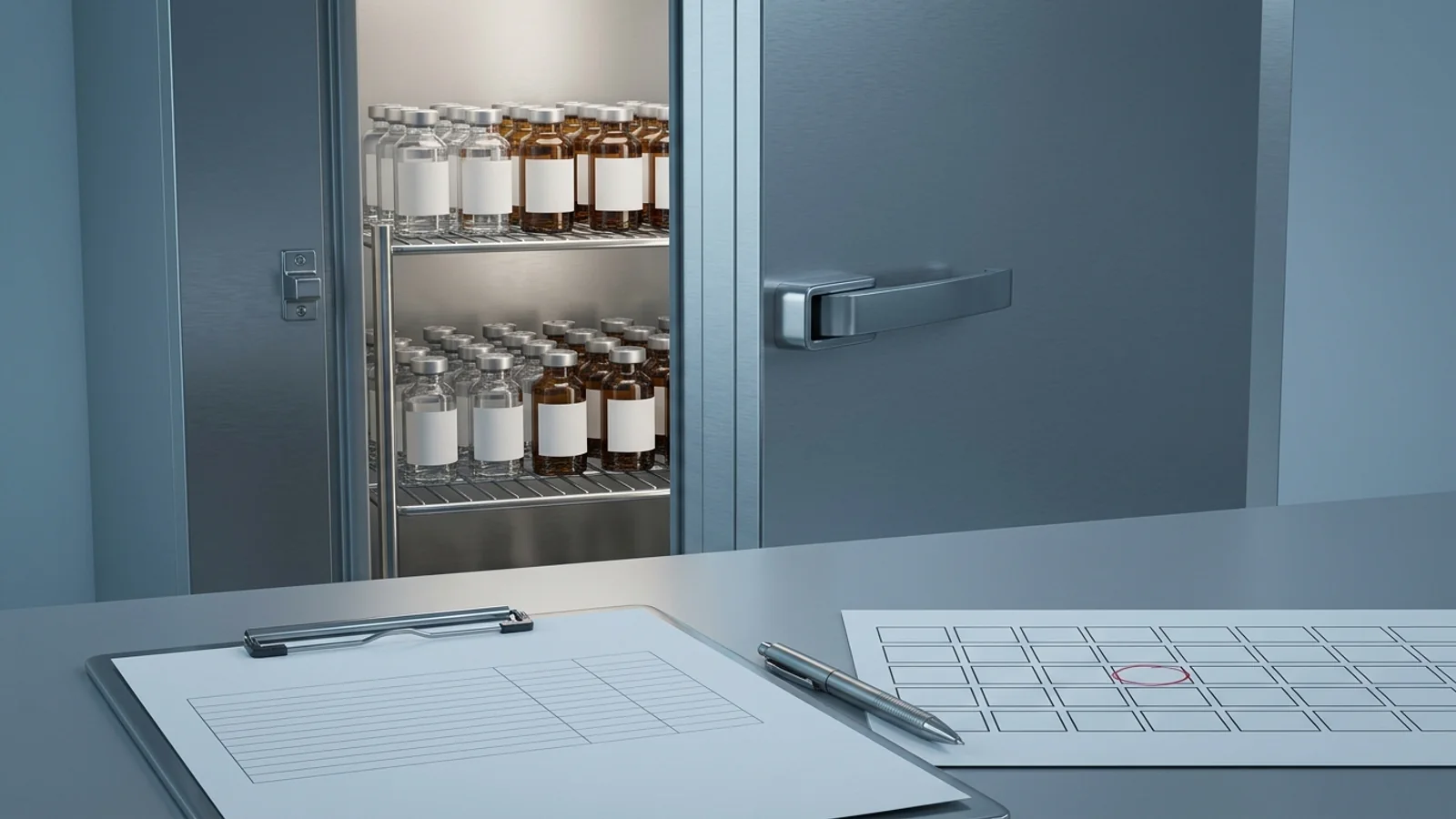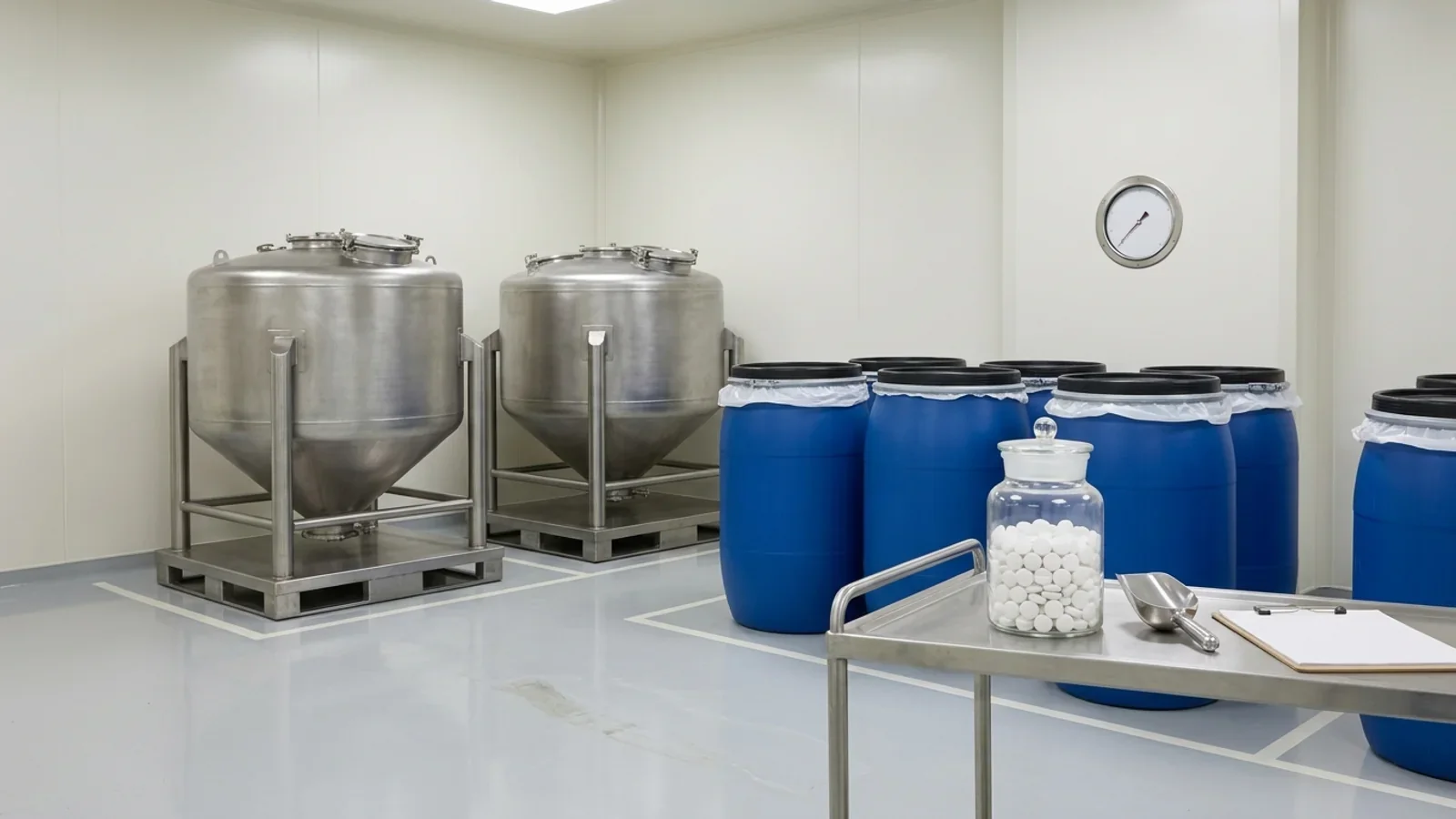
A tablet batch can wait between manufacturing stages only as long as the manufacturer's own data support. When granulation finishes on a Friday, a lubricated blend sits in intermediate bulk containers waiting for a rotary press, or compressed tablet cores wait in polyethylene-lined drums for pan coating or blister packaging, quality and manufacturing teams face a concrete operational question: which holding stages require a prospective study, in what container and environmental conditions, sampled on what schedule, and declared how in regulatory filings?
In the United States, 21 CFR 211.111 sets a performance standard: when appropriate, time limits for the completion of each phase of production shall be established to assure the quality of the drug product, and a deviation from those limits may be acceptable only if it does not compromise quality and is justified and documented. The regulation sets no day counts. FDA's CGMP Questions and Answers on Production and Process Controls (page content current as of May 5, 2026) describes production time limits as one control against the growth of objectionable microorganisms, with the example of a firm that holds a bulk topical or liquid product for several months before filling and might establish a holding-time limit to help prevent microbial buildup.
For non-sterile oral solid dosage forms, the most detailed regulator-published study design is the World Health Organization's Technical Report Series No. 992, Annex 4: General guidance on hold-time studies (2015). The annex lists the holding stages to consider from binder preparation through bulk coated tablets awaiting final packaging, sets container-equivalence and worst-case headspace expectations, and gives example study times and tests: initial, 2, 5 and 8 hours for binders; up to 72 hours for dispersions and coating suspensions; the 15th, 30th and 45th day for granules and blends; and the 30th through 90th day for bulk cores and coated tablets. It excludes cleaning-validation hold times and the manufacture of active pharmaceutical ingredients (APIs) and biologicals. In the European Union, the EMA Guideline on manufacture of the finished dosage form (Revision 1, EMA/CHMP/QWP/245074/2015) and EMA Quality of medicines questions and answers: Part 2 expect the maximum bulk storage interval to be declared in the marketing-authorisation dossier, and treat bulk storage beyond 30 days for solid oral dosage forms as prolonged storage that needs supporting evidence, including data from at least two pilot-scale batches.
Those sources—21 CFR 211.111 with FDA's CGMP Q&A, WHO TRS 992 Annex 4, EMA's finished-dosage-form framework, and the ICH Q1 consolidated stability Step 2 draft guidance (April 2025)—point the same way. Yet a search for tablet hold-time rules still surfaces an uncited May 2024 SOP template that fixes house limits (starch binder within 5 hours, other binders within 8, sized and lubricated granules no more than 45 days, compressed tablets coated within 90 days, coating solution within 72 hours) without citing a regulatory document or linking each limit to study data, and a practitioner forum thread where the question gets peer opinions rather than a decision path. A house number with no study behind it is what FDA has cited: a hold limit assigned without a study is unsupported, and routine end-product release testing does not cure it.
Where a hold time applies: the tablet stages that wait
Before drafting a protocol or selecting pull intervals, a site has to separate two terms that are easy to conflate: an intermediate and a bulk product. Under WHO TRS 992, Annex 4, an intermediate is partly processed product that must undergo further manufacturing steps before it becomes a bulk product, and a bulk product is any product that has completed all processing stages up to, but not including, final packaging. In a tablet plant, intermediates include binder solutions, wet granulations awaiting drying, dried granules awaiting lubrication and lubricated blends awaiting compression (EMA's guideline names granulates and uncoated tablets as examples). Bulk product is most often uncoated tablet cores destined for direct packaging, or film- or sugar-coated tablets staged in drums before blister sealing or bottle filling.
The annex's scope should carry into any site validation plan unchanged. WHO TRS 992 Annex 4 addresses the design of hold-time studies in the manufacture of non-sterile solid dosage forms and says many of its principles also apply to liquids, creams and ointments. It does not cover hold times in cleaning validation, or the manufacture of APIs or biologicals. Applying a solid-dosage bulk hold table to a drug substance synthesis step or a sterile biological fill-finish line misstates that scope.
flowchart TD
    S1["1. Binder Preparation"] -->|"Hold 1: Liquid Binder / Starch Paste (Hours)"| S2["2. Wet Granulation"]
    S2 -->|"Hold 2: Wet Mass Before Drying (If Not Immediate)"| S3["3. Drying & Sizing"]
    S3 -->|"Hold 3: Dried / Sized Granules in Drums or IBCs (Days)"| S4["4. Lubrication & Final Blending"]
    S4 -->|"Hold 4: Lubricated Blend Ready for Press (Days)"| S5["5. Tablet Compression"]
    S6["6. Coating Solution / Suspension Prep"] -->|"Hold 6: Prepared Coating Dispersion (Hours)"| S7["7. Tablet Coating"]
    S5 -->|"Hold 5: Bulk Uncoated Tablet Cores (Days)"| S7
S7 -->|"Hold 7: Bulk Coated Tablets Awaiting Packaging (Days)"| S8["8. Primary & Secondary Packaging"]Section 4 of WHO TRS 992, Annex 4 suggests reviewing the manufacturing procedure with a flow chart and, as an example for coated oral tablets, lists the stages that may be considered. Grouped by the material that actually waits, they are:
Binder preparation to granulation: Aqueous or starch-based granulating fluids prepared ahead of high-shear or fluid-bed wet granulation. Aqueous binders usually carry no preservative and starch pastes change consistency as they stand, which is why WHO's example study times for binders run in hours rather than days.
Wet granulation to drying: Usually a continuous or near-immediate transfer from high-shear bowl to fluid-bed dryer; if equipment scheduling creates a staging pause, wet mass hydrolysis, solvent evaporation, or microbial multiplication must be controlled and bounded.
Dried granules to lubrication and blending: Dried, milled granules held in lined drums or intermediate bulk containers (IBCs) before extragranular excipients and lubricants are added. Moisture uptake or loss during staging directly alters compressibility and downstream dissolution.
Lubricated blend to compression: Final blend containing magnesium stearate or another lubricant, staged before rotary tableting. Vibration during handling, headspace humidity or extended storage can cause segregation and changes in flow or compressibility.
Compression to coating (uncoated tablet cores): Compressed cores held in bulk containers awaiting film or sugar coating, or awaiting direct packaging if the product is an uncoated tablet. Cores are exposed to mechanical abrasion, moisture relaxation (post-compression hardness changes), and oxidative or photolytic stress.
Coating solution or suspension preparation to application: Aqueous or organic polymer dispersions, plasticizers, and pigments mixed in preparation tanks prior to pan spraying. Settling of opacifiers (such as titanium dioxide or iron oxides), viscosity drift, and microbial growth govern the allowable hold window.
Coating to packing (bulk coated tablets): Finished tablets that have completed all processing steps except primary packaging, held in bulk drums or totes either in the manufacturing plant or shipped to a contract packager.
Packing of bulk into finished packed form: The cumulative interval on the packaging line while bulk hoppers and intermediate feeders empty into blisters or bottles.
A site does not have to invent artificial holds at stages that run continuously without interruption—for example, if wet granulation discharges directly into a fluid-bed dryer within minutes by closed gravity transfer, no multi-day wet-mass hold study is needed. However, every stage where batch scheduling, analytical in-process release, campaign batching, or off-site contract packaging allows material to sit in quarantine or staging requires an established, data-backed maximum holding period.
What each regulator requires, and what they do not
US CGMP regulations, WHO technical guidance, EU marketing-authorisation expectations and a draft ICH text are easy to blur into one mandate. Each sits on a different legal tier and answers a different slice of the hold-time problem.
| Source & Document ID | Jurisdiction & Legal Status | Product Scope & Exclusions | Numeric Thresholds Stated | Core Evidentiary Requirement |
|---|---|---|---|---|
| 21 CFR 211.111 (Time limitations on production) | United States; binding federal CGMP regulation | Finished pharmaceuticals subject to 21 CFR Part 211 | None (performance-based standard) | Establish time limits for each production phase when appropriate to assure quality; justify and document any deviation without compromising quality |
| FDA CGMP Q&A: Production and Process Controls (current as of 05/05/2026) | United States; agency CGMP interpretation / operational guidance | Drug products under Part 211; worked example cites bulk topical or liquid held before filling | None; gives the example of a bulk topical or liquid held for several months before filling, for which a firm might set a holding-time limit | Treats 211.111 time limits as a process control to prevent growth of objectionable microorganisms during in-process holds |
| WHO TRS 992, Annex 4 (2015) | International (WHO ECSPP); non-binding guidance for manufacturers and GMP inspectors | Non-sterile solid dosage forms (principles extend to liquids, creams, ointments); explicitly excludes cleaning validation, APIs, and biologicals | Illustrative study times in Table A4.1 (2–8 h binders; 12–72 h dispersions; 15/30/45 d granules/blends; 30/45/60/90 d cores/coated tablets) | Written protocol; production or equivalent container; worst-case headspace; quarantine-stage conditions; stability-indicating tests; criteria tighter than registered specs; baseline comparison |
| EMA Guideline on Manufacture of the Finished Dosage Form (Rev. 1, EMA/CHMP/QWP/245074/2015) & EMA Quality Q&A Part 2 | European Union; marketing-authorisation dossier expectation (hold-time validation itself is treated as a GMP matter) | Finished dosage forms; bulk-storage Q&A highlights solid oral dosage forms (especially tablet cores and granulates) | Prolonged storage: more than 30 days for solid oral dosage forms, more than 24 hours for sterile products | Where relevant, state and justify the maximum bulk hold (or maximum batch manufacturing time to final packaging) with data; for prolonged storage, show container, storage-interval and transport suitability, with data from at least two pilot-scale batches |
| ICH Q1 Stability Testing (Step 2 Draft Guidance, April 2025) | ICH / FDA draft guidance; Step 2 draft ONLY—not final and not an operative requirement | Drug substance and drug product intermediates awaiting further processing or packaging | Proposed prolonged holding thresholds: >30 days for solid dosage forms for the entire manufacturing process; >24 hours for non-solid or sterile products | Proposes a written holding-time protocol, data covering the proposed holds at relevant temperature and humidity, and, for prolonged holds, suitability evidence (representative container, storage period, transport) in the submission when requested |
Three distinctions in this regulatory matrix govern how quality and regulatory affairs teams write their SOPs and dossier sections:
1. Performance standard versus dossier disclosure threshold: Under 21 CFR 211.111, US law does not grant a "free 30-day window" in which tablet granules or cores can sit without data. Whether a plant holds lubricated blend for 7 days or bulk coated tablets for 60 days, US CGMP expects the quality system to hold data showing the wait does not degrade quality. The EU's 30-day mark, by contrast, is a dossier threshold. The EMA finished-dosage-form guideline says hold-time validation for stored intermediates is a GMP matter that normally need not be presented routinely in a marketing-authorisation application. Where relevant, though, the maximum holding time of the bulk product (or the maximum batch manufacturing time to completion of primary packaging) should be stated, justified and supported by data. Beyond 30 days for solid oral dosage forms, storage counts as prolonged, and EMA Quality Q&A Part 2 expects evidence that the container, storage interval or transport arrangements are suitable, with data from at least two pilot-scale batches stored under conditions that represent bulk storage. The Q&A says its aim is transparency of the supporting data, not new regulatory requirements, so the 30-day mark is a disclosure trigger rather than a ban.
2. Per-stage bulk storage versus cumulative manufacturing time: Teams compiling global Module 3 files should watch a wording difference between EU guidance and the ICH Q1 consolidated stability Step 2 draft (April 2025). The EMA guideline lets an applicant state either the maximum holding time of the bulk product or the maximum batch manufacturing time from start of product manufacture to completion of packaging into the final primary container. The ICH draft gives, as an example of prolonged holding, more than 30 days for solid dosage forms for the entire manufacturing process (or more than 24 hours for non-solid or sterile products), and proposes that evidence of the suitability of the holding times, a container representative of the marketing one, and the storage period or transportation arrangements be included in the regulatory submission when requested. The draft also says cumulative hold times are generally assessed in process validation, with a cumulative holding-time study if a stability risk is identified. Because ICH Q1 remains a Step 2 draft, its wording and thresholds could change before Step 4 adoption, and it should not be cited in SOPs or regulatory responses as a final requirement.
3. Illustrative guidance versus unsourced house limits: The May 2024 SOP template on m-pharmainfo.com that ranks for these queries sets fixed limits: starch binder used within 5 hours and other binders within 8, sized and lubricated granules stored no more than 45 days, compressed tablets coated within 90 days, coating solution used within 72 hours. Those figures coincide with the last time points in WHO TRS 992, Annex 4, Table A4.1 (5 and 8 hours for binders, the 45th day for granules and blends, the 90th day for cores, 72 hours for dispersions), but the template presents them as permitted storage limits without citing WHO or tying each limit to study data. WHO frames the same numbers differently: the annex is not intended to prescribe a process for establishing hold times, and Table A4.1 lists examples of stages, study times and tests that may be considered based on risk assessment and specific product needs. A Pharmaguideline forum thread shows the questions practitioners bring to the problem, such as whether a multi-product plant can study only its worst-case tablet products and on how many batches. Replies range from studying each product to bracketing by strength, and one quotes the WHO annex's batch-number language.
Designing the study: container, conditions, headspace, and sampling
A prospective hold-time study only supports commercial production if the storage of the test samples reproduces, or represents the worst case of, the actual plant-floor hold. WHO TRS 992, Annex 4, EMA's bulk-storage Q&A and recent FDA enforcement point to six design and sampling controls that decide whether a study survives inspection.
| Design Parameter | WHO TRS 992 Annex 4 & EU Expectation | Worst-Case Operational Rule | Common Audit Failure Mode |
|---|---|---|---|
| Container & Closure Equivalence | Use the same pack as production; if that pack is exceptionally large, an equivalent of the same material and closure system may be used, and any size reduction must be justified (WHO). EU dossiers describe the bulk container composition and control specification in Module 3.2.P.3.4 | If production uses double LDPE liners twist-tied with desiccant between liners inside an HDPE drum, the simulated pack should match the liner resin, thickness, tie method and desiccant ratio, with any container-size reduction justified | Storing hold-time samples in laboratory glass amber jars with screw caps or heat-sealed aluminum foil pouches that are far less permeable than production drum liners |
| Headspace-to-Contents Ratio | Where headspace matters (WHO's example is oxidation risk), the ratio of headspace to contents in the test container should be at least as great as the maximum possible in routine production, including part-filled containers | Model the end-of-batch partially filled drum or IBC tote (for example, a 25%-full tail drum) rather than a 90%-full drum, and account for repeated opening when pulling samples | Filling small sample bags to capacity with zero air pocket, masking oxidative degradation or moisture exchange seen in half-empty plant drums |
| Environmental Storage Conditions | Store samples under the same environmental conditions as the quarantine area or manufacturing stage (WHO). EMA's Q&A asks applicants to state controlled or non-controlled storage and says bulk stability studies should reflect real storage conditions in the standard container, not ICH chamber conditions | Stage study containers in the actual work-in-progress (WIP) quarantine bay or an environmental chamber set to the upper temperature and humidity limits of the WIP staging room | Placing hold-time samples in a tightly controlled 25°C / 60% RH ICH stability chamber while plant bulk drums sit in an unconditioned warehouse corridor up to 30°C |
| Sample Sizing & Pull Mechanics | Calculate total sample quantity in advance from batch size, number of scheduled intervals, and analytical/microbiological test weights; compare each pull against the initial baseline control sample | Use separate dedicated simulated containers per time point or calculate pull volumes so removing samples does not violate the target headspace-to-bulk ratio for remaining time points | Running out of sample before the 60- or 90-day pull, or failing to test a true T=0 baseline control from the same batch |
| Sample Pooling & Stratification | Pool samples only where a composite cannot hide an issue that individual samples would reveal | Never pool top, middle, and bottom pulls when testing lubricated blend uniformity or checking for surface moisture crusting at the top of a drum | Homogenizing or shaking a small sample bag in the lab before blend-uniformity testing, erasing evidence of in-bin segregation |
| Number of Batches | WHO: typically one or more batches, with the number set by risk. EMA: data from at least two pilot-scale batches to support bulk storage, verified on commercial-scale batches after approval if not provided in the dossier | Use one representative commercial or pilot batch for short, low-risk in-process holds; expand to two or more batches when claiming EU bulk storage beyond 30 days or when an initial batch shows borderline drift | Claiming a 90-day bulk tablet hold in an EU dossier based on a single lab-scale batch without container-closure or transport data |
Why container-closure evaluation draws so much attention is clear from FDA's October 10, 2025 warning letter to PQ Pharmacy, LLC (WL 715795). PQ Pharmacy is a sterile 503B outsourcing facility, a different regulatory and technical setting from non-sterile tablet manufacturing, so the lesson transfers by principle rather than detail. Reviewing the firm's response to the inspection findings, FDA said that measures such as media fill runs were insufficient on their own: a hold-time study remained necessary to evaluate the container closures of the bulk holding material, test the bulk material held before further processing, and assess risks of sterility loss, contamination, product degradation, adsorption or absorption. FDA also wanted hold-time studies to cover any additional step used to extend the bulk hold beyond its initial period.
For oral solid dosage plants, that container principle means a simulated hold pack cannot outperform the production container. When compressed cores or dried granules sit in polyethylene-lined fiber drums on the plant floor, moisture vapor can pass through the polyethylene film and the tied neck of the liner. If the QC laboratory stores its hold-time samples in heat-sealed aluminum-foil laminate bags or glass bottles with lined caps, the study container acts as a near-hermetic barrier that can mask moisture gain, hardness loss and hydrolytic impurity growth. WHO TRS 992, Annex 4 requires any reduction in container size to be justified; that justification is credible when the contact material, liner thickness, closure, desiccant configuration (if used) and worst-case headspace ratio stay equivalent to full-scale production.
What to test, when: the stage-by-stage matrix
Once the holding stages and container simulation are fixed, the protocol pairs each stage with stability-indicating tests and scheduled pull intervals. Table A4.1 of WHO TRS 992, Annex 4 gives examples of stages, study times and tests for a coated tablet. The table below sets out those examples stage by stage, with the failure modes each test is meant to catch; the failure-mode column is our analysis, not WHO text.
| Tablet Manufacturing Stage | WHO Table A4.1 Example Study Times | WHO Example Tests (as per specification) | What the Tests Watch For (our analysis) |
|---|---|---|---|
| Binder preparation | Initial, 2, 5, 8 hours (starch: initial, 2, 5 hours) | Microbial test, appearance, viscosity (if applicable) | Microbial growth in aqueous solutions; starch paste thickening or gelling that changes granulation behaviour |
| Dispersions (granulation pastes, coating solutions and suspensions) | Initial, 12, 24, 36, 48, 60, 72 hours | Physical appearance, specific gravity, viscosity, sedimentation, pH, microbial test | Pigment and opacifier settling, polymer flocculation, viscosity drift that affects spraying, microbial growth |
| Granules (dried and sized, before lubrication) | Initial, 15th, 30th, 45th day | Description, assay, related substances, loss on drying, water content, particle size distribution, bulk density, tap density, angle of repose | Moisture gain or loss changing granule behaviour, caking or agglomeration in lower drum layers, hydrolytic or oxidative impurity growth |
| Blend (lubricated, ready for compression) | Initial, 15th, 30th, 45th day | Microbial test, loss on drying, blend uniformity, particle size, bulk/tapped density | Segregation during staging or transfer, moisture change affecting flow and compressibility |
| Core tablets, uncoated (in bulk container) | Initial, 30th, 45th, 60th, 90th day | Description, hardness, thickness, friability, disintegration, dissolution or dissolution profile, assay, degradation products/related substances, uniformity of dosage units, microbial test | Post-compression relaxation or moisture uptake lowering hardness and raising friability (edge chipping in coating pans); hardening that slows dissolution |
| Coated tablets (in bulk container) | Initial, 30th, 45th, 60th, 90th day | Description, appearance or visual examination, hardness, thickness, friability, disintegration, dissolution or dissolution profile, assay, degradation products/related substances, moisture content, microbial test | Film-coat tackiness or twinning under drum weight, colour fade or mottling, moisture equilibration across the coat slowing dissolution, chemical or microbial drift |
Four points in WHO TRS 992, Annex 4 govern how analytical and quality teams evaluate the numbers generated across these intervals:
Acceptance criteria tighter than registered specifications: WHO notes that hold-time acceptance criteria are typically more stringent than registered specifications, so the material stays well within control, and that known stability trends need to be taken into account. A hypothetical example: if a tablet's registered shelf-life limit for a hydrolytic impurity is 0.50% and its dissolution specification is Q = 80% at 30 minutes, letting bulk uncoated cores reach 0.45% impurity or 81% dissolution during a 60-day drum hold leaves almost no margin for coating, packaging and 24 to 36 months of commercial shelf life.
Validated stability-indicating methods: WHO says all testing of bulk intermediates and product should use validated stability-indicating methods, which for assay and related substances means procedures that resolve process impurities from time- and humidity-driven degradation products.
Microbiological testing where relevant: WHO says microbiological aspects should be considered and included where appropriate, and FDA's CGMP Q&A on Production and Process Controls frames 211.111 time limits as one control against objectionable microorganisms. Dry granules and compressed tablets have low water activity, but aqueous binders, coating suspensions and humid staging areas can still support microbial growth, which is why WHO's example panels include a microbial test at the binder, dispersion, blend, core and coated-tablet stages. If the protocol drops an attribute at maximum hold, record the scientific rationale; FDA's Cosmax letter asked for exactly that for any attribute not tested at maximum hold time.
Comparison to baseline (T=0) and statistical trend evaluation: Passing the specification at the final pull is necessary but not sufficient. WHO says results should be compared with the initial baseline data on the control sample and that, where appropriate, statistical analysis should be used to identify trends and justify the limits and hold time set. A hypothetical example: if tablet hardness falls from 120 N at T=0 to 95 N at Day 30, 82 N at Day 60 and 72 N at Day 90 against a 65 N minimum, the steady downward slope argues for a shorter declared maximum (for example, 30 or 45 days) rather than claiming 90 days.
Setting the limit and starting the shelf-life clock
When a quality unit signs off on a completed hold-time report, two numbers must be reconciled: the declared maximum holding period for each stage and the finished-product shelf-life start date. Getting either rule wrong creates immediate compliance exposure during pre-approval inspections or dossier review.
First, WHO TRS 992, Annex 4 says the chosen maximum holding period should be supported by relevant data, and that studies may extend beyond it but it is not necessary to extend testing to determine the extreme limits at which failure occurs. Manufacturers do not need to run edge-of-failure experiments until granules cake or tablets fail dissolution. A site may study 45 days for a lubricated blend or 90 days for bulk coated tablets, confirm flat trends against tightened acceptance criteria, and adopt either the full studied interval or a shorter operational limit (for instance, a 30-day administrative limit backed by 45-day data) that leaves room for scheduling delays.
Second, holding a batch between stages has consequences for the finished product's shelf-life clock, and WHO and EMA frame the start of shelf life differently:
WHO rule (shelf life runs from mixing): Under WHO TRS 992, Annex 4, the shelf life of the product, irrespective of hold times, should be measured from the time the active ingredients are mixed with other ingredients. If API and intragranular excipients are blended and granulated on January 2, held as dried granules for 20 days, compressed and coated by February 1, and held as bulk coated tablets for 40 days before blister packaging on March 13, the shelf life is still measured from January 2.
EU rule (start-of-shelf-life note, or full-hold stability batches): Both EMA Quality of medicines questions and answers: Part 2 and the EMA Guideline on manufacture of the finished dosage form (Rev. 1) say the product's shelf life should be calculated according to the separate Note for Guidance on the start of shelf-life of the finished dosage form. If an applicant proposes another approach, it must be declared and justified by including batches that represent the full proposed holding interval of the bulk product in the finished-product stability programme. The longer the claimed bulk hold, the more important it is to settle the shelf-life calculation before the hold limit goes into the dossier.
Third, WHO Annex 4 links in-process hold performance to the commercial stability programme. Hold times are normally determined before a product is marketed and confirmed during process validation at commercial scale. If finished batches are made from held intermediates or bulk that showed adverse trending or shifting patterns at the intermediate time points, WHO says those batches should be considered for long-term stability testing. FDA made the same link in its Cosmax letter, asking the firm to state whether batches tested in its hold-time studies would also be placed on long-term stability. Once a batch is in the finished-product stability programme, later scheduling lapses or analytical drift fall under commercial stability controls; see our companion analyses on documenting a missed stability pull and its follow-up plan and how stability out-of-trend signals can derail launch supply.
When the wait goes wrong: exceeding the maximum
Even in a well-scheduled tablet plant, packaging line breakdowns, foil-stock shortages, or laboratory OOS investigations occasionally trap a batch of granules, blend, or bulk tablets past its validated hold time. How a quality unit handles that moment separates compliant CGMP deviation management from warning-letter citations.
WHO TRS 992, Annex 4 says that, normally, intermediate and bulk products should not be stored beyond the established hold time, and the ICH Q1 Step 2 draft (April 2025) states that intermediates should not be used beyond established holding times. US CGMP leaves a narrow opening: under 21 CFR 211.111, a deviation from an established production time limit may be acceptable only if it does not compromise the quality of the drug product, and the deviation must be justified and documented.
Two FDA warning letters show what investigators cite when manufacturers treat hold limits as elastic administrative targets or lean on end-product release testing. Neither involved a non-sterile tablet line: one addressed a manufacturer of over-the-counter topical sunscreen products and the other a sterile 503B outsourcing facility, so their lessons transfer to solid oral dosage operations by principle, not detail:
Cosmax USA, Inc. (WL 606909, October 15, 2020): In Warning Letter 606909 to Cosmax USA, FDA cited 21 CFR 211.111 after finding that the firm lacked bulk hold-time studies for multiple drug products that may be held at the in-process stage for up to six months before final fill. The firm had assigned a maximum bulk hold time without an approved study, procedure or protocol, and had exceeded that maximum without an appropriate investigation. Its response argued that released product faced no risk because routine quality control testing had been performed. FDA called the response inadequate: it did not explain how the firm would establish production time limits, nor address the impact of missing bulk hold data on product stability. FDA asked for a revised procedure defining the time limits and the studies behind them, listing all attributes to be tested at maximum hold time and the rationale for any attribute not tested.
PQ Pharmacy, LLC (WL 715795, October 10, 2025): In Warning Letter 715795 to PQ Pharmacy, a sterile 503B outsourcing facility whose hold durations are redacted in the published letter, FDA found the firm's corrective actions on hold time deficient. Media fill runs and similar measures were insufficient on their own; a hold-time study remained necessary to evaluate the bulk container closures, test the held bulk before further processing, and assess sterility, contamination, degradation, adsorption and absorption risks. FDA framed the gap as a failure to establish adequate written production and process control procedures, including hold-time studies covering the impact of an additional processing step used to extend the bulk hold beyond its initial period. The step itself is redacted; the transferable principle is that anything done to extend a hold needs its own hold-time data.
Translated to an oral solid dosage plant, these letters suggest what an inspection-ready excursion package under 21 CFR 211.111 and the investigation requirement in 21 CFR 211.192 should contain before a batch held past its limit moves to the next unit operation:
Immediate quarantine and formal deviation initiation: Lock the batch in physical or ERP quarantine before compression, coating, or packaging can proceed. Never process first and investigate after finished-product release testing.
Root-cause and environmental log verification: Document why the limit was breached and pull continuous temperature and relative-humidity records for the staging bay plus container-closure integrity records for every drum or IBC in the batch across the entire elapsed hold.
Pre-processing testing of the held material against the full hold-time panel: Sample the aged granules, blend, or bulk tablets before further processing and test every stage-relevant attribute from the hold-time protocol (such as stratified blend uniformity, LOD/water content, related substances, hardness, friability, dissolution, and microbial count)—not merely routine finished-pack release tests.
Comparison to existing study data and stability follow-up: Check whether prospective study data already extend beyond the operational limit (for example, a 30-day administrative limit breached at Day 35 when the study passed through Day 45). If the excursion goes beyond the studied period, evaluate whether proceeding is permissible under the marketing authorisation (in the EU, the declared maximum hold is part of the dossier), and consider placing the resulting finished batch on long-term stability, as WHO recommends when held material shows adverse trending.
This excursion path covers unreleased in-process material that has stayed under the manufacturer's control. Finished product that has been distributed and then comes back is a different decision, handled under the returned-drug provisions of US CGMP; see our guide on returned drug lots and when to reprocess or destroy under 21 CFR 211.204.
Changes that reopen the hold-time question
A prospective hold-time study is not a one-time pre-launch artifact. WHO TRS 992, Annex 4 says the risk assessment of changes in processes, equipment, storage conditions, or starting or packaging materials should include an assessment of whether further hold-time studies should be performed. The ICH Q1 Step 2 draft (April 2025) similarly says the risk assessment and control strategy for drug product manufacturing should include an assessment of whether holding-time studies should be performed.
In commercial operations, five lifecycle events commonly undercut an earlier hold-time justification unless bridged by a documented risk assessment or a new study:
Bulk container or liner material changes: Switching intermediate storage from rigid stainless-steel IBC totes to polyethylene-lined fiber drums, changing LDPE liner resin or film thickness, eliminating inter-liner silica gel desiccant bags, or increasing drum volume (which alters the headspace-to-bulk ratio in partial drums) invalidates moisture-protection assumptions.
Site transfers and CDMO onboarding: Moving compression, coating or primary packaging to a second facility or a contract development and manufacturing organization (CDMO) adds transport vibration, transit temperature and humidity excursions, and longer staging queues. The EMA finished-dosage-form guideline (Rev. 1) points to GMP Annex 15 for bulk transport between sites and expects the impact of excursions outside the original storage conditions to be discussed, and the ICH Q1 Step 2 draft says stability studies should consider transportation when more than one production site is involved. When scoping a transfer, pair hold-time verification with our guide to tech-transfer package gaps before moving a commercial product to a second site and our analysis of why a CDMO arrangement does not transfer CGMP responsibility.
Process or equipment modifications: Changing from fluid-bed drying to tray drying (altering residual moisture distribution), switching blender geometry or shear rate, or changing aqueous film-coating solids loading alters the physical state of the held intermediate.
Starting material or excipient grade shifts: Adding an alternate API source with a different particle size distribution or polymorphic habit, or switching to a different grade of microcrystalline cellulose or starch, can shift blend segregation propensity and hygroscopicity during staging.
Extending the declared bulk hold in global dossiers: Increasing a bulk tablet core hold from 30 days to 60 or 90 days to accommodate global packaging campaigns crosses the EU's 30-day prolonged-storage threshold in EMA Quality Q&A Part 2, and the same change may be classified differently from one region to the next; see global CMC change classification mismatch between FDA, EMA, and non-ICH markets.
When a change control record concludes that a re-study is not required—for example, when replacing a 200-liter stainless-steel bin with an identical 316L stainless-steel bin from a second fabricator with the same silicone gasket specification—the risk assessment must explicitly record the technical equivalence of the contact material, closure seal, headspace ratio, and staging environment rather than checking a generic "no stability impact" box.
A hold-time protocol checklist operators can audit against
To replace uncited SOP templates with an inspection-defensible system, quality and manufacturing teams can audit their existing hold-time protocol and final report templates directly against the protocol elements listed in WHO TRS 992, Annex 4, cross-referenced with 21 CFR 211.111, EMA Quality Q&A Part 2, and the deficiencies cited in the Cosmax USA and PQ Pharmacy warning letters.
| Protocol / Report Section | What WHO TRS 992 Annex 4 & Regulators Expect | Common Gaps (SOP template, Cited Firms, Typical Practice) |
|---|---|---|
| 1. Document Control, Scope & Responsibilities | Title, reference number, version, date, objective, scope (non-sterile solid dosage stages covered; APIs, biologicals and cleaning validation excluded), responsibilities and procedure, with signatures and dates before the study starts | Cosmax assigned a maximum bulk hold time without an approved study, procedure or protocol; the SOP template assigns roles and protocol numbers but cites no regulatory source |
| 2. Stage Map & Batch Selection | Flow chart of every intermediate and bulk hold stage (binder, wet mass, dried granules, lubricated blend, cores, coating dispersion, bulk coated tablets); risk-based batch count (one or more per WHO; at least two pilot-scale batches to support EU prolonged storage) | The SOP template fixes stage limits (45 days for granules, 90 days for cores) and defaults to one batch without linking either to product risk |
| 3. Container-Closure & Headspace Specification | Construction material and closure system of the production pack or justified equivalent; worst-case headspace-to-contents ratio including part-filled drums and IBCs; EU Module 3.2.P.3.4 bulk container composition and control specification | PQ Pharmacy lacked a hold-time study evaluating bulk container closures; the SOP template mentions same-pack storage and worst-case headspace but gives no method for matching liners, closures or part-filled containers |
| 4. Storage Conditions & Transport Controls | Same environmental conditions as the quarantine area or manufacturing stage; controlled or non-controlled storage stated; bulk transport between sites described, with GDP controls | Testing samples in idealized lab chambers that do not reflect plant staging bay temperature and humidity excursions |
| 5. Sampling Plan, Sizing & Pooling Rules | Up-front calculation of sample quantities from batch size, intervals, and tests; defined sampling thief/method and top-middle-bottom locations; prohibition on pooling where compositing could mask segregation or surface moisture | Ad-hoc grab sampling from the top of a drum without pre-calculated sample mass or stratified blend-uniformity pulls |
| 6. Validated Methods & Tightened Acceptance Criteria | Stage-specific physical, chemical and, where relevant, microbiological tests using validated stability-indicating methods; acceptance criteria typically tighter than registered specifications; rationale for any attribute not tested at maximum hold | Cosmax pointed to routine QC testing instead of hold-time data, and FDA asked it to list all attributes tested at maximum hold; the SOP template defers to "testing as per specification" with no stage-by-stage panel |
| 7. Baseline Comparison, Statistics & Shelf-Life Rule | Every time point compared with the baseline control sample; statistical trend evaluation where appropriate; reconciliation with WHO's shelf-life start (mixing of actives with other ingredients) and the EU start-of-shelf-life note | Treating a single pass below the release ceiling at Day 90 as proof of stability while ignoring downward hardness or dissolution trends and expiry-date impacts |
| 8. Excursion Investigation & Change-Control Triggers | Deviation path under 21 CFR 211.111 (justified, documented, no quality impact) with pre-processing testing of the held material; long-term stability considered for lots made from adversely trending material; re-assessment after process, equipment, storage-condition or material changes | Exceeding maximum hold times without investigation (Cosmax) or extending bulk holding via extra steps without hold-time study coverage (PQ Pharmacy) |
When an investigator or dossier assessor asks how long granules, lubricated blends, uncoated tablet cores or bulk coated tablets can wait before the next operation, the defensible answer is never a memorized industry number. It is a closed evidentiary loop: a stage map built on WHO TRS 992, Annex 4, a container and headspace simulation that reflects worst-case plant staging, stability-indicating data measured against tightened acceptance limits to support the time limits 21 CFR 211.111 requires, and, whenever solid oral bulk storage for the European market goes beyond 30 days, suitability evidence with at least two pilot-scale batches of data declared in the marketing-authorisation dossier.
Sources
World Health Organization. WHO Technical Report Series No. 992, Annex 4: General guidance on hold-time studies (2015). Covers non-sterile solid dosage forms (with principles extending to liquids, creams, and ointments) and explicitly excludes cleaning validation, APIs, and biologicals.
Office of the Federal Register (eCFR). 21 CFR 211.111 - Time limitations on production. Binding US CGMP requirement for establishing production phase time limits and justifying/documenting deviations.
U.S. Food and Drug Administration. Questions and Answers on Current Good Manufacturing Practice Regulations: Production and Process Controls (page content current as of May 5, 2026). Interprets 21 CFR 211.111 time limits as a control against objectionable microorganisms during extended bulk holds.
European Medicines Agency. Guideline on manufacture of the finished dosage form - Revision 1 (EMA/CHMP/QWP/245074/2015) (adopted by CHMP July 2017). Sets EU dossier expectations for bulk holding times, defines prolonged storage (more than 30 days for solid oral dosage forms), and expects pilot-batch stability support where relevant.
European Medicines Agency. Quality of medicines questions and answers: Part 2 - Stability issues of pharmaceutical bulk products use in manufacture of the finished product. Covers dossier information on bulk containers (Module 3.2.P.3.4), storage conditions, transport, the prolonged-storage threshold, pilot-batch data and shelf-life calculation.
U.S. Food and Drug Administration / ICH Q1 Expert Working Group. Q1 Stability Testing of Drug Substances and Drug Products (Step 2 draft guidance, April 2025). Draft international stability guideline (not final) proposing intermediate holding-time study requirements and prolonged holding thresholds.
U.S. Food and Drug Administration. Warning Letter: Cosmax USA, Inc. (WL 606909, October 15, 2020). Cites 21 CFR 211.111 for missing bulk hold-time studies on products held up to six months, a maximum hold assigned without a study and exceeded without investigation, and a response that relied on routine QC testing.
U.S. Food and Drug Administration. Warning Letter: PQ Pharmacy, LLC (WL 715795, October 10, 2025). States that measures such as media fill runs are insufficient on their own and that hold-time studies must evaluate bulk container closures, test held bulk before further processing, and cover steps used to extend bulk holding.
m-pharmainfo.com. SOP for Hold Time Study in Pharmaceuticals (May 2024). Example of an SOP template that sets fixed house hold limits without citing a regulatory source.
Pharmaguideline Forum. Forum thread: Hold time study for intermediate bulk tablet products (2018–2021). Practitioner discussion of worst-case product selection, bracketing and batch numbers for tablet hold-time studies.