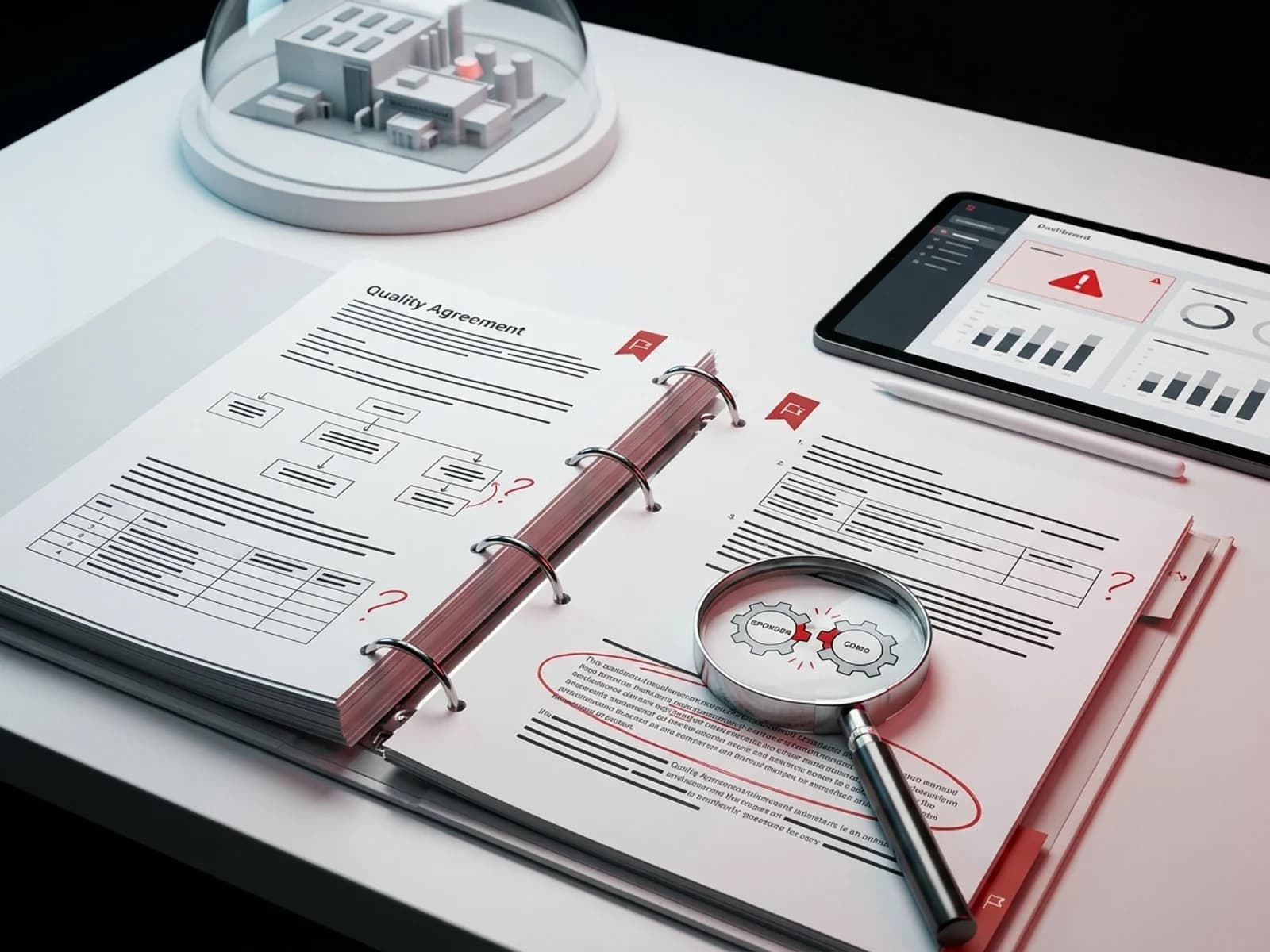
A technology transfer for a commercial drug product is a regulatory event, not just an operational handoff. Under 21 CFR 314.70, moving manufacture of an approved drug product to a new site almost always requires a prior-approval supplement (PAS), and the content of that supplement depends entirely on the quality and completeness of the tech-transfer package shared between the sending unit (SU) and the receiving unit (RU).
A 2025 CDMO Live roundtable revealed that approximately 50% of pharmaceutical tech transfers experience quality problems. The root cause is usually not the receiving site's capability but the sending site's failure to transfer complete, actionable process knowledge. When the transfer package has gaps, the PAS is incomplete, FDA issues information requests, and launch supply from the new site is delayed.
This article is for CMC regulatory leads, quality leads, CDMO oversight managers, and manufacturing science teams responsible for site transfers of commercial products. It identifies the most common tech-transfer package gaps, links each to the specific regulatory requirement it undermines, and provides corrective actions.
Regulatory framework for site transfers
21 CFR 314.70 reporting categories
Under 21 CFR 314.70, post-approval manufacturing site changes are classified by risk:
| Change category | Supplement type | Distribution rule |
|---|---|---|
| Major change | Prior Approval Supplement (PAS) | Cannot distribute until FDA approves |
| Moderate change | Changes Being Effected in 30 Days (CBE-30) | Can distribute 30 days after FDA receipt |
| Minor change | Annual Report | No pre-distribution FDA review |
A complete transfer of drug product manufacturing to a new facility not previously approved in the application requires a PAS because it is considered to have substantial potential to adversely affect identity, strength, quality, purity, or potency. If the new site does not have a satisfactory CGMP inspection for the type of operation being moved, even changes that would normally qualify as CBE-30 must be submitted as a PAS per FDA's guidance Changes to an Approved NDA or ANDA.
FDA's SUPAC guidance framework
FDA's Scale-Up and Post-Approval Changes (SUPAC) guidances define three levels of change based on the extent of the modification and the supporting data required. For a site transfer, the tech-transfer team must determine the SUPAC level to decide which tests and documentation are needed. The WHO 2011 guideline on technology transfer in pharmaceutical manufacturing states explicitly that the RU is not required to have identical capabilities to the SU, but should have similar capabilities operating according to similar principles.
ICH quality guidelines that apply
ICH Q8(R2) on pharmaceutical development, Q9 on quality risk management, and Q10 on pharmaceutical quality systems all provide the scientific basis for demonstrating that a site transfer does not adversely affect product quality. FDA's 2026 CMC guidance further emphasizes the importance of incorporating a Product Lifecycle Management (PLCM) document and preparing Post-Approval Change Management Protocols (PACMPs) for anticipated site changes.
Gap 1: Incomplete process description and critical process parameters
What the transfer package should contain
A complete transfer package must include detailed process descriptions, batch records, critical quality attributes (CQAs), critical process parameters (CPPs), and equipment specifications. Danaher Life Sciences notes that CQAs and CPPs must be defined early, monitored closely, and validated through scale-up studies to ensure consistent product quality at the receiving site.
The common failure
Sending sites frequently provide batch records and standard operating procedures but omit the tacit knowledge that makes those records work in practice. This includes:
Ranges for CPPs that are narrower than what appears in the regulatory filing, because the sending site learned through experience that certain ranges cause deviations
Seasonal or environmental adjustments made informally on the manufacturing floor but never documented
Hold-time data for in-process materials that was generated during development but not included in the commercial-scale documentation
Equipment-specific parameters that are embedded in legacy control systems rather than in written procedures
Regulatory consequence
When the receiving site files its PAS with process parameters that differ from the sending site's actual operating ranges, FDA reviewers identify the discrepancy and issue information requests. The review clock does not stop while the sponsor resolves the gap. For CMC supplements and labeling supplements, the PAS review clock is four months. For efficacy supplements, it is ten months for non-priority and six months for priority review.
Corrective action
Before the transfer begins, conduct a structured knowledge-gap assessment with the sending site's process owners. BioProcess International recommends having translators with science backgrounds available if documents need translation from another language. The tech-transfer team should interview the people who developed the existing process and analytical methods, specifically asking about undocumented adjustments, near-miss events, and informal workarounds.
Gap 2: Analytical method transfer without equivalence criteria
What FDA expects
FDA's guidance on changes to an approved NDA or ANDA requires comparative analytical data as part of a site transfer supplement. The transfer package must include method transfer reports and comparative analytical data demonstrating that the receiving site's test results are equivalent to the sending site's results.
The common failure
Analytical method transfer is often treated as a formality rather than a scientific exercise. The most common failures include:
| Failure | Consequence |
|---|---|
| No predefined acceptance criteria for method transfer | Equivalence cannot be demonstrated to FDA's satisfaction |
| Sending site provides the method but not the method validation history | Receiving site cannot troubleshoot unexpected results |
| High-risk methods not identified | Critical methods (related substances, potency, sterility) receive the same level of transfer effort as non-critical methods |
| Inter-laboratory comparison skipped | No evidence that results are consistent between sites |
Regulatory consequence
BioProcess Online recommends that analytical methods deemed high risk by the regulatory affairs team should first be performed by sending-site personnel with receiving-site supervision, then the exercise flipped, and finally the receiving site performs testing without supervision. Skipping this staged approach means the method transfer report does not contain the evidence FDA needs to assess equivalence.
Corrective action
Classify every analytical method by risk level before transfer. For high-risk methods, execute a three-stage transfer: (1) sending site performs with receiving site observing, (2) receiving site performs with sending site supervising, (3) receiving site performs independently. Define numerical acceptance criteria for each method. Conduct formal inter-laboratory comparisons and document the results in the method transfer report.
Gap 3: Missing equipment qualification and similarity justification
What the guidance requires
The WHO technology transfer guideline states that the RU should have similar capabilities to the SU, but not necessarily identical equipment. However, similarity must be justified. FDA's SUPAC Manufacturing Equipment Addendum provides the framework for determining whether equipment changes require additional validation data.
The common failure
Transferring sites often assume that any equipment capable of performing the same general function is equivalent. The gap appears when:
Equipment has different operating principles (e.g., different mixing shear profiles, different filtration surface-area-to-volume ratios)
Scale differences are not addressed with appropriate bridging studies
Equipment qualification reports (IQ/OQ/PQ) from the receiving site are not included in the supplement
Cleaning validation for shared equipment at the receiving site is not addressed
Regulatory consequence
The IJPS review of post-approval site transfers notes that a complete PAS typically must include equipment qualification reports (IQ/OQ/PQ), cleaning validation reports, environmental monitoring qualification, water system qualification, and HVAC validation summary. Without these, the supplement is administratively incomplete.
Corrective action
Perform a detailed equipment comparison between the sending and receiving sites as part of the gap analysis. For each unit operation, document whether the equipment operates on the same principle, within the same operating range, and at the same scale. Where differences exist, generate bridging data before filing the PAS. Include all IQ/OQ/PQ documentation in the supplement.
Gap 4: Inadequate stability data strategy
What the supplement requires
A site transfer PAS must include stability study protocols and stability data (accelerated and long-term) from the receiving site. FDA expects to see a stability protocol, a commitment to place batches on stability, and any available comparative data.
The common failure
Sponsors often file the PAS with a stability commitment but no actual data from the receiving site. This is technically acceptable if the commitment is well-defined, but it creates a risk: if the first production batches at the receiving site fail stability at any time point, FDA has already approved the supplement and the sponsor faces a potential field alert, recall, or additional supplement.
The accelerated-data shortcut
Some sponsors attempt to file with only three months of accelerated data from the receiving site. This can work for simple dosage forms, but for complex products (sterile, modified-release, biologics), FDA may require longer comparative data before approval.
Corrective action
Before filing the PAS, manufacture at least one engineering or exhibit batch at the receiving site and place it on both accelerated and long-term stability. File the supplement with whatever comparative data is available and a clear commitment protocol. If the product is a biologic or sterile drug, expect FDA to request at least three to six months of data during review.
Gap 5: Quality system and documentation gaps at the receiving site
What FDA inspects
FDA inspectors evaluate whether the receiving site's quality system is adequate to support the transferred product. The inspection focuses on:
Training records showing that receiving-site personnel have been trained on the transferred process and methods
Deviation and CAPA systems that are equipped to handle product-specific issues
Change-control procedures that will capture any post-transfer modifications
Document control systems that maintain the current version of all transferred procedures
The common failure
Outsourced Pharma identifies the "contract-to-execution gap" as a major challenge: companies experience an agility break between signing business and starting work, often requiring a second knowledge transfer. This gap manifests at the receiving site as incomplete training records, generic SOPs that have not been adapted to the transferred product, and quality systems that cannot differentiate between the transferred product and existing products.
Corrective action
Before filing the PAS, conduct a quality-system readiness assessment at the receiving site. Verify that training records are complete, product-specific SOPs are in place, and the quality agreement between the sponsor and the receiving site clearly defines responsibilities for deviation investigation, change control, and batch release.
Gap 6: Regulatory submission lifecycle hygiene
eCTD Module 3 updates
A site transfer generates multiple eCTD sequence updates. Each supplement requires a new sequence number in the eCTD lifecycle. The regional envelope must correctly identify the submission type and sub-type (PAS, CBE-30, or CBE-0). The supplement must update all relevant Module 3 sections, including:
Section 3.2.S (drug substance) if the drug substance manufacturing site is also changing
Section 3.2.P (drug product) for the new manufacturing site, process, equipment, and container closure
Section 3.2.P.8 for stability data and commitments
Section 2.3 and 2.4 for updated quality overall summaries
The common failure
After multiple post-approval supplements, the eCTD lifecycle can become inconsistent. Previous sequences may contain outdated cross-references, orphaned documents, or Module 3 sections that no longer reflect the current approved process. When a site transfer PAS is filed on top of this accumulated technical debt, FDA reviewers struggle to trace the current state of the product.
Corrective action
Before filing the site transfer PAS, audit the entire eCTD lifecycle for the product. Resolve any outstanding information requests from previous supplements. Ensure that the current Module 3 accurately reflects the process as it exists at the sending site before documenting the changes for the receiving site.
Checklist: tech-transfer package completeness
| Element | Included | Gap identified |
|---|---|---|
| Complete process description with CPP ranges | ||
| Batch records (commercial-scale) | ||
| Method validation reports and transfer protocols | ||
| Analytical method risk classification | ||
| Inter-laboratory comparison data | ||
| Equipment comparison and similarity justification | ||
| IQ/OQ/PQ documentation (receiving site) | ||
| Cleaning validation (receiving site) | ||
| Stability protocol and comparative data | ||
| Stability commitment letter | ||
| Quality agreement between sponsor and RU | ||
| Training records for receiving-site personnel | ||
| Product-specific SOPs at receiving site | ||
| Updated eCTD Module 3 sections | ||
| Risk assessment documentation | ||
| Regulatory reporting category justification |
What to monitor
PAS review clock: Track the four-month review clock for CMC PAS submissions. FDA may issue information requests at any point, and the clock does not pause.
CGMP inspection status of the receiving site: If the receiving site does not have a satisfactory CGMP inspection for the type of operation being moved, the reporting category escalates from CBE-30 to PAS.
Stability data from receiving-site batches: Monitor accelerated and long-term data at every time point. An out-of-specification result requires a field alert within three working days.
Post-transfer deviations: The first six months of production at the receiving site are the highest-risk period. Track deviation frequency, investigation quality, and CAPA effectiveness.
Sources
U.S. FDA. Changes to an Approved NDA or ANDA. Guidance for Industry. https://www.fda.gov/files/drugs/published/Changes-to-an-Approved-NDA-or-ANDA.pdf
U.S. FDA. ANDA Submissions — Prior Approval Supplements Under GDUFA. https://www.fda.gov/media/89263/download
21 CFR 314.70. Supplements and Other Changes to an Approved Application. https://www.ecfr.gov/current/title-21/chapter-I/subchapter-D/part-314/subpart-G/section-314.70
21 CFR Parts 210 and 211. Current Good Manufacturing Practice. https://www.ecfr.gov/current/title-21/chapter-I/subchapter-C/part-211
IJPS. Post-Approval Changes in Site Transfer Under the U.S. FDA Regulatory Framework. 2025. https://www.ijpsjournal.com/article/PostApproval+Changes+in+Site+Transfer+Under+the+US+FDA+Regulatory+Framework+A+Comprehensive+Review
Federal Register. Supplements and Other Changes to an Approved Application. 69 FR 17890. https://www.federalregister.gov/documents/2004/04/08/04-7532/supplements-and-other-changes-to-an-approved-application
PMC. Best Practices for the Development, Scale-up, and Post-approval Changes. https://pmc.ncbi.nlm.nih.gov/articles/PMC4037495
PharmaSource. Tech Transfers in Pharma: Definitions and Key Processes in Technology Transfers. 2025. https://pharmasource.global/content/tech-transfer-in-pharma-guide-to-technology-transfers-and-key-processes
BioProcess Online. 9 Common Tech Transfer Pitfalls To Avoid. 2024. https://www.bioprocessonline.com/doc/common-tech-transfer-pitfalls-to-avoid-0001
Outsourced Pharma. Navigating Industry Guidelines for Effective Tech Transfer. 2024. https://www.outsourcedpharma.com/doc/navigating-regulatory-guidelines-for-effective-tech-transfer-0001
Danaher Life Sciences. Understanding Pharma Tech Transfer. 2025. https://lifesciences.danaher.com/us/en/library/pharma-tech-transfer-overview.html
BioProcess International. Keys to Successful Technology Transfer. 2024. https://www.bioprocessintl.com/information-technology/keys-to-successful-technology-transfer
enkrisi. FDA 2026 CMC Guidance: What Sponsors Must Do Differently. January 2026. https://enkrisi.com/2026/01/07/https-www-enkrisi-com-insights-fda-2026-cmc-guidance-regulatory-strategy
ProPharma Group. How to File Post-Approval Changes to an NDA or ANDA. 2021. https://www.propharmagroup.com/thought-leadership/post-approval-changes-nda-anda