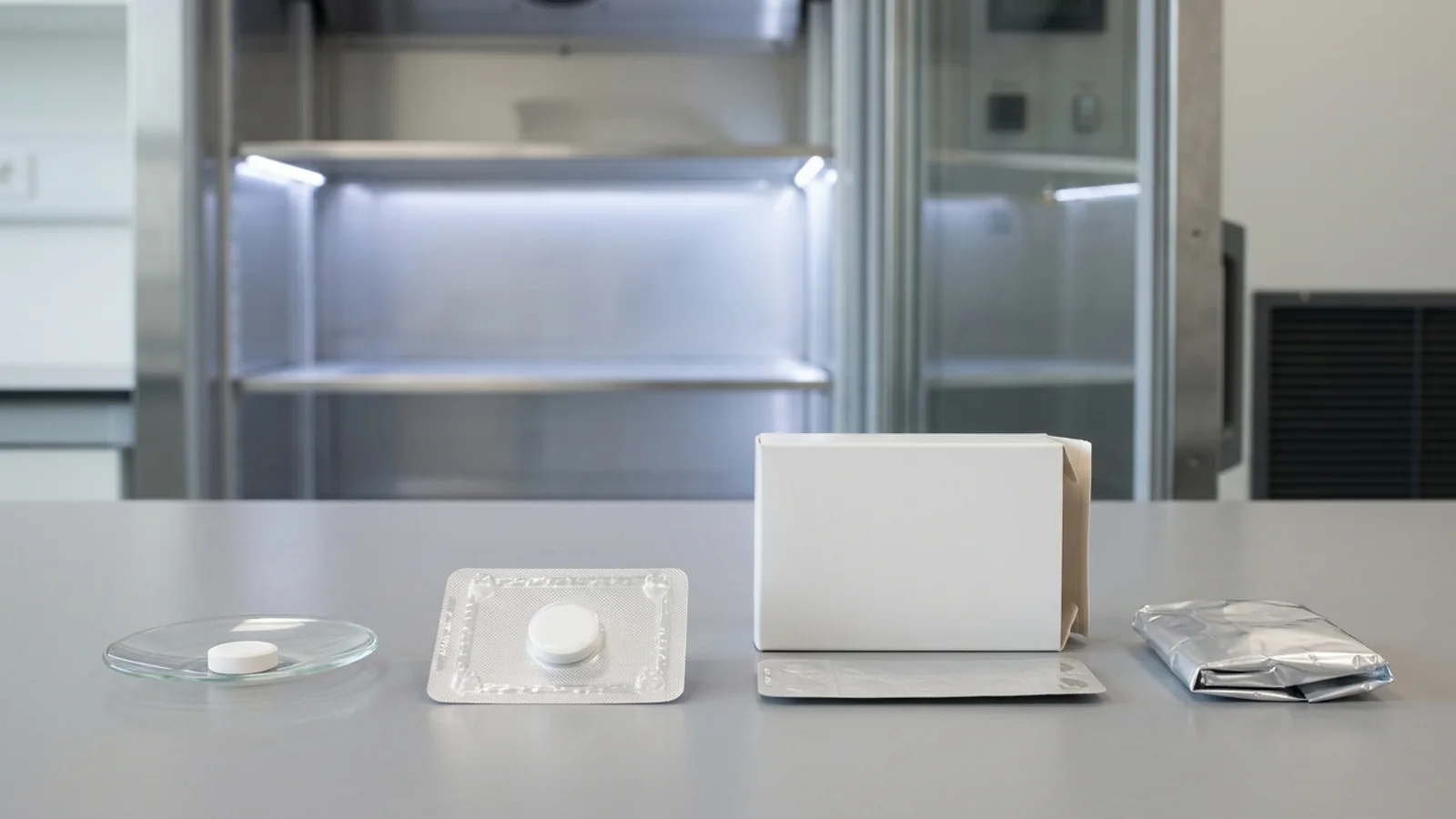
What evidence supports a light-protection claim?
Passing long-term and accelerated stability in the marketed container, together with acceptable retained-sample appearance, does not by itself establish that the pack protects the product from light. First review the existing photostability evidence. A new study is not automatic: development records may already address the proposed formulation, packaging and conclusion.
Under ICH Q1B, product testing normally starts with the fully exposed product and progresses to the immediate pack and then the complete marketing pack only as necessary. Acceptable change can end the sequence at an earlier stage. A result obtained with the carton in place does not establish protection after that carton is removed. Conversely, an acceptable exposed-product result describes the product response under the tested conditions; it does not measure the performance of an untested packaging barrier.
The distinction matters for chemistry, manufacturing and controls (CMC), quality assurance and packaging teams reviewing a proposed protection claim. Define the conclusion first: intrinsic product response, protection in a particular immediate pack, or protection dependent on the complete marketing presentation. Then identify the evidence supporting that conclusion and its limits.
Name the guideline version and its regional status
The technical framework used here is ICH Q1B Step 4, dated 6 November 1996, and EMA CPMP/ICH/279/95 Step 5, January 1998. The EMA version uses decimal section numbers; the ICH rendering uses lettered subsections. Section references below identify the relevant rendering so the evidence can be located without confusing the two.
EMA’s Q1B version record identifies Step 5 as the current effective version, with a legal effective date of 1 January 1998. That regional listing should not be described as proof that every recommendation is a binding statutory requirement worldwide. ICH harmonisation, regional implementation, guidance recommendations and applicable regulations have different roles.
The retrieved FDA Q1B page displays March 1996 and labels its document Draft, not for implementation, with non-binding recommendations. This is an observation about that page. It does not establish the status of every other FDA publication or remove separate US current good manufacturing practice obligations. In particular, 21 CFR 211.166 addresses a written stability program, while 211.94 addresses container and closure protection.
As checked for this review on 4 November 2026, EMA’s consolidated ICH Q1 listing identifies its current document as a Step 2b draft with consultation closed; the consultation ran from 30 April to 30 July 2025. Although the overview describes consolidation and supersession of Q1A–F and Q5C, that wording alone does not demonstrate completed regional implementation. Check the adopted version, effective date and transition terms when preparing a submission or assessing a later change.
Follow the product and pack evidence ladder
This table is an editorial synthesis of ICH Q1B Step 4 and EMA Step 5, not a regulator-issued form or a report of new experiments. The core product sequence is exposed product, immediate pack and complete marketing pack, with conditional stopping. The substance row supplies context; the in-use and ordinary-storage rows mark separate questions rather than additional mandatory Q1B stages. Reassessment prompts are operating interpretations of the change-dependent review principle, not automatic retest rules.
| Material or configuration | Question answered | Supported conclusion | Unsupported extrapolation | Decision record or control | Reassessment prompt | Source and section |
|---|---|---|---|---|---|---|
| Drug substance: forced and confirmatory studies | What is its photosensitivity, and what precautions may be needed? | Forced studies support method development and pathway understanding; confirmatory studies inform handling, packaging and labeling. | Neither alone establishes the finished product’s behavior or marketed-pack protection. | Separate study purposes, justified exposure and suitably validated analyses; use the applicable thermal-control approach. | Could a substance or formulation change affect the basis of the product conclusion? | Q1B §§2 and 5; EMA §§2, 2.1–2.3 and 5. |
| Fully exposed drug product | Does the product show acceptable change under the defined exposure? | Acceptable change can end the normal product testing sequence at this stage. | Does not quantify an untested pack’s transmission, approve label wording or establish unlimited exposure tolerance. | Actual formulation and presentation; verified confirmatory exposure; justified limits and thermal-control rationale. | Could a formulation or coating change alter the tested response? | Q1B §3 and decision flowchart; EMA §§3–3.3. |
| Product in immediate pack | Is the product adequately protected in this configuration? | Acceptable change can support stopping without proceeding to the marketing pack. | Does not automatically cover a different container, label or use scenario. | Direct-contact components and appropriate label; exposure, methods, limits and controls actually used. | Do changed components or label coverage affect the evidence relied on? | Q1B §§3 and 5; EMA §§3–3.3 and 5. |
| Product in complete marketing pack | Is protection adequate with immediate and secondary packaging together? | An acceptable result supports the evaluated complete configuration. | A carton-dependent conclusion does not establish protection after carton removal. | Immediate pack, appropriate label and secondary components; actual study configuration and results. | Does a proposed carton, sleeve or presentation change affect light exposure? | Q1B §§3 and 5; EMA §§3–3.3 and 5. |
| Separate in-use scenario: boundary | Does the evidence address handling described in the directions for use? | Product-specific testing may address the defined scenario; Q1B leaves its extent to the applicant’s discretion. | Marketed-pack results do not settle every preparation scenario; after-administration photostability is outside Q1B. | Defined scenario and directions for use, relevant conditions and suitably validated analyses; no universal in-use dose is supplied. | Have the proposed handling conditions or directions for use changed? | Q1B §§1.A and 3; EMA §§1.1 and 3. |
| Ordinary stability or retained-sample observation: boundary | What happened under the actual storage conditions? | Formal stability supports time-dependent quality assessment; appearance records describe the stored sample. | Without a defined light challenge, these records alone do not establish a light-protection barrier. | Actual storage history, packaging and tests; identify whether any relevant light challenge was documented. | Does the proposed conclusion require exposure evidence missing from the storage record? | Q1A(R2) §§2.2.2 and 2.2.4; Q1B §1; 21 CFR 211.166 and 211.94. |
Q1B’s glossary defines the immediate pack as the packaging constituent in direct contact with the substance or product, including any appropriate label. The marketing pack combines the immediate pack with secondary packaging such as a carton. Record those components explicitly: a description such as “commercial pack tested” can conceal whether a protective carton or label was present. The reader needs the actual configuration to understand the reach of the conclusion.
An acceptable exposed-product result may remove the need to continue through the normal pack-testing sequence. It should be described within its exposure conditions and justified limits. If the immediate-pack result is acceptable, proceeding to the marketing pack may likewise be unnecessary. If the marketing-pack result remains unacceptable, the Q1B flowchart points to redesigning the package or reformulating. These are study decisions; none is an independent authorization to release a batch or approve a storage statement.
Record the actual exposure and the control
For confirmatory studies, Q1B section 1.C specifies illumination of at least 1.2 million lux hours and integrated near-ultraviolet energy of at least 200 Wh/m². Both components matter. They are minimum study exposures, not universal limits for acceptable product change. They also do not specify a fixed study duration or convert directly into days of commercial shelf life.
Q1B provides two light-source options. Option 1 uses a source designed to produce output similar to the D65/ID65 emission standard; the text gives artificial daylight fluorescent, xenon and metal-halide examples. For a source emitting significant radiation below 320 nm, appropriate filters may be fitted to eliminate that radiation. Option 2 exposes the same sample to cool white fluorescent and near-UV fluorescent lamps. Its near-UV distribution is 320–400 nm, with maximum emission between 350 and 370 nm and a significant proportion in both the 320–360 and 360–400 nm bands.
The record should connect the chosen option to delivered exposure. Q1B permits samples alongside a validated chemical actinometric system, or exposure for an appropriate duration when conditions have been monitored with calibrated radiometers and lux meters. A lamp’s nominal wattage or a calendar duration alone does not document both cumulative exposure components. The quinine procedure in the annex is an example for near-UV monitoring, with source-specific calibration considerations; it should not be portrayed as a universal measurement of every lamp or the entire sample field.
Under Q1B section 1.B, the applicant should maintain appropriate temperature control to minimize localized temperature effects or include a dark control in the same environment, unless otherwise justified. If protected samples are used to evaluate thermally induced change, section 1.C places them alongside the exposed samples. The analysis provisions call for concomitant analysis of exposed and protected samples when dark controls are used. Record which approach was used rather than retrospectively assuming that a foil-wrapped control was mandatory in every design.
A dark-control comparison helps assess the thermal contribution to observed change. It does not, by itself, identify a reaction mechanism or prove that every difference is caused exclusively by light. Review it together with the exposure record, analytical performance and sample presentation. Q1B also asks applicants to minimize physical-state changes and irrelevant interactions while interfering as little as possible with sample irradiation. These details affect what the result can reasonably support.
Judge change using justified limits and validated analyses
Q1B defines acceptable change by limits justified by the applicant. Substance forced-degradation studies have a different purpose: they support development and validation of methods and understanding of degradation pathways, rather than establishing qualitative or quantitative change limits. Decomposition products seen only under forcing conditions are not automatically the products expected during confirmatory testing. Keep the two study purposes separate in the conclusion.
At the end of exposure, Q1B calls for examination of physical properties and for assay and degradants using suitably validated methods. For products, examples include appearance, solution clarity or color, and dissolution or disintegration where relevant. The analytical methods should address products likely to arise from photochemical degradation. A visual inspection alone cannot replace this assessment, and an assay result alone may leave relevant degradants or physical changes unexamined.
Batch selection also needs its proper boundary. Sections 2 and 3 normally describe one development batch followed by confirmation on a selected single batch when the material is clearly photostable or photolabile. If confirmatory results are equivocal, testing of up to two additional batches should be conducted. The parent Q1A(R2), section 2.2.2, refers to photostability on at least one primary product batch if appropriate. These statements do not create a universal one-batch formal stability program or define a numerical threshold for “equivocal.”
Finally, Q1B asks that photostability findings be considered alongside other formal stability results. An acceptable light-challenge outcome is not sufficient on its own to set shelf life. The question is whether the combined evidence supports the proposed specifications and precautions through the relevant period, rather than whether one study can substitute for the whole stability package.
A product-specific lacidipine example
The 2013 lacidipine tablet study evaluated coating levels and packaging configurations using Option 2 exposure and protected controls. Its packaging comparison used film-coated tablets directly exposed, in an Alu–Alu immediate blister, and in that blister within a folding carton. In the packaging comparison, the authors reported no significant change in the evaluated attributes for the immediate pack and similarly non-significant changes in the marketing pack. It therefore does not demonstrate that the tested immediate pack failed and required rescue by a carton.
The useful lesson is product and configuration dependence. Coating and packaging variables should be identified separately in the evidence record. This single-product study does not establish performance for every aluminium blister, a universal coating recipe or transferable acceptance criteria. Its illustrative results should not replace the applicant’s justification for another formulation and pack.
Keep storage, labeling and in-use conclusions within scope
Q1A(R2) section 2.2.4 describes formal stability testing in the proposed marketed container-closure system, including secondary packaging and the container label as appropriate. That packaging identity is important, but the exposure question still matters. Records of time, temperature and humidity do not become a documented photostability challenge merely because the product was stored in its final pack. Nor should ordinary storage always be described as occurring in darkness without checking its actual conditions.
In the US, 21 CFR 211.166(a) requires a written stability program that is followed, including storage conditions, reliable and specific methods, sample sizes and intervals, and testing in the marketed container-closure system. Separately, 21 CFR 211.94(b) and (d) require adequate protection against foreseeable external factors in storage and use, with written container and closure specifications and test methods. Neither provision itself supplies the Q1B light dose or approves a particular protection claim.
Retained-sample appearance remains an observation about that sample under its storage history. Without relevant exposure and analytical evidence, it cannot establish how an untested light barrier performs. The separate purposes and quantities of reference, retention and reserve samples are covered in Reference vs Retention Samples. Questions about which formal stability combinations to test belong in Stability Bracketing and Matrixing; neither decision replaces the configuration-specific photostability assessment.
Labeling requires the same discipline. Q1B leaves formal labeling requirements to national or regional requirements and notes that special packaging or labeling may be needed depending on change. It does not prescribe a worldwide “store in original carton” statement after a marketing-pack result, or automatically waive all light-related precautions after an exposed-product result. The scientific conclusion should identify any dependence on the carton; the appropriate storage instructions then require the applicable product and regional assessment.
Q1B excludes photostability after administration while also noting that testing may be appropriate for certain in-use situations, such as infusion liquids or dermal creams, depending on directions for use. Do not treat these as interchangeable scopes. The public abstract of Baertschi and colleagues’ 2010 commentary identifies protocol issues and a patient-use gap and recommends clarification. It is historical critique, not an operative replacement guideline. Neither that abstract nor Q1B supplies a universal in-use illumination level, administration deadline or protective device recommendation.
Reassess the conclusion when formulation or packaging changes
Q1B section 1.A, corresponding to EMA section 1.1, makes repeat testing depend on established photostability characteristics and the nature of a formulation or packaging change. Start with the evidence supporting the current conclusion and identify what the change affects. The appropriate outcome may be continued reliance on existing evidence, a justified alternative or additional testing of the affected configuration. Every change does not automatically invalidate the original study or require a complete repeat.
Formulation or coating: identify whether the exposed-product result depended on the evaluated composition or coating. Explain why the proposed change does or does not affect the basis of that result before deciding what further evidence is needed.
Immediate pack or appropriate label: compare the changed components with those evaluated. A change that affects light reaching the product deserves assessment, but a different supplier name alone does not establish either equivalent protection or a need to retest.
Secondary packaging: if the conclusion depends on the complete marketing pack, assess a carton, sleeve or presentation change against that dependence. Removing the carton creates a different configuration; the original carton-dependent result cannot simply be carried over.
Directions for use: determine whether the proposed handling scenario is represented in the available evidence. Keep product-specific in-use questions separate from packaged-storage conclusions and the after-administration exclusion.
These prompts are editorial applications of Q1B’s reassessment principle. They are not a prescribed list of regulatory reporting categories. A review should state the affected conclusion, the existing evidence considered, the rationale for its continued applicability or insufficiency, and the next evidence needed. Visual similarity of packs is not a substitute for that reasoning; equally, a change record should not claim that Q1B automatically demands a full study when its text leaves the decision conditional.
Assemble a reviewable evidence record
The following unpopulated fields are an editorial operating aid. They organize the connection between the proposed claim and the observed configuration; they do not represent a regulator form or completed study results. Use the relevant fields and record any justified alternative rather than inventing observations to fill every entry.
Intended conclusion and market: specify the proposed light-protection statement, its jurisdiction and whether it concerns exposed product, immediate pack or the complete marketing pack.
Product identity: record formulation, strength, dosage form, coating where relevant, batch identity and the basis for applying the data to the presentation under review.
Pack identity: identify the actual immediate components, appropriate label and secondary packaging. State which were present during exposure and which the proposed commercial presentation retains.
Applicable text and existing evidence: record guideline version and sections, regional status, prior photostability records and the reason they are or are not adequate for this decision.
Study conditions: record the light-source option, verified illumination and near-UV energy, sample presentation, and the method used to verify exposure.
Temperature and controls: record the temperature-control or dark-control approach, any justification for an alternative and the associated comparative analyses where controls were used.
Methods and limits: identify the suitably validated physical and chemical assessments, applicant-justified limits and the basis for judging the observed change.
Results and remaining uncertainty: record actual observations, the configuration supporting them, any equivocal findings and the rationale for further batch or pack testing.
Conclusion and follow-up: state the supported boundary, why testing stopped or continued, how formal stability and labeling considerations were addressed, and which changes reopen the assessment.
A useful review ends with a traceable statement: the evidence supports this conclusion for this formulation and configuration under these conditions. Where that connection is missing, identify the gap precisely. That approach can preserve valid existing development work while preventing a storage observation or a carton-dependent result from becoming an unsupported claim about the pack.
Sources
Primary guidance, regulatory texts and product-specific literature used for the analysis are listed below. The evidence ladder and record fields are editorial interpretations of these sources.