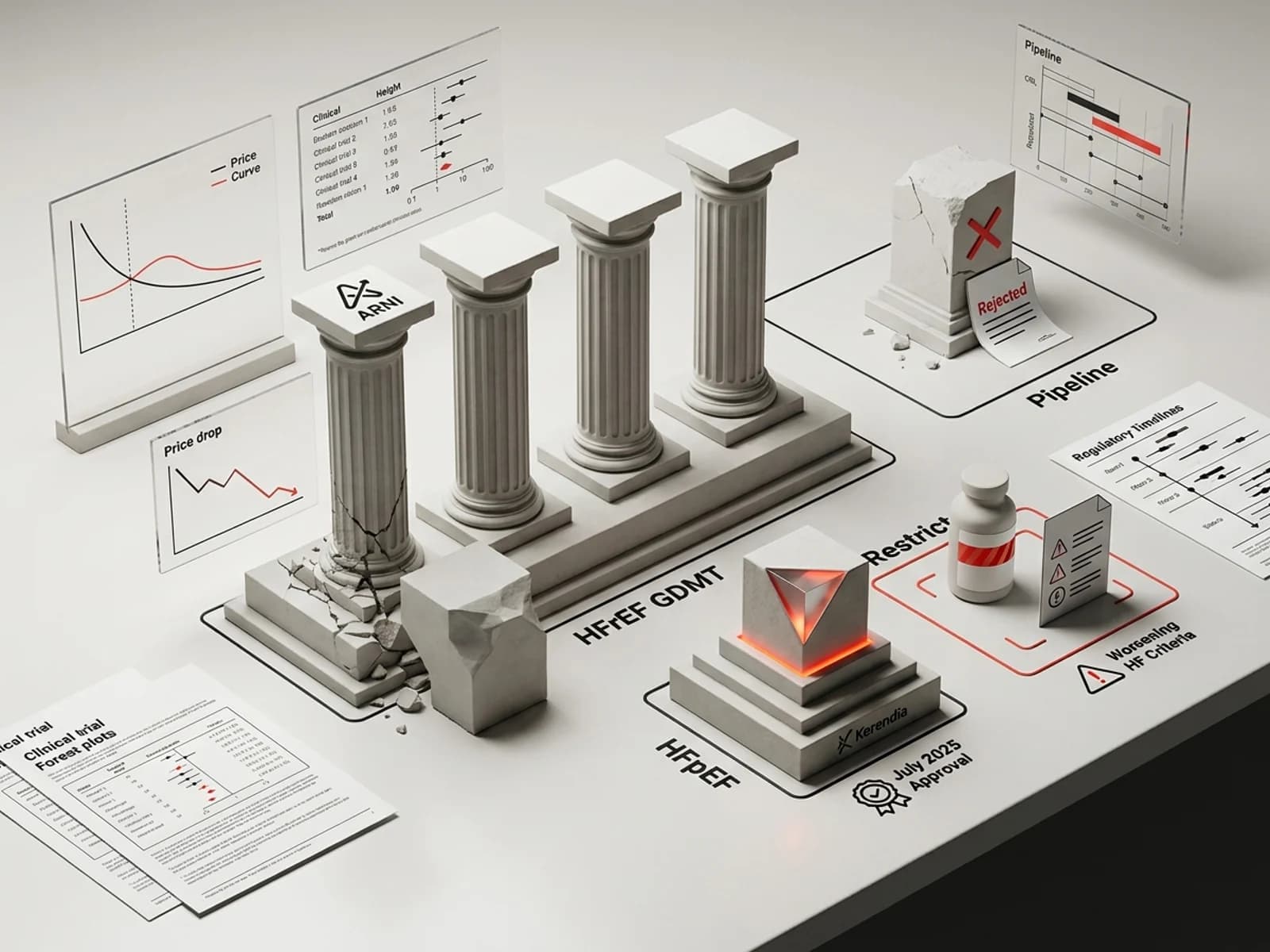
Heart failure represents one of the largest clinical and financial spend categories in cardiovascular medicine. In the United States, managing chronic heart failure involves navigating complex clinical guidelines, shifting payer formulary preferences, and recent multi-source generic launches. Payer organizations, pharmacy benefit managers (PBMs), and clinical cardiology teams must continuously realign their utilization management (UM) and prior authorization (PA) criteria to reflect the latest evidence and pricing shifts.
This cardiology access landscape reviews the clinical and economic realities of heart failure pharmacological therapy in 2026. We examine the 2022 AHA/ACC/HFSA four-pillar guideline-directed medical therapy (GDMT) backbone, the July 2025 FDA approval of finerenone (Kerendia) for heart failure with preserved ejection fraction (HFpEF), the pricing dynamics of generic sacubitril/valsartan following the Entresto generic cliff, the narrow worsening-HFrEF indication for vericiguat (Verquvo) following the negative VICTOR trial, and the regulatory status of cardiac-myosin activators like omecamtiv mecarbil.
Executive Summary & Scenario Analysis
To align on the pricing and access dynamics for chronic heart failure therapies, we must address the primary questions facing clinical pharmacy directors and benefit designers.
Scenario Question
Which heart-failure drugs are accessible and affordable in 2026, how do the HFrEF four pillars and the HFmrEF/HFpEF finerenone addition map to approval and pricing, and why is the cardiac-myosin class absent?
Direct Answer
For HFrEF, guideline-directed medical therapy (2022 AHA/ACC/HFSA) is anchored by four pillars: an angiotensin receptor-neprilysin inhibitor (ARNI; Entresto first-line class 1a), an evidence-based beta-blocker, a mineralocorticoid receptor antagonist (MRA), and an SGLT2 inhibitor. Entresto (sacubitril/valsartan, NDA 207620, approved 2015-07-07) is now available as a generic at approximately $0.89 to $0.94 per tablet compared to $11.26 per tablet for the brand in the CMS NADAC snapshot, representing a 92% price erosion. For HFmrEF/HFpEF, SGLT2 inhibitors are the lead option, and finerenone (Kerendia) was FDA-approved on July 14, 2025 for heart failure with LVEF at least 40% based on a 16% relative risk reduction in the FINEARTS-HF trial (RR 0.84, 95% CI 0.74–0.95, p = 0.007). Vericiguat (Verquvo, NDA 214377, approved 2021-01-19) is indicated only for worsening HFrEF (EF below 45% following an outpatient IV diuretic need or HF hospitalization) because the VICTOR trial in chronic stable HFrEF was negative (HR 0.93, p = 0.22). The cardiac-myosin activator class (omecamtiv mecarbil) remains absent due to the FDA's February 28, 2023 complete response letter citing insufficient evidence in the GALACTIC-HF trial (8% relative risk reduction).
The Four Pillars of HFrEF Guideline-Directed Medical Therapy (GDMT)
Heart failure with reduced ejection fraction (HFrEF)—defined as a left ventricular ejection fraction (LVEF) of 40% or less—is managed using a highly structured pharmacological regimen. The joint 2022 AHA/ACC/HFSA Guideline for the Management of Heart Failure established a Class 1 recommendation for four foundational drug classes, commonly referred to as the "four pillars." These therapies must be initiated and titrated to target doses as tolerated to reduce morbidity and mortality.
THE FOUR PILLARS OF HFrEF GDMT (LVEF <= 40%)
| Class/Pillar | Representative Agents | Recommendation Level | Clinical Rationale |
|---|---|---|---|
| 1. ARNI (First-Line Preference) | Sacubitril/Valsartan (Entresto) | Class 1a | Displaces ACE inhibitors/ARBs due to superior reduction in cardiovascular death and HF hospitalizations (PARADIGM-HF). |
| 2. Beta-Blockers | Carvedilol, Metoprolol Succinate, Bisoprolol | Class 1a | Controls heart rate, reduces sympathetic tone, and prevents progressive remodeling. |
| 3. MRA | Spironolactone, Eplerenone | Class 1a | Blocks aldosterone, reduces myocardial fibrosis and fluid retention (eGFR > 30 mL/min, potassium < 5.0 mEq/L). |
| 4. SGLT2 Inhibitor | Empagliflozin (Jardiance), Dapagliflozin (Farxiga) | Class 1a | Reduces cardiovascular death and HF hospitalizations regardless of diabetes status (DAPA-HF, EMPEROR-Reduced). |
Pillar 1: Renin-Angiotensin-Aldosterone System (RAAS) Inhibition & Neprilysin Blockade (ARNI)
The first pillar requires blocking the RAAS pathway while enhancing beneficial natriuretic peptides. The guidelines recommend an Angiotensin Receptor-Neprilysin Inhibitor (ARNI) as first-line therapy (Class 1a) to reduce morbidity and mortality. In patients who cannot tolerate an ARNI due to cost or side effects, standard Angiotensin-Converting Enzyme (ACE) inhibitors (such as lisinopril or enalapril) or Angiotensin II Receptor Blockers (ARBs) (such as valsartan or candesartan) serve as alternatives. The landmark PARADIGM-HF trial (NCT01035255) demonstrated that sacubitril/valsartan reduced the risk of the primary composite endpoint of cardiovascular death or heart failure hospitalization by 20% compared to enalapril (HR 0.80, 95% CI 0.73–0.87, p < 0.0001).
Pillar 2: Evidence-Based Beta-Blockers
Beta-blockers represent the second pillar of GDMT (Class 1a). Clinical benefit is limited to specific agents: carvedilol, metoprolol succinate, and bisoprolol. Payer formularies typically cover these agents on the lowest generic tiers (Tier 1) at near-zero copays.
Pillar 3: Mineralocorticoid Receptor Antagonists (MRAs)
The third pillar comprises aldosterone antagonists, primarily spironolactone and eplerenone. MRAs carry a Class 1a recommendation for patients with NYHA class II–IV symptoms and an LVEF of 35% or less, provided renal function is preserved (eGFR greater than 30 mL/min/1.73m²) and serum potassium is below 5.0 mEq/L. Spironolactone is widely available as an inexpensive generic, while eplerenone serves as a selective alternative for patients experiencing painful gynecomastia from spironolactone.
Pillar 4: Sodium-Glucose Cotransporter 2 (SGLT2) Inhibitors
SGLT2 inhibitors represent the fourth pillar of HFrEF GDMT (Class 1a). Empagliflozin (Jardiance) and dapagliflozin (Farxiga) received approvals based on the DAPA-HF and EMPEROR-Reduced trials. These studies demonstrated that adding an SGLT2 inhibitor to standard heart failure therapy reduced cardiovascular mortality and heart failure hospitalizations by 26% and 25% respectively, independent of type 2 diabetes status. For more details on class-wide dynamics, refer to the SGLT2-inhibitor access landscape.
How Entresto's Generic Entry Reshaped Heart Failure Pricing
For a decade, the ARNI pillar was represented solely by brand-name Entresto (sacubitril/valsartan), a multi-billion-dollar driver of cardiovascular spend. Payers managed this cost through preferred brand tiering (Tier 2) and manufacturer rebate contracts. However, the expiration of pediatric exclusivity on the core combination patent (US Patent No. 8,101,659) on July 15, 2025 cleared the path for multi-source generic entry.
Generic Price Erosion Metrics
The launch of generic sacubitril/valsartan resulted in rapid price erosion. According to the CMS National Average Drug Acquisition Cost (NADAC) snapshot, generic sacubitril/valsartan acquisition costs collapsed by approximately 92% relative to the brand.
24-26 MG Strength: Brand Entresto is priced at $11.26909 per tablet (Classification for Rate Setting = B, brand), while the generic equivalent is $0.88590 per tablet (Classification = G, generic), representing a 92.1% price reduction.
49-51 MG Strength: Brand Entresto is $11.26638 per tablet vs. generic sacubitril/valsartan at $0.91601 per tablet (a 91.9% reduction).
97-103 MG Strength: Brand Entresto is $11.26161 per tablet vs. generic sacubitril/valsartan at $0.93639 per tablet (a 91.7% reduction).
This steep discount allows commercial and government payers to capture immediate savings by transitioning patients from brand Entresto to the generic. For a detailed review of the generic entry and price transition, see the Entresto generic-launch and price-erosion analysis.
The Entresto Sprinkle Exception
Clinical pharmacy directors must note a key exception: Entresto Sprinkle (oral pellets, approved under NDA 218591 on April 12, 2024). Because Entresto Sprinkle has unique pharmacokinetic properties and a different administration pathway, the FDA does not rate standard sacubitril/valsartan tablets as therapeutically equivalent to the Sprinkle formulation (i.e., they are not "A-rated" equivalents in the Orange Book).
In the CMS NADAC snapshot, brand Entresto Sprinkle (15-16 mg strength) remains brand-only at $11.28474 per unit. Standard generic substitution laws do not apply. Payer formulary designs typically place Entresto Sprinkle on non-preferred brand tiers (Tier 3) or require prior authorization to document that the patient has a swallowing impairment (e.g., severe dysphagia, pediatric or geriatric tube-feeding dependency) that prevents them from utilizing crushed generic sacubitril/valsartan tablets.
What the July 2025 Kerendia Approval Added for HFmrEF and HFpEF
Heart failure with preserved ejection fraction (HFpEF)—defined as LVEF of 50% or greater—and heart failure with mildly reduced ejection fraction (HFmrEF)—defined as LVEF of 41% to 49%—historically had limited treatment options. The 2022 guidelines recommended SGLT2 inhibitors as Class 2a (reasonable) to reduce hospitalizations, while ARNIs and MRAs carried Class 2b (may be considered) recommendations.
On July 14, 2025, the treatment landscape expanded with the FDA approval of finerenone (Kerendia, NDA 215341) for the treatment of heart failure in patients with a left ventricular ejection fraction (LVEF) of 40% or greater (encompassing both HFmrEF and HFpEF). Finerenone was originally approved on July 9, 2021 to reduce the risk of renal and cardiovascular events in adults with chronic kidney disease associated with type 2 diabetes.
FINEARTS-HF Trial Evidence
The FDA approval for heart failure was based on the Phase III FINEARTS-HF trial (NCT04435626), which evaluated 6,001 patients with symptomatic heart failure and an LVEF of 40% or greater. Patients were randomized to receive finerenone (up to 20 mg or 40 mg daily based on eGFR) or placebo in addition to background therapy.
Primary Endpoint: Finerenone demonstrated a 16% relative risk reduction in the primary composite endpoint of cardiovascular death and total (first and recurrent) worsening heart failure events (RR 0.84, 95% CI 0.74–0.95, p = 0.007).
Worsening Heart Failure Events: The benefit was driven primarily by a reduction in total (first and recurrent) worsening heart-failure events and heart-failure hospitalizations rather than cardiovascular death, with an absolute risk reduction of roughly 3.2% over a median 32-month follow-up.
Safety Signals: Hyperkalemia (potassium > 5.5 mEq/L) was higher in the finerenone group (9.7% vs. 4.2% in placebo), but it rarely led to discontinuation. Finerenone showed a lower rate of hypokalemia compared to placebo.
Payer Formulary Positioning of Kerendia
Despite its expanded indication, Kerendia remains brand-only. In the CMS NADAC snapshot, Kerendia is priced at $21.95306 per tablet for the 10 mg strength, $21.94198 per tablet for 20 mg, and $22.86037 per tablet for 40 mg.
Payers managing HFmrEF/HFpEF spending typically mandate SGLT2 inhibitors (such as Jardiance or Farxiga) as the preferred brand-name agents. They apply prior authorization criteria for Kerendia to ensure it is reserved for patients who either have concomitant chronic kidney disease and type 2 diabetes or continue to experience worsening symptoms despite optimal therapy with an SGLT2 inhibitor. For company-wide pipeline context, see the Novartis portfolio dossier.
Why Verquvo is Limited to Worsening HFrEF: The Negative VICTOR Trial
Vericiguat (Verquvo, NDA 214377, approved January 19, 2021) is an oral soluble guanylate cyclase (sGC) stimulator. By directly stimulating sGC and enhancing sensitivity to endogenous nitric oxide, vericiguat restores the NO-sGC-cGMP pathway, which is deficient in heart failure, thereby improving myocardial and vascular function.
The VICTORIA Trial: Establishing the Worsening HFrEF Niche
The initial approval of vericiguat was based on the Phase III VICTORIA trial (NCT02861534), which enrolled 5,050 patients with symptomatic chronic heart failure, an LVEF below 45%, and evidence of recent worsening heart failure (defined as a heart-failure hospitalization within 6 months or receiving outpatient intravenous diuretics within 3 months).
Primary Endpoint: Vericiguat (titrated to 10 mg daily) demonstrated a 10% relative risk reduction in the primary composite endpoint of cardiovascular death or first heart failure hospitalization compared to placebo (HR 0.90, 95% CI 0.82–0.98, p = 0.02).
Absolute Risk Reduction: The absolute risk reduction was 4.2 events per 100 patient-years, reflecting the high-risk nature of the trial population.
Niche Role: The clinical benefit was modest, and there was no statistically significant reduction in cardiovascular death alone. Consequently, the 2022 guidelines assigned vericiguat a Class 2b recommendation, specifically for high-risk patients with HFrEF and recent worsening heart failure already on optimal GDMT.
The VICTOR Trial: Negative Results in Chronic Stable HFrEF
To expand the commercial market for vericiguat, Merck and Bayer conducted the Phase III VICTOR trial (NCT05093933). The VICTOR study evaluated vericiguat in 6,105 patients with chronic HFrEF (LVEF ≤ 45%) who were clinically stable and did not have a recent heart-failure hospitalization or need for outpatient IV diuretics.
The primary results of the VICTOR trial were negative:
Primary Outcome: The trial failed to show a statistically significant reduction in the primary composite endpoint of cardiovascular death or first heart-failure hospitalization (HR 0.93, 95% CI 0.83–1.04, p = 0.22).
Clinical Implications: The negative outcome confirmed that vericiguat's therapeutic value is restricted to the acute post-worsening window. It does not provide significant clinical benefit in stable, chronic HFrEF patients who are successfully managed on standard four-pillar GDMT.
Indications: Because VICTOR was negative, the Verquvo label was not expanded to chronic stable HFrEF. Verquvo remains indicated only for worsening HFrEF (ejection fraction below 45% following a heart-failure hospitalization or outpatient IV diuretic need), keeping vericiguat a niche agent for high-risk, post-worsening patients. A secondary mortality signal in VICTOR (CV mortality HR 0.83, all-cause HR 0.84) is hypothesis-generating but did not change the approved indication.
Payer Access and Prior Authorization Criteria
Because the VICTOR trial was negative, payers maintain narrow prior authorization criteria for Verquvo. In the CMS NADAC snapshot, Verquvo is priced as a brand-only agent at $22.15552 per tablet for 2.5 mg, $22.20520 per tablet for 5 mg, and $22.21022 per tablet for 10 mg.
To secure coverage, prior authorization criteria typically require:
Documentation of HFrEF: Left ventricular ejection fraction (LVEF) below 45%.
Recent Worsening Event: Documentation of a heart-failure hospitalization within the past 6 months OR receipt of outpatient intravenous diuretics for heart failure within the past 3 months.
GDMT Backbone: Patient must be on a stable, optimized regimen of the four pillars (an ARNI or ACEi/ARB, an evidence-based beta-blocker, an MRA, and an SGLT2 inhibitor) unless clinically contraindicated.
No Concomitant PDE-5 Inhibitor Use: Vericiguat is contraindicated with PDE-5 inhibitors (such as sildenafil or tadalafil) due to the risk of severe hypotension.
Why Omecamtiv Mecarbil is Absent: The FDA Rejection and Evidence Gap
Cardiac myosin activators represent a novel pharmacological class designed to improve myocardial contractility without increasing intracellular calcium or myocardial oxygen consumption. The lead molecule in this class was omecamtiv mecarbil (developed by Cytokinetics).
The GALACTIC-HF Trial
The NDA for omecamtiv mecarbil was supported by the Phase III GALACTIC-HF trial (NCT02929329), which evaluated 8,256 patients with symptomatic HFrEF (LVEF ≤ 35%).
Primary Endpoint: Omecamtiv mecarbil demonstrated a statistically significant but clinically modest 8% relative risk reduction in the primary composite endpoint of a heart-failure event or cardiovascular death (HR 0.92, 95% CI 0.86–0.99, p = 0.03).
Mortality Deficit: The trial showed no reduction in cardiovascular mortality (HR 1.01, 95% CI 0.92–1.11, p = 0.86) or improvement in quality of life.
Efficacy Heterogeneity: Subgroup analysis indicated that the drug's benefit was concentrated in patients with very low ejection fractions (LVEF ≤ 28%).
FDA Complete Response Letter and Advisory Committee Vote
In December 2022, the FDA's Cardiovascular and Renal Drugs Advisory Committee (CRDAC) voted 8 to 3 against approving omecamtiv mecarbil, concluding that the benefit-risk profile was not favorable.
On February 28, 2023, the FDA issued a Complete Response Letter (CRL) to Cytokinetics. The agency determined that the single GALACTIC-HF trial was not sufficiently persuasive to establish effectiveness. The FDA stated that an additional clinical trial would be required to demonstrate a clinically meaningful treatment effect, particularly regarding mortality or hospitalization rates. Because Cytokinetics declined to fund a second large-scale Phase III trial, omecamtiv mecarbil remains unapproved and absent from the cardiovascular armamentarium.
Payer organizations must monitor next-generation cardiac-myosin inhibitors (such as aficamten), which are under evaluation for hypertrophic cardiomyopathy (HCM). However, for systolic heart failure, the contractility class remains a clinical and formulary gap. Payer teams should cross-link these findings with the ATTR-CM access landscape for broader context on cardiomyopathy drug spend.
Heart Failure Class Affordability & Pricing Benchmarks
To assist pharmacy directors in constructing formulary tiers, the table below consolidates the retail pharmacy acquisition cost benchmarks for the heart-failure class, compiled from the CMS NADAC snapshot.
HEART FAILURE PRICING BENCHMARKS (CMS NADAC SNAPSHOT)
| Drug Name | Brand/Generic | NDC Code | NADAC Per Unit | Pricing Unit | Monthly Cost (30-Day Supply)* |
|---|---|---|---|---|---|
| Entresto 24-26 mg | Brand | 00078-0659-20 | $11.26909 | EA (Tablet) | $676.15 |
| Entresto 49-51 mg | Brand | 00078-0777-20 | $11.26638 | EA (Tablet) | $675.98 |
| Entresto 97-103 mg | Brand | 00078-0696-20 | $11.26161 | EA (Tablet) | $675.70 |
| Entresto Sprinkle 15-16 mg | Brand | 00078-1064-20 | $11.28474 | EA (Sprinkle) | $677.08 |
| Generic Sacubitril-Valsartan 24-26 | Generic | 00904-7580-04 | $0.88590 | EA (Tablet) | $53.15 |
| Generic Sacubitril-Valsartan 49-51 | Generic | 00904-7582-04 | $0.91601 | EA (Tablet) | $54.96 |
| Generic Sacubitril-Valsartan 97-103 | Generic | 70377-0033-13 | $0.93639 | EA (Tablet) | $56.18 |
| Kerendia 10 mg | Brand | 50419-0540-30 | $21.95306 | EA (Tablet) | $658.59 |
| Kerendia 20 mg | Brand | 50419-0541-30 | $21.94198 | EA (Tablet) | $658.26 |
| Kerendia 40 mg | Brand | 50419-0542-30 | $22.86037 | EA (Tablet) | $685.81 |
| Verquvo 2.5 mg | Brand | 00006-5018-02 | $22.15552 | EA (Tablet) | $664.67 |
| Verquvo 5 mg | Brand | 00006-5019-02 | $22.20520 | EA (Tablet) | $666.16 |
| Verquvo 10 mg | Brand | 00006-5020-02 | $22.21022 | EA (Tablet) | $666.31 |
| Spironolactone 25 mg | Generic | 00904-6291-60 | $0.11038 | EA (Tablet) | $3.31 |
*Note: Monthly cost calculations assume standard twice-daily dosing (60 tablets/month) for Entresto, generic sacubitril/valsartan, and Verquvo; and once-daily dosing (30 tablets/month) for Kerendia and spironolactone.
Payers should leverage these acquisition-cost differentials to enforce standard generic substitution. Excluding brand Entresto and transitioning patients to generic sacubitril/valsartan yields immediate savings of over $600 per patient per month, while maintaining therapeutic equivalence and guideline adherence.
FAQ Section
Is Entresto available as a generic in 2026, and how much cheaper is it?
Yes, generic sacubitril/valsartan (the active ingredients in Entresto) is widely available in 2026 following the expiration of the brand's key patent exclusivity in July 2025. In the CMS NADAC registry, the generic is priced between $0.89 and $0.94 per tablet depending on the strength, representing an approximate 92% price reduction from the brand's price of $11.26 per tablet. This has led major PBMs and commercial insurers to implement national formulary exclusions for brand Entresto, mandating the use of the generic.
What is the difference between HFrEF and HFpEF drug therapy under the 2022 guideline?
HFrEF (LVEF ≤ 40%) pharmacological management is driven by a Class 1a recommendation for four pillars of guideline-directed medical therapy (GDMT): an ARNI (preferred first-line), an evidence-based beta-blocker, an MRA, and an SGLT2 inhibitor. Conversely, HFpEF (LVEF ≥ 50%) management historically relied on treating comorbidities and fluid retention. The 2022 guidelines gave SGLT2 inhibitors a Class 2a recommendation for HFpEF, while ARNIs and MRAs carried Class 2b recommendations. However, the July 2025 approval of finerenone (Kerendia) for LVEF ≥ 40% based on the FINEARTS-HF trial introduced a selective non-steroidal MRA option specifically shown to reduce worsening heart failure events in the HFpEF population.
Does Medicare or commercial insurance cover Kerendia and Verquvo, and under what prior-authorization criteria?
Medicare Part D and commercial insurance plans widely cover both Kerendia and Verquvo, but they restrict access through prior authorization (PA) and step-therapy requirements. For Verquvo, payers require documentation of an LVEF below 45%, concomitant use of foundational HFrEF GDMT, and a recent worsening heart-failure event (a hospitalization within 6 months or an outpatient IV diuretic requirement within 3 months). For Kerendia, PAs require documentation of an LVEF of 40% or greater, persistent symptoms despite baseline therapy with an SGLT2 inhibitor, and monitoring to ensure baseline serum potassium is below 5.0 mEq/L and eGFR is at least 30 mL/min/1.73m².
Sources
Heidenreich, P. A., et al. "2022 AHA/ACC/HFSA Guideline for the Management of Heart Failure: A Report of the American College of Cardiology/American Heart Association Joint Committee on Clinical Practice Guidelines." Journal of Cardiac Failure, 2022. U.S. Food and Drug Administration / American College of Cardiology. https://www.acc.org/latest-in-cardiology/ten-points-to-remember/2022/03/29/19/53/2022-aha-acc-hfsa-heart-failure-guideline-gl-hf
U.S. Food and Drug Administration. Drugs@FDA approval records for Entresto (NDA 207620), Kerendia (NDA 215341), and Verquvo (NDA 214377). CDER Approval History. Accessed July 2026. https://www.accessdata.fda.gov/scripts/cder/daf/
Solomon, S. D., et al. "Finerenone in Heart Failure with Mildly Reduced or Preserved Ejection Fraction (FINEARTS-HF)." New England Journal of Medicine, 2024. https://www.nejm.org/doi/full/10.1056/NEJMoa2407107
Armstrong, P. W., et al. "Effect of Vericiguat on the Combination of Cardiovascular Death or Hospitalization for Heart Failure in HFrEF (VICTORIA)." New England Journal of Medicine, 2020. https://www.nejm.org/doi/full/10.1056/NEJMoa2001765
Centers for Medicare & Medicaid Services (CMS). National Average Drug Acquisition Cost (NADAC) database update dated July 8, 2026. Medicaid Prescription Drug Pricing Resources. https://www.medicaid.gov/medicaid/prescription-drugs/registration/index.html
Cytokinetics, Inc. "Cytokinetics Receives Complete Response Letter from FDA for New Drug Application for Omecamtiv Mecarbil." PR Newswire. Published February 28, 2023. Accessed July 2026. https://ir.cytokinetics.com/press-releases/press-release-details/2023/Cytokinetics-Receives-Complete-Response-Letter-From-FDA-for-New-Drug-Application-for-Omecamtiv-Mecarbil-02-28-2023/default.aspx
Merck & Co., Inc. "Merck Provides Update on Phase 3 VICTOR Trial Evaluating Vericiguat in Patients with Chronic Heart Failure and Reduced Ejection Fraction." Business Wire. Published January 2026. Accessed July 2026. https://www.merck.com/news/merck-provides-new-results-for-verquvo-vericiguat-in-patients-with-chronic-heart-failure-and-reduced-ejection-fraction
Novartis AG. "Novartis Announces FDA Approval of Entresto Sprinkle (sacubitril/valsartan) for Pediatric and Geriatric Heart Failure Patients." Novartis Press Release. Published April 12, 2024. Accessed July 2026. https://www.novartis.com/news/media-releases