GLP-1 receptor agonists are almost entirely self-administered injectable medications, which means they route through the pharmacy benefit on most commercial, Medicaid, and Medicare Part D plans. But the benefit-channel assignment is not always obvious — and for self-funded employers, health plans, and provider offices, getting the routing wrong can trigger claim rejections, prior authorization (PA) failures, and unexpected patient cost-sharing. In 2025–2026, the introduction of the Medicare GLP-1 Bridge, CMS's BALANCE Model, and expanding employer GLP-1 carve-out programs are adding new routing complexity.
This guide maps which GLP-1 medications fall under which benefit channel, explains how J-code buy-and-bill works for provider-administered drugs, details specialty pharmacy lock-in and limited-distribution network rules, and identifies the cost-sharing and PA implications of pharmacy vs medical benefit routing. It is independent information and not medical advice or reimbursement guidance for a specific patient or plan.
Quick answer: GLP-1 benefit routing
| GLP-1 Drug | Administration | Primary Benefit Channel | HCPCS / J-Code |
|---|---|---|---|
| Ozempic (semaglutide injection) | Self-injectable, weekly | Pharmacy benefit | No dedicated J-code; J3490 if needed |
| Wegovy (semaglutide 2.4 mg injection) | Self-injectable, weekly | Pharmacy benefit | No dedicated J-code; J3490 if needed |
| Mounjaro (tirzepatide injection) | Self-injectable, weekly | Pharmacy benefit | No dedicated J-code; J3490 if needed |
| Zepbound (tirzepatide injection) | Self-injectable, weekly | Pharmacy benefit | No dedicated J-code; J3490 if needed |
| Trulicity (dulaglutide injection) | Self-injectable, weekly | Pharmacy benefit | No dedicated J-code; J3490 if needed |
| Rybelsus (semaglutide oral tablet) | Oral, daily | Pharmacy benefit | No J-code (oral) |
| Saxenda (liraglutide injection) | Self-injectable, daily | Pharmacy benefit | No dedicated J-code; J3490 if needed |
| Victoza (liraglutide injection) | Self-injectable, daily | Pharmacy benefit | No dedicated J-code; J3490 if needed |
| Byetta / Bydureon (exenatide) | Self-injectable | Pharmacy benefit | No dedicated J-code; J3490 if needed |
| Oral Wegovy (semaglutide 25 mg tablet) | Oral, daily (FDA-approved Dec 2025) | Pharmacy benefit | No J-code (oral) |
All current GLP-1 drugs are self-administered. They route through the pharmacy benefit — dispensed by retail or specialty pharmacies, processed through PBM formularies, and subject to pharmacy-tier copayments or coinsurance. No current GLP-1 is routinely administered in a clinic setting or billed under medical benefit with a J-code.
Pharmacy benefit: how GLP-1 coverage works
Under the pharmacy benefit, GLP-1 prescriptions are:
Written by the prescriber and sent electronically to an in-network pharmacy (often a specialty pharmacy).
Processed through the PBM's formulary — checked against the plan's tier structure, prior authorization requirements, step therapy rules, and quantity limits.
Adjudicated at the point of sale — the pharmacy submits the claim, and the PBM confirms coverage, applies copay or coinsurance, and routes reimbursement.
Subject to pharmacy-tier cost-sharing — GLP-1s are typically placed on Tier 3 (preferred brand) or Tier 4 (specialty). Patient cost-sharing is usually a fixed copay ($50–$150 per fill) or coinsurance (25–33% of drug cost).
Advantages of pharmacy benefit routing for GLP-1s
Lower patient cost-sharing: A Tier 3 copay of $50–$100 per month is significantly less than the 20–30% coinsurance that would apply under medical benefit for a drug costing $900–$1,400 per month.
Faster dispensing: Pharmacy-benefit prescriptions can be filled at retail or mail-order pharmacies, typically within 1–3 business days.
PBM utilization management: Step therapy, prior authorization, and quantity limits are applied at the PBM level, with established electronic PA workflows (CoverMyMeds, Surescripts).
Rebate flow: PBMs negotiate manufacturer rebates on GLP-1 drugs, which flow back to the plan sponsor (employer or insurer). This is a key cost-management lever that does not exist under medical benefit.
Specialty pharmacy requirements
Many plans require GLP-1 prescriptions to be filled through a designated specialty pharmacy:
CVS Caremark Specialty Pharmacy for Caremark-managed plans.
Accredo (Express Scripts) for Cigna/ESI-managed plans.
Optum Specialty Pharmacy for UnitedHealthcare plans.
Plan-specific specialty pharmacies for other carriers.
If a patient fills a GLP-1 at a non-designated retail pharmacy, the claim may be rejected at point of sale, or the patient may be charged the full out-of-network cost. Prescribers and patients should verify the plan's specialty pharmacy requirement before sending the prescription.
Limited-distribution networks
Some GLP-1 drugs — particularly during launch or shortage periods — may be subject to limited-distribution agreements, where the manufacturer restricts dispensing to a narrow set of specialty pharmacies. This is separate from the plan's specialty pharmacy requirement and can create conflicts if the two do not align. If the patient's plan requires CVS Caremark Specialty but the drug is only available through Accredo, the prescriber may need to request a network exception.
Medical benefit: when GLP-1s intersect with J-codes
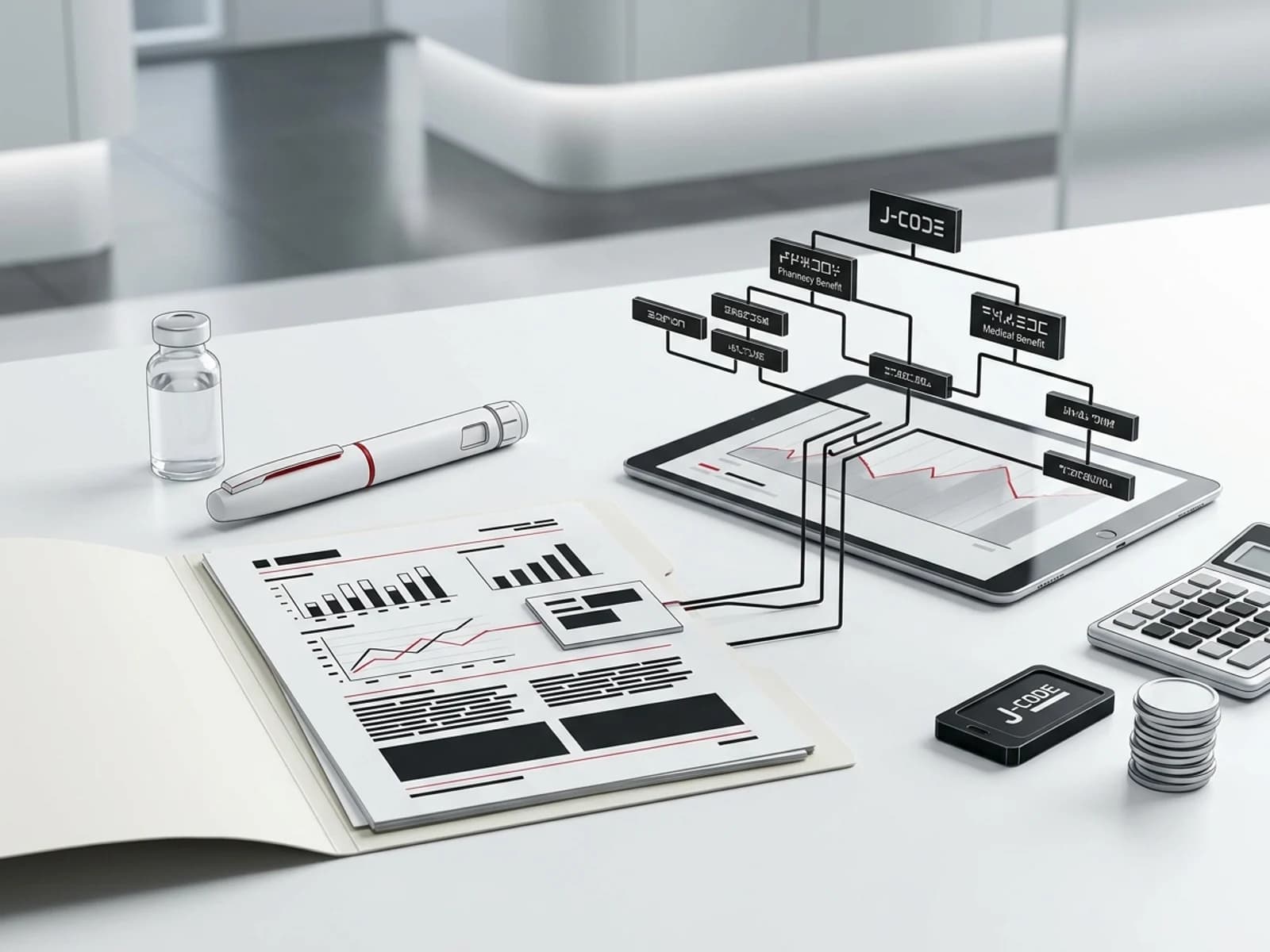
GLP-1 drugs are not routinely administered by providers, so they are almost never billed under medical benefit with a J-code (the HCPCS Level II codes used for provider-administered drugs). However, the medical benefit channel is relevant in several contexts:
1. J-codes exist but are rarely used for GLP-1s
GLP-1 active ingredients such as liraglutide and semaglutide do not have dedicated, product-specific J-codes. CMS classifies both as self-administered drugs, and they are typically billed under miscellaneous codes (e.g., J3490, unclassified drugs) if a J-code is ever needed — for instance, in a buy-and-bill or medical-benefit scenario. Dedicated J-codes are reserved for provider-administered drugs, and since all current GLP-1 products are self-injectable or oral, J-code billing for GLP-1s almost never occurs in practice.
2. Buy-and-bill is the medical benefit model
For provider-administered drugs, the "buy-and-bill" model means the provider purchases the medication, administers it to the patient, and bills the plan under medical benefit using the J-code. The plan reimburses the provider at a negotiated rate (often ASP + 4–6%). This model applies to infused biologics (e.g., Remicade, Keytruda) but not to self-administered GLP-1s.
3. Why medical benefit routing could matter for GLP-1s
If a GLP-1 were reclassified as a provider-administered drug — for example, if a new formulation required clinical administration — the routing would shift from pharmacy benefit (PBM-managed, tier copay) to medical benefit (J-code, coinsurance, buy-and-bill economics). This would:
Increase patient cost-sharing from a $50–$100 copay to 20–30% coinsurance on a $1,000+ drug.
Remove PBM rebate leverage from the cost equation.
Shift utilization management from PBM-level PA to medical-PA processes (often slower, less standardized).
Create buy-and-bill inventory risk for providers.
4. J-code conundrum for employers
The MJ Companies (February 2026) describes the "J-code conundrum" facing self-funded employers: medication costs hidden in medical benefit claims that circumvent pharmacy benefit discounts, rebates, and utilization management. While this primarily affects infused drugs, employer pharmacy benefit teams should be aware that any shift of GLP-1 dispensing from pharmacy to medical benefit would expose the plan to buy-and-bill pricing without PBM protections.
Medicare Part D: pharmacy benefit with new bridge pathways
Diabetes indication
Medicare Part D covers GLP-1 drugs for type 2 diabetes through the pharmacy benefit, subject to plan formularies and cost-sharing. Ozempic, Mounjaro, Trulicity, Rybelsus, and Victoza are covered under Part D for diabetes with PA, step therapy, and tier placement varying by plan.
Obesity indication — the GLP-1 Bridge (July 2026)
Historically, Medicare Part D was prohibited from covering drugs for weight loss under the Social Security Act's exclusion of "weight gain, weight loss, or cosmetic" treatments. In late 2025, CMS announced the Medicare GLP-1 Bridge, a short-term demonstration running from July 1, 2026, through December 31, 2027:
Mechanism: CMS uses a single central processor to manage PA, claims adjudication, and payment to pharmacies. Part D sponsors do not carry risk for eligible GLP-1 drugs under the Bridge.
Patient cost-sharing: $50 per month copayment.
Covered drugs: All formulations of Wegovy and Foundayo (orforglipron), and the KwikPen formulation of Zepbound.
PA criteria: Provider must attest the beneficiary meets BMI and clinical criteria (BMI ≥ 35, or BMI ≥ 27 with qualifying comorbidities).
Routing: The Bridge operates outside normal Part D coverage and payment flow, so participating pharmacies bill through the central processor rather than the Part D plan.
BALANCE Model (planned for 2027)
CMS's BALANCE Model (Better Approaches to Lifestyle and Nutrition for Comprehensive Health) was announced in December 2025 as a voluntary demonstration to allow participating Part D plans to cover GLP-1s for obesity starting in 2027, with manufacturers providing lifestyle support programs at no cost. As of April 2026, CMS indicated that the 80% Part D plan participation threshold required to proceed was not met, putting the 2027 BALANCE launch in question. The Bridge demonstration continues regardless.
Self-funded employer considerations
Self-funded employers — who bear the full financial risk of their employees' drug costs — face specific routing decisions for GLP-1 coverage:
Cost exposure
GLP-1 medications cost $7,200–$10,800 per enrolled employee per year after PBM rebates, according to Embla's 2026 employer cost analysis. For a self-funded employer with 1,000 employees and a conservative 5% utilization rate, that translates to 50 employees on GLP-1s costing $360,000–$540,000 annually in pharmacy spend.
GLP-1 carve-out programs
Some employers are moving away from PBM-managed GLP-1 coverage toward carved-out, clinically managed programs:
Embla and similar vendors offer fully managed GLP-1 benefits for self-funded employers at under $500 per employee per month, with no plan integration required.
9amHealth partners with Harvard Pilgrim's EncircleRx program to provide virtual weight management alongside GLP-1 access.
These carve-outs operate outside the traditional PBM pharmacy benefit, routing GLP-1 dispensing through the vendor's pharmacy network and clinical management protocols.
Plan design decisions
Employer plan sponsors must decide:
Cover or exclude GLP-1s for weight management — many smaller and mid-size employers exclude weight-loss GLP-1s from the formulary entirely.
Pharmacy benefit vs carve-out — whether to manage GLP-1s through the PBM or through a specialty carve-out vendor.
BMI and comorbidity thresholds — whether to adopt payer-standard thresholds (BMI ≥ 30 / 27 + comorbidity) or tighten criteria (BMI ≥ 35, BMI ≥ 40).
Specialty pharmacy network — whether to restrict GLP-1 dispensing to a single specialty pharmacy or allow broad retail access.
Routing checklist for prescribers and benefit verification teams
Before submitting a GLP-1 prescription or PA:
Verify benefit channel — is the drug covered under pharmacy benefit, medical benefit, or a carve-out program?
Confirm specialty pharmacy requirement — which designated specialty pharmacy does the plan require?
Check formulary status — is the specific GLP-1 drug on formulary for the requested indication (diabetes vs weight management vs cardio)?
Verify PA pathway — submit PA through the correct channel (PBM electronic PA for pharmacy benefit, medical PA for medical benefit, vendor portal for carve-out).
Confirm cost-sharing — understand the patient's copay or coinsurance based on tier placement.
For Medicare patients: Check GLP-1 Bridge eligibility (starting July 2026) and submit PA through the central processor, not the Part D plan.
For self-funded employer patients: Check whether the employer has carved out GLP-1 coverage to a specialty vendor, which changes the dispensing and PA pathway.
Sources
IntuitionLabs, "Pharmacy vs. Medical Benefit Explained: GLP-1 Coverage." https://intuitionlabs.ai/articles/pharmacy-vs-medical-benefit-glp1-coverage
The MJ Companies, "What Looks Like a Pharmacy Benefit Sometimes Isn't: The J-Code Conundrum," February 10, 2026. https://themjcos.com?p=24948
CMS, "Medicare GLP-1 Bridge." https://www.cms.gov/medicare/coverage/prescription-drug-coverage/medicare-glp-1-bridge
CMS, "Medicare GLP-1 Bridge: Information for Medicare Beneficiaries." https://www.cms.gov/medicare/coverage/prescription-drug-coverage/medicare-glp-1-bridge/information-medicare-beneficiaries
KFF, "What to Know About the BALANCE Model for GLP-1s in Medicare and Medicaid." https://www.kff.org/medicare/what-to-know-about-the-balance-model-for-glp-1s-in-medicare-and-medicaid
Embla, "How Much Do GLP-1s Cost Self-Funded Employers? (2026 Guide)." https://www.joinembla.com/us-2/learn/how-much-do-glp-1s-cost-employers
RxBenefits, "Four Strategies for Managing GLP-1 Cost Trends." https://www.rxbenefits.com/blogs/four-strategies-for-managing-glp-1-cost-trends
Harvard University (Harvie Health), "GLP-1 2026 Clinical Changes and Coverage Requirements FAQs." https://harvie.harvard.edu/sites/g/files/omnuum12046/files/2025-10/GLP1_Clinical_Changes_FAQ.pdf
Drug Channels Institute, "The 2026 Economic Report on U.S. Pharmacies and Pharmacy Benefit Managers," March 2026. https://drugchannelsinstitute.com/products/industry_report/pharmacy
SmartHealth, "2026 Provider Manual (All Markets)." https://www.mysmarthealth.org/-/media/project/aca/mysmarthealth/provider-manuals/2025-sh-provider-manual-all-markets---updated-3-25-25.pdf