Enhertu (fam-trastuzumab deruxtecan-nxki) is a HER2-directed antibody-drug conjugate (ADC) jointly developed and commercialized by Daiichi Sankyo and AstraZeneca. Its DXd payload — a topoisomerase I inhibitor — is linked to a humanized anti-HER2 IgG1 antibody via a cleavable tetrapeptide linker. After binding HER2 on tumor cells, Enhertu is internalized and the linker is cleaved by lysosomal enzymes, releasing membrane-permeable DXd that causes DNA damage and apoptotic cell death. This bystander effect allows cytotoxic activity even against neighboring HER2-negative tumor cells.
Since its initial FDA approval in December 2019, Enhertu has expanded across eight distinct indication groups, most recently gaining early-stage breast cancer approvals in May 2026 and first-line metastatic HER2-positive breast cancer with pertuzumab in December 2025. The January 2025 approval for HER2-ultralow breast cancer — IHC 0 with membrane staining — redefined who qualifies for HER2-directed therapy. Access teams now must navigate multiple HER2 testing thresholds, indication-specific prior authorization criteria, and ADC-specific safety monitoring requirements.
Short answer
| Enhertu (IV) | |
|---|---|
| Generic name | fam-trastuzumab deruxtecan-nxki |
| Drug class | HER2-directed antibody-drug conjugate (ADC) |
| Manufacturer | Daiichi Sankyo / AstraZeneca |
| FDA first approval | December 20, 2019 (BLA 761139) |
| Administration | IV infusion; first dose over 90 min, subsequent over 30 min |
| Dosing — breast, NSCLC, solid tumors | 5.4 mg/kg IV every 3 weeks |
| Dosing — gastric/GEJ | 6.4 mg/kg IV every 3 weeks |
| HCPCS code | J9358 (Injection, fam-trastuzumab deruxtecan-nxki, 1 mg) |
| NDC | 65597-0406-01 (100 mg single-dose vial) |
| Benefit channel | Medical benefit (buy-and-bill) |
| Boxed warnings | ILD/pneumonitis; embryo-fetal toxicity |
| WAC per 100 mg vial | ~$3,174 (estimated) |
| PA required | Yes, all major commercial and Medicare plans |
| Patient support | ENHERTU4U (1-833-ENHERTU) |
All FDA-approved indications
| Indication group | Date | Dose | Trial |
|---|---|---|---|
| HER2+ mBC (3rd-line+) — accelerated | Dec 2019 | 5.4 mg/kg q3w | DESTINY-Breast01 |
| HER2+ mBC (2nd-line) — regular approval | May 2022 | 5.4 mg/kg q3w | DESTINY-Breast03 |
| HER2-low mBC (IHC 1+ or 2+/ISH-) | Aug 2022 | 5.4 mg/kg q3w | DESTINY-Breast04 |
| HER2-mutant NSCLC — accelerated | Aug 2022 | 5.4 mg/kg q3w | DESTINY-Lung02 |
| HER2+ (IHC 3+) solid tumors (tumor-agnostic) — accelerated | Apr 2024 | 5.4 mg/kg q3w | DESTINY-PanTumor02 |
| HR+, HER2-low/ultralow mBC (post-endocrine) | Jan 2025 | 5.4 mg/kg q3w | DESTINY-Breast06 |
| HER2+ mBC with pertuzumab (1st-line) | Dec 2025 | 5.4 mg/kg q3w + pertuzumab | DESTINY-Breast09 |
| HER2+ early-stage BC (neoadjuvant) | May 2026 | 5.4 mg/kg q3w | DESTINY-Breast11 |
| HER2+ early-stage BC (residual disease) | May 2026 | 5.4 mg/kg q3w | DESTINY-Breast05 |
| HER2+ gastric/GEJ adenocarcinoma (post-trastuzumab) | Sep 2021 | 6.4 mg/kg q3w | DESTINY-Gastric01 |
HER2 testing thresholds and companion diagnostics
The HER2-low and HER2-ultralow approvals fundamentally changed pathology requirements. Access teams must understand the exact testing thresholds each indication requires.
HER2 status definitions
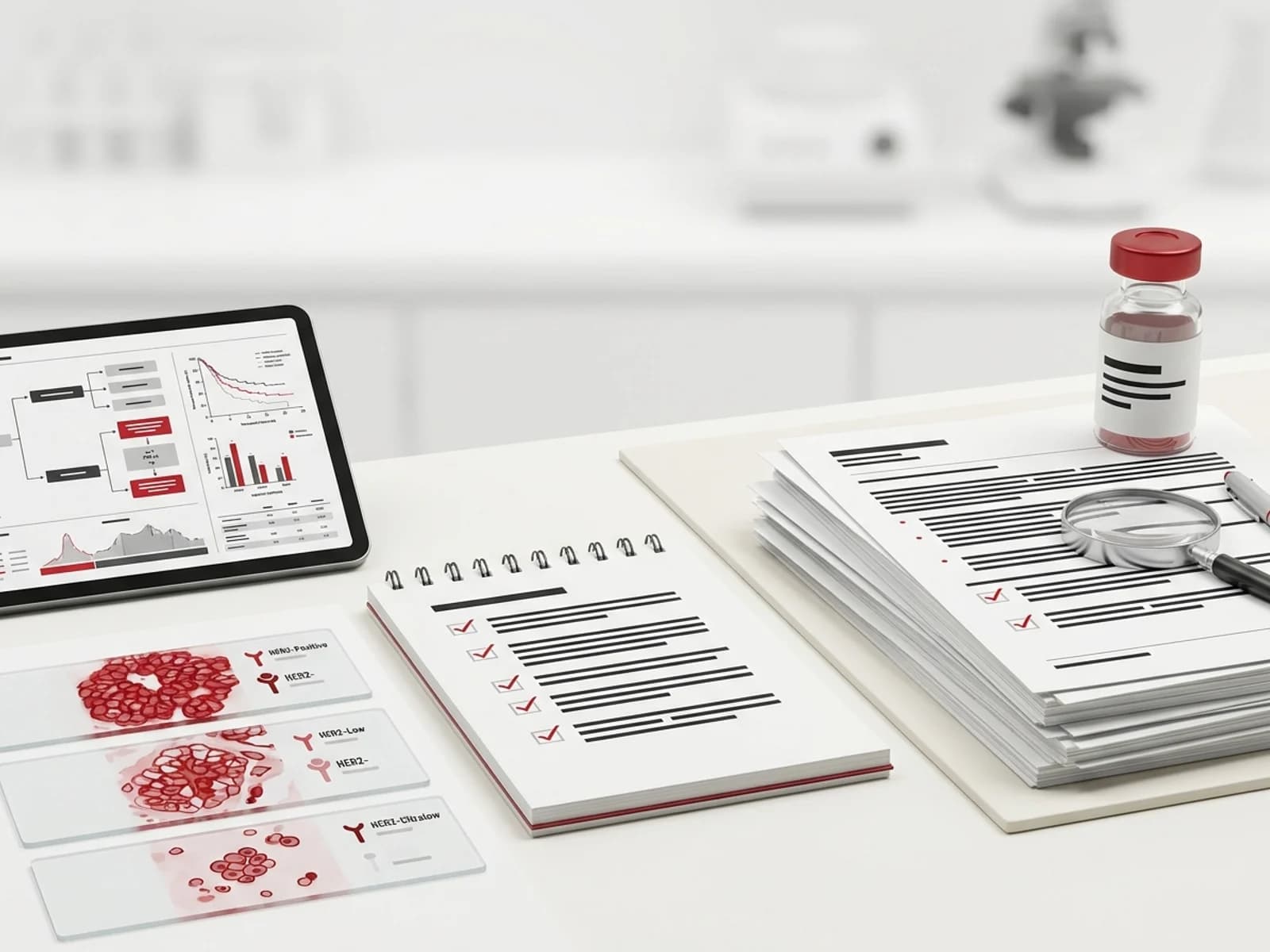
| HER2 status | Definition | Qualifying indications |
|---|---|---|
| HER2-positive | IHC 3+ or ISH-positive | HER2+ mBC (all lines), HER2+ gastric, HER2+ solid tumors, early-stage BC |
| HER2-low | IHC 1+ or IHC 2+/ISH-negative | HER2-low mBC (both HR+ and HR-) |
| HER2-ultralow | IHC 0 with membrane staining | HR+ mBC after endocrine therapy |
| True HER2-negative (IHC 0) | No membrane staining or <10% tumor cells with faint/barely perceptible membrane staining | Not currently eligible |
Companion diagnostics
FDA requires an FDA-authorized companion diagnostic for all Enhertu indications:
PATHWAY anti-HER-2/neu (4B5) Rabbit Monoclonal Primary Antibody (Ventana/Roche): IHC testing for HER2-positive, HER2-low, and HER2-ultralow
VENTANA HER2 Dual ISH DNA Probe Cocktail: ISH confirmation for equivocal IHC 2+ results
Oncomine Dx Target Test and Guardant360 CDx: HER2 (ERBB2) mutation testing for NSCLC
The 4B5 assay was specifically approved in January 2025 to identify HER2-ultralow (IHC 0 with membrane staining) patients. Pathology reports must include the specific IHC score, not just "HER2-negative."
Testing variability concern
Central analysis in DESTINY-Breast06 found that nearly two-thirds of patients previously classified as IHC 0 at local laboratories were reclassified as HER2-low or HER2-ultralow. Access teams should:
Request central laboratory re-review when local IHC reads are IHC 0, particularly if membrane staining is noted in the pathology narrative
Include the actual pathology report (not a summary note) with PA submissions
Document the specific assay used (Ventana 4B5 is preferred by most payers for HER2-low/ultralow)
HCPCS coding and billing
J9358
J9358: Injection, fam-trastuzumab deruxtecan-nxki, 1 mg (permanent since July 1, 2020)
1 billable unit = 1 mg
NDC: 65597-0406-01 (100 mg single-dose vial, 11-digit zero-filled)
100 mg vial = 100 billing units
Unit calculation examples
| Patient weight | Dose (5.4 mg/kg) | Billing units | Dose (6.4 mg/kg) | Billing units |
|---|---|---|---|---|
| 60 kg | 324 mg | 324 | 384 mg | 384 |
| 70 kg | 378 mg | 378 | 448 mg | 448 |
| 80 kg | 432 mg | 432 | 512 mg | 512 |
| 90 kg | 486 mg | 486 | 576 mg | 576 |
Administration and revenue codes
| Code | Description |
|---|---|
| 96365 | IV infusion, up to 1 hour |
| 96366 | Each additional hour |
| 0636 | Revenue code — drugs requiring detailed coding |
JW/JZ modifiers
Medicare requires JW/JZ modifiers for discarded drug from single-use vials. Given the weight-based dosing, most administrations will have some waste — the JZ modifier attests to no discarded drug from a given vial; JW reports discarded amounts.
Key coding notes
Enhertu is not substitutable with trastuzumab (Herceptin) or ado-trastuzumab emtansine (Kadcyla). Claims must use J9358 exclusively.
Some Medicaid programs (e.g., NC Medicaid) may still require J9999 (not otherwise classified) rather than J9358 — verify payer-specific requirements.
The ICD-10 code Z17.31 (HER2-positive malignancy status) was effective October 1, 2024 and should be appended to the primary cancer diagnosis code.
Indication-specific PA criteria
HER2-positive metastatic breast cancer (2nd-line monotherapy)
Most payers require:
Confirmed HER2-positive status (IHC 3+ or ISH+) via FDA-authorized test
Prior anti-HER2-based regimen in metastatic setting, or recurrence during/within 6 months of adjuvant therapy
No concurrent use with Kadcyla or other HER2-directed ADCs
Prescribed by or in consultation with a medical oncologist
HER2-positive mBC with pertuzumab (1st-line, Dec 2025)
This is the newest indication. Many payer policies are still updating. Expected criteria:
Unresectable or metastatic HER2-positive (IHC 3+ or ISH+) breast cancer
No prior systemic therapy for metastatic disease (first-line)
Baseline LVEF within normal limits
This is a Category 1 NCCN preferred regimen
HER2-low metastatic breast cancer
Two sub-indications with different PA criteria:
HR-negative HER2-low mBC: prior chemotherapy in metastatic setting or recurrence during/within 6 months of adjuvant chemo
HR-positive HER2-low/ultralow mBC (DESTINY-Breast06): progression on one or more endocrine therapies in the metastatic setting. Key differentiator: no prior chemotherapy required — this moves Enhertu earlier in the treatment sequence for HR+ patients.
HER2-mutant NSCLC
Confirmed HER2 (ERBB2) activating mutation via FDA-approved companion diagnostic (Oncomine Dx Target Test or Guardant360 CDx)
Prior systemic therapy for metastatic disease
This is an accelerated approval — continued approval may depend on confirmatory trial results
HER2-positive solid tumors (tumor-agnostic)
HER2-positive (IHC 3+) unresectable or metastatic solid tumor
Prior systemic treatment
No satisfactory alternative treatment options
This is also an accelerated approval
HER2-positive gastric/GEJ adenocarcinoma
Confirmed HER2-positive (IHC 3+ or IHC 2+/ISH+) gastric or GEJ adenocarcinoma
Prior trastuzumab-based regimen
Dosing: 6.4 mg/kg q3w (not 5.4 mg/kg)
Early-stage breast cancer (May 2026)
Two separate indications approved May 15, 2026:
Neoadjuvant: HER2-positive (IHC 3+ or ISH+) Stage II or III, followed by THP (taxane + trastuzumab + pertuzumab)
Adjuvant for residual disease: HER2-positive patients with residual invasive disease after neoadjuvant HER2-targeted treatment
Payer policies are expected to update through mid-2026.
Payer formulary positioning
Aetna
Aetna Clinical Policy Bulletin 0966 covers Enhertu with indication-specific criteria. HCPCS J9358 covered when selection criteria are met. Authorization typically 6 months, renewable.
UnitedHealthcare
Enhertu is on the medical benefit under the oncology injectable drug policy. Prior authorization required. Site-of-care edits may apply — some plans restrict administration to non-hospital outpatient settings.
Humana
Tier 4 specialty drug. PA via Availity portal. Standard review 7 business days, expedited 72 hours. Authorization length 6 months. ICD-10 Z17.31 (HER2 status) required alongside the primary cancer diagnosis code.
EmblemHealth/ConnectiCare
Policy MG.MM.PH.210: 6-month authorization. Maximum 600 billable units every 21 days for breast/NSCLC indications. Requires LVEF documentation at baseline.
Kaiser Permanente (Washington)
Effective September 2025, quantity limits updated for Enhertu. Must be administered in non-hospital setting per site-of-care policy. Prior authorization required.
Carelon/eviCore
Enhertu is listed as the second-line preferred regimen for HER2+ mBC and HER2-low mBC in their Cancer Treatment Pathways workbook. Pathway compliance may reduce PA friction.
ILD monitoring and documentation
Interstitial lung disease (ILD) and pneumumonitis are the most serious safety concern. The label includes a Boxed Warning:
5.4 mg/kg: ILD occurred in 12% of patients; fatal in 1.0%. Median onset: 5.5 months (range 0.9–31.5)
6.4 mg/kg: ILD occurred in 10% of patients; fatal in 0.8%. Median onset: 2.8 months (range 1.2–21)
ILD monitoring protocol
| Grade | Action |
|---|---|
| Grade 1 (asymptomatic, imaging only) | Interrupt Enhertu. If resolves within 28 days, maintain dose. If >28 days, reduce one level. Start corticosteroids |
| Grade 2 (symptomatic) | Permanently discontinue. Start corticosteroids immediately |
| Grade 3–4 | Permanently discontinue. Start corticosteroids immediately |
Payers increasingly require documentation of an ILD monitoring plan as part of PA:
Baseline chest CT before initiating therapy
Regular symptom assessment (cough, dyspnea, fever) at each visit
Imaging protocol for new respiratory symptoms
Prescriber attestation of awareness of ILD risk and monitoring commitment
Other safety monitoring
Neutropenia: Grade 3–4 in 19% of patients. CBC required before each dose.
Left ventricular dysfunction: LVEF decrease in 4.6% (monotherapy) and 11% (with pertuzumab). Baseline and regular echocardiogram/MUGA required.
ENHERTU4U patient support
Contact
Phone: 1-833-ENHERTU (1-833-364-3788)
Website: enhertu4u.com
Fax: 1-866-760-5917
Benefit investigation
Completed within 1 business day of enrollment. Provides PA requirements, forms, and specialty pharmacy coordination.
Copay assistance
For commercially insured patients:
$0 per dose for eligible patients
Annual benefit up to $26,000 per calendar year
Covers drug cost and up to $100 in infusion administration costs per administration
No income requirements
Not available for Medicare, Medicaid, VA, or TRICARE
Exclusions: Massachusetts, Michigan, Minnesota, and Rhode Island residents not eligible for infusion assistance
Free limited supply
For eligible patients experiencing a coverage delay of more than 5 business days, Enhertu may be provided at no cost while PA is resolved.
Patient Assistance Program (PAP)
For qualifying uninsured or underinsured patients:
Free Enhertu for up to 1 year, renewable
Shipped to prescriber's office (IV drug with special handling requirements)
Income-based eligibility criteria
Independent foundations
HealthWell Foundation: 866-316-7263
Patient Access Network (PAN) Foundation
The Assistance Fund (TAF)
CancerCare
Documentation checklist for PA submission
HER2 test results: Original pathology report showing IHC score and/or ISH result from an FDA-authorized assay. For HER2-low/ultralow, include Ventana 4B5 report with exact IHC description.
ICD-10 codes: Primary cancer diagnosis (C50.- for breast, C16.- for gastric, C34.- for NSCLC, site-specific for solid tumors) plus Z17.31 (HER2-positive status) where applicable.
Prior therapy documentation: Drug name, dose, start/stop dates, reason for discontinuation for each prior therapy. For HER2-low HR+ mBC, document endocrine therapy progression specifically.
LVEF results: Baseline echocardiogram or MUGA within normal limits.
CBC results: Baseline neutrophil count.
ILD screening plan: Baseline chest CT, monitoring protocol attestation.
Specialist attestation: Prescribed by or in consultation with a medical oncologist.
Companion diagnostic report: Required for all indications — include the specific test name (4B5, Oncomine, Guardant360).
Key takeaways for access teams
HER2-ultralow (IHC 0 with membrane staining) is now an actionable category since January 2025. Request re-review of IHC 0 pathology, especially if membrane staining is described in the narrative.
DESTINY-Breast06 moved Enhertu earlier in the HR+ treatment sequence — patients need only endocrine therapy failure, not chemotherapy failure, qualifying a larger population.
The tumor-agnostic and NSCLC indications are accelerated approvals — payer criteria may be more restrictive, and continued approval depends on confirmatory data.
ILD monitoring documentation is increasingly a PA requirement, not just a clinical best practice. Include a baseline chest CT protocol with every submission.
Early-stage breast cancer indications (May 2026) are brand-new — payer policies will be updating through mid-2026. Check plan-specific criteria frequently.
ENHERTU4U copay assistance covers up to $26,000/year for commercially insured patients, which can offset the 20% Medicare Part B coinsurance for those with commercial secondary coverage.
Sources
FDA. FDA Approves Fam-trastuzumab Deruxtecan-nxki for HER2-Positive Early-Stage Breast Cancer. May 15, 2026. https://www.fda.gov/drugs/resources-information-approved-drugs/fda-approves-two-separate-indications-fam-trastuzumab-deruxtecan-nxki-her2-positive-early-stage
FDA. FDA Approves Fam-trastuzumab Deruxtecan-nxki With Pertuzumab for HER2-Positive mBC. December 15, 2025. https://www.fda.gov/drugs/drug-approvals-and-databases/fda-approves-fam-trastuzumab-deruxtecan-nxki-pertuzumab-unresectable-or-metastatic-her2-positive
FDA. FDA Approves Fam-trastuzumab Deruxtecan-nxki for HR+, HER2-Low/HER2-Ultralow mBC. January 27, 2025. https://www.fda.gov/drugs/resources-information-approved-drugs/fda-approves-fam-trastuzumab-deruxtecan-nxki-unresectable-or-metastatic-hr-positive-her2-low-or-her2
Daiichi Sankyo / AstraZeneca. Enhertu Prescribing Information. BLA 761139. https://www.accessdata.fda.gov/drugsatfda_docs/label/2024/761139s028lbl.pdf
Aetna. Fam-trastuzumab Deruxtecan-nxki (Enhertu) Clinical Policy Bulletin. CPB 0966. https://www.aetna.com/cpb/medical/data/900_999/0966.html
EmblemHealth/ConnectiCare. Enhertu Policy. MG.MM.PH.210. https://www.emblemhealth.com/content/dam/global/pdfs/provider/enterprise-policies/enhertu.pdf
ENHERTU4U. Coding and Reimbursement Guide. https://www.enhertu4u.com/hcp/coding-and-reimbursement.html
BuyandBill.com. Enhertu J9358 Code and Cost. https://buyandbill.com/enhertu-j9358
Bardia A, et al. Trastuzumab Deruxtecan after Endocrine Therapy in Metastatic Breast Cancer. N Engl J Med. 2024;391:2110-2122. https://pubmed.ncbi.nlm.nih.gov/
NCCN Clinical Practice Guidelines in Oncology: Breast Cancer, NSCLC, Gastric Cancer. https://www.nccn.org