Padcev (enfortumab vedotin-ejfv) is a Nectin-4-directed antibody-drug conjugate (ADC) from Astellas and Pfizer. Its monomethyl auristatin E (MMAE) payload — a microtubule-disrupting agent — is linked to a humanized anti-Nectin-4 IgG1 antibody via a protease-cleavable valine-citrulline linker. Nectin-4 is overexpressed in most urothelial carcinomas. After binding, the ADC is internalized and MMAE is released, causing cell-cycle arrest and apoptosis.
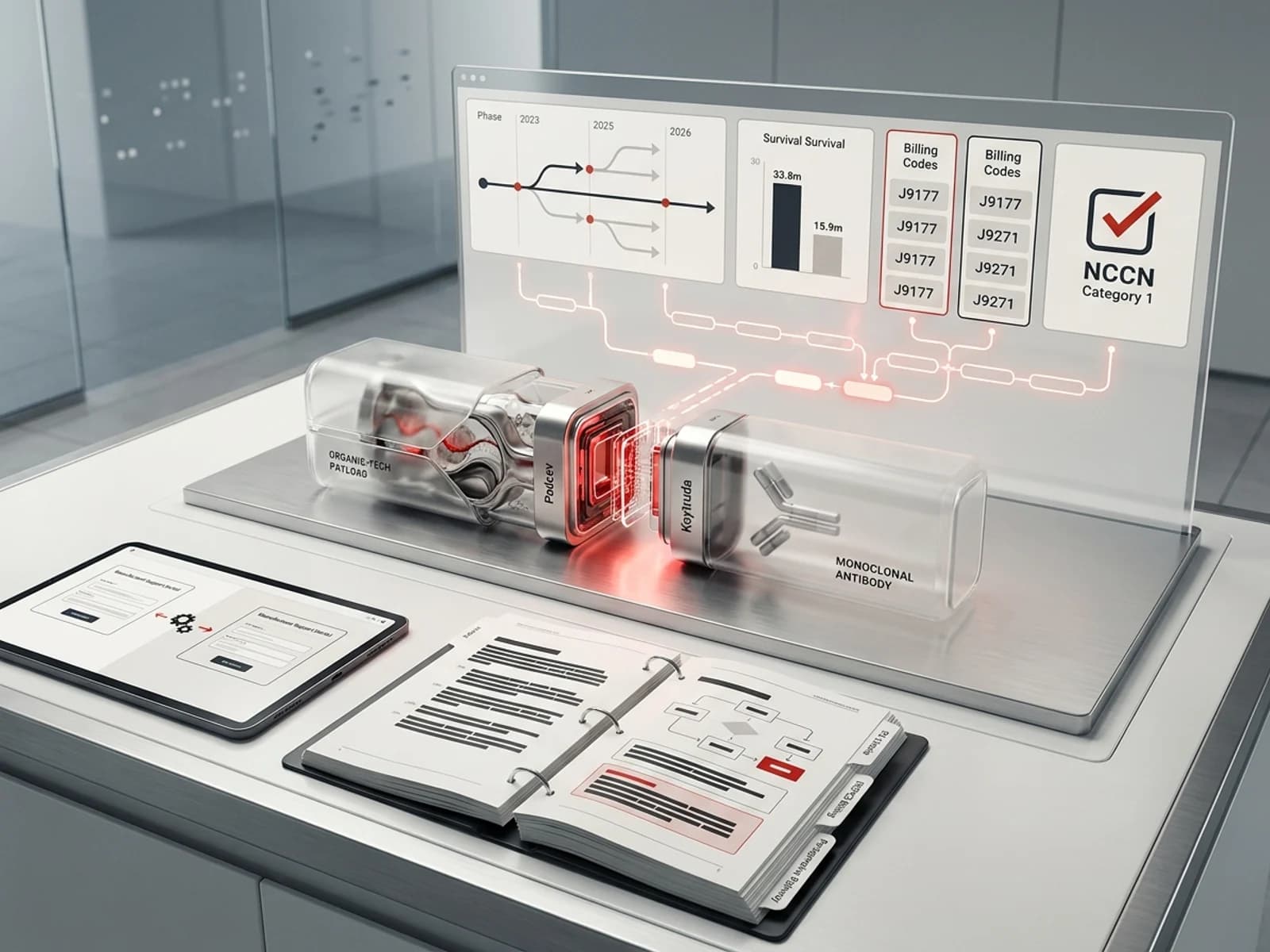
The combination of Padcev with Keytruda (pembrolizumab, Merck), a PD-1 inhibitor, received FDA approval in December 2023 for first-line locally advanced or metastatic urothelial cancer (la/mUC), based on the EV-302/KEYNOTE-A39 trial. With 26 months of follow-up, the combination demonstrated a median overall survival of 33.8 months versus 15.9 months for chemotherapy, a median progression-free survival of 12.5 months versus 6.3 months, and an approximately 30% complete remission rate. In November 2025, the FDA approved the combination for perioperative treatment (neoadjuvant followed by adjuvant after cystectomy) of muscle-invasive bladder cancer (MIBC) in cisplatin-ineligible patients, based on the EV-303/KEYNOTE-905 trial showing a 60% reduction in recurrence, progression, or death.
In April 2026, the FDA accepted a second sBLA under priority review for perioperative use in cisplatin-eligible MIBC patients, based on the EV-304/KEYNOTE-B15 trial showing a 47% reduction in recurrence risk and a 55.8% pathological complete response rate versus 32.5% for chemotherapy.
Padcev is also approved as a single agent for previously treated la/mUC. Access teams must navigate regimen-level PA (two drugs, two HCPCS codes, two manufacturers' support programs), evolving perioperative indications, NCCN category 1 first-line placement, and site-of-care requirements.
Short answer
| Padcev + Keytruda regimen | |
|---|---|
| Drug class | Nectin-4-directed ADC + PD-1 inhibitor |
| Manufacturers | Astellas/Pfizer (Padcev) + Merck (Keytruda) |
| Padcev FDA first approval | December 2019 (accelerated, single agent) |
| Combination FDA approval | December 15, 2023 (la/mUC); November 21, 2025 (perioperative MIBC, cisplatin-ineligible) |
| Padcev dosing — combination | 1.25 mg/kg IV (max 125 mg for ≥100 kg) on days 1 and 8 of 21-day cycle |
| Keytruda dosing — combination | 200 mg IV every 3 weeks or 400 mg every 6 weeks |
| Padcev HCPCS | J9177 (Injection, enfortumab vedotin-ejfv, 0.25 mg) |
| Keytruda HCPCS | J9271 (Injection, pembrolizumab, 1 mg) |
| Benefit channel | Medical benefit (buy-and-bill) for both drugs |
| Boxed warning (Padcev) | Serious skin reactions (including SJS/TEN) |
| PA required | Yes — regimen-level PA for both drugs |
| Patient support | PADCEV Support Solutions (1-888-402-0627); Merck KEY+YOU |
All FDA-approved indications for Padcev
| Indication | Date | Dose | Trial |
|---|---|---|---|
| Single agent: la/mUC after PD-1/PD-L1 + platinum, or cisplatin-ineligible with ≥1 prior line | Dec 2019 (accelerated); Jul 2021 (regular) | 1.25 mg/kg days 1, 8, 15 of 28-day cycle | EV-201/EV-301 |
| Combination with pembrolizumab: la/mUC (first-line) | Dec 2023 | 1.25 mg/kg days 1, 8 of 21-day cycle + pembro q3w | EV-302/KEYNOTE-A39 |
| Perioperative with pembrolizumab: MIBC, cisplatin-ineligible | Nov 2025 | Neoadjuvant → cystectomy → adjuvant | EV-303/KEYNOTE-905 |
| Pending: Perioperative with pembrolizumab: MIBC, cisplatin-eligible | Under FDA priority review (PDUFA pending) | Same | EV-304/KEYNOTE-B15 |
Regimen-level prior authorization
The Padcev + Keytruda combination requires separate PA submissions for each drug, but payers evaluate them as a regimen. Key considerations:
First-line la/mUC (combination)
Payer criteria (from Prime Therapeutics IC-0542, Express Scripts, CarelonRx CC-0157, Aetna CPB 0967, CVS Caremark) typically require:
Diagnosis: Locally advanced or metastatic urothelial carcinoma (bladder, upper GU tract, urethra, or prostate)
First-line use: No prior systemic therapy for metastatic disease
Combination requirement: Padcev must be used in combination with pembrolizumab (not as monotherapy for first-line)
Prescriber: Oncologist or urologic oncologist
Authorization duration: 6–12 months depending on payer
Single-agent use (subsequent therapy)
For Padcev monotherapy after prior treatment, criteria require:
Prior PD-1/PD-L1 inhibitor AND platinum-containing chemotherapy, OR
Cisplatin ineligibility AND ≥1 prior line of therapy
Perioperative MIBC
For the November 2025 perioperative indication (cisplatin-ineligible MIBC):
Diagnosis: Muscle-invasive bladder cancer (MIBC) confirmed by pathology
Cisplatin ineligibility: Documented (e.g., renal function, neuropathy, hearing loss)
Treatment plan: Neoadjuvant cycles → planned radical cystectomy → adjuvant cycles
Payer policies for this indication are still being updated as of mid-2026
HCPCS coding and billing
Padcev (J9177)
| Element | Detail |
|---|---|
| HCPCS code | J9177 — Injection, enfortumab vedotin-ejfv, 0.25 mg |
| Billing unit | 0.25 mg per unit |
| Dose example (70 kg patient) | 87.5 mg per infusion = 350 billable units |
| Max units per 84 days | 4,680 billable units (per Prime Therapeutics policy) |
| NDCs | 51144-0020-xx (20 mg vial), 51144-0030-xx (30 mg vial) |
| JW/JZ modifiers | Required for Medicare Part B |
Keytruda (J9271)
| Element | Detail |
|---|---|
| HCPCS code | J9271 — Injection, pembrolizumab, 1 mg |
| Billing unit | 1 mg per unit |
| Dose | 200 mg q3w = 200 billable units per infusion |
| NDC | Multiple presentations (vial and co-pack with Keytruda Qlex) |
Dual-drug billing considerations
Because both drugs are billed under the medical benefit, practices submit two separate drug claims (J9177 and J9271) plus chemotherapy administration codes (96413–96416). The combination is administered on the same day: Padcev IV over 30 minutes, then Keytruda IV over 30 minutes. Ensure the PA covers both drugs for the same date of service.
NCCN guideline positioning
NCCN Bladder Cancer Guidelines (Version 6.2024, updated January 2025) recommend:
Padcev + pembrolizumab: Category 1, first-line preferred regimen for la/mUC
Padcev single agent: Category 2A, subsequent therapy after platinum + CPI
Padcev + pembrolizumab (perioperative): Category 1 for cisplatin-ineligible MIBC (added after November 2025 FDA approval)
The NCCN category 1 designation for the first-line combination is the strongest evidence basis for PA approvals and appeals.
Safety monitoring and payer-relevant documentation
| Monitoring | Why it matters for PA |
|---|---|
| Skin reactions | Boxed warning for SJS/TEN; severe reactions require permanent discontinuation |
| Peripheral neuropathy | Grade ≥3 requires permanent discontinuation; baseline neuropathy assessment needed |
| Hyperglycemia | Padcev can cause hyperglycemia in diabetic and non-diabetic patients; baseline glucose required |
| Ocular disorders | Regular eye exams recommended; dose modification may be needed |
| Infusion site reactions | Monitor during infusion; premedication not required per label but may be used |
Payer policies often require documentation that the patient does not have uncontrolled hyperglycemia or baseline Grade ≥2 peripheral neuropathy before initiating Padcev.
ICD-10 codes
| Code | Description |
|---|---|
| C67.0–C67.9 | Malignant neoplasm of bladder |
| C68.0–C68.9 | Malignant neoplasm of overlapping sites of urinary organs |
| C65.1–C65.9 | Malignant neoplasm of renal pelvis |
| C66.1–C66.9 | Malignant neoplasm of ureter |
| C61 | Malignant neoplasm of prostate (urothelial carcinoma of prostate) |
| D09.0 | Carcinoma in situ of bladder |
| Z85.51 | Personal history of malignant neoplasm of bladder |
Patient support programs
PADCEV Support Solutions (1-888-402-0627)
Benefits investigation and prior authorization support
Coding and billing guidance
Appeals assistance
Quick Start program for eligible patients
Copay assistance for commercially insured patients
Merck KEY+YOU
Keytruda-specific patient support
Copay assistance for commercially insured patients
Benefits investigation and PA support for the Keytruda component
Coordination challenge
Because the regimen involves two manufacturers, access teams must coordinate two separate support programs, two PA submissions, and potentially two copay assistance programs. The Padcev coding and billing guide from Astellas explicitly notes that the combination requires two HCPCS codes and separate billing.
Access friction points
Regimen-level PA complexity: Two drugs, two HCPCS codes, two manufacturers, two PAs — yet payers evaluate as one regimen. If one drug is denied, the entire regimen is blocked. Access teams should submit both PAs simultaneously and cross-reference the companion drug
Dosing schedule differences: Padcev is given days 1 and 8 of a 21-day cycle; Keytruda is given day 1 every 3 weeks. The schedules align on day 1 but diverge on day 8 (Padcev only). PA must reflect the correct dosing frequency for each drug
Perioperative indication adoption: The November 2025 MIBC perioperative approval is new, and many payer policies have not yet been updated. Appeal with EV-303 data may be needed
Single-agent vs. combination criteria confusion: Some policies have separate criteria sections for Padcev as a single agent versus Padcev in combination. Submit under the correct criteria section
Keytruda Qlex compatibility: The FDA label specifies the combination may be used with either IV Keytruda or Keytruda Qlex (subcutaneous pembrolizumab and berahyaluronidase alfa). Payer policies may not yet address Keytruda Qlex in this combination context
Sources
Padcev prescribing information. Astellas Pharma US, Inc. Revised February 2025. Available at: https://www.accessdata.fda.gov/drugsatfda_docs/label/2025/761209s023lbl.pdf
Keytruda prescribing information. Merck & Co., Inc. Available at: https://www.accessdata.fda.gov/drugsatfda_docs/label/2025/125514s148lbl.pdf
FDA approves enfortumab vedotin-ejfv with pembrolizumab for locally advanced or metastatic urothelial cancer. FDA. December 15, 2023. https://www.fda.gov/drugs/resources-information-approved-drugs/fda-approves-enfortumab-vedotin-ejfv-pembrolizumab-locally-advanced-or-metastatic-urothelial
FDA approves pembrolizumab with enfortumab vedotin-ejfv for muscle invasive bladder cancer. FDA. November 21, 2025. https://www.fda.gov/drugs/resources-information-approved-drugs/fda-approves-pembrolizumab-enfortumab-vedotin-ejfv-muscle-invasive-bladder-cancer
EV-302/KEYNOTE-A39: Enfortumab vedotin and pembrolizumab vs chemotherapy in untreated locally advanced or metastatic urothelial cancer. ClinicalTrials.gov. NCT04223856. https://clinicaltrials.gov/ct2/show/NCT04223856
EV-303/KEYNOTE-905: Perioperative enfortumab vedotin plus pembrolizumab for cisplatin-ineligible MIBC. ClinicalTrials.gov. NCT03924895. https://clinicaltrials.gov/ct2/show/NCT03924895
EV-304/KEYNOTE-B15: Perioperative EV plus pembrolizumab vs neoadjuvant chemotherapy for cisplatin-eligible MIBC. ClinicalTrials.gov. NCT04700124. https://clinicaltrials.gov/ct2/show/NCT04700124
Powles T, et al. Enfortumab vedotin and pembrolizumab in untreated locally advanced or metastatic urothelial cancer (EV-302/KEYNOTE-A39). Updated results presented at ASCO GU 2025.
Prime Therapeutics. Padcev medical necessity criteria. IC-0542. Revised March 2025.
CarelonRx. Padcev medical drug clinical criteria. CC-0157. Revised April 2025.
Aetna. Enfortumab vedotin-ejfv clinical policy bulletin. CPB 0967. https://www.aetna.com/cpb/medical/data/900_999/0967.html
NCCN Clinical Practice Guidelines in Oncology: Bladder Cancer. Version 6.2024. https://www.nccn.org/guidelines/guidelines-detail?category=1&id=1448