When a generic developer identifies a target molecule for an Abbreviated New Drug Application (ANDA), the first stop is the FDA Orange Book to locate the Reference Listed Drug (RLD). But in a mature pharmaceutical market, developers frequently discover that the originator brand is no longer actively marketed. Instead, it sits in the Orange Book's "Discontinued Drug Product List."
A discontinued brand does not close the door on generic entry, but it changes the regulatory workflow. Under FDA regulations, an ANDA developer cannot simply select another approved generic as their reference listed drug, nor can they perform bioequivalence testing on a product that is no longer commercially available.
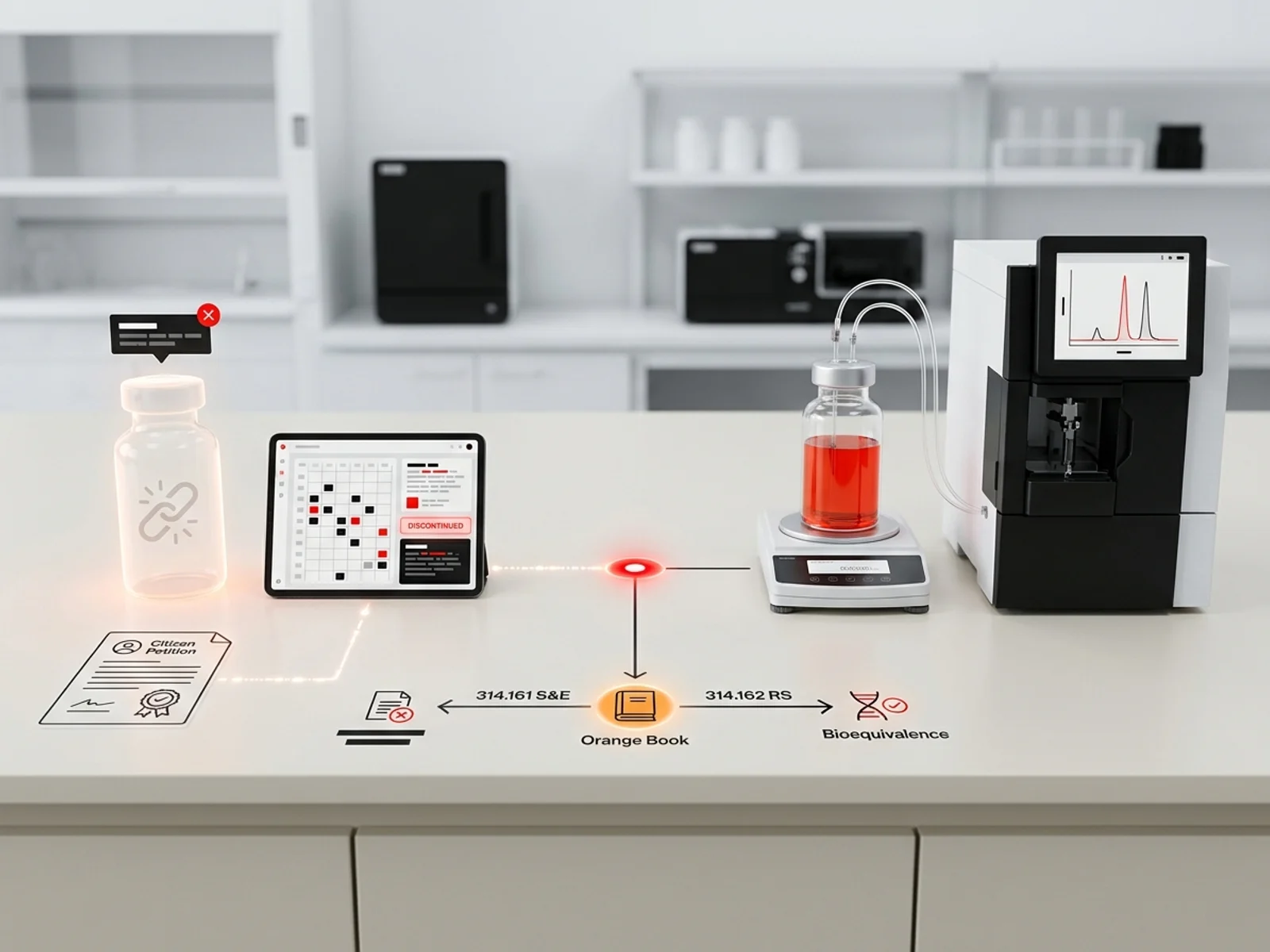
To bring a generic to market when the originator has exited, developers must navigate a dual-pathway regulatory framework: obtaining a safety and effectiveness determination for the discontinued RLD under 21 CFR 314.161, and requesting a Reference Standard (RS) designation under 21 CFR 314.162 for bioequivalence testing.
RLD vs. Reference Standard: The Critical Distinction
In generic drug development, the terms Reference Listed Drug (RLD) and Reference Standard (RS) are often used interchangeably, but they represent entirely distinct regulatory concepts:
Reference Listed Drug (RLD): The specific drug product approved under an NDA (Section 505(c) of the FD&C Act) that the FDA designates as the basis for generic sameness. Generic developers must show that their proposed product is the "same as" the RLD in active ingredient(s), dosage form, route of administration, strength, labeling, and conditions of use. Even if an RLD is discontinued, it remains the RLD for sameness purposes.
Reference Standard (RS): The specific approved drug product selected by the FDA that an ANDA applicant must physically use in conducting in vivo bioequivalence (BE) testing.
When the RLD is actively marketed, it serves as both the RLD and the RS. However, if the RLD is discontinued, developers cannot obtain commercial samples of the brand to test in their clinical bioequivalence trials. To resolve this, the FDA designates an active, marketed generic product to serve as the Reference Standard (RS).
Generic developers must still design their product to match the discontinued RLD (e.g., matching its labeling and drug release profile), but they must conduct their physical bioequivalence studies against the designated Reference Standard (RS).
Discontinuation by the Numbers: An Orange Book Census
To understand how common this scenario is, we conducted an analysis of the FDA Orange Book database (June 2026 snapshot containing 48,215 approved product records). The data reveals that product discontinuation is not an exception; it represents nearly half of the regulatory database:
Total Approved Products: 48,215
Discontinued Products (DISCN Status): 22,903 (47.50% of the database)
Discontinued Reference Listed Drugs (RLDs): 2,995 products
Active RX Products Designated as Reference Standards (RS) but NOT the RLD: 1,304 products
These 1,304 active products represent the "surrogate standards" in the market—approved generic products that developers must now purchase and use in their bioequivalence trials because the originator brand has exited the market.
Several prominent examples of these "RS but not RLD" products are detailed in the table below:
| Active Ingredient | Brand Name (RLD, Discontinued) | Designated Reference Standard (RS, Active Generic) | Strength | RS Sponsor |
|---|---|---|---|---|
| Budesonide (Rectal Foam) | Uceris | Budesonide | 2 mg/actuation | Padagis Israel |
| Betamethasone Valerate (Topical Foam) | Luxiq | Betamethasone Valerate | 0.12% | Taro |
| Clindamycin Phosphate (Topical Gel) | Cleocin T | Clindamycin Phosphate | 1% | Padagis Israel |
| Clobetasol Propionate (Topical Gel) | Temovate | Clobetasol Propionate | 0.05% | Taro |
| Halobetasol Propionate (Topical Cream) | Ultravate | Halobetasol Propionate | 0.05% | Padagis Israel |
| Ketoconazole (Topical Foam) | Extina | Ketoconazole | 2% | Xiromed |
| Beclomethasone Dipropionate (Inhalation Aerosol) | Qvar | Beclomethasone Dipropionate | 0.04 mg / 0.08 mg | Amneal Ireland |
| Duloxetine Hydrochloride (Oral Capsule) | Cymbalta | Duloxetine Hydrochloride | EQ 60 mg Base | Ajanta Pharma |
The 21 CFR 314.161 Safety & Effectiveness (S&E) Determination
The FDA is legally prohibited from approving an ANDA that references a discontinued RLD unless the agency has determined that the RLD was not withdrawn from the market for reasons of safety or effectiveness. This requirement prevents brand manufacturers from avoiding generic competition by voluntarily withdrawing a drug and claiming it no longer exists, while also ensuring generics are not approved if the brand was pulled due to underlying safety hazards.
There are two ways this determination is triggered:
1. Citizen Petition Pathway
Any interested person can submit a Citizen Petition under 21 CFR 10.30 requesting that the FDA determine whether a drug was withdrawn for safety or effectiveness.
Requirements: The petitioner must state the request clearly, identify the drug's application number, and provide any available public information or literature supporting the claim that the withdrawal was commercial rather than safety-related.
The 180-Day Reality Check: Under federal rules, the FDA has 180 days to respond to a Citizen Petition. In practice, however, the FDA rarely issues a substantive final determination in this window. Instead, the agency routinely issues a "tentative response" stating that it has been unable to reach a decision due to competing priorities or complexity. A final decision can remain pending for years, making it critical for developers to submit these petitions early in the product selection phase.
2. FDA Self-Initiation
The FDA can make safety and effectiveness determinations on its own initiative. The agency frequently does this in batches to clear administrative backlogs or when it notices a pending ANDA that has reached the final stages of review but lacks an S&E determination. If the FDA determines a drug was not withdrawn for safety or efficacy, it publishes a notice in the Federal Register.
If the FDA determines that the brand was indeed withdrawn due to safety or efficacy defects:
The drug is removed from the Orange Book.
Pending ANDAs referencing it will be denied.
Already-approved ANDAs referencing it may have their approvals suspended.
Requesting a Reference Standard Designation
If a developer wants to target a discontinued RLD but finds that the FDA has not designated a Reference Standard (RS) in the Orange Book, or if the designated RS is in short supply, they cannot proceed with bioequivalence testing.
To resolve this, the developer must submit a Controlled Correspondence to the FDA.
It is a common regulatory error to submit a Citizen Petition to request a Reference Standard designation. The table below outlines the boundaries between these two communication channels:
| Feature / Scenario | Citizen Petition (21 CFR 10.30) | Controlled Correspondence |
|---|---|---|
| Primary Purpose | Safety and effectiveness (S&E) determination of a discontinued RLD under 21 CFR 314.161. | Requesting designation of an RS, or querying BE study design when the standard is limited. |
| Submission Pathway | Electronic Submission via Regulations.gov (Dockets Management Staff). | FDA CDER Direct Portal. |
| Typical Target | The RLD application status. | The bioequivalence testing standard (RS). |
| Timeline | 180 days (procedural goal; often results in a tentative response). | 60 to 120 days depending on complexity (GDUFA II / III goals). |
| Public Visibility | Publicly posted docket; competitors can see your target molecule. | Confidential between applicant and FDA until designated. |
When requesting a new RS designation via Controlled Correspondence, the developer should suggest a candidate product (usually the generic market leader based on volume or approval date) and provide justification, such as proof of commercial availability and manufacturing capacity.
Alternative Bioequivalence Strategies
What happens when the designated Reference Standard is also discontinued or facing severe supply-chain shortages? Under FDA GDUFA guidelines, developers have several alternative pathways to establish bioequivalence:
Authorized Generics: An applicant may use an authorized generic (a drug product approved under the brand’s original NDA but marketed without the brand name) as the reference standard for in vivo BE testing.
Alternative Strengths or Formulations: If the designated RS is unavailable in the target strength but available in a lower strength, developers can perform the in vivo BE study on the available strength and request a biowaiver for the target strength, supported by in vitro dissolution profiling.
Scientific Bridging and Modeling: For complex dosage forms where physical reference standards are entirely absent, developers may propose alternative bioequivalence methods. This includes in vitro characterization studies, physiologically based pharmacokinetic (PBPK) modeling, or quantitative methods to bridge historical data of the discontinued product. Such strategies must be negotiated with CDER via a pre-ANDA meeting.
The Generic Developer's Decision Workflow
To minimize regulatory delay, generic developers should follow this structured decision matrix when evaluating a target drug with a discontinued brand:
Work the four gates in order, because each one is a hard blocker for the next:
Identify the target discontinued RLD in the Orange Book. Confirm the NDA/ANDA number and that the product sits in the Discontinued Drug Product List.
Gate 1 — Is a Reference Standard already designated in the Orange Book?
No → Submit Controlled Correspondence requesting an RS designation (suggest the generic market leader and justify commercial availability).
Yes → go to Gate 2.
Gate 2 — Is the designated RS commercially available in sufficient quantity for an in vivo BE study?
No → Submit Controlled Correspondence requesting selection of a new RS (or propose an authorized generic / alternate strength with a biowaiver).
Yes → go to Gate 3.
Gate 3 — Has FDA issued a Safety & Effectiveness determination under 21 CFR 314.161? (Check the discontinued-section footnote and the Federal Register.)
Yes → proceed to Gate 4.
No → go to Gate 4 and trigger the determination yourself.
Gate 4 — File (or join) the Citizen Petition.
Pending petition already on the docket → reference its FDA-assigned docket number in your ANDA so your application is held rather than refused, then proceed.
No petition on file → submit a Citizen Petition under 21 CFR 10.30 requesting the S&E determination immediately, then reference it in the ANDA once received.
Proceed. With the RS secured and the S&E determination in motion, run the in vivo bioequivalence studies against the designated RS while designing your product and labeling to match the discontinued RLD.
By separating the sameness comparison (referenced to the RLD) from the physical bioequivalence testing (conducted against the active RS), and by submitting Citizen Petitions and Controlled Correspondence early in the development cycle, generic sponsors can successfully commercialize products even after the originator has abandoned the market.
This article is an informational regulatory explainer and does not constitute legal advice, regulatory consulting, or a recommendation for any specific ANDA filing, product, or applicant. Reference Listed Drug and Reference Standard designations, Citizen Petition and Controlled Correspondence procedures, and GDUFA performance goals change; always verify the current Orange Book record, the Code of Federal Regulations, and the applicable FDA guidance before acting.
Sources
21 CFR § 314.161 - Determination of whether a listed drug was withdrawn from sale for reasons of safety or effectiveness. https://www.ecfr.gov/current/title-21/chapter-I/subchapter-D/part-314/subpart-D/section-314.161
21 CFR § 314.162 - Approval of an application for a duplicate of a listed drug. https://www.ecfr.gov/current/title-21/chapter-I/subchapter-D/part-314/subpart-D/section-314.162
FDA Guidance for Industry - Referencing Approved Drug Products in ANDA Submissions (October 2020). https://www.fda.gov/media/108398/download
FDA Guidance for Industry - Controlled Correspondence Related to Generic Drug Development (December 2020). https://www.fda.gov/media/164111/download
US FDA, Approved Drug Products with Therapeutic Equivalence Evaluations (Orange Book) - products file, run date June 10, 2026; aggregates computed by PharmaDossier from the public Orange Book extract. https://www.accessdata.fda.gov/scripts/cder/ob/default.cfm
FDA, ANDA approval letter, Beclomethasone Dipropionate HFA Inhalation Aerosol (ANDA 213811) - documents the discontinued QVAR RLD, the Federal Register S&E determination (84 FR 13298), and the Amneal generic as the marketed reference. https://www.accessdata.fda.gov/drugsatfda_docs/appletter/2026/213811Orig1s000ltr.pdf