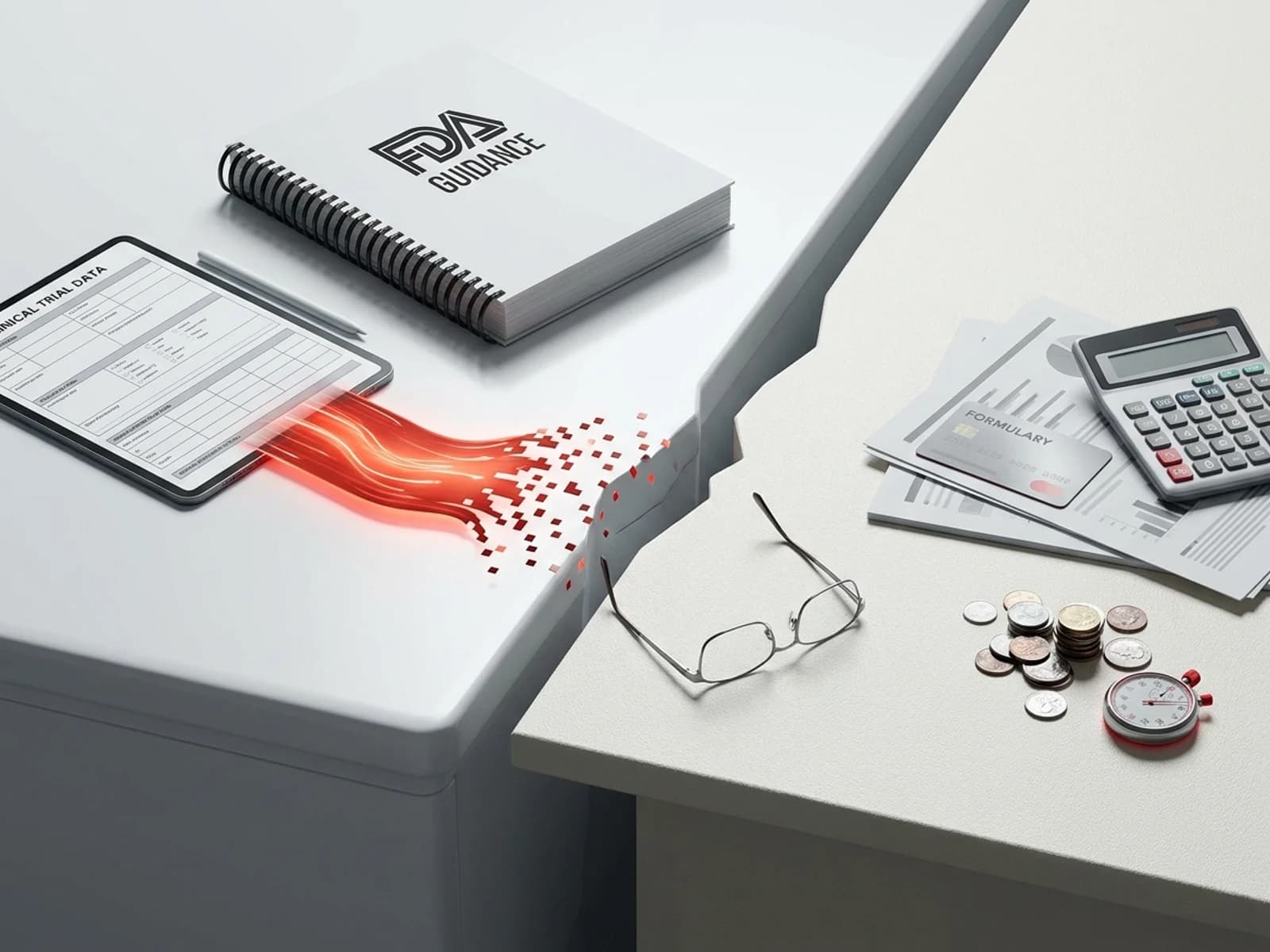
The AMCP Format for Formulary Submissions, now in Version 5.0 with Version 6.0 in public comment through April 2026, is the closest thing the U.S. market has to a standard evidence submission framework for payer review. Manufacturers use it to compile clinical, economic, and humanistic evidence into dossiers that health care decision-makers (HCDMs) evaluate during formulary reviews, coverage determinations, and reimbursement negotiations. But the Format is advisory, not mandatory, and the quality and completeness of submitted dossiers varies widely.
Payer feedback is consistent and unsparing: dossiers are too long, missing critical evidence, and lack transparency in their methodology. An ISPOR poster presented by Streeton and Lodowski found that 89% of surveyed payers identified transparency of evidence and methodology as the most important factor in a high-quality dossier, followed by a clear value proposition (78%) and brevity (78%). The same survey found that only 11% of payers were "extremely knowledgeable" about the Version 5.0 update released in April 2024, and 22% were not aware of the new version at all.
This article is for market access directors, medical affairs leads, health economics and outcomes research (HEOR) teams, and commercial operations staff who prepare or oversee AMCP dossiers for new specialty drug launches.
The AMCP Format framework
What the Format covers
The AMCP Format organizes the dossier into six core sections:
| Section | Content | Payer expectation |
|---|---|---|
| 1.0 Product information | FDA approval status, indications, dosing, mechanism of action | Baseline context; should be concise |
| 2.0 Disease background | Epidemiology, treatment landscape, unmet need | Brief; 1–2 pages per disease |
| 3.0 Clinical evidence | Pivotal trials, safety data, comparative effectiveness | Core of the review; must include head-to-head data or rigorous indirect comparisons |
| 4.0 Economic model | Cost-effectiveness analysis, budget impact model | Must be transparent, reproducible, and reflect the plan's population |
| 5.0 Other evidence | Patient-reported outcomes, real-world evidence, systematic reviews | Increasingly important; Version 5.0 added RWE guidance |
| 6.0 Summary and value proposition | Key takeaways, formulary recommendation | Must be concise; payers report this is where most dossiers fail |
Version 5.0, released in April 2024, added guidance on digital therapeutics, health disparities, pre-approval information exchange (PIE) documents, real-world evidence, and the need for brevity. AMCP opened public comment on Version 6.0 through April 22, 2026.
How dossiers reach payers
Manufacturers cannot proactively send AMCP dossiers to formulary decision-makers. Dossiers are shared reactively: either through the FormularyDecisions.com platform, in response to an unsolicited request from a health plan's P&T committee, or through PIE interactions for pre-approval evidence exchange. This means the dossier must be complete and current when it is requested, because the payer will evaluate whatever is provided without the opportunity for interactive follow-up in many cases.
Trinity Life Sciences surveyed U.S. payers on the real-world utility of AMCP dossiers and found that while the framework provides a systematic structure, questions persist about how much influence dossiers actually exert on final formulary decisions. Payers reported that they supplement dossier evidence with their own internal analyses, third-party assessments from organizations like the Institute for Clinical and Economic Review (ICER), and clinical practice guidelines.
The six evidence gaps that weaken payer review
Gap 1: Missing or insufficient comparator data
Payers expect head-to-head clinical evidence against the principal comparators in their formulary. For a new specialty drug entering a crowded therapeutic class (IL-23 inhibitors, TNF inhibitors, GLP-1 receptor agonists), the dossier must address how the new product compares to the drugs that the payer's members are currently using. The AMCP Format explicitly states: "The HCDM is particularly interested in head-to-head clinical studies between the proposed product and the principal comparators."
Common deficiencies include:
No active comparator data: The pivotal trial compared the new drug to placebo, but payers need to know how it performs against the standard of care.
Indirect treatment comparisons without proper methodology: When head-to-head trials do not exist, manufacturers may present network meta-analyses or Bucher indirect comparisons. Payers reject these when the methodology is not transparent, when cross-trial heterogeneity is not addressed, or when the analysis relies on assumptions that favor the manufacturer's product.
Comparator selection bias: Dossiers that compare the new drug only to weaker or older alternatives, rather than to the current market leaders, are viewed as promotional rather than evidentiary.
Gap 2: Economic models that cannot be reproduced
The economic model is typically the most scrutinized section of the dossier. Payers expect to be able to understand and, in some cases, reproduce the model's outputs. Common gaps include:
Black-box models: The model structure, inputs, and assumptions are not disclosed in sufficient detail for the payer to verify the results. ISPOR's survey found that transparency of methodology was the single most important factor in payer evaluation, cited by 89% of respondents.
Plan-population mismatch: The model uses a clinical trial population that does not reflect the payer's enrolled population. For example, a model based on a trial that excluded patients with common comorbidities may overstate effectiveness for a real-world Medicare Advantage population.
Unrealistic cost inputs: Drug acquisition costs, administration costs, adverse-event management costs, and monitoring costs that do not reflect the payer's contracted rates or the site-of-care distribution in their network.
Time horizons that obscure long-term costs: Models with short time horizons that capture the drug's benefit period but not the downstream costs of treatment failure, disease progression, or switching.
Version 5.0 encourages the use of the AMCP eModel platform powered by Digital Health Outcomes (DHO) for communicating health economic models, which allows payers to interact with the model directly rather than reviewing static tables.
Gap 3: Absence of real-world evidence
Version 5.0 added explicit guidance on incorporating real-world evidence (RWE) into dossiers, reflecting payer demand for evidence beyond the randomized controlled trial setting. Common RWE gaps include:
No external validity bridge: The dossier does not address how the pivotal trial population differs from the real-world population that the payer covers.
No early real-world data: For products that have been on the market in other countries or in limited U.S. launch settings, payers expect to see early utilization, persistence, and outcomes data.
Missing subgroup analyses: Payers with specific demographic or clinical composition (e.g., high Medicaid or dual-eligible populations) need subgroup data that the pivotal trial may not have been powered to generate.
AMCP's RWE Standards, published separately from the Format, provide guidance on what constitutes credible real-world evidence for payer decision-making. Manufacturers should align their RWE generation plans with these standards well before launch.
Gap 4: Unclear or missing value proposition
The AMCP Format Section 6.0 is the summary and value proposition. Payer surveys consistently report that this section is where dossiers fail most often. The ISPOR poster found that the most common limitations cited by payers were "too long or cumbersome," "missing or insufficient evidence," "lack of clear value story or summary of key takeaways," and "lack of transparency in evidence and/or methodology."
Specific failures include:
No clear positioning statement: The dossier does not explicitly state where the product fits in the treatment algorithm and why a payer should prefer it over existing options.
Confusing cost-effectiveness results: Incremental cost-effectiveness ratios (ICERs) presented without context, or with selective framing that obscures unfavorable comparisons.
Overly promotional language: Dossiers that read like marketing materials rather than evidence summaries undermine credibility with P&T committees.
Missing financial implications: No clear estimate of the budget impact for the payer's specific population, including the cost of displaced therapies and any anticipated utilization management savings.
Gap 5: Health disparities and subpopulation data
Version 5.0 added guidance on addressing health disparities in dossiers. This is increasingly important as payers face regulatory and accreditation pressure to demonstrate equitable access and outcomes. Common gaps include:
No representation data: The dossier does not report the demographic composition of the pivotal trial population, making it impossible for the payer to assess whether the evidence applies to their members.
No subgroup analyses by race, ethnicity, or socioeconomic status: For conditions with documented disparities in treatment outcomes, the absence of subgroup data is a significant gap.
No access or affordability analysis: The dossier does not address how the product's cost and distribution model will affect access for underserved populations.
Gap 6: Brevity and streamlining failures
Version 5.0 explicitly encouraged brevity and streamlining of dossiers. ISPOR's survey found that 78% of payers identified overall brevity and concision as a key quality factor. Yet many dossiers continue to run hundreds of pages with redundant information across sections.
Common structural problems:
Duplicate content: Information presented in Section 3.0 (clinical evidence) is repeated verbatim in Section 6.0 (summary) without synthesis.
Excessive appendix material: Long appendices of published studies without curated summaries or relevance annotations.
No executive summary: The dossier lacks a one- to two-page executive summary that a P&T committee member can review in the 15 minutes typically allocated to a new drug review.
Trinity's payer survey noted that HCDMs increasingly rely on concise, curated evidence rather than encyclopedic compilations. The most effective dossiers are those that anticipate the P&T committee's decision framework and present evidence organized around the specific questions the committee will ask.
What launch teams should do differently
Start the dossier early and align it with payer research
The AMCP Format provides for pre-approval information exchange (PIE), which allows manufacturers to share clinical and economic evidence with payers before FDA approval under specific conditions. Launch teams should:
Develop the PIE document in parallel with the Phase 3 program, not after FDA approval.
Conduct payer market research to identify the specific evidence gaps that the target payer audience cares about.
Align the economic model inputs with contracted rates and population characteristics of the top 10–15 target payers.
Design the economic model for transparency
The economic model should be structured so that a payer health economist can:
Identify every input, assumption, and data source within minutes
Modify key parameters (drug cost, population size, time horizon, comparator) and see updated results
Understand the sensitivity analysis and which variables drive the most uncertainty in the results
Using the AMCP eModel platform can facilitate this transparency.
Build the value proposition around payer decision frameworks
P&T committees typically evaluate new drugs against four criteria:
Clinical benefit: Is the drug more effective, safer, or more convenient than existing options?
Economic value: Does the drug provide adequate value relative to its cost?
Budget impact: Can the plan afford to add the drug without displacing other covered services?
Operational feasibility: Can the drug be integrated into the plan's utilization management, specialty pharmacy, and distribution infrastructure without excessive administrative burden?
The dossier should address each criterion explicitly, with evidence mapped to the specific questions the committee will ask.
Generate real-world evidence proactively
Rather than waiting for post-launch data, launch teams should:
Design Phase 3 trials to capture outcomes that matter to payers (productivity, health care resource utilization, treatment discontinuation rates) in addition to regulatory endpoints.
Plan early-access or expanded-access programs that generate real-world data before commercial launch.
Use external control arms constructed from real-world data sources when the pivotal trial does not include an active comparator.
Keep the dossier current
The AMCP Format describes the dossier as a "living document" that should evolve with the product's lifecycle. After launch, the dossier should be updated to incorporate:
Post-marketing safety data
Real-world effectiveness and persistence data
Updated economic models reflecting actual utilization and cost patterns
New indications or label changes
Biosimilar entry or generic competition in the therapeutic class
Payers reported that stale dossiers, submitted without updates reflecting new evidence or market changes, are treated with skepticism and may be discounted entirely.
Key sources
Sources
AMCP, Format for Formulary Submissions, Version 5.0, April 2024. https://www.amcp.org/sites/default/files/2024-04/AMCP-Format-5.0-JMCP-web_0.pdf.
AMCP, Format for Formulary Submissions guidance. https://www.amcp.org/resource/amcp-format-formulary-submissions-guidance.
AMCP, Format 6.0 public comment (open through April 22, 2026). https://www.amcp.org/resource/amcp-format-formulary-submissions-guidance.
Streeton SE, Lodowski N, "AMCP Dossier Format v5.0: US Payer Preferences and Implications for Manufacturers," ISPOR poster HTA16, Abstract ID 5076. https://www.ispor.org/docs/default-source/cti-meeting-21021-documents/bd271cf8-1881-4ff7-ab35-f6e0656d3390.pdf.
Trinity Life Sciences, "The Evolving Role of AMCP Dossiers in U.S. Payer Decision Making." https://trinitylifesciences.com/resources/amcp-dossiers-us-payer-decision-making.
RTI Health Solutions, "What's New in AMCP Dossier Format 5.0." https://www.rtihs.org/resource/insight/amcp-2024-new-dossier-format-5.0.
AJMC, "Quality of Clinical and Economic Evidence in Dossier Formulary Submissions." https://www.ajmc.com/view/jul07-2507p401-407.
PMC, "Evolution of the AMCP Format for Formulary Submissions." https://pmc.ncbi.nlm.nih.gov/articles/PMC10391300.
AMCP, Format for Formulary Submissions, Version 4.1. https://www.amcp.org/sites/default/files/2019-12/AMCP_Format%204.1_1219_final.pdf.
JMCP, AMCP Nexus 2025 Professional Reviewed Abstracts. https://amcpnexus.org/sites/default/files/2025-11/JMCP%20Supplement%20-%20Nexus%202025%20Poster%20Abstracts.pdf.
Wolters Kluwer, "From Complexity to Clarity: Managing Specialty Drugs and Shortages." https://www.wolterskluwer.com/en/expert-insights/from-complexity-to-clarity-managing-specialty-drugs-and-shortages.
AMCP, "Getting It Straight with the Updated AMCP Format." https://www.amcp.org/blog/getting-it-straight-updated-amcp-format.