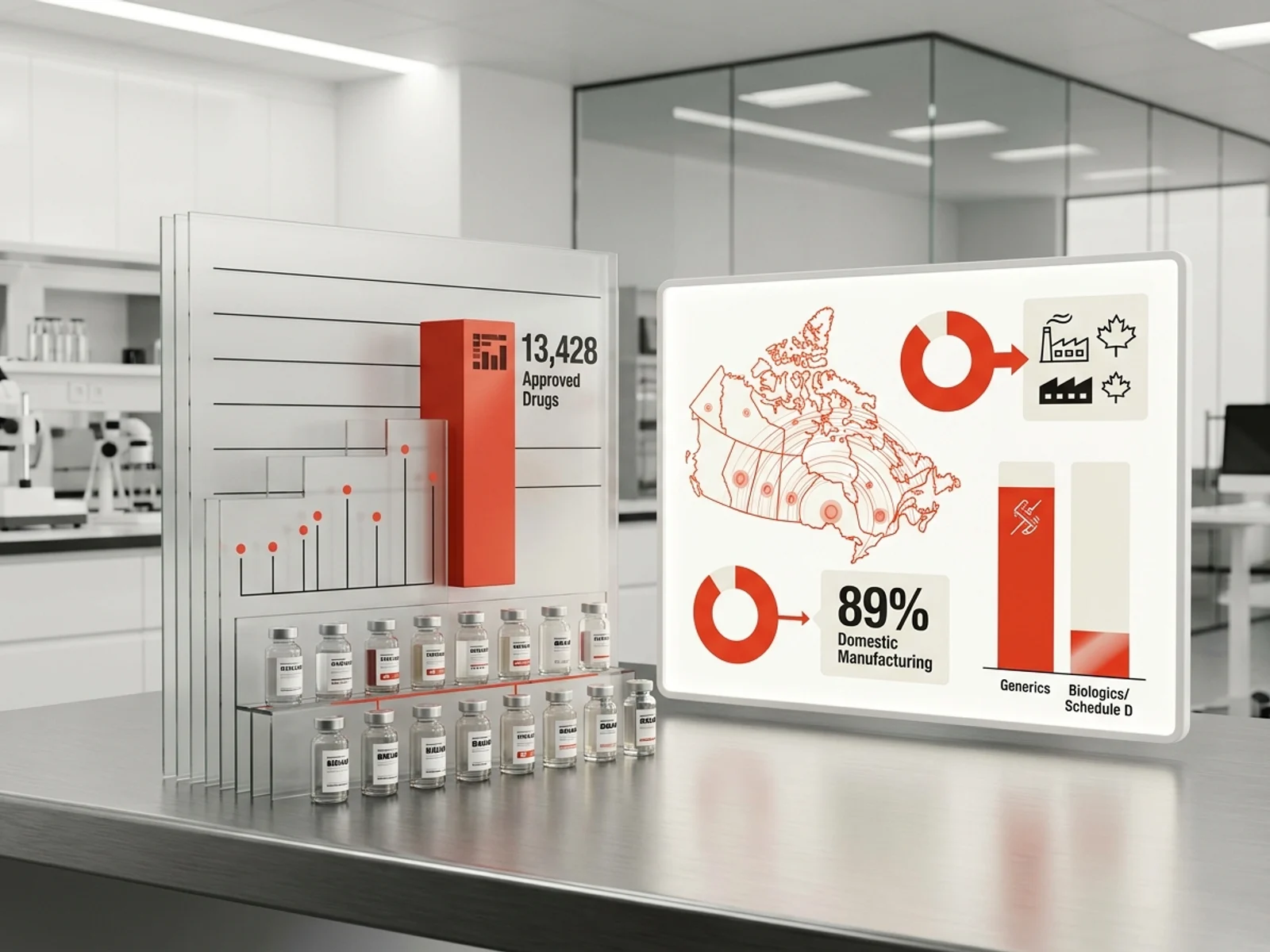
Health Canada's Drug Product Database (DPD) is the closest Canadian equivalent of the FDA's catalog of approved drug products: every product issued a Drug Identification Number (DIN), searchable by active ingredient, brand, schedule, manufacturer, and therapeutic class. The June 10, 2026 extract contains 13,428 marketed human, veterinary, disinfectant, and radiopharmaceutical drugs. Two structural facts dominate the dataset. The DIN base is generic-owned: the three largest DIN holders are Teva Canada, Apotex, and Sandoz. And the manufacturing base is domestic: 89% of DIN-holding companies manufacture in Canada.
This analysis processes the full Health Canada DPD extract dated June 10, 2026. Every count is computed from the DPD's own tables — drug, status, schedule, therapeutic class, route, form, company, and biosimilar flag. The DPD captures products that hold a DIN and are marketed in Canada; it is not a pricing database, and it does not separately track hospital or special-access products.
Product class: 11,416 human drugs, plus disinfectants and veterinary products
| Class | Drugs | Share |
|---|---|---|
| Human | 11,416 | 85.0% |
| Disinfectant | 1,025 | 7.6% |
| Veterinary | 926 | 6.9% |
| Radiopharmaceutical | 61 | 0.5% |
The DPD is broader than a pure prescription-drug registry. All 13,428 records carry a status of "Marketed." Human drugs account for 85% of the base; the remainder is disinfectants (regulated by Health Canada and assigned DINs), veterinary drugs, and radiopharmaceuticals. For market-access teams comparing Canada to the United States, the practical consequence is that Canada's DIN count (13,428) is far smaller than the FDA's NDC universe (over 135,000 NDCs), because a Canadian DIN corresponds to a product-strength-form combination rather than each package size and labeler, and because the DIN registry excludes the long tail of discontinued and OTC package variants that inflate the NDC count.
Schedule: two-thirds prescription, 819 Schedule D biologics
| Schedule | Drugs |
|---|---|
| Prescription | 8,846 |
| Over-the-counter (OTC) | 2,991 |
| Schedule D (biologics) | 819 |
| Ethical (pharmacist-dispensed) | 649 |
| Narcotic / controlled (CDSA I–IV, Schedule G) | ~470 |
| Schedule C (radiopharmaceuticals) | 61 |
Canada organizes drug control through the Food and Drugs Act schedules rather than through a single prescription/OTC binary. Prescription products dominate at 8,846 (66% of all DINs). OTC products account for 2,991. Two schedules matter most for launch teams:
Schedule D (819 drugs) lists biologic drugs — vaccines, blood products, recombinant proteins, monoclonal antibodies, and biosimilars — and is the regulatory home for the products most biopharma launches target. Schedule D drugs are reviewed by Health Canada's Biologics and Genetic Therapies Directorate (BGTD), separately from small molecules. On July 1, 2025, the portions of the Food and Drug Regulations replacing Part C, Division 4 for Schedule D drugs came into force, modernizing the biologics framework under Health Canada's "Agile Licensing" initiative.
Schedule C (61 drugs) covers radiopharmaceutical and biological diagnostic products.
Controlled substances sit under the Controlled Drugs and Substances Act (CDSA) and Schedule G — roughly 470 DINs across narcotics and targeted substances.
Therapeutic class: nervous system and cardiovascular lead
| ATC anatomical group | Drugs |
|---|---|
| N — Nervous system | 2,944 |
| C — Cardiovascular | 1,944 |
| V — Various | 1,395 |
| L — Antineoplastic and immunomodulatory | 1,144 |
| D — Dermatological | 1,091 |
| A — Alimentary tract and metabolism | 1,013 |
| J — Antiinfectives (systemic) | 884 |
| B — Blood and blood-forming organs | 771 |
| R — Respiratory | 565 |
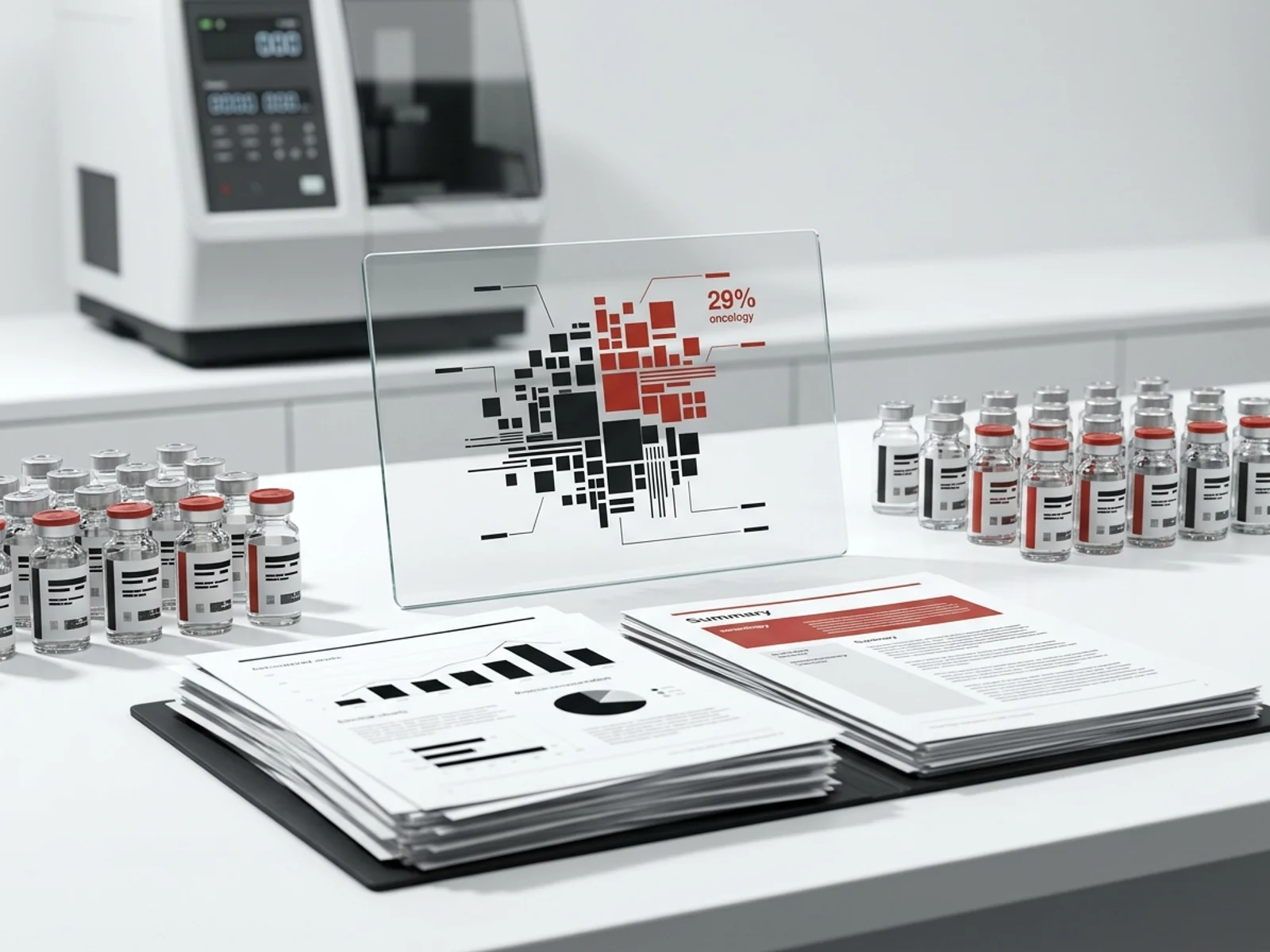
The DPD codes most products to the WHO Anatomical Therapeutic Chemical (ATC) classification. Nervous-system drugs (analgesics, antiepileptics, antidepressants, antipsychotics) are the largest group at 2,944, followed by cardiovascular at 1,944. Antineoplastic and immunomodulatory agents (ATC group L) — oncology and biologic immunology — account for 1,144, a category that has grown with the targeted-therapy and biologic pipelines. The distribution mirrors the US and European drug markets: chronic-disease therapies in neurology and cardiology dominate the volume, while oncology and immunology drive the spending.
Route and formulation
| Route | Drugs | Formulation | Drugs | |
|---|---|---|---|---|
| Oral | 7,743 | Tablet | 4,833 | |
| Intravenous | 1,484 | Solution | 2,722 | |
| Topical | 1,295 | Capsule | 1,137 | |
| Subcutaneous | 855 | Powder for solution | 684 | |
| Intramuscular | 603 | Extended-release tablet | 340 |
Oral administration accounts for 7,743 DINs, consistent with a generic-heavy market dominated by solid oral dosage. Tablets (4,833) and capsules (1,137) together outnumber all other forms. Injectable routes — intravenous (1,484), subcutaneous (855), and intramuscular (603) — carry the biologic and hospital-infrafusion volume, and overlap heavily with the Schedule D biologics and the L (antineoplastic/immunomodulatory) ATC group.
Biosimilars: 150 DIN records, and a provincial switching layer
The DPD flags 150 product records (DINs) as biosimilar biologic drugs. Health Canada tracks distinct biosimilar brands separately: as of mid-2025, approximately 68 biosimilars were approved in Canada, spanning 21 innovator reference products, with aflibercept biosimilars (AFLIVU, YESAFILI) among the most recent additions. The gap between 150 DIN records and 68 brands reflects that a single biosimilar typically holds multiple DINs across strengths, formulations, and routes.
Canada's biosimilar market differs from the US in one structurally important way: interchangeability is a provincial decision, not a Health Canada determination. Health Canada authorizes a biosimilar as similar to its reference product but does not declare the two interchangeable; each province and territory sets its own substitution rules. In practice, the access lever that has driven Canadian biosimilar uptake is not pharmacy substitution but provincial switching policy — public drug plans in British Columbia, Alberta, Saskatchewan, Manitoba, Quebec, New Brunswick, Nova Scotia, Ontario, and the Northwest Territories have required patients on certain reference biologics to transition to a biosimilar, with the public plan reimbursing only the biosimilar version except in defined exceptions. Biosimilars in Canada launch at roughly a 40–50% discount to their reference product, and uptake has historically lagged the OECD median, which is the gap these switching policies were designed to close.
Access implication. A US launch team entering Canada should not assume that an FDA interchangeability designation carries over. Canadian biosimilar uptake is won province by province through switching-policy negotiations and public-plan formularies, not at the pharmacy counter. The DIN and biosimilar data here show the supply side is mature (150 biosimilar DINs, 21 reference products with biosimilar competition); the demand side is governed by provincial policy calendars.
Who holds the DINs: a generic-owned market
| DIN holder (manufacturer) | DINs |
|---|---|
| Teva Canada | 672 |
| Apotex | 658 |
| Sandoz Canada | 564 |
| JAMP Pharma | 556 |
| Pharmascience | 461 |
| Sanis Health | 336 |
| Auro Pharma | 317 |
| Pro Doc Limitée | 293 |
| Pfizer Canada | 281 |
| Sivem Pharmaceuticals | 244 |
| Mint Pharmaceuticals | 217 |
| Marcan Pharmaceuticals | 169 |
| Taro Pharmaceuticals | 169 |
| Laboratoire Riva | 165 |
| AA Pharma | 163 |
The DIN-holder ranking is a generics league table. Teva Canada (672 DINs), Apotex (658), and Sandoz (564) — the Canadian operations of the world's largest generic manufacturers — lead, followed by Canadian-owned generic companies (JAMP, Pharmascience, Sanis, Auro, Pro Doc, Sivem, Mint, Marcan, Riva, AA Pharma). Pfizer Canada (281) is the highest-ranked originator company, and it sits ninth. Originator multinationals hold meaningful portfolios but are heavily outnumbered by generic DIN holders, which is the structural reason Canada's public drug plans can extract biosimilar and generic savings: the supply base to switch to is large and domestic.
Manufacturing base: 89% of DIN owners make in Canada
| Country of manufacturer | DIN holders |
|---|---|
| Canada | 11,933 |
| United States | 894 |
| Ireland | 118 |
| Germany | 76 |
| United Kingdom | 61 |
| India | 57 |
| Switzerland | 39 |
| France | 38 |
Of the DIN-holding companies in the DPD, 11,933 (89%) list Canada as their country of manufacture. The United States (894) is a distant second, followed by Ireland (118) and Germany (76). The domestic-manufacturing concentration reflects both the generic industry's Canadian production footprint and Health Canada's long-standing regulatory preference for domestic supply of essential medicines. For supply-chain and shortage teams, this is the relevant contrast with the United States: Canada's marketed-drug base is far more domestically manufactured than the US generic base, which relies heavily on API and finished-dose imports from India and China.
How the registry grew: ~700 new DINs per year
| Period | DINs first marketed |
|---|---|
| Pre-1990 | ~892 |
| 1990–1999 | 1,587 |
| 2000–2009 | 2,258 |
| 2010–2019 | 4,952 |
| 2020–2024 | 3,499 |
| 2025 (partial) | 187 |
Using the first marketed-status date per DIN, the registry has added new products at roughly 700 per year since 2018 (637 in 2020, 770 in 2021, 663 in 2022, 741 in 2023, 688 in 2024). The 2025 figure (187) reflects a partial-year extract. The post-2010 acceleration coincides with generic-company portfolio expansion and the biosimilar wave, and the 2020–2024 cohort (3,499 DINs) is the largest five-year block in the dataset.
What this means for global launch and access teams
1. Canada is a generic-dominated, domestically manufactured market, not a US replica. The DIN base is 66% prescription and led by generic companies, with 89% domestic manufacturing. Launch forecasting and supply planning that import US assumptions will misread both the competitive set and the sourcing base.
2. Schedule D is the regulatory home for biologic launches, and it just modernized. The 819 Schedule D biologics are reviewed by the BGTD, and the Part C, Division 4 replacement (effective July 1, 2025) changed the biologics regulatory framework. Biologic launch teams should re-verify submission expectations against the new Agile Licensing requirements rather than relying on pre-2025 precedent.
3. Biosimilar uptake is won provincially, not through interchangeability. Health Canada does not designate interchangeability; provincial switching policies drive uptake. The supply side is mature (150 biosimilar DINs, 21 reference products), so the access battleground is the public-plan formulary and switching calendar in each province — a fundamentally different channel from US PBM negotiations.
4. DIN-level data is the right unit of comparison, not NDC-level. Canada's 13,428 DINs cannot be compared directly to the US's 135,000+ NDCs; a DIN is a product-strength-form record, while an NDC also encodes package size and labeler. Cross-border portfolio comparisons should normalize to molecule and product-strength, not to raw registry counts.
5. The public-plan layer governs reimbursement, separate from Health Canada approval. A Health Canada DIN authorizes marketing; it does not guarantee reimbursement. Public drug-plan listing (per province) and the Patented Medicine Prices Review Board's price regulation operate as a second gate that determines whether a marketed product is actually accessible to Canadian patients — a layer that does not exist in the same form in the United States.
Sources
Health Canada, Drug Product Database (DPD), full extract, June 10, 2026 (13,428 marketed DINs). Analysis by PharmaDossier, run date 2026-06-13. https://health-products.canada.ca/dpd-bdpp/
Health Canada, "Biosimilar biologic drugs in Canada: Fact Sheet," updated May 20, 2026 — Schedule D biologics reviewed by the Biologics and Genetic Therapies Directorate; interchangeability is a provincial decision. https://www.canada.ca/en/health-canada/services/drugs-health-products/biologics-radiopharmaceuticals-genetic-therapies/applications-submissions/guidance-documents/fact-sheet-biosimilars.html
PMC / PubMed Central, "The Law and Ethics of Switching from Biologic to Biosimilar in Canada" — biologics are listed under Schedule D of the Food and Drugs Act; reviewed by the Biologics and Genetic Therapies Directorate; interchangeability authority rests with each province. https://pmc.ncbi.nlm.nih.gov/articles/PMC7465550
Smart & Biggar, "Update on biosimilars in Canada – June 2025" — 66 (now 68) biosimilars approved of 21 innovator reference products; Part C Division 4 replacement effective July 1, 2025 (Agile Licensing). https://www.smartbiggar.ca/insights/publication/update-on-biosimilars-in-canada-june-2025
GaBI Journal / Biosimilars approved in Canada — first biosimilar Omnitrope 2009; 67 biosimilars across human growth hormone, G-CSF, insulin, monoclonal antibodies, and TNF inhibitors. https://www.gabionline.net/biosimilars/general/biosimilars-approved-in-canada
Canadian Digestive Health Foundation, "Switching from a Biologic to a Biosimilar Drug in Canada" — provincial switching policies in BC, Alberta, Quebec, New Brunswick, Nova Scotia, and the Northwest Territories; 40–50% discount to originators; Canada below OECD median for penetration. https://cdhf.ca/en/switching-from-a-biologic-to-a-biosimilar-drug-in-canada
Biosimilars • Exchange (JointHealth), "Policy" — 55 Health Canada–approved biosimilar biologics available; public and private plan adoption. https://biosimilars.jointhealth.org/policy