Tysabri (natalizumab, Biogen) has been a cornerstone disease-modifying therapy for relapsing multiple sclerosis since its 2004 FDA approval and for moderate-to-severe Crohn's disease since 2008. In August 2023, the FDA approved Tyruko (natalizumab-sztn, Sandoz/Polpharma) as the first biosimilar to Tysabri, covering both the MS and Crohn's indications. After a delay tied to JCV assay availability and HCPCS code assignment, Sandoz launched Tyruko commercially in the United States on November 17, 2025.
Tyruko does not carry an interchangeability designation. Payer switching is physician-led, and each product operates under its own REMS program. Access teams now face a dual-REMS, dual-HCPCS landscape where understanding the documentation and billing differences is essential to avoid claim rejections and treatment delays.
This guide covers the natalizumab benefit-channel structure, REMS logistics, PML risk documentation, HCPCS coding, payer positioning, and switching rules.
Short answer
| Tysabri (reference product) | Tyruko (biosimilar) | |
|---|---|---|
| Generic name | natalizumab | natalizumab-sztn |
| Manufacturer | Biogen Inc. | Sandoz Inc. (Novartis) |
| FDA approval | November 23, 2004 (BLA 125104) | August 24, 2023 (BLA 761322) |
| FDA indications | Relapsing MS (CIS, RRMS, active SPMS); moderate-to-severe CD | Same indications |
| Administration | 300 mg IV infusion over 1 hour, every 4 weeks | Same |
| HCPCS code | J2323 (Injection, natalizumab, 1 mg) | Q5134 (Injection, natalizumab-sztn, biosimilar, 1 mg) |
| NDC (300 mg vial) | 64406-0008-xx | 61314-0543-xx |
| REMS program | TOUCH Prescribing Program (Biogen, 800-456-2255) | Tyruko REMS (Sandoz, 800-489-7856) |
| Interchangeability | Not designated | Not designated |
| Q2 2026 ASP+6% | ~$24.32/mg | ~$24.32/mg (currently identical) |
| PA required | Yes, all major plans | Yes, all major plans |
| Reauthorization | 12 months with documented clinical response | Same |
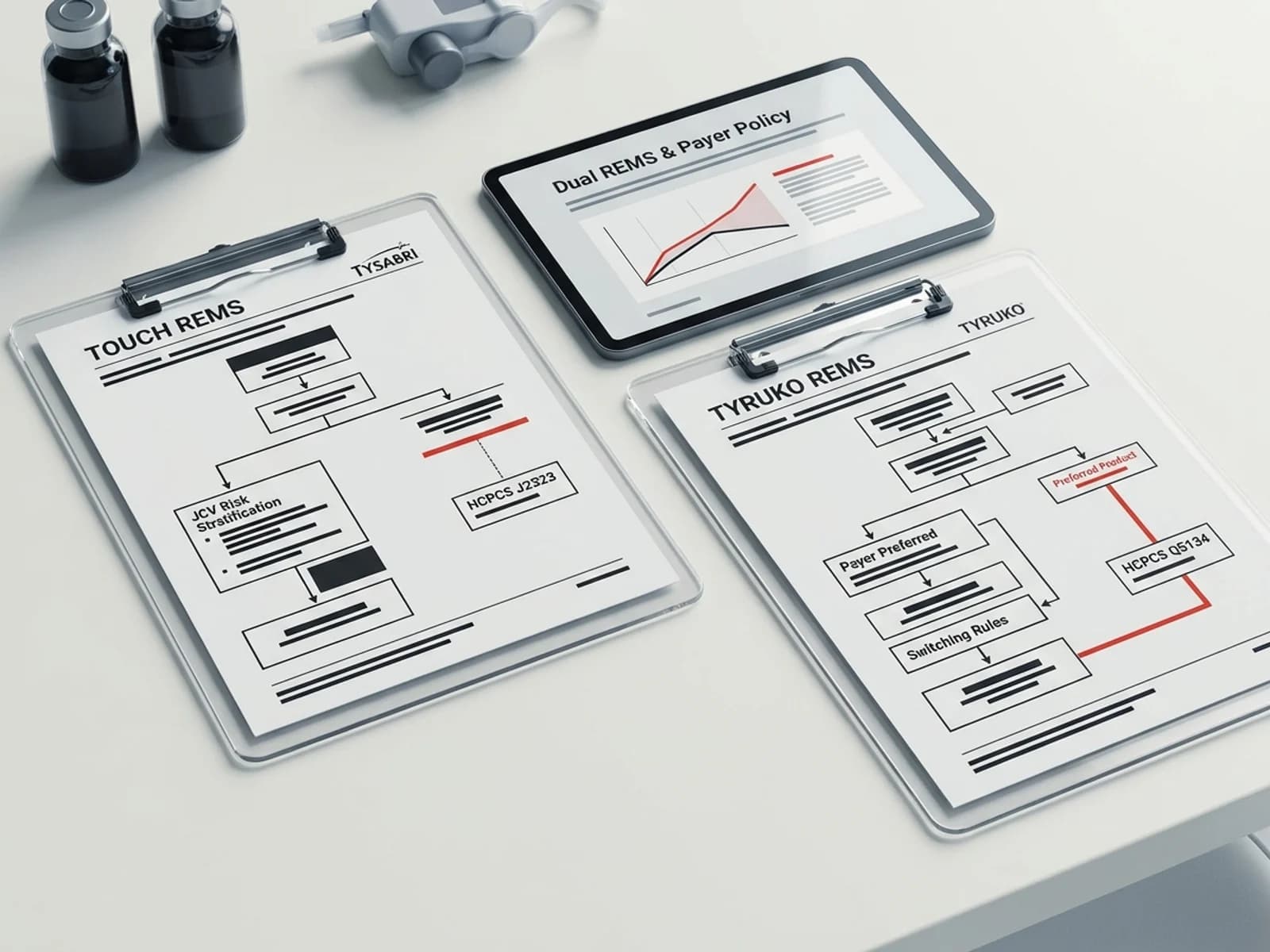
Dual REMS: TOUCH and Tyruko REMS
Both natalizumab products carry a boxed warning for progressive multifocal leukoencephalopathy (PML) and are available only through restricted REMS programs. A site that administers both products must enroll in and maintain compliance with both programs independently.
TOUCH Prescribing Program (Tysabri)
The TOUCH Prescribing Program has operated since 2006 and tracks every Tysabri patient in the United States. Requirements include:
Prescriber enrollment: Only prescribers enrolled in TOUCH can prescribe Tysabri. New prescribers must complete the Prescriber Enrollment Form.
Patient enrollment: Patients must read the Medication Guide, understand PML risks, and sign the Patient Enrollment Form before each infusion.
Infusion site certification: Pharmacies and infusion centers must be specially certified to dispense or infuse Tysabri.
Start Form: Required before the first infusion, submitted via TOUCH On-Line or fax.
Ongoing monitoring: Healthcare professionals must monitor for new signs or symptoms suggestive of PML. Tysabri dosing must be withheld immediately at the first sign of PML.
TOUCH On-Line: A web-based tool providing real-time access to patient data, JCV antibody status and index history, and infusion scheduling.
Tyruko REMS (Sandoz)
Tyruko operates under a separate REMS with parallel requirements:
Prescriber enrollment: Prescribers must enroll in the Tyruko REMS, separate from TOUCH.
Patient enrollment: Patients must sign the Tyruko REMS Patient Enrollment Form acknowledging PML risks.
Information sharing: As part of Tyruko REMS enrollment, patients authorize Sandoz to share information with Biogen to evaluate the safe use of both products.
Infusion site certification: Sites must be separately certified for Tyruko.
Practical implications for infusion centers
Dual enrollment: A site administering both products must maintain certifications, enrollment forms, and compliance documentation for both TOUCH and Tyruko REMS.
No cross-substitution: Because Tyruko lacks interchangeability designation, a pharmacy cannot substitute Tyruko for Tysabri (or vice versa) without a new prescription.
JCV antibody testing: Both products require anti-JCV antibody testing and discussion of results with the patient. The same assay (ELISA-based, analytically and clinically validated) applies to both products.
MRI baseline: A gadolinium-enhanced brain MRI must be obtained prior to initiating either product, to help differentiate subsequent MS symptoms from PML.
PML risk stratification and JCV documentation
PML risk is the central safety concern driving both REMS programs and payer coverage criteria. Three risk factors determine a patient's PML risk profile:
JCV antibody status
| JCV antibody status | PML risk |
|---|---|
| Negative | Lower risk, but not zero (potential for new JCV infection or false-negative result at ~3% rate) |
| Positive, index ≤0.9 | Intermediate risk |
| Positive, index 0.9–1.5 | Higher risk |
| Positive, index >1.5 | Highest risk |
Prior immunosuppressant use
Patients with prior exposure to immunosuppressants (mitoxantrone, azathioprine, methotrexate, cyclophosphamide, mycophenolate mofetil) have elevated PML risk regardless of JCV antibody status.
Treatment duration
Risk increases with longer treatment duration, particularly beyond 2 years. For JCV-positive patients on natalizumab for 25–36 months with no prior immunosuppressant use:
Index ≤0.9: ~0.2 per 1,000
Index 0.9–1.5: ~0.3 per 1,000
Index >1.5: ~3 per 1,000
Documentation requirements for PA
Payers universally require the following PML-risk documentation in PA submissions:
JCV antibody test result (positive/negative) and index value
Discussion documentation: attestation that JCV results and PML risks/benefits have been discussed with the patient
Prior immunosuppressant history: drug names, dates, and duration of any prior immunosuppressant use
Baseline MRI: gadolinium-enhanced brain MRI obtained prior to treatment initiation
No concurrent immunosuppressants: attestation that the patient is not using concurrent immunosuppressants, TNF-alpha inhibitors, or other DMTs for the same indication
JCV testing timing caveats
After plasma exchange (PLEX): wait at least 2 weeks before JCV testing to avoid false negatives from antibody removal.
After IVIg infusion: wait at least 6 months (5 half-lives) for IVIg to clear to avoid false positives.
Periodic retesting: patients who initially test JCV-negative should be retested periodically, as seroconversion can occur.
HCPCS coding and billing
Each product uses its own HCPCS code. Using the wrong code will result in claim denial.
Tysabri (reference product)
J2323: Injection, natalizumab, 1 mg
Bill 300 units per dose (300 mg administered every 4 weeks)
NDC: 64406-0008-xx (300 mg/15 mL single-dose vial)
Administration CPT: 96365 (IV infusion, first hour)
JW/JZ modifier: required for Medicare Part B claims for single-use vials
Tyruko (biosimilar)
Q5134: Injection, natalizumab-sztn (tyruko), biosimilar, 1 mg
Bill 300 units per dose (300 mg administered every 4 weeks)
NDC: 61314-0543-xx (300 mg/15 mL single-dose vial)
Administration CPT: 96365 (IV infusion, first hour)
JW/JZ modifier: required for Medicare Part B
ICD-10 codes
MS: G35.A (relapsing-remitting MS), G35.C1 (active secondary progressive MS)
Crohn's disease: K50.00–K50.919
Payer positioning and preferred-product policies
Payers are beginning to differentiate between Tysabri and Tyruko, with a clear trend toward designating Tyruko as the preferred natalizumab product.
UnitedHealthcare (effective July 1, 2026)
UHC's Commercial Medical Benefit Drug Policy (effective 07/01/2026) designates Tyruko as the preferred natalizumab product. Key provisions:
Medical Necessity Plans: Tyruko is covered under standard diagnosis-specific criteria. Tysabri coverage requires meeting Preferred Product Criteria — specifically, documented intolerance, contraindication, or adverse event with Tyruko that would not be expected with Tysabri or another natalizumab biosimilar.
Non-Medical Necessity Plans: Any natalizumab product is approved under standard diagnosis-specific criteria without preference.
Coverage period: 12 months for both MS and Crohn's, with documented clinical response at reauthorization.
Blue Shield of California (effective February 1, 2026)
Blue Shield of California's Medi-Cal Medical Benefit Drug Policy (updated 4Q 2025) added Tyruko as the preferred natalizumab product effective 02/01/2026:
Requests for Tysabri require documented intolerable side effect with Tyruko.
Updated reauthorization criteria for MS and added prescriber specialty requirement for Crohn's.
Aetna (CPB 0751)
Aetna's Clinical Policy Bulletin lists both J2323 and Q5134 as covered codes. Tyruko is listed alongside Tysabri as a preferred MS alternative. Both require precertification. Coverage criteria are identical for both products.
Iowa Medicaid (PAM-077)
Iowa Medicaid's combined natalizumab policy covers both Tysabri and Tyruko under identical clinical criteria. Last reviewed April 17, 2026. Authorization duration: 12 months for MS, 12 weeks initial for Crohn's with 6-month renewals.
Carelon/Anthem (CC-0020)
Carelon's combined Medical Drug Clinical Criteria (published 12/01/2025) treats Tysabri and Tyruko under a single policy with identical medical necessity criteria. Both products require TOUCH or Tyruko REMS enrollment and JCV antibody testing.
Health Net (CP.PHAR.259)
Health Net's combined policy covers both products with identical step-therapy criteria. Approval duration: 12 months for all lines of business.
Indication-specific coverage criteria
Relapsing multiple sclerosis
Across major payers, initial authorization for natalizumab (either product) requires:
Diagnosis: relapsing MS (CIS, RRMS, or active SPMS) confirmed per 2024 McDonald criteria revisions
Age: 18 years or older
REMS enrollment: patient enrolled in TOUCH or Tyruko REMS as applicable
JCV antibody test: result documented and risks/benefits discussed
Baseline brain MRI: obtained prior to treatment initiation
Monotherapy attestation: not used in combination with other DMTs (Aubagio, Avonex, Betaseron, Copaxone, Extavia, Gilenya, Glatopa, Rebif, Tecfidera, Ocrevus, etc.)
Prior treatment history: some plans require failure of or intolerance to at least one other DMT before natalizumab, given PML risk
Crohn's disease
For Crohn's disease, payers impose additional requirements:
Diagnosis: moderate-to-severe Crohn's disease with evidence of inflammation
Age: 18 years or older
Prescriber specialty: gastroenterologist (required by most plans)
Prior therapy failure: inadequate response to or inability to tolerate conventional CD therapies and TNF-alpha inhibitors
No concurrent immunosuppressants: aminosalicylates may be continued, but azathioprine, 6-MP, methotrexate, cyclosporine, and TNF-alpha inhibitors must be discontinued
CD TOUCH enrollment: patient enrolled in the CD TOUCH Prescribing Program
Payer switching rules
Switching between Tysabri and Tyruko is physician-directed and requires attention to several administrative steps:
New prescription required: because Tyruko lacks interchangeability designation, a new prescription is required when switching products.
New PA required: most payers require a new prior authorization when switching between reference and biosimilar, even if the prior authorization for the original product is active.
REMS transition: the patient must be enrolled in the appropriate REMS for the new product. If switching from Tysabri to Tyruko, enroll in Tyruko REMS. If switching from Tyruko to Tysabri, enroll in TOUCH.
Clinical justification: for payers that have designated Tyruko as preferred (UHC, Blue Shield of CA), switching to Tysabri requires documentation of intolerance or adverse event with Tyruko.
HCPCS code change: claims must use the correct HCPCS code for the product administered. J2323 for Tysabri, Q5134 for Tyruko.
No treatment gap: when possible, coordinate the switch to avoid a gap in therapy. The standard 4-week dosing interval applies to both products.
Reauthorization documentation
Across major payers, reauthorization every 12 months requires:
Clinical response: documented improvement or stabilization in MS relapse rate, disability progression, or MRI lesion activity (MS); or maintained clinical response and remission (CD)
Continued REMS compliance: patient remains enrolled in TOUCH or Tyruko REMS
No concurrent DMTs or immunosuppressants: attestation that no disallowed concurrent therapies have been added
Ongoing PML monitoring: continued vigilance for new neurological signs or symptoms; periodic MRI monitoring per clinical judgment
JCV antibody retesting: if initially negative, periodic retesting is recommended to detect seroconversion
Documentation checklist for PA submission
ICD-10 codes: G35.A (RRMS), G35.C1 (active SPMS), K50.00–K50.919 (CD)
Diagnosis confirmation: per 2024 McDonald criteria (MS) or endoscopic/histologic confirmation (CD)
JCV antibody test: result and index value, with attestation that results and PML risks have been discussed
Baseline brain MRI: obtained prior to treatment initiation
Prior treatment history: drug names, doses, start/stop dates, and reasons for discontinuation
REMS enrollment: TOUCH or Tyruko REMS enrollment confirmation
Prescriber specialty: neurologist (MS) or gastroenterologist (CD)
Monotherapy attestation: no concurrent DMTs or immunosuppressants
For switching to Tysabri (where Tyruko is preferred): documented adverse event, intolerance, or contraindication to Tyruko
Weight-based dosing confirmation: dose does not exceed 300 mg every 4 weeks
Key takeaways for access teams
Tyruko launched November 2025 as the first and only MS biosimilar, covering both MS and Crohn's indications. Payers are moving to designate it as preferred: UHC effective July 2026, Blue Shield of California effective February 2026.
Dual REMS is the biggest operational hurdle: a site administering both products must enroll in and maintain both TOUCH and Tyruko REMS independently. Each patient must be enrolled in the correct REMS for the product they receive.
Use the correct HCPCS code: J2323 for Tysabri, Q5134 for Tyruko. Mixing codes will cause claim denials.
JCV antibody documentation is universal: every payer requires JCV status, index value, risk discussion, and baseline MRI. Keep this documentation current and accessible.
Switching requires a new prescription and new PA: Tyruko is not interchangeable, so transitions between products are physician-led and require full administrative coordination.
Sources
FDA. Tyruko (natalizumab-sztn) Prescribing Information. BLA 761322. October 2025. https://www.accessdata.fda.gov/drugsatfda_docs/label/2025
FDA. Tysabri (natalizumab) Prescribing Information. BLA 125104. March 2025. https://www.accessdata.fda.gov/drugsatfda_docs/label/2025/125104s984lbl.pdf
FDA. FDA Approves First Biosimilar to Treat Multiple Sclerosis. Press release. August 24, 2023. https://www.fda.gov/news-events/press-announcements/fda-approves-first-biosimilar-treat-multiple-sclerosis
Sandoz. Sandoz Launches TYRUKO (natalizumab-sztn) in US. Press release. November 17, 2025. sandoz.com
UnitedHealthcare. Natalizumab (Tyruko & Tysabri) Commercial Medical Benefit Drug Policy. 2026D0026T. Effective 07/01/2026. uhcprovider.com
Blue Shield of California Promise Health Plan. Natalizumab Medical Benefit Drug Policy. Effective 12/01/2025. blueshieldca.com
Aetna. Natalizumab Clinical Policy Bulletin. CPB 0751. aetna.com
Iowa Medicaid. Natalizumab Agents (Tysabri, Tyruko) Clinical Criteria. PAM-077. Last reviewed 04/17/2026. hhs.iowa.gov
Carelon. Natalizumab Agents Medical Drug Clinical Criteria. CC-0020. Published 12/01/2025. carelonrx.com
Health Net. Natalizumab, Natalizumab-sztn Clinical Policy. CP.PHAR.259. healthnet.com
OHSU Health Services. Natalizumab (Tyruko, Tysabri) Medical Policy. Last reviewed 12/02/2025. ohsu.edu
HCSC/HealthSpring. Natalizumab and Associated Biosimilar(s) Policy. RX501.059. Effective 05/07/2026. healthspring.com
Biogen. TOUCH Prescribing Program. touchprogram.com
Sandoz. Tyruko REMS Program. tyruko.com
Hemmer B, Wiendl H, et al. Efficacy and Safety of Proposed Biosimilar Natalizumab (PB006): The Antelope Phase 3 Randomized Clinical Trial. JAMA Neurol. 2023;80(3):298-307
Montalban X, et al. Diagnosis of Multiple Sclerosis: 2024 Revisions of the McDonald Criteria. Lancet Neurol. 2025;24(10):850-865