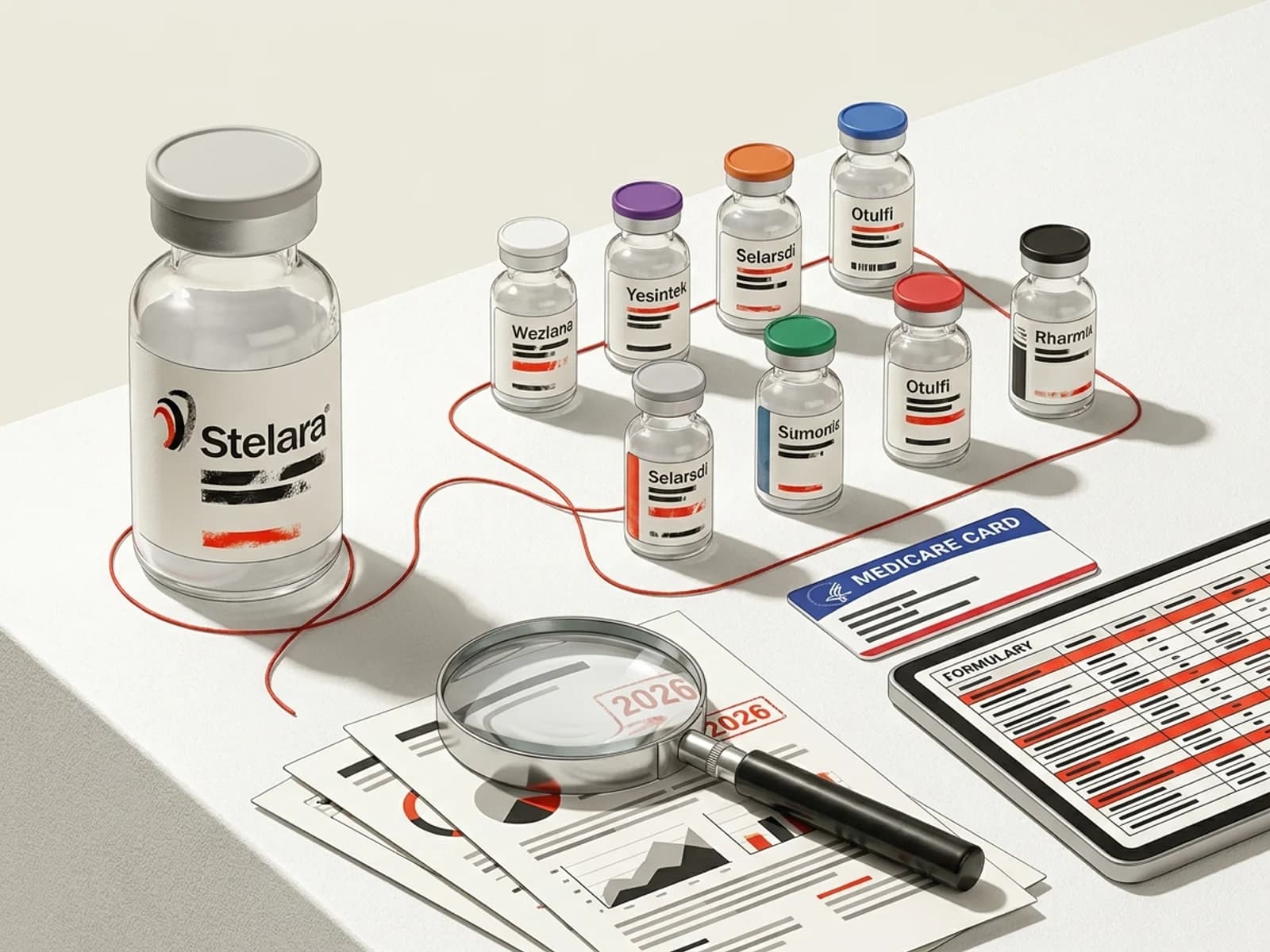
Stelara (ustekinumab, Janssen Biotech) is an interleukin-12 and interleukin-23 antagonist approved for four immune-mediated conditions: moderate-to-severe plaque psoriasis, active psoriatic arthritis, moderately-to-severely active Crohn's disease, and moderately-to-severely active ulcerative colitis. Since its first approval in 2009, Stelara has become a backbone biologic in immunology. But the access landscape shifted dramatically in 2025–2026: nine biosimilars are now FDA-approved, and payers are moving quickly to prefer biosimilar products.
This guide is for access teams, prior authorization coordinators, and prescribers navigating Stelara coverage in a post-biosimilar market.
Short answer
| Stelara (ustekinumab) | |
|---|---|
| Drug class | IL-12/IL-23 antagonist |
| Manufacturer | Janssen Biotech (Johnson & Johnson) |
| FDA indications | Plaque psoriasis (age 6+), psoriatic arthritis (age 6+), Crohn's disease (age 2+ for CD), ulcerative colitis (adults) |
| Administration | Subcutaneous (PsO/PsA: 45 or 90 mg every 12 wk; CD/UC: 90 mg SC every 8 wk after weight-based IV induction) |
| Biosimilars FDA-approved | Yesintek, Selarsdi, Wezlana, Steqeyma, Otulfi, Pyzchiva, Imuldosa, Starjemza, unbranded ustekinumab |
| Interchangeable biosimilars | Wezlana, Yesintek, Selarsdi, Otulfi |
| List price (WAC) | ~$22,000–$30,000 per dose depending on strength |
| Commercial copay | $5 per dose with STELARA withMe Savings Program |
| Medicare Part D | Covered; out-of-pocket capped at $2,100/year for 2026 under IRA |
| PA required | Yes, for all payer types and indications |
| Step therapy | Commonly required; many payers now require trial of a preferred biosimilar before brand Stelara |
FDA-approved indications and dosing
Plaque psoriasis (approved September 2009)
Adults and pediatric patients 6 years and older with moderate-to-severe plaque psoriasis who are candidates for phototherapy or systemic therapy
Adult dosing: 45 mg SC for patients ≤100 kg; 90 mg SC for patients >100 kg; at weeks 0 and 4, then every 12 weeks
Pediatric dosing (age 6–17): weight-based at 0.75 mg/kg (<60 kg), 45 mg (60–100 kg), or 90 mg (>100 kg)
Psoriatic arthritis (approved June 2013)
Adults and pediatric patients 6 years and older with active psoriatic arthritis
Dosing: 45 mg SC every 12 weeks; 90 mg every 12 weeks if coexistent plaque psoriasis and weight >100 kg
Crohn's disease (approved September 2016)
Adults and pediatric patients 2 years and older with moderately-to-severely active Crohn's disease
IV induction: weight-based (≤55 kg: 260 mg; >55–85 kg: 390 mg; >85 kg: 520 mg)
SC maintenance: 90 mg at week 8 after IV dose, then every 8 weeks
Ulcerative colitis (approved October 2019)
Adults with moderately-to-severely active ulcerative colitis
Same IV induction and SC maintenance regimen as Crohn's disease
Biosimilar landscape
The Stelara biosimilar market is now one of the most crowded in the US. As of May 2026, nine biosimilar products are FDA-approved:
| Product | Suffix | Manufacturer | Interchangeable | Launch status |
|---|---|---|---|---|
| Yesintek | ustekinumab-kfce | Biocon | Yes | Available |
| Selarsdi | ustekinumab-aekn | Teva/Alvotech | Yes (as of April 2025) | Available |
| Otulfi | ustekinumab-aauz | Fresenius Kabi | Yes (as of May 2025) | Available |
| Wezlana | ustekinumab-auub | Amgen | Yes (since October 2023) | Available |
| Steqeyma | ustekinumab-stba | Celltrion | No | Available |
| Pyzchiva | ustekinumab-ttwe | Samsung Bioepis/Sandoz | No | Available |
| Imuldosa | ustekinumab-srlf | Accord BioPharma | No | Available |
| Starjemza | ustekinumab-hmny | Hikma | No | Available |
| Unbranded ustekinumab | — | Janssen | No | Available |
Four products carry interchangeability designations (Wezlana, Yesintek, Selarsdi, Otulfi), meaning pharmacies may substitute them for brand Stelara at the point of dispensing without a new prescription, subject to state law. Wezlana was the first interchangeable ustekinumab biosimilar, approved in October 2023. Yesintek (November 2024), Selarsdi (April 2025), and Otulfi (May 2025) followed after Wezlana's interchangeability exclusivity period ended.
This is critical for access: interchangeable biosimilars can be dispensed without prescriber intervention when a plan prefers them, while non-interchangeable biosimilars require a new prescription or prior authorization.
Billing and coding
| Product | Route | HCPCS code |
|---|---|---|
| Stelara (originator) | SC injection | J3357 |
| Stelara (originator) | IV infusion | J3358 |
| Imuldosa | IV infusion | Q5098 |
| Steqeyma | IV infusion | Q5099 |
| Yesintek | IV infusion | Q5100 |
| Pyzchiva | SC/IV | Q9997 |
| Selarsdi | SC/IV | Q9998 |
| Otulfi | SC/IV | Q9999 |
PBM-level formulary positioning (2026)
| PBM | Preferred | Excluded or non-preferred |
|---|---|---|
| Express Scripts NPF | Imuldosa SC, Selarsdi SC | Stelara SC, Otulfi SC, Pyzchiva SC, Starjemza SC, Steqeyma SC, Wezlana SC |
| CVS Caremark (effective July 2026) | Pyzchiva, Yesintek | Stelara brand and several other biosimilars |
| OptumRx | Yesintek, Steqeyma, Wezlana, Imuldosa | Stelara, Selarsdi, Otulfi, Pyzchiva (varies by plan) |
Note: PBM exclusion lists change frequently. Verify current formulary status before submitting PA.
Coverage by payer type
Commercial insurance
Stelara and its biosimilars are covered under the pharmacy benefit (SC formulations) and medical benefit (IV formulations) by most major commercial plans. Prior authorization is required.
Key payer actions in 2025–2026:
Horizon BCBS of New Jersey: Effective July 2025, moved brand Stelara to non-formulary or Tier 3 non-preferred, while designating Steqeyma and Yesintek as Tier 2 preferred biosimilars. Existing prior authorizations were transitioned to biosimilars without new PA requests.
UnitedHealthcare: Stelara, Selarsdi, Otulfi, Pyzchiva, and unbranded ustekinumab-ttwe are excluded from coverage for most commercial benefit plans. Wezlana, Steqeyma, Yesintek, and Imuldosa are available with PA.
Cigna: Updated IV ustekinumab policy (reviewed April 2026) adding Starjemza; Crohn's disease initial criteria updated in February 2026.
Mississippi Medicaid: Brand Stelara requires documented clinical justification for why preferred biosimilars cannot be used; reauthorization requires the same justification every year.
Network Health: Updated ustekinumab PA (PAR-286) to require step-through biosimilar Yesintek for Medicare; extended continuation to 3 years for some indications.
Aetna Better Health (NJ Medicaid): Requires inability to take two preferred ustekinumab products (Yesintek, Steqeyma) before covering brand Stelara.
Typical commercial PA criteria for plaque psoriasis:
Diagnosis of moderate-to-severe plaque psoriasis
BSA ≥3% or involvement of crucial body areas (face, hands, feet, genitals)
Failure, contraindication, or intolerance to one formulary TNF inhibitor after a minimum 3-month trial
TB screening completed
Not used in combination with other targeted immunomodulators
Typical PA criteria for Crohn's disease or ulcerative colitis:
Confirmed diagnosis of moderately-to-severely active CD or UC
Failure, contraindication, or intolerance to conventional therapies (aminosalicylates, corticosteroids, immunomodulators such as azathioprine or methotrexate)
Many plans require prior TNF inhibitor trial (Humira/adalimumab or infliximab)
TB and hepatitis B screening completed
Not used in combination with other targeted immunomodulators
Medicare Part D
Stelara and its biosimilars are covered under Medicare Part D. The IRA out-of-pocket cap is $2,100 for 2026.
Key 2026 Medicare changes:
$2,100 annual out-of-pocket cap for all Part D drugs
Medicare Prescription Payment Plan (MPPP) allows monthly installment payments instead of lump-sum cost-sharing
Low-Income Subsidy (LIS) patients pay $12.65 or less per treatment
Part D plans may apply step therapy requiring a preferred biosimilar before brand Stelara
Medicaid
State Medicaid programs cover Stelara with prior authorization. PA criteria now frequently require documented clinical justification for why preferred biosimilars cannot be used. Cost is typically $8/month or less depending on the state plan.
Prior authorization process
Required documentation
| Indication | Required documentation |
|---|---|
| Plaque psoriasis | BSA measurement, PASI or PGA score, prior topical and systemic therapy records, TB screening |
| Psoriatic arthritis | Joint examination findings, imaging if available, prior DMARD therapy records, TB screening |
| Crohn's disease | Endoscopy or imaging confirmation, prior conventional therapy records, TB and hepatitis B screening |
| Ulcerative colitis | Endoscopy confirmation, prior conventional therapy records, TB and hepatitis B screening |
Reauthorization requirements
Authorization duration: typically 12 months for all indications
Documentation of positive clinical response (reduced disease activity, improved signs and symptoms)
For CD/UC: improvement in stool frequency, rectal bleeding, CRP, or fecal calprotectin
Reauthorization may require documented justification for continued brand Stelara vs. preferred biosimilar
Common denial reasons and solutions
| Denial reason | Solution | Required documentation |
|---|---|---|
| Step through biosimilar not tried | Submit documented trial of preferred biosimilar or clinical justification for brand | Trial records or medical necessity letter |
| Not medically necessary | Submit objective severity scores | PASI ≥10, CDAI scores, endoscopy results |
| Step therapy not met (TNF inhibitor) | Document prior TNF inhibitor failure | Detailed treatment history with dates and outcomes |
| Non-formulary drug | Request formulary exception | Medical necessity letter explaining why alternatives are unsuitable |
| Incomplete screening | Submit complete TB/hepatitis results | TST/IGRA results, hepatitis B serology |
Cost and patient assistance
Manufacturer savings programs
| Program | Eligibility | Benefit |
|---|---|---|
| STELARA withMe Savings Program | Commercially insured patients | $5 per dose; annual maximum benefit applies |
| Janssen CarePath | Commercially insured patients | Benefits investigation, PA support, specialty pharmacy coordination |
| Janssen Link | Commercially insured with delayed or denied coverage | Free Stelara until insurance coverage is approved |
| myAbbVie Assist | Uninsured or underinsured who cannot afford medication | Free medication for eligible patients |
Important: The STELARA withMe Savings Program is not valid for Medicare, Medicaid, or other government-funded insurance. Patients enrolled in copay maximizer or optimizer programs may have a reduced annual maximum benefit.
Biosimilar savings programs
Yesintek: Copay assistance as low as $0 for commercially insured patients; IV savings program up to $100 for initial induction dose; patient transition program ($250 health debit card) for patients switching from Stelara
Selarsdi: Copay savings card through Teva Biosimilars
Wezlana: Copay support through Amgen
Biosimilar copay programs may offer lower out-of-pocket costs than brand Stelara, which is a factor when payers are steering toward preferred biosimilars.
Cost by insurance type
| Insurance type | Approximate out-of-pocket cost |
|---|---|
| Commercial + STELARA withMe Savings Card | $5 per dose |
| Commercial + preferred biosimilar copay card | $0 per dose (varies by program) |
| Commercial without savings card | Varies by plan (specialty copay or coinsurance) |
| Medicare Part D | $0–$2,100/year depending on coverage phase |
| Medicare Part D + LIS | $12.65 or less per treatment |
| Medicaid | $8/month or less depending on state |
| Uninsured | Full WAC (~$22,000–$30,000/dose) or free via myAbbVie Assist if eligible |
What changed in 2026
Four interchangeable biosimilars now on market: Wezlana (October 2023, first interchangeable), Yesintek (November 2024), Selarsdi (April 2025), and Otulfi (May 2025) all carry interchangeability designations, expanding automatic pharmacy substitution options.
Major payer formulary shifts: Horizon BCBS of NJ, UnitedHealthcare, and multiple Medicaid programs moved brand Stelara to non-preferred or non-formulary status, designating preferred biosimilars instead.
Medicare Part D $2,100 out-of-pocket cap: Effective January 2026 under the IRA.
Cigna IV policy update (February 2026): Updated Crohn's disease initial authorization criteria, removing certain pre-requisite therapy requirements per CMS kickout.
Mississippi Medicaid version update (May 2026): Reauthorization requires documented clinical justification for why patient could not be switched to any preferred biosimilar. Stabilization on brand Stelara alone is not adequate justification.
What to monitor
Additional payer formulary shifts: Expect more commercial and Medicare plans to prefer biosimilars during 2026 formulary updates. Track OptumRx, Express Scripts, and CVS Caremark preferred drug list changes.
Interchangeability expansion: Monitor whether additional biosimilars (Wezlana, Steqeyma) seek and obtain interchangeability designation.
Patient-level switching outcomes: As payers mandate biosimilar transitions, real-world switching data will inform future coverage policies and prescriber comfort.
IRA expanded negotiation: Monitor whether Stelara or its biosimilars are selected for future Medicare price negotiation rounds.
Label differences: Some biosimilars may not carry all pediatric indications of the reference product. Verify indication coverage before switching pediatric patients.
Sources
FDA, Stelara prescribing information (revised January 2026): https://www.accessdata.fda.gov/scripts/cder/daf/
FDA, Selarsdi label (interchangeability supplement approved May 2025): https://www.accessdata.fda.gov/drugsatfda_docs/label/2025/761343Orig1s005lbl.pdf
Teva and Alvotech, Selarsdi interchangeability approval press release (May 2025): https://ir.tevapharm.com/news-and-events/press-releases/press-release-details/2025/Teva-and-Alvotech-Announce-FDA-Approval-of-Interchangeability-for-SELARSDI-ustekinumab-aekn-with-Stelara-ustekinumab/default.aspx
Aetna, Ustekinumab clinical policy bulletin: https://www.aetna.com/cpb/medical/data/900_999/0912.html
Horizon BCBS of NJ, biosimilar formulary changes (July 2025): https://www.horizonblue.com/providers/news/news-legal-notices/effective-july-1-2025-new-biosimilars-replace-humira-and-stelara
UnitedHealthcare, ustekinumab PA criteria (effective September 2025): https://www.uhcprovider.com/content/dam/provider/docs/public/prior-auth/drugs-pharmacy/commercial/r-z/PA-Med-Nec-Ustekinumab-Stelara.pdf
Cigna, ustekinumab intravenous PA policy (reviewed April 2026): https://static.cigna.com/assets/chcp/pdf/coveragePolicies/cnf/cnf_449_coverage_position_criteria_inflammatory_conditions_stelara_intravenous_pa.pdf
Mississippi Medicaid, Stelara PA criteria (effective May 2026): https://medicaid.ms.gov/wp-content/uploads/2026/04/Stelara-PA-Criteria-05-01-2026-to-Current.V2.pdf
Drugs.com, Stelara biosimilars overview (updated February 2026): https://www.drugs.com/medical-answers/what-biosimilars-stelara-3581861/
Drugs.com, Stelara copay card qualification (updated May 2026): https://www.drugs.com/medical-answers/qualify-stelara-copay-card-how-save-3578061/
Yesintek savings and support: https://yesintek.com/savings-and-support/
Wezlana dosing and administration: https://www.wezlana.com/dosing-administration
Blue Shield of California, ustekinumab IV medical benefit policy: https://www.blueshieldca.com/content/dam/bsca/en/provider/docs/bsc-med-benefit-drug-policy/ustekinumab-intravenous-COMM-UMRx-provider.pdf