Skyrizi (risankizumab-rzaa, AbbVie) and Stelara (ustekinumab, Janssen/Johnson & Johnson) are interleukin pathway inhibitors that share overlapping therapeutic territory in plaque psoriasis, psoriatic arthritis, Crohn's disease, and ulcerative colitis. Both are specialty biologics administered by subcutaneous injection or intravenous infusion, and both carry significant annual treatment costs.
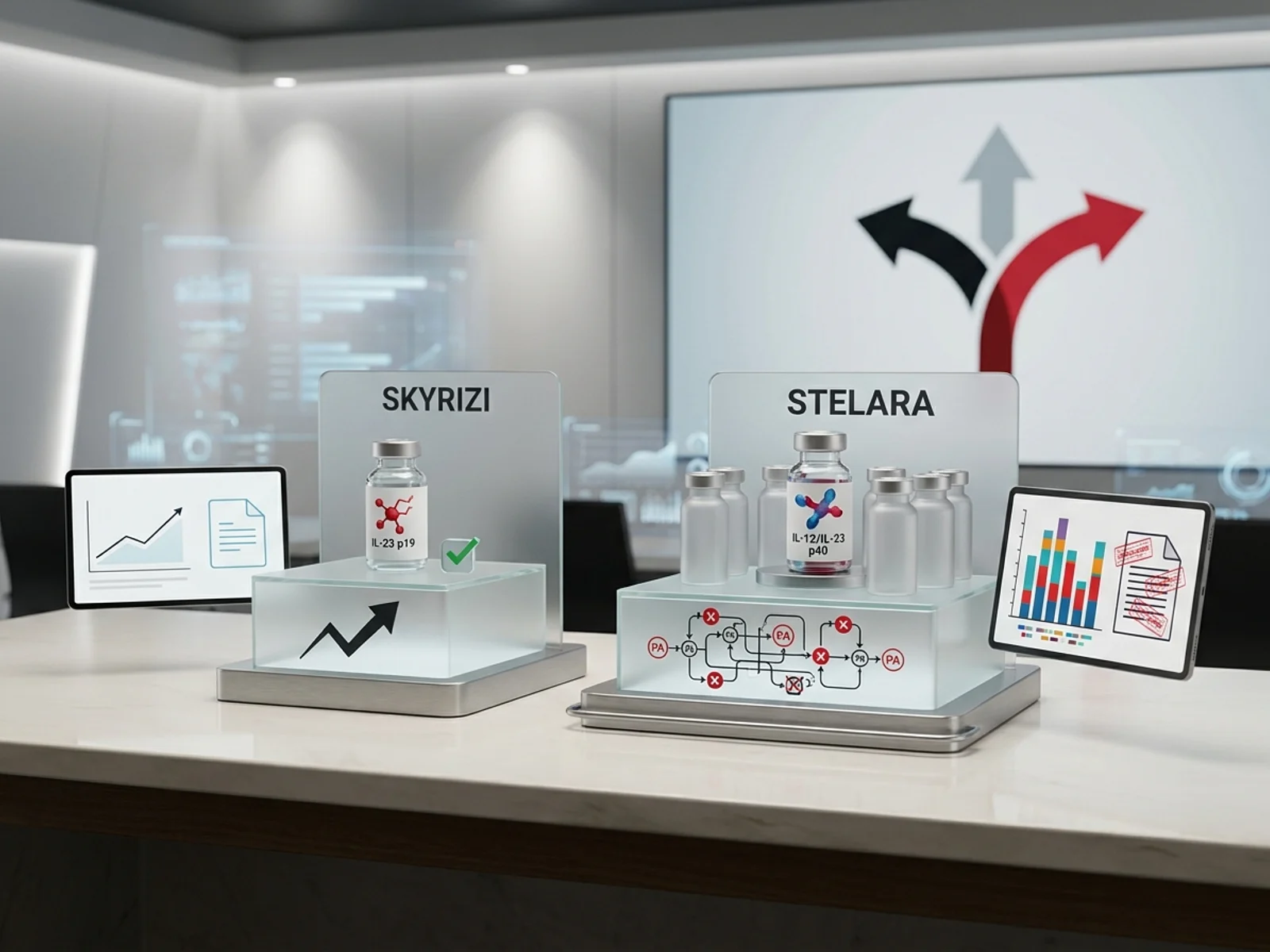
But the parallel ends there. Skyrizi selectively targets the IL-23 p19 subunit, while Stelara binds the shared p40 subunit of IL-12 and IL-23. Skyrizi has no biosimilar competition and enjoys preferred formulary placement across the major PBMs in 2026. Stelara now faces eight FDA-approved biosimilars, has been excluded from Express Scripts and Optum Rx national formularies, and requires prior authorization on nearly every major commercial plan.
This comparison is for access teams, formulary decision-makers, and prescribers navigating coverage and clinical choice between these two agents in the current payer environment.
Short answer
| Skyrizi (risankizumab-rzaa) | Stelara (ustekinumab) | |
|---|---|---|
| Drug class | IL-23 antagonist (selective p19) | IL-12/IL-23 antagonist (p40) |
| FDA indications | Plaque psoriasis, psoriatic arthritis, Crohn's disease, ulcerative colitis | Plaque psoriasis, psoriatic arthritis, Crohn's disease, ulcerative colitis |
| Age range | Adults only | PsO/PsA: age 6+; CD: age 2+; UC: adults |
| PsO/PsA dosing | 150 mg SC at weeks 0, 4, then q12w | 45 mg SC (<=100 kg) or 90 mg SC (>100 kg) at weeks 0, 4, then q12w |
| CD/UC induction | 600 mg IV (CD) or 1200 mg IV (UC) at weeks 0, 4, 8 | Weight-based IV infusion |
| CD/UC maintenance | 180 or 360 mg SC q8w | 90 mg SC q8w |
| Boxed warning | None | None |
| Biosimilar competition | None | 8 FDA-approved biosimilars |
| WAC per dose | ~$7,000-$8,000 | ~$22,000-$30,000 |
| Express Scripts 2026 | Preferred | Excluded |
| Optum Rx 2026 | Tier 2 with PA/specialty | Excluded |
| CVS Caremark 2026 | On formulary | On formulary (parity with biosimilars) |
Mechanism and clinical differentiation
Skyrizi and Stelara both act on the IL-23/Th17 inflammatory axis, but they target different points in the pathway:
| Skyrizi (risankizumab) | Stelara (ustekinumab) | |
|---|---|---|
| Target | IL-23 p19 subunit (selective) | IL-12/IL-23 shared p40 subunit |
| Specificity | Blocks IL-23 only | Blocks both IL-12 and IL-23 |
| Downstream effect | Inhibits Th17 cell differentiation | Inhibits both Th1 (via IL-12) and Th17 (via IL-23) pathways |
The clinical significance of this selectivity difference is debated. Blocking IL-12 in addition to IL-23 may provide broader immunosuppression but could also contribute to different adverse-event profiles. Selective p19 inhibition may preserve some IL-12-mediated immune functions, including Th1 responses involved in host defense.
No formal head-to-head Phase 3 trial has directly compared Skyrizi against Stelara in any indication. Indirect treatment comparisons suggest Skyrizi generally shows higher endoscopic remission rates in Crohn's disease after anti-TNF failure:
| Measure | Skyrizi (CD) | Stelara (CD) |
|---|---|---|
| Induction remission (approx. 12 weeks) | ~40-45% | ~34-40% |
| Maintenance remission (44-52 weeks) | ~52-55% | ~45-53% |
| Sustained remission beyond one year | Yes | Yes |
Both agents demonstrate sustained remission beyond one year. These figures come from separate pivotal trials (FUNDAMENTAL/INSPIRE for Skyrizi; UNITI/IM-UNITI for Stelara) and are not derived from direct comparison, so cross-trial comparisons should be interpreted with caution.
FDA-approved indications and dosing comparison
Indication timeline
| Indication | Skyrizi approval | Stelara approval |
|---|---|---|
| Plaque psoriasis | April 2019 | September 2009 |
| Psoriatic arthritis | January 2022 | June 2013 |
| Crohn's disease | June 2022 | September 2016 |
| Ulcerative colitis | June 2024 | October 2019 |
Stelara's earlier market entry gave it a substantial head start in clinical adoption and real-world experience. It also carries broader pediatric labeling, covering patients as young as age 2 for Crohn's disease and age 6 for psoriasis and psoriatic arthritis. Skyrizi is approved for adults only across all four indications.
Dosing comparison
Plaque psoriasis and psoriatic arthritis:
| Skyrizi | Stelara | |
|---|---|---|
| Loading dose | 150 mg SC at weeks 0 and 4 | 45 mg SC (<=100 kg) or 90 mg SC (>100 kg) at weeks 0 and 4 |
| Maintenance | 150 mg SC every 12 weeks | 45 or 90 mg SC every 12 weeks |
| Administration | Subcutaneous only | Subcutaneous only |
| Weight-based dosing | No | Yes (threshold at 100 kg) |
Crohn's disease:
| Skyrizi | Stelara | |
|---|---|---|
| Induction | 600 mg IV at weeks 0, 4, and 8 | Single weight-based IV infusion (~6 mg/kg) |
| Maintenance | 180 or 360 mg SC every 8 weeks | 90 mg SC every 8 weeks |
| SC induction option | Under FDA review (submitted April 2026) | Not available |
Ulcerative colitis:
| Skyrizi | Stelara | |
|---|---|---|
| Induction | 1200 mg IV at weeks 0, 4, and 8 | Single weight-based IV infusion (~6 mg/kg) |
| Maintenance | 180 or 360 mg SC every 8 weeks | 90 mg SC every 8 weeks |
A notable development: AbbVie submitted an FDA application in April 2026 for subcutaneous induction in adults with moderately to severely active Crohn's disease. If approved, this would allow the entire Skyrizi CD treatment course to be administered without IV infusions, a meaningful logistics advantage for patients and infusion centers.
Biosimilar landscape
This is the single largest differentiator between the two products in 2026.
Skyrizi: No biosimilar competition
Skyrizi has no FDA-approved biosimilars and no known near-term biosimilar applications. As a newer biologic with patent protection extending well into the 2030s, Skyrizi faces no interchangeable or follow-on competition. This gives AbbVie pricing and formulary stability, and it means payers cannot redirect patients to a lower-cost biosimilar alternative.
Stelara: Eight FDA-approved biosimilars
Stelara's composition-of-matter patent expired in the United States in 2024, triggering a wave of biosimilar approvals:
| Biosimilar | Manufacturer | Interchangeable? |
|---|---|---|
| Wezlana | Amgen | Yes |
| Selarsdi | Alvotech/Teva | Yes |
| Yesintek | Biocon/Viatris | Yes |
| Otulfi | Fresenius Kabi | Yes |
| Steqeyma | Samsung Bioepis | No |
| Pyzchiva (also available unbranded via Quallent) | Sandoz | No |
| Imuldosa | Ichnos/Intas | No |
| Starjemza | Accord Bio | No |
Four of the eight biosimilars carry interchangeability designations. Wezlana was the first, followed by Selarsdi (interchangeable as of May 2025), Yesintek, and Otulfi (interchangeable as of June 2025). Interchangeable biosimilars can be substituted for Stelara at the pharmacy level without prescriber intervention, subject to state pharmacy practice law. The remaining four non-interchangeable biosimilars require a new prescription or prior authorization to switch from branded Stelara.
The biosimilar availability is the primary driver behind Stelara's formulary displacement in 2026. PBMs have strong financial incentives to prefer lower-cost biosimilar ustekinumab products over branded Stelara.
Coverage comparison by payer
Commercial insurance
| Payer | Skyrizi | Stelara |
|---|---|---|
| Express Scripts 2026 NPF | Preferred | Excluded (preferred alternatives: Selarsdi, Yesintek, ustekinumab-TTWE) |
| Optum Rx 2026 | Tier 2, PA and specialty required | Excluded (preferred alternatives: Yesintek, Selarsdi, Skyrizi) |
| CVS Caremark 2026 | On formulary | On formulary at parity with Pyzchiva and Yesintek (supply chain concerns cited) |
| Anthem BCBS | Covered on 5 commercial plans | Covered on 5 commercial plans |
| UnitedHealthcare | Covered on 4 commercial plans | Covered on 4 commercial plans |
The divergence among PBMs is stark. Express Scripts and Optum Rx have excluded branded Stelara in favor of biosimilars (and, in Optum Rx's case, Skyrizi). CVS Caremark is the exception, retaining Stelara at parity with select biosimilars, reportedly due to supply chain concerns about biosimilar ustekinumab availability.
Medicare Part D
Both Skyrizi and Stelara are covered under Medicare Part D specialty tiers. Skyrizi's cleaner formulary positioning and lack of PA friction may translate to fewer administrative barriers for Medicare beneficiaries. Stelara's Part D coverage is increasingly contingent on plan-level biosimilar substitution policies; beneficiaries may be redirected to biosimilar ustekinumab products depending on their Part D plan's formulary design.
Medicaid
State Medicaid programs generally cover both agents, but coverage terms vary by state. Prior authorization is common for both. Some states may require trial and failure of a biosimilar ustekinumab before approving branded Stelara. Skyrizi, with no biosimilar alternative, typically faces a more straightforward PA pathway.
Prior authorization comparison
PA requirements represent one of the clearest practical differences for prescribers and access teams:
| Payer | Skyrizi PA rate | Stelara PA rate |
|---|---|---|
| Anthem BCBS (5 commercial plans) | 0/12 plans require PA | 12/12 plans require PA |
| UnitedHealthcare (4 commercial plans) | 0/8 plans require PA | 4/8 plans require PA |
For Skyrizi, Anthem BCBS and UnitedHealthcare plans do not require prior authorization. For Stelara, every Anthem BCBS plan reviewed requires PA, and half of UnitedHealthcare plans require PA.
Step therapy requirements follow the same pattern:
| Payer | Skyrizi step therapy | Stelara step therapy |
|---|---|---|
| Anthem BCBS (5 commercial plans) | 0/12 plans | 12/12 plans |
| UnitedHealthcare (4 commercial plans) | 0/8 plans | 4/8 plans |
Some plans require failure on two biosimilar ustekinumab products before branded Stelara will be approved. This multi-step requirement can delay treatment initiation by weeks.
For prescribers, Skyrizi often has a cleaner access pathway in 2026 because it faces no biosimilar competition. Stelara's access friction is a direct consequence of the eight biosimilar alternatives now available.
Cost comparison
| Skyrizi | Stelara | |
|---|---|---|
| WAC per dose | ~$7,000-$8,000 (varies by strength/route) | ~$22,000-$30,000 per dose |
| Annual WAC (PsO/PsA, approximate) | ~$25,000-$30,000 (3-4 doses/year at maintenance) | ~$80,000-$120,000 (dose-dependent) |
| Biosimilar cost pressure | None | Significant (biosimilars priced below Stelara WAC) |
| Formulary trend | Stable or improving access | Tightening as biosimilars capture share |
Stelara's WAC is substantially higher per dose than Skyrizi's, though the comparison is complicated by different dosing schedules, weight-based dosing for Stelara, and route-of-administration differences for induction phases. The net cost to payers after rebates and discounts is not publicly disclosed for either product.
Savings and assistance programs
| Program | Skyrizi | Stelara |
|---|---|---|
| Manufacturer copay savings | $0 copay for commercially insured patients | $5 per dose for commercially insured patients (STELARA withMe) |
| Eligibility | Commercial insurance only; not available for government-funded plans | Commercial insurance only |
| Patient support program | AbbVie patient support services | Janssen CarePath |
Skyrizi's $0 copay program for commercially insured patients is more generous than Stelara's $5-per-dose offering, though both programs are subject to annual maximums and eligibility restrictions. Neither program is available to Medicare or Medicaid beneficiaries.
What to monitor
AbbVie SC induction filing for Crohn's disease: Submitted to FDA in April 2026. If approved, eliminating the need for IV induction infusions would be a meaningful clinical and logistical advantage for Skyrizi in the CD space.
Stelara biosimilar market uptake: Monitor whether biosimilar ustekinumab products gain sufficient supply chain reliability for CVS Caremark to shift away from Stelara parity. Widespread biosimilar adoption could further restrict Stelara's formulary position.
Interchangeable biosimilar substitution: Wezlana's interchangeable status may drive pharmacy-level substitution in states that permit it. Monitor adoption rates and any state-level legislative or regulatory developments.
Skyrizi pediatric development: Skyrizi is currently approved for adults only. Any expansion to pediatric populations would broaden its label and compete with Stelara's established pediatric indications.
Payer PA policy evolution: If Skyrizi faces increased utilization management as uptake grows, PA and step therapy requirements could tighten. Monitor quarterly formulary updates from Express Scripts, Optum Rx, and CVS Caremark.
New IL-23 p19 competitors: Monitor whether additional selective p19 inhibitors enter the market and shift payer positioning within the IL-23 class.
Sources
FDA, Skyrizi prescribing information: https://www.accessdata.fda.gov/drugsatfda_docs/label/2026/761262s014lbl.pdf
AbbVie, SKYRIZI dosing (gastroenterology): https://www.skyrizihcp.com/gastroenterology/skyrizi-dosing
AbbVie, SC induction regulatory submission: https://news.abbvie.com/2026-04-27-AbbVie-Submits-Regulatory-Application-to-FDA-for-SKYRIZI-R-risankizumab-rzaa-Subcutaneous-Induction-for-Adults-with-Moderately-to-Severely-Active-Crohns-Disease
Drugs.com, Skyrizi approval history: https://www.drugs.com/history/skyrizi.html
PrescriberPoint, Skyrizi vs Stelara comparison: https://prescriberpoint.com/compare/psoriatic-arthritis/skyrizi-7148c8e-vs-stelara-c77a966
Express Scripts, 2026 National Preferred Formulary: https://www.express-scripts.com/pdf/formulary/NPE1702_204612.pdf
Drug Channels, 2026 formulary exclusions analysis: https://www.drugchannels.net/2026/01/the-big-three-pbms-2026-formulary.html
PSLRx, 2026 formulary exclusions review: https://phslrx.com/2026-formulary-exclusions-lists-a-review-of-express-scripts-cvs-caremark-and-optumrx/
Ubie Health, Skyrizi vs Stelara Crohn's remission data: https://ubiehealth.com/doctors-note/skyrizi-vs-stelara-crohns-remission-flare-study-8732e1
Colorado DOI, Stelara affordability review: https://doi.colorado.gov/sites/doi/files/documents/PUBLIC_Stelara%20Affordability%20Review%20Final%20Report.pdf