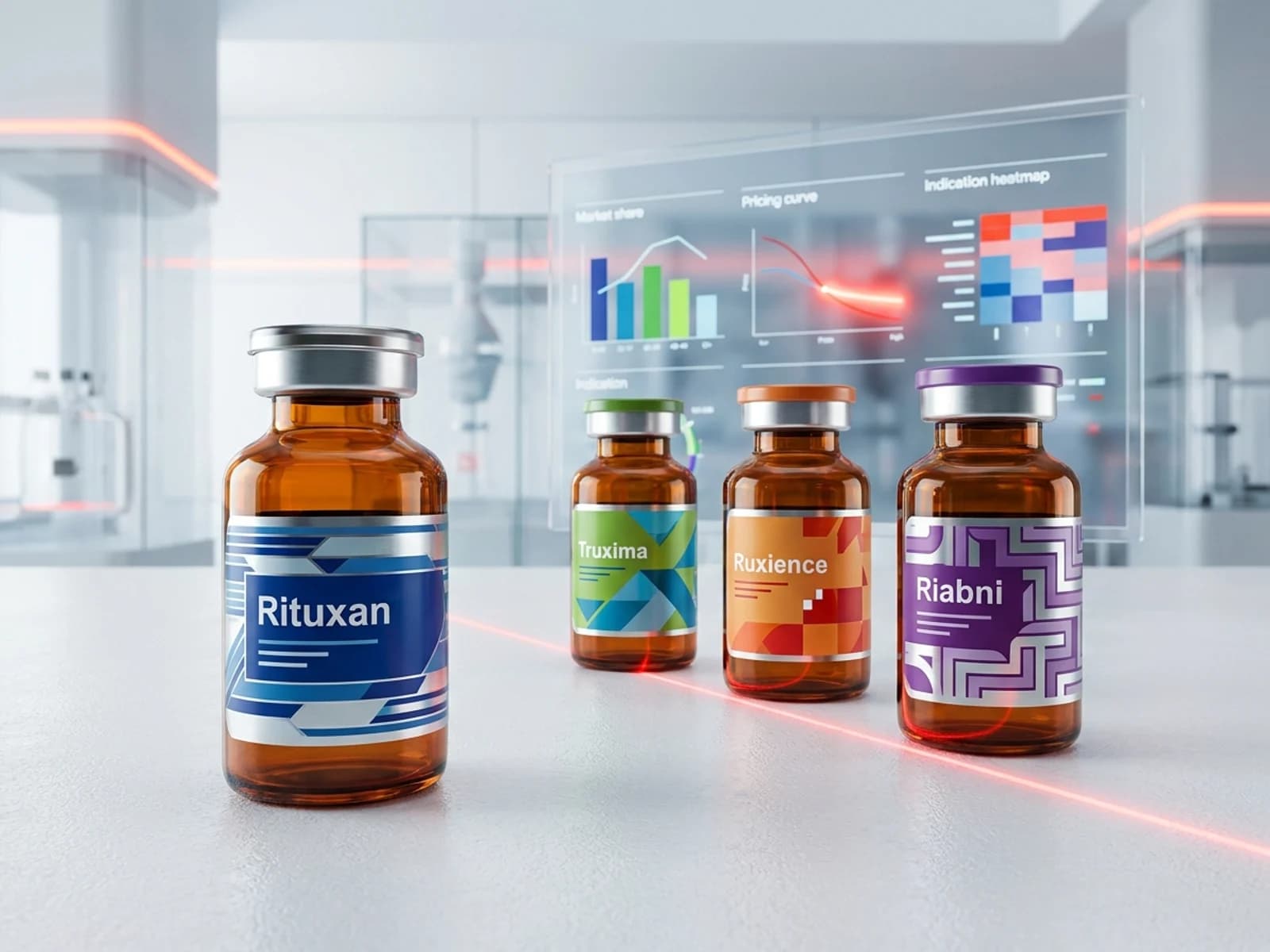
Rituxan (rituximab, Genentech/Biogen) was the first monoclonal antibody approved for cancer treatment when the FDA cleared it in 1997 for relapsed or refractory B-cell non-Hodgkin's lymphoma. Over nearly three decades, its indications expanded to include chronic lymphocytic leukemia, rheumatoid arthritis, granulomatosis with polyangiitis, microscopic polyangiitis, and pemphigus vulgaris. Three biosimilars have been approved since 2018, and biosimilars now hold 77% of the rituximab market by volume.
This reference-product dossier is for oncology prescribers, access teams, pharmacists, and payer professionals who need to track which biosimilars are available, how payers are covering them, and what switching rules apply.
FDA-approved biosimilars
As of May 2026, three biosimilars referencing Rituxan have been approved by the FDA:
| Biosimilar | Nonproprietary name | Manufacturer | FDA Approval | Interchangeable | US Launch |
|---|---|---|---|---|---|
| Truxima | rituximab-abbs | Celltrion / Teva | Nov 2018 | No | Nov 2019 |
| Ruxience | rituximab-pvvr | Pfizer | Jul 2019 | No | Feb 2020 |
| Riabni | rituximab-arrx | Amgen | Dec 2020 | No | Jan 2021 |
A fourth product, Rituxan Hycela (rituximab and hyaluronidase), is not a biosimilar. It is a subcutaneous formulation of the reference product co-administered with human hyaluronidase to enable subcutaneous injection. Rituxan Hycela has no biosimilar competitors.
Interchangeability
None of the three rituximab biosimilars carry the FDA interchangeable designation. All are approved as biosimilars, meaning they must be dispensed when a prescription is written specifically for the biosimilar product. Pharmacy-level auto-substitution is not permitted for any rituximab biosimilar.
Indication coverage
Rituxan's indications span both oncology and autoimmune diseases. Biosimilar coverage varies:
| Indication | Rituxan | Truxima | Ruxience | Riabni | Rituxan Hycela |
|---|---|---|---|---|---|
| Relapsed/refractory low-grade or follicular CD20+ B-cell NHL | Yes | Yes | Yes | Yes | Yes |
| Previously untreated follicular CD20+ B-cell NHL | Yes | Yes | Yes | Yes | Yes |
| Non-progressing low-grade CD20+ B-cell NHL (maintenance) | Yes | Yes | Yes | Yes | Yes |
| Diffuse large B-cell lymphoma (with chemotherapy) | Yes | Yes | Yes | Yes | Yes |
| Chronic lymphocytic leukemia (with FC chemotherapy) | Yes | Yes | No | Yes | No |
| Pediatric DLBCL / Burkitt lymphoma / B-AL (with chemotherapy) | Yes | No | No | Yes | No |
| Rheumatoid arthritis (with MTX, after anti-TNF failure) | Yes | Yes | No | Yes | No |
| Granulomatosis with polyangiitis (GPA) | Yes | Yes | Yes | Yes | No |
| Microscopic polyangiitis (MPA) | Yes | Yes | Yes | Yes | No |
| Moderate to severe pemphigus vulgaris | Yes | Yes | Yes | Yes | No |
Key coverage gaps:
Ruxience does not carry CLL or RA indications. Pfizer's rituximab biosimilar has the narrowest label, missing both chronic lymphocytic leukemia and rheumatoid arthritis. It also lacks the pediatric lymphoma indication.
Truxima does not carry the pediatric lymphoma indication. Celltrion's biosimilar covers all other Rituxan indications including CLL, RA, GPA, MPA, and PV.
Riabni is the only biosimilar approved for all Rituxan indications, including CLL, pediatric lymphoma, and RA. Amgen's product achieved full indication parity with the reference product.
On June 12, 2025, the FDA approved an additional indication for all three biosimilars for the treatment of moderate to severe pemphigus vulgaris in adult patients.
HCPCS coding
Rituximab products are billed under the medical benefit using specific HCPCS codes:
| Product | HCPCS Code |
|---|---|
| Rituxan (reference) | J9312 |
| Truxima | Q5115 |
| Ruxience | Q5119 |
| Riabni | Q5123 |
| Rituxan Hycela | J9311 |
Separate billing codes enable payers to track utilization by product and apply product-specific reimbursement rates.
Payer and PBM coverage
Commercial insurance
Rituximab is administered intravenously (or subcutaneously as Rituxan Hycela) in clinical settings, so it is covered under the medical benefit. Payer coverage is driven by:
Formulary preferred products: Many commercial payers designate Truxima and Riabni as preferred rituximab biosimilars. These products have the broadest indication coverage and lowest ASPs.
Step-through requirements: Payers typically require use of a preferred biosimilar before approving Rituxan or a non-preferred biosimilar. For autoimmune indications (RA, GPA, MPA, PV), payers may also require prior TNF blocker failure before rituximab.
Prior authorization: Oncology use of rituximab requires prior authorization confirming diagnosis, treatment regimen, and often NCCN guideline concordance. Autoimmune use (RA, GPA/MPA) requires documentation of prior therapy failure.
Buy-and-bill reimbursement: Hospitals and clinics purchase the product and bill for administration. Lower-cost biosimilars provide different margin dynamics depending on payer contracts.
Medicare Part B
Rituximab is covered under Medicare Part B (physician-administered drugs). Key considerations:
CMS reimburses at 106% of ASP for biosimilars. The reference product's higher ASP yields a higher absolute margin under the buy-and-bill model, which can create a financial disincentive for providers to switch.
CarelonRx's step therapy policy for rituximab agents in oncologic indications designates biosimilars as preferred products, with Rituxan requiring step-through or documented medical necessity for a non-preferred product.
A PMC study found that rituximab ASP declined 9.9% within three years of biosimilar entry, with mean biosimilar ASP 40-50% below the reference product's counterfactual price.
Medicaid
State Medicaid programs vary in their rituximab biosimilar coverage. Common approaches include:
Preferred product lists designating specific biosimilars
Prior authorization requirements for the reference product
Mandatory trial of a preferred biosimilar before Rituxan approval
Louisiana Medicaid's updated policy (effective April 2025) aligns biosimilar coverage criteria with Rituxan across all indications
Pricing landscape
Average sales prices (Q1 2026)
According to Samsung Bioepis's Q1 2026 Biosimilar Market Report, rituximab pricing (per 500 mg) as of Q1 2026:
| Product | WAC (Q1 2026) | ASP (Q1 2026) | ASP Discount vs. Rituxan |
|---|---|---|---|
| Rituxan (reference) | $4,364 | $2,912 | — |
| Truxima | $4,228 | $1,225 | -58% |
| Ruxience | $3,584 | $381 | -87% |
| Riabni | $3,584 | $763 | -74% |
The average ASP across all biosimilars was $790 per 500 mg in Q1 2026, a 29% decline from the prior quarter, primarily driven by a drop in Ruxience's ASP.
Volume market share
As of Q3 2025, biosimilars held 77% of the rituximab market by volume:
| Product | Volume Share | ASP (Q1 2026) |
|---|---|---|
| Rituxan | 22% | $2,912 |
| Truxima | 39% | $1,225 |
| Riabni | 31% | $763 |
| Ruxience | 7% | $381 |
The rituximab market is bifurcated: lower-cost biosimilars account for 77% of the market, while the reference product maintains 22% share despite having the highest ASP. This retention reflects established prescribing patterns, some indication-specific considerations, and 340B program dynamics.
Price erosion trend
Rituximab price erosion has been more moderate than for other oncology biosimilars:
At launch, Riabni's WAC was 23.7% lower than Rituxan and 15.2% lower than Truxima
Ruxience has aggressively discounted its ASP to $381, the lowest in the category, but has only 7% volume share — suggesting that pricing alone does not drive market share in the buy-and-bill oncology market
The global Rituxan market is projected to decline from $1.58 billion (2026) to $1.08 billion (2033) at a -5.1% CAGR, driven by biosimilar competition and treatment paradigm shifts
Market dynamics
Competitive landscape
The three biosimilar manufacturers have taken different market approaches:
Truxima (Celltrion/Teva): First-to-market advantage with all adult indications including RA. Holds 39% volume share.
Riabni (Amgen): The only biosimilar with full indication parity with Rituxan, including CLL, pediatric lymphoma, and RA. Holds 31% volume share.
Ruxience (Pfizer): Lowest ASP ($381) but narrowest indication coverage (no CLL, no RA). Holds only 7% volume share despite aggressive pricing.
Pipeline
No additional rituximab biosimilar applications appear to be pending FDA review as of May 2026. The market appears to be consolidating around the three existing products.
Switching and operational guidance
Medical benefit administration
Rituximab is administered by intravenous infusion (or subcutaneously as Rituxan Hycela). Switching from Rituxan to a biosimilar requires:
Prescriber writes a new order for the preferred biosimilar product.
Pharmacy verifies payer preference, prior authorization status, and indication coverage.
Verify indication match: If the patient has CLL or RA, Ruxience cannot be used. If the patient has a pediatric indication, only Riabni is approved.
Clinic purchases the preferred product through its GPO or wholesale channel.
Administration proceeds under the same dosing and schedule as the reference product.
Indication-specific switching considerations
Because biosimilar indication coverage differs, switching decisions must account for the patient's diagnosis:
NHL (adult): Any biosimilar can be used. Truxima and Riabni are preferred by most payers.
CLL: Only Truxima or Riabni. Ruxience is not approved for this indication.
Rheumatoid arthritis: Truxima or Riabni. Ruxience is not approved for RA.
Pediatric lymphoma: Only Riabni.
GPA/MPA/PV: Any biosimilar can be used.
Patient communication
Because rituximab is administered in clinic, patients may not be aware of which product they receive. Key communication points:
The biosimilar has been FDA-approved as highly similar to Rituxan with no clinically meaningful differences.
The dosing schedule and administration process remain the same.
The clinic has selected the product based on efficacy, safety, and cost considerations.
What to monitor
Ruxience market share trajectory: Despite having the lowest ASP, Ruxience has only 7% market share. Monitor whether its narrow indication coverage limits further adoption.
Interchangeability applications: No rituximab biosimilar currently holds interchangeable status. Monitor FDA Purple Book for any new designations.
340B program dynamics: Hospital systems' 340B pricing for Rituxan may continue to favor the branded product, creating a split incentive between the pharmacy and medical benefit channels.
Rituxan Hycela biosimilar pathway: No biosimilar for the subcutaneous formulation exists. Monitor whether any biosimilar manufacturer pursues this formulation.
Pediatric indication and Ruxience RA/CLL expansion: Monitor whether Ruxience pursues CLL and RA indication approvals to close the gap with Truxima, Riabni, and the reference product. Only Riabni currently carries the pediatric lymphoma indication.
Sources
FDA. Biosimilar Product Information. Updated May 2026. https://www.fda.gov/drugs/biosimilars/biosimilar-product-information
FDA. Purple Book: Database of Licensed Biological Products. https://purplebooksearch.fda.gov/
Samsung Bioepis. Biosimilar Market Report Q1 2026. February 2026. https://biologicshq.com/wp-content/uploads/2026/02/SB-Biosimilar-Market-Report-Q1-2026.pdf
Pearce IP. New Indication Alert: FDA Expands Indications for Celltrion's, Pfizer's and Amgen's Rituximab Biosimilars. June 12, 2025. https://www.pearceip.law/2025/06/12/new-indication-alert-fda-expands-indications-for-celltrions-pfizers-and-amgens-rituximab-biosimilars
Safe Biologics. FDA Approves 29th Biosimilar, Third for Rituximab. December 2020.
Coherent Market Insights. Rituxan Market Size, Share and Forecast, 2026-2033.
PMC. Biologic Drug Prices in Medicare Part B After Entry of Biosimilars to the Market. 2026. https://pmc.ncbi.nlm.nih.gov/articles/PMC12606378/
CarelonRx. Rituximab Agents for Oncologic Indications Step Therapy. 2025.
Gabionline. Biosimilars of rituximab. https://www.gabionline.net/biosimilars/general/Biosimilars-of-rituximab
InsightAce Analytic. Rituximab Biosimilar Market Share, Size, Growth and Forecast to 2034.