Independent copay assistance foundations sit at the center of a complex, multi-billion-dollar drug access ecosystem in the United States. While pharmaceutical manufacturer copay cards provide direct commercial co-payment relief at retail counters, federal anti-kickback statutes strictly prohibit manufacturers from offering direct copay assistance to beneficiaries of federal healthcare programs like Medicare and Medicaid. To bridge out-of-pocket affordability gaps for underinsured and Medicare patients without violating anti-kickback laws, drug manufacturers donate hundreds of millions of dollars annually to independent 501(c)(3) charitable foundations.
According to the latest IRS Form 990 tax filings (predominantly describing fiscal year 2023 performance filed during tax year 2024), the five largest independent copay assistance and patient assistance program (PAP) charities reported a combined $1.72 billion in total contributions and $1.78 billion in total revenue. These organizations—HealthWell Foundation, Patient Access Network (PAN) Foundation, American Kidney Fund, Patient Advocate Foundation, and the National Organization for Rare Disorders (NORD)—deploy the vast majority of these funds directly into patient disease funds that cover co-pays, deductibles, premiums, and travel assistance for specialty therapeutics.
| Foundation Name | Total Contributions | Total Revenue | Total Expenses | End-of-Year Net Assets | IRS Form 990 Identifier |
|---|---|---|---|---|---|
| HealthWell Foundation | $730,901,028 | $742,364,218 | $721,499,830 | $637,832,771 | 202422959349301102 |
| PAN Foundation (Patient Access Network) | $364,186,196 | $374,424,371 | $288,133,138 | $468,568,076 | 202421719349300227 |
| American Kidney Fund | $349,583,602 | $352,931,631 | $284,331,924 | $159,891,758 | 202411239349302251 |
| Patient Advocate Foundation | $222,896,128 | $243,478,172 | $274,207,632 | $313,168,594 | 202433319349300408 |
| National Organization for Rare Disorders (NORD) | $55,591,572 | $66,397,453 | $52,832,739 | $65,154,464 | 202433199349301903 |
| Combined Five-Foundation Total | $1,723,158,526 | $1,779,595,845 | $1,621,005,263 | $1,644,615,663 | 2024 IRS TEOS XML Filing Batch |
Data source: IRS Form 990 e-file public disclosures. Financials reflect the most recent electronically filed 990 returns (FY2023/FY2024 filing cycle).
This analysis provides a dollar-level accounting of the financial flows through these five major independent charities, examines the regulatory firewalls mandated by the HHS Office of Inspector General (OIG), and analyzes how copay foundation grants interact with commercial copay accumulator adjustor programs and the Inflation Reduction Act’s (IRA) $2,100 Medicare Part D out-of-pocket cap.
How much did each of the five largest copay foundations take in and spend (latest 990)?
Analyzing the IRS Form 990 electronic filings reveals a high concentration of charitable copay assistance capital within a handful of dedicated non-profit entities.
1. HealthWell Foundation
HealthWell Foundation is by far the largest independent copay assistance charity in the United States. On its 2024-filed Form 990 (tax period ending December 31, 2023), HealthWell reported:
Total Contributions (Line 1h): $730,901,028
Total Revenue (Line 12): $742,364,218
Total Functional Expenses (Line 25): $721,499,830
End-of-Year Net Assets (Line 22): $637,832,771
HealthWell operates over 50 disease-specific funds spanning oncology, autoimmune conditions, rare pediatric diseases, and specialty biopharmaceuticals. The foundation's program efficiency remains exceptionally high, with program service expenses accounting for over 98% of total functional expenditure.
2. Patient Access Network (PAN) Foundation
The PAN Foundation represents the second-largest copay charity, operating dozens of disease funds tailored to Medicare Part D beneficiaries and underinsured commercial patients. Its 2024-filed Form 990 recorded:
Total Contributions: $364,186,196
Total Revenue: $374,424,371
Total Functional Expenses: $288,133,138
End-of-Year Net Assets: $468,568,076
During this fiscal cycle, PAN Foundation generated an operating surplus of approximately $86.3 million, building capital reserves to sustain multi-year grant commitments across chronic disease categories.
3. American Kidney Fund (AKF)
While AKF operates a broader mission serving end-stage renal disease (ESRD) and chronic kidney disease (CKD) patients, its Safety Net Grant and Health Insurance Premium Program (HIPP) function as major patient assistance mechanisms covering Medicare Part B, Medigap, and commercial premiums for dialysis and transplant therapies.
Total Contributions: $349,583,602
Total Revenue: $352,931,631
Total Functional Expenses: $284,331,924
End-of-Year Net Assets: $159,891,758
4. Patient Advocate Foundation (PAF)
PAF provides both direct financial copay/premium relief and individualized case management for patients with chronic, life-threatening, or debilitating illnesses. Its 2024-filed Form 990 reported:
Total Contributions: $222,896,128
Total Revenue: $243,478,172
Total Functional Expenses: $274,207,632
End-of-Year Net Assets: $313,168,594
Unlike the other four entities, PAF’s functional expenses exceeded its annual revenue during this filing period by approximately $30.7 million, intentionally drawing down accrued net asset reserves to satisfy surging patient copay assistance demand.
5. National Organization for Rare Disorders (NORD)
NORD serves as the primary advocacy umbrella and assistance provider for rare disease populations. Its patient assistance programs provide copay, premium, and clinical trial travel grants for orphan drug indications.
Total Contributions: $55,591,572
Total Revenue: $66,397,453
Total Functional Expenses: $52,832,739
End-of-Year Net Assets: $65,154,464
Where does the money come from, and how much reaches patients versus overhead?
The economic mechanics of independent copay foundations differ fundamentally from standard public charities. The vast majority of contributions received by these five organizations originate as corporate grants from biopharmaceutical manufacturers.
The Manufacturer-Charity Money Pipeline
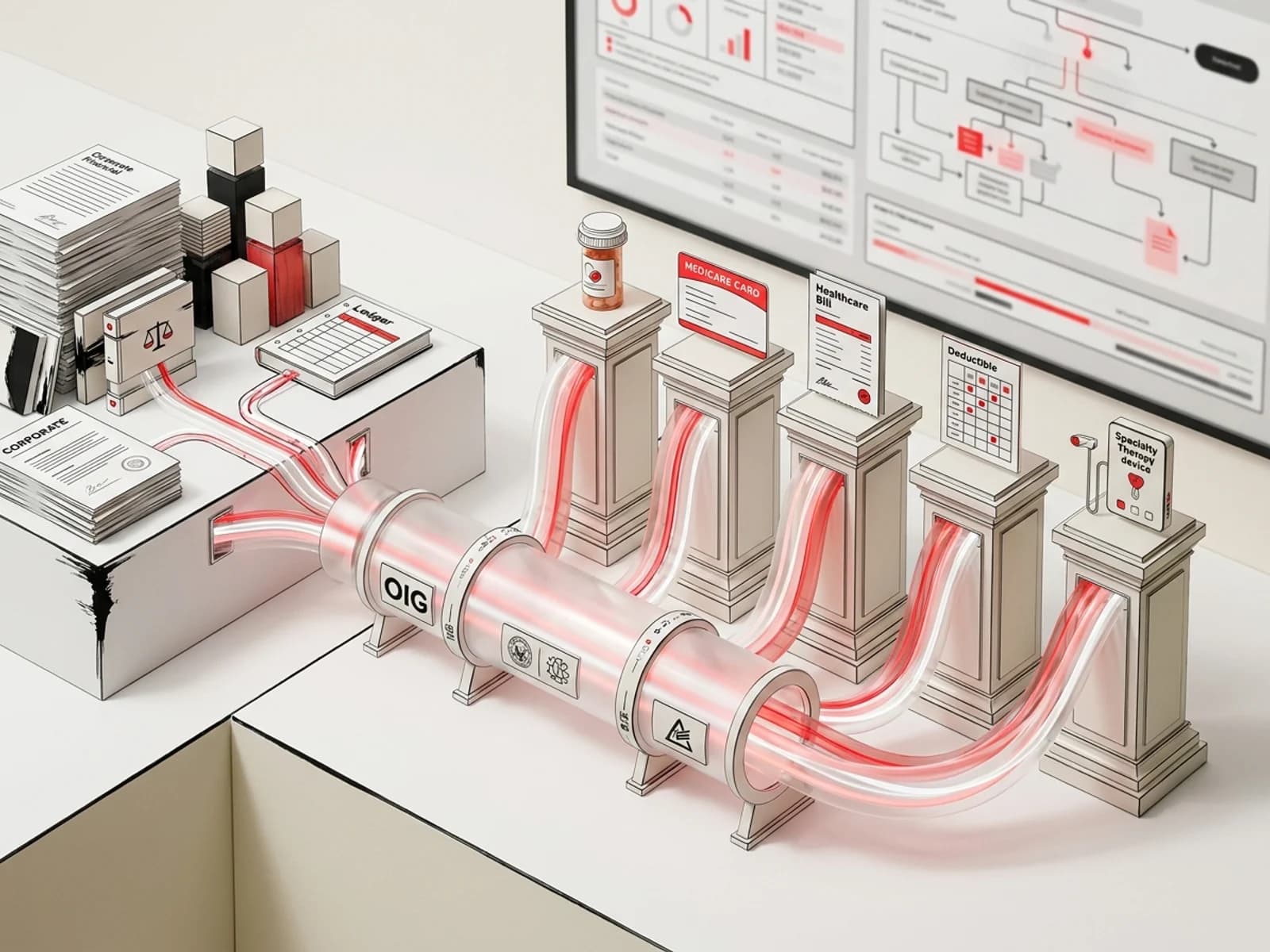
Drug manufacturers cannot legally pay Medicare patients' copays directly due to the federal Anti-Kickback Statute (42 U.S.C. § 1320a-7b(b)). Doing so is treated by federal regulators as an illegal inducement to purchase a federally reimbursable drug. However, under long-standing HHS OIG Special Advisory Bulletins and Advisory Opinions, pharmaceutical companies may make charitable, tax-deductible cash donations to independent 501(c)(3) foundations.
+-----------------------------------+
|  Biopharmaceutical Manufacturers  |
+-----------------------------------+
                  |
                  | Tax-Deductible Corporate Grants
                  v
+-----------------------------------+
|  Independent 501(c)(3) Copay      |
|  Foundations (HealthWell, PAN)    |
+-----------------------------------+
                  |
                  | Disease-Specific Grant Allocations
                  v
+-----------------------------------+
|  Underinsured Patients &          |
|  Medicare Part D Beneficiaries    |
+-----------------------------------+
Overhead Ratios and Operational Efficiency
Because copay foundations function primarily as grant-making pass-through mechanisms, administrative and fundraising overhead is remarkably minimal compared to traditional health charities:
Direct Patient Aid Share: Between 92% and 98% of total functional expenses across these five foundations consist of direct program services—specifically financial assistance grants paid to pharmacies, medical providers, or directly credited to patient accounts.
Management & General Expenses: Typically range between 1.5% and 4.0% of total expenditure, covering IRS reporting, IT infrastructure, audit fees, and compliance monitoring.
Fundraising Overhead: Typically accounts for less than 1.5% of annual revenue, as donations are solicited through institutional biopharmaceutical corporate grant applications rather than direct-mail consumer campaigns.
In our by-the-numbers look at CMS Open Payments, we examined how biopharmaceutical firms report direct transfers of value to physicians and teaching hospitals. Copay foundation contributions represent a parallel, highly regulated funding channel that is reported via IRS Form 990 e-files rather than the Sunshine Act database.
How do copay foundations interact with accumulator adjustors and the $2,100 Part D cap?
The operational role of independent copay foundations is shifting dramatically due to two major policy developments: commercial payer copay accumulator adjustor programs and the Inflation Reduction Act’s restructuring of Medicare Part D.
Commercial Accumulator Adjustors vs. Foundation Grants
In commercial health insurance, pharmacy benefit managers (PBMs) and health plans historically permitted manufacturer copay card value and foundation grant dollars to count toward a patient’s annual deductible and out-of-pocket (OOP) maximum. Once the card or grant was exhausted, the patient had satisfied their deductible.
Over the past decade, PBMs introduced Copay Accumulator Adjustor Programs (CAAPs) and Copay Maximizer Programs. Under an accumulator, third-party assistance dollars pay for the drug at the pharmacy counter, but none of that value accrues toward the patient’s deductible or annual OOP limit. When the foundation grant or manufacturer card reaches its cap, the patient suddenly faces full out-of-pocket cost-sharing.
While manufacturer copay cards bear the brunt of commercial accumulators, foundation grants for commercially insured patients with high-deductible health plans are also frequently impacted. Although federal litigation (HIV and Hepatitis Policy Institute v. HHS) and a subsequent HHS final rule restricted accumulator enforcement when no generic equivalent is available, health plans continue to challenge these boundaries through maximizer designs.
The Inflation Reduction Act $2,100 Part D Cap
For Medicare beneficiaries, the legal landscape is entirely different. Medicare patients are barred from manufacturer copay cards, making foundation grants their primary financial lifeline for specialty therapies.
Under the IRA’s Medicare Part D redesign:
2024: The 5% catastrophic coinsurance requirement was eliminated, capping Medicare Part D out-of-pocket costs at approximately $3,300 to $3,800 depending on plan design.
2025/2026: Out-of-pocket prescription drug spending is hard-capped at $2,000 annually (indexed to $2,100 for 2026).
As detailed in our analysis of the Part D $2,100 out-of-pocket cap and manufacturer hub impact, the $2,100 cap significantly reduces catastrophic out-of-pocket exposure for Medicare patients on high-cost biologics (e.g., oncology, immunology, neurology). However, $2,100 remains a formidable upfront hurdle for fixed-income seniors, particularly in January when annual deductibles reset.
Copay foundations report that while the $2,100 cap decreases the maximum grant size needed per individual patient (from $5,000+ down to $2,100), the total number of patients seeking upfront deductible relief has expanded, redistributing foundation capital across broader beneficiary pools.
What are the rules and the controversy around manufacturer-funded assistance?
To maintain compliance with federal law, independent copay foundations must operate under strict legal guardrails established by the HHS OIG.
HHS OIG Compliance Guardrails
To prevent manufacturer donations from functioning as illegal kickbacks, OIG Advisory Opinions enforce four strict rules:
Absolute Donor Anonymity & Independence: Foundations must establish and manage disease funds independently. Donors cannot influence fund criteria, selection guidelines, or patient eligibility.
Broad Disease Fund Definitions: Funds must be defined according to broad, recognized clinical disease categories (e.g., "Metastatic Breast Cancer") rather than narrow drug classes or specific mechanisms of action designed to favor a donor’s product.
Open Drug Coverage: Foundation disease funds must cover all FDA-approved products available for that disease, including generic competitors, regardless of whether the manufacturer of a specific drug donated to the fund.
No Donor Access to Patient Data: Foundations are strictly prohibited from sharing donor-specific reporting that links donation dollars to drug-specific utilization or market share.
+------------------------------------------------------------------------+
|                      HHS OIG MANDATED FIREWALL                         |
|                                                                        |
|  Pharma Donor  --->  Unrestricted Contribution  --->  Disease Fund    |
|  (No Influence)                                      (Covers All Drugs)|
+------------------------------------------------------------------------+
Regulatory Enforcement and Corporate Settlements
Despite these firewalls, the U.S. Department of Justice (DOJ) has pursued extensive Civil False Claims Act investigations against biopharmaceutical manufacturers for allegedly using copay foundations as indirect kickback conduits. Between 2017 and 2024, major drugmakers paid over $1 billion in cumulative federal settlements following allegations that company executives coordinated with foundations to create narrowly tailored funds that exclusively benefited their own high-cost specialty drugs.
These enforcement actions forced charities to tighten internal compliance controls, update software firewalls, and audit disease-fund expenditure to preserve their 501(c)(3) tax-exempt status and OIG safe-harbor protections.
How does this compare to direct manufacturer copay cards and to 340B?
Understanding patient assistance requires distinguishing between the three major financial support mechanisms operating across U.S. healthcare.
| Feature | Independent Copay Foundations (501c3) | Manufacturer Copay Cards | 340B Patient Assistance / Charity Care |
|---|---|---|---|
| Legal Basis | Independent charitable grants under OIG Safe Harbor | Commercial manufacturer price concession | Statutory safety-net hospital drug discount (340B) |
| Eligible Patients | Underinsured, Insured Commercial & Medicare/Medicaid | Commercial insurance ONLY (Prohibited in Medicare) | Low-income / uninsured patients treated at Covered Entities |
| Funding Source | Corporate tax-deductible grants to 501(c)(3) | Direct commercial marketing / access budget | Hospital/clinic drug margin reinvestment |
| Payer Interaction | Grants pay pharmacy or patient directly | Integrated into retail/specialty PBM claims switch | Discounted drug procurement by health system |
| Regulatory Risk | DOJ kickback scrutiny on donor independence | PBM copay accumulators & maximizer programs | HRSA compliance & contract pharmacy dispute |
Frequently Asked Questions
Are donations to HealthWell, PAN, and the other copay foundations tax-deductible, and who funds them?
Yes. HealthWell Foundation, PAN Foundation, Patient Advocate Foundation, NORD, and the American Kidney Fund are all registered 501(c)(3) public charities. Contributions made to them by biopharmaceutical corporations, corporate foundations, and private individuals are tax-deductible under Section 170 of the Internal Revenue Code. The vast majority of funding originates from corporate charitable grants awarded by biopharmaceutical manufacturers.
Can patients use copay-foundation grants with Medicare or only commercial insurance?
Unlike manufacturer copay cards—which are legally restricted to commercially insured patients—independent copay foundation grants can be used by Medicare Part D and Medicare Advantage beneficiaries, as well as commercially insured and underinsured individuals. Because the foundations operate independently of drug sponsors under HHS OIG safe-harbor guidance, Medicare permits beneficiaries to accept foundation assistance.
What is a copay accumulator adjustor and which payers apply it?
A copay accumulator adjustor is a policy implemented by commercial health plans and PBMs that prevents financial assistance dollars (from manufacturer cards or charitable grants) from counting toward a patient's annual deductible or out-of-pocket maximum. Under an accumulator, third-party funds cover the immediate prescription cost, but the patient receives no progress toward satisfying their annual health plan deductible.
Sources
U.S. Internal Revenue Service (IRS): Form 990 e-File Series Downloads & TEOS XML Database. URL:
https://www.irs.gov/charities-non-profits/form-990-series-downloadsU.S. Department of Health and Human Services (HHS) Office of Inspector General (OIG): Supplemental Special Advisory Bulletin: Independent Charity Patient Assistance Programs (2014 & 2020 updates). URL:
https://oig.hhs.gov/reports-and-publications/guidance/files/63FR52479.pdfCenters for Medicare & Medicaid Services (CMS): CY 2026 Medicare Part D Redesign and Out-of-Pocket Cap Implementation Guidance. URL:
https://www.cms.gov/newsroom/fact-sheets/calendar-year-2026-medicare-part-dProPublica: Nonprofit Explorer — Form 990 Tax Exemption Organization Filings (HealthWell, PAN, AKF, PAF, NORD). URL:
https://projects.propublica.org/nonprofits/U.S. Department of Justice (DOJ): Civil Division False Claims Act Enforcement Actions Regarding Patient Assistance Foundations. URL:
https://www.justice.gov/opa/pr