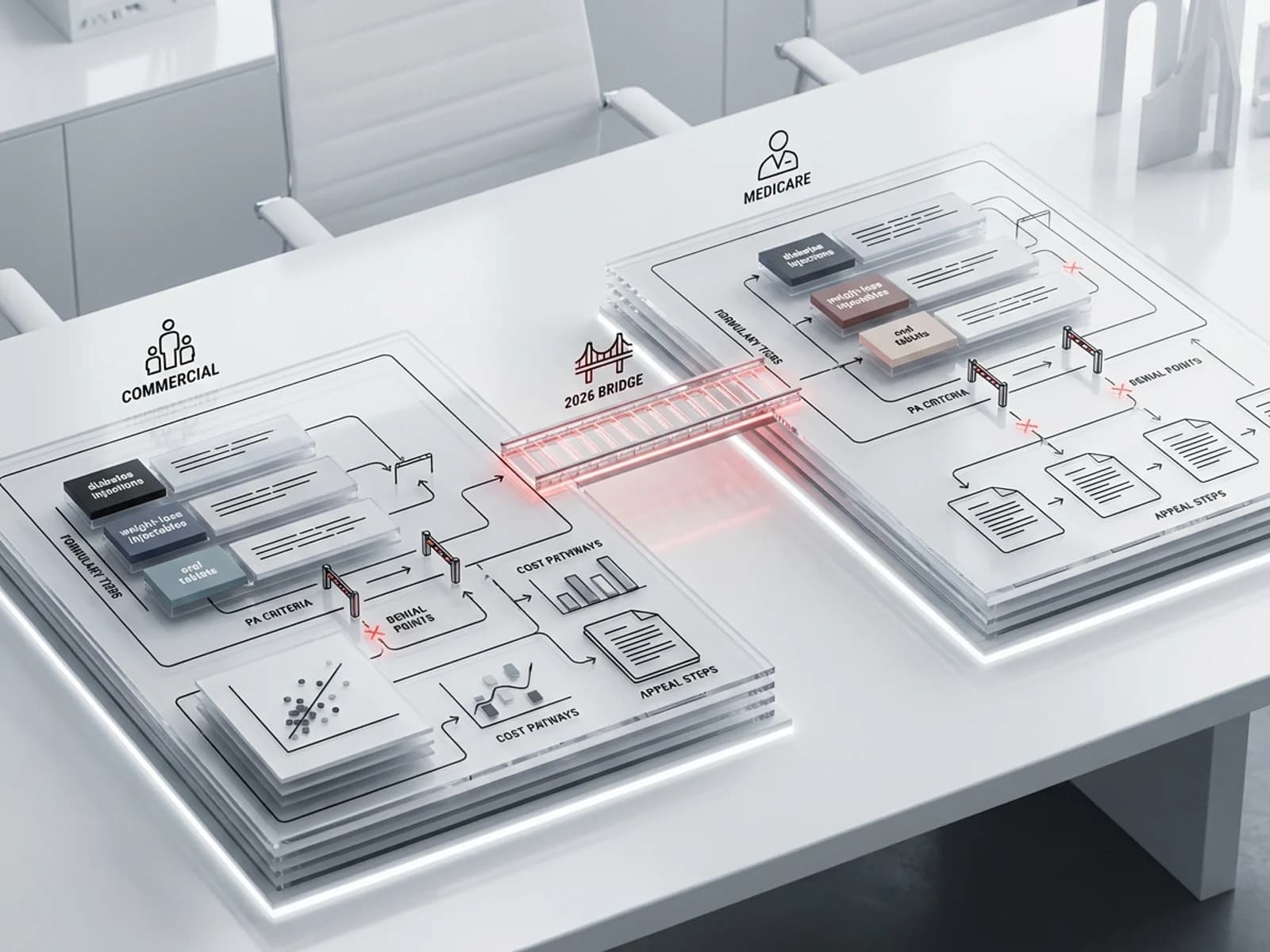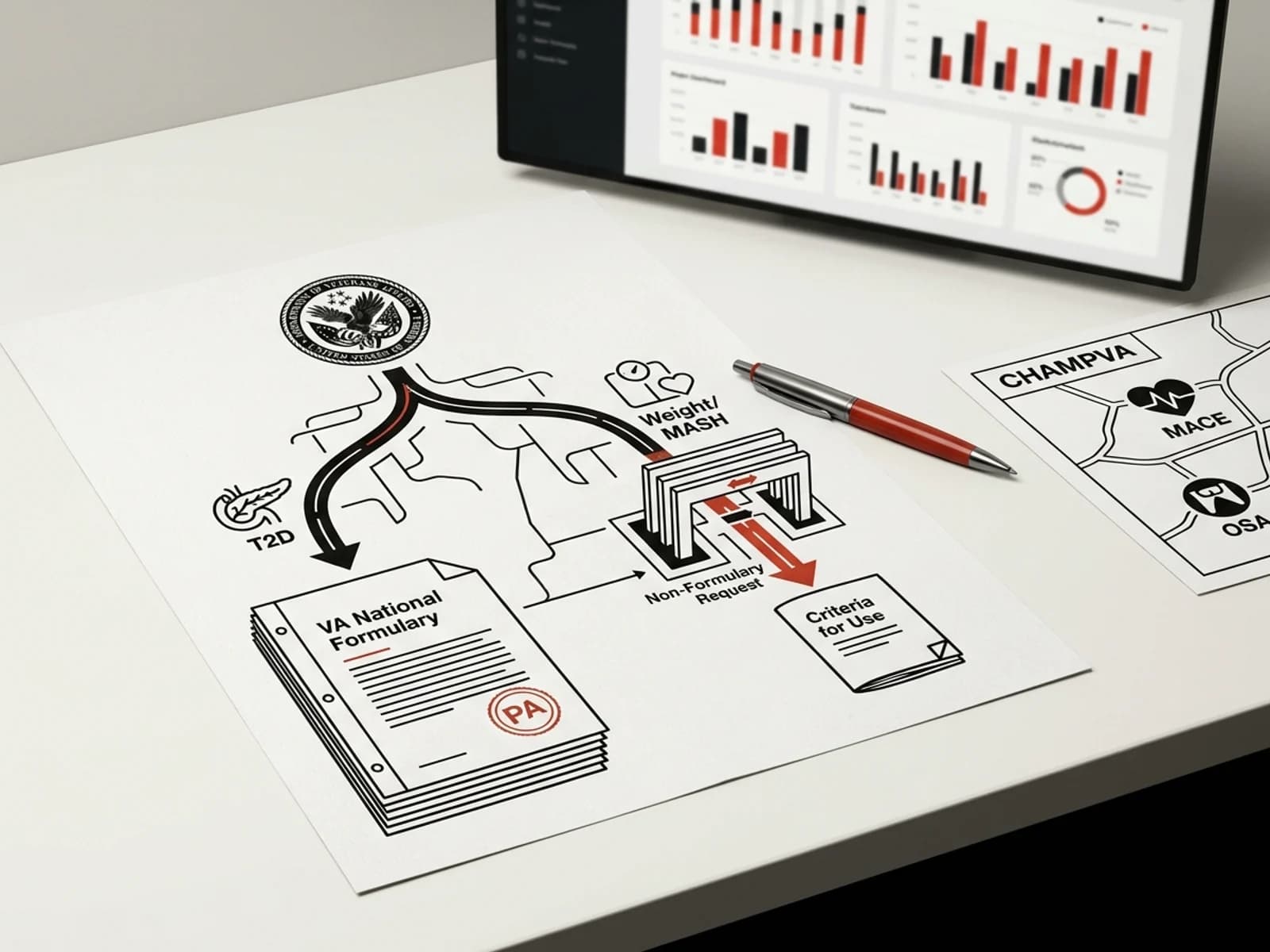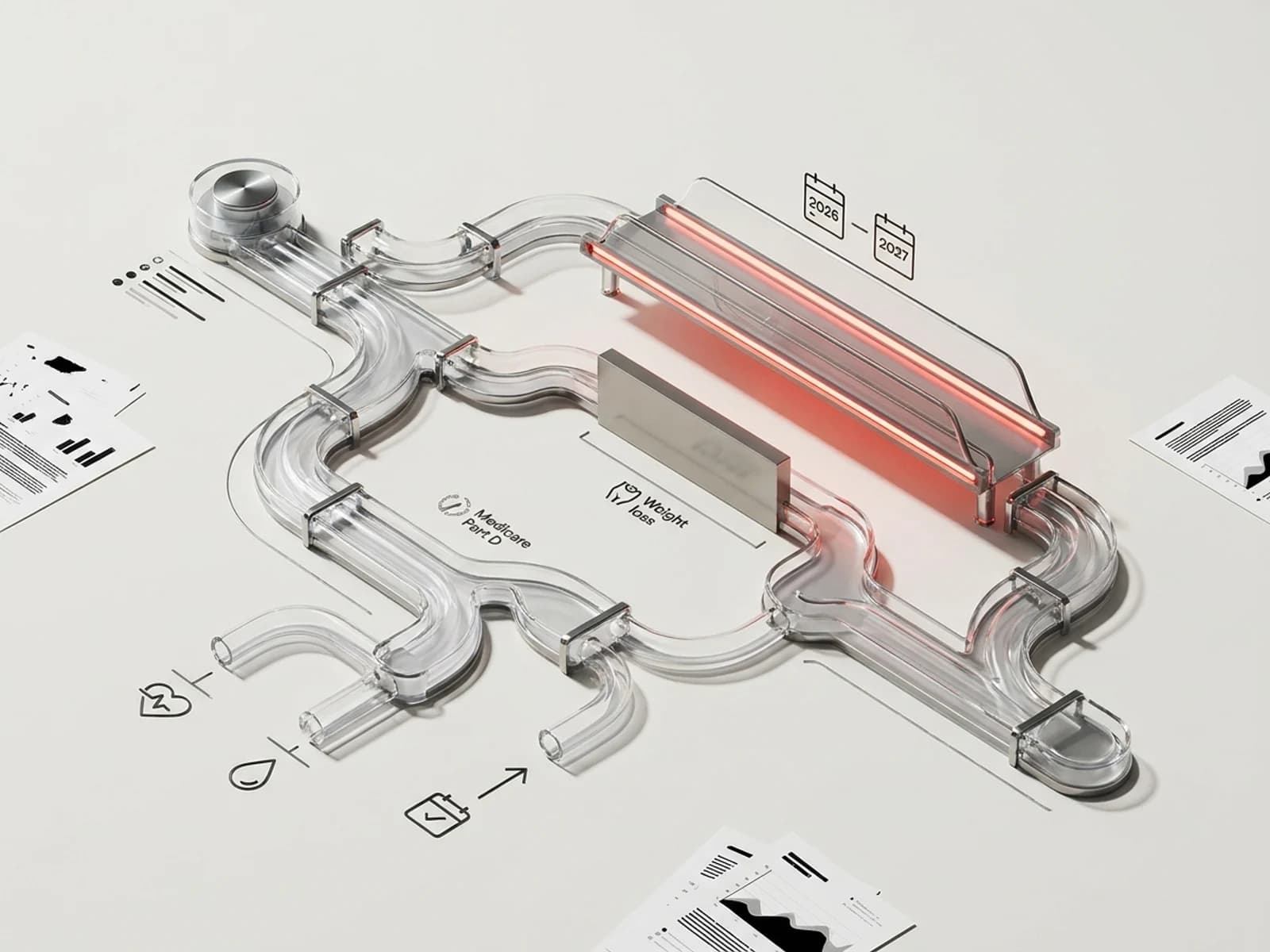
Medicare Part D covers GLP-1 receptor agonists — but only for specific FDA-approved indications. The Social Security Act excludes drugs "used for weight loss" from Part D coverage, so Wegovy prescribed for obesity alone is not covered. However, Wegovy prescribed for cardiovascular risk reduction or MASH, and Zepbound prescribed for obstructive sleep apnea, are covered. On July 1, 2026, CMS launches the Medicare GLP-1 Bridge — a temporary demonstration program that provides Wegovy and Zepbound to eligible Part D beneficiaries for $50 per month when prescribed for weight loss, operating entirely outside the Part D benefit structure.
This guide maps Medicare Part D GLP-1 coverage by drug and indication, explains the Bridge program, details the BALANCE Model, and identifies what prescribers, beneficiaries, and market access teams should monitor. It is independent information and not medical advice or reimbursement guidance for a specific patient or plan.
Quick answer
| GLP-1 Drug | Part D Covered Indications | Not Covered | Bridge Program (Jul 2026–Dec 2027) |
|---|---|---|---|
| Ozempic (semaglutide) | T2D, CKD/CV risk reduction in T2D | Weight loss | Not eligible (T2D drug) |
| Mounjaro (tirzepatide) | T2D | Weight loss | Not eligible (T2D drug) |
| Trulicity (dulaglutide) | T2D | Weight loss | Not eligible |
| Victoza (liraglutide) | T2D | Weight loss | Not eligible |
| Rybelsus (semaglutide oral) | T2D | Weight loss | Not eligible |
| Wegovy (semaglutide injection) | CVD risk reduction, MASH | Weight loss alone | Eligible — $50/month |
| Wegovy (semaglutide tablets) | CVD risk reduction (if on formulary) | Weight loss alone | Eligible — $50/month |
| Zepbound (tirzepatide KwikPen) | OSA | Weight loss alone | Eligible — $50/month |
| Foundayo (orforglipron) | Not covered (weight loss only) | Weight loss only | Eligible — $50/month |
Who this is for
Medicare beneficiaries and their caregivers navigating GLP-1 coverage
Prescribers treating Medicare patients who need GLP-1 medications for diabetes, cardiovascular risk, MASH, sleep apnea, or obesity
Benefit verification and prior authorization specialists handling Medicare Part D claims
Market access teams at GLP-1 manufacturers tracking Medicare policy
Health plan formulary managers preparing for the BALANCE Model
Pharmacists processing GLP-1 claims for Medicare beneficiaries
Source standard
Every fact in this guide is sourced from CMS.gov (Medicare GLP-1 Bridge page, Part D plan information, BALANCE Model announcements), Congressional Research Service reports, KFF analyses, CMS press releases, Reed Smith legal analysis, AMCP regulatory updates, and AARP Medicare coverage summaries dated 2025–2026. The Part D out-of-pocket cap figures are from CMS and PAN Foundation. Always verify current formulary and coverage through your Part D plan's formulary search tool or by contacting your plan directly.
Part D coverage rules for GLP-1 drugs
The statutory weight-loss exclusion
Under Section 1860D-2(e)(2) of the Social Security Act, Medicare Part D excludes coverage of drugs "when used for weight loss" or "weight gain." This is a statutory exclusion — it applies to all Part D plans and cannot be overridden by formulary exception or prior authorization.
However, GLP-1 drugs that have FDA-approved indications other than weight loss are covered under Part D for those indications:
Ozempic: FDA-approved for T2D, cardiovascular risk reduction in T2D, and kidney disease/CV death risk reduction in T2D. All three are Part D covered indications.
Wegovy: FDA-approved for chronic weight management, cardiovascular risk reduction in overweight/obese adults with CVD, and noncirrhotic MASH. Only the CVD and MASH indications are Part D covered; the weight management indication is excluded.
Zepbound: FDA-approved for chronic weight management and moderate-to-severe obstructive sleep apnea in adults with obesity. Only the OSA indication is Part D covered.
Mounjaro, Trulicity, Victoza, Rybelsus: FDA-approved for T2D only. Covered under Part D for T2D.
Part D formulary requirements
Part D plans are required to cover at least two drugs each for the treatment of T2D and cardiovascular disease. But plans are not required to include any specific GLP-1 drug. This means:
A Part D plan may cover Ozempic but not Mounjaro, or vice versa
A plan may cover Wegovy for CVD risk reduction but place it on a higher formulary tier
Formulary placement, prior authorization, step therapy, and quantity limits vary by plan
Plans must have a formulary exception process, but exceptions cannot override the statutory weight-loss exclusion
2026 Part D cost structure
| Cost Component | 2026 Amount | Source |
|---|---|---|
| Maximum Part D deductible | $615 | CMS |
| Out-of-pocket cap | $2,100 | CMS |
| Specialty tier coinsurance | 25–33% typical | Plan-specific |
| Copay after cap reached | $0 for covered Part D drugs | CMS |
For a GLP-1 drug costing approximately $1,000–$1,350 per month (list price), a beneficiary with 25% coinsurance would pay approximately $250–$338 per month until reaching the $2,100 cap, after which the plan covers 100% for the rest of the year.
The Medicare GLP-1 Bridge program
On July 1, 2026, CMS will launch the Medicare GLP-1 Bridge — a short-term demonstration program that provides GLP-1 drugs for weight loss to eligible Part D beneficiaries. The program was initially scheduled to run through December 31, 2026, but has been extended through December 31, 2027, because the planned BALANCE Model will not launch in 2027 as originally designed.
Bridge program details
| Feature | Detail |
|---|---|
| Start date | July 1, 2026 |
| End date | December 31, 2027 (extended from Dec 2026) |
| Eligible drugs | Wegovy (injection and tablets), Zepbound (KwikPen formulation only), Foundayo (all formulations) |
| Copay | $50 per monthly supply |
| Operates | Outside Part D benefit — claims go to a single central processor, not the beneficiary's Part D plan |
| Part D plan involvement | None — Part D sponsors do not carry risk or process Bridge claims |
| Eligibility | Enrolled in a Part D PDP or MA-PD plan for 2026; BMI and clinical criteria must be met |
| PA process | Provider submits prior authorization to the central processor |
| Coupons/discounts | Manufacturer coupons and discount programs may not be applied to Bridge claims |
| 2027 Part D OOP cap | $2,400 (the $2,100 cap applies to 2026 only) |
Eligible drugs and formulations
CMS updated the eligible drug list on April 6, 2026, to include Foundayo (orforglipron) following FDA approval and to clarify that only the KwikPen formulation of Zepbound is included:
Wegovy: All formulations (injection and oral tablets)
Zepbound: KwikPen formulation only. Single-dose vial and single-dose pen formulations are NOT included
Foundayo: All formulations
Clinical eligibility criteria
To qualify for the Bridge, a provider must submit a prior authorization request attesting the beneficiary is being prescribed the drug to reduce excess body weight and maintain weight reduction and that the beneficiary falls into one of three categories:
BMI ≥ 35 kg/m²
BMI ≥ 27 kg/m² plus qualifying comorbidities (e.g., hypertension, dyslipidemia, sleep apnea, T2D)
Other clinical diagnostic criteria as defined by CMS
What the Bridge does NOT cover
GLP-1 drugs prescribed for uses that are coverable under basic Part D (e.g., Wegovy for CVD risk reduction, Zepbound for OSA) must continue to be processed through the beneficiary's Part D plan
The $50 copay does not count toward the Part D deductible, the $2,100 out-of-pocket maximum, or TrOOP (true out-of-pocket) costs
Low-Income Subsidy (LIS) cost-sharing reductions do not apply to Bridge copays
Part D sponsors cannot shift coverage from the Part D benefit to the Bridge to avoid formulary obligations
Bridge transition risk
Because the Bridge operates outside Part D and the BALANCE Model launch in Part D is delayed, beneficiaries who participate in the Bridge face a potential transition gap:
After December 31, 2027, Bridge coverage ends
To continue GLP-1 coverage for obesity in 2028, beneficiaries would need to be enrolled in a Part D plan that participates in the BALANCE Model (which is voluntary for plans)
Beneficiaries may need to switch Part D plans during the 2027 open enrollment period (October 15–December 7) to ensure continuity
CMS is collecting GLP-1 utilization data during the Bridge to share with Part D plan sponsors ahead of potential BALANCE implementation
The BALANCE Model
The Better Approaches to Lifestyle and Nutrition for Comprehensive hEalth (BALANCE) Model is CMS's longer-term initiative to provide GLP-1 coverage for obesity through Medicare Part D. Key points:
Original launch: Planned for January 2027 through participating Part D plan sponsors
Current status: Delayed. CMS extended the Bridge through December 31, 2027, because sufficient Part D plan participation was not secured
Voluntary for plans: Part D plan sponsors choose whether to participate
Same $50 copay: When BALANCE launches in Part D, eligible beneficiaries would pay $50 per month through their Part D plan
Includes lifestyle supports: BALANCE combines GLP-1 access with evidence-based lifestyle interventions
Estimated federal cost: $25–35 billion over 10 years for Part D obesity drug coverage
CMS has not announced a revised launch date for BALANCE in Part D beyond the Bridge extension through end of 2027.
IRA price negotiation impact
Under the Inflation Reduction Act, CMS negotiates prices for selected high-cost Part D drugs. For 2027 (prices effective January 1, 2027):
Ozempic and Wegovy are both selected for IRA price negotiation
CMS announced negotiated prices in December 2025: the maximum fair price (MFP) for semaglutide products (Ozempic, Rybelsus, Wegovy) is $274 per 30-day supply, down from a 2024 list price of $959 (71% discount)
Negotiated prices take effect January 1, 2027
These negotiated prices may affect Part D formulary placement, tiering, and cost-sharing for the T2D and CVD indications
The Bridge program pricing ($245/month net cost to CMS, $50 copay to beneficiary) is separate from the IRA-negotiated prices.
GLP-1 coverage by indication: decision framework
When determining whether a GLP-1 drug is covered under Part D for a Medicare beneficiary, use this framework:
| Step | Question | If Yes | If No |
|---|---|---|---|
| 1 | Does the patient have T2D? | Ozempic, Mounjaro, Trulicity, Victoza, Rybelsus are Part D covered with PA | Go to step 2 |
| 2 | Does the patient have CVD + overweight/obesity? | Wegovy is Part D covered for CVD risk reduction with PA | Go to step 3 |
| 3 | Does the patient have noncirrhotic MASH? | Wegovy is Part D covered for MASH | Go to step 4 |
| 4 | Does the patient have moderate-to-severe OSA + obesity? | Zepbound is Part D covered for OSA | Go to step 5 |
| 5 | Does the patient need a GLP-1 for weight loss only? | Not covered under Part D. Check Bridge eligibility (if on or after July 1, 2026) | GLP-1 not covered |
What to monitor
Bridge program enrollment and PA process: CMS has stated that more details on the central processor and PA submission process will be released in spring 2026. Providers should monitor CMS.gov for the PA portal.
BALANCE Model Part D participation: The voluntary nature of BALANCE means coverage continuity after the Bridge depends on which Part D plans opt in. Monitor CMS announcements and plan formulary changes during fall 2027 open enrollment.
IRA negotiated prices: When CMS announces the 2027 negotiated prices for Ozempic and Wegovy (expected by November 30, 2025, with effect January 1, 2027), Part D plan formularies and cost-sharing may change.
New FDA approvals and indications: Any new GLP-1 indication (e.g., kidney disease, additional cardiovascular uses) may create new Part D covered indications beyond the weight-loss exclusion.
Foundayo launch and coverage: The newly approved oral GLP-1 (orforglipron, branded Foundayo) has been added to the Bridge eligible drug list. Monitor Part D formulary additions and Bridge eligibility.
State Medicaid GLP-1 policy changes: While this guide focuses on Medicare, state Medicaid GLP-1 coverage decisions affect dual-eligible beneficiaries. KFF reports that 13 state Medicaid programs covered GLP-1s for obesity as of January 2026, down from 16 in October 2025.
Disclaimer
This article is independent information for health care professionals, Medicare beneficiaries, and their advocates. It is not medical advice, reimbursement guidance, or legal counsel for any specific patient or plan. Medicare Part D coverage rules, the Bridge program, and BALANCE Model details are evolving. Always verify current coverage through your Part D plan, CMS.gov, or a qualified Medicare counselor.
Sources
CMS.gov: Medicare GLP-1 Bridge — FAQs and information for Part D plans. https://www.cms.gov/medicare/coverage/prescription-drug-coverage/medicare-glp-1-bridge
CMS press release: "Coming Soon: CMS to Provide $50 Monthly Access to GLP-1 Medications for Medicare Beneficiaries." https://www.cms.gov/newsroom/press-releases/coming-soon-cms-provide-50-monthly-access-glp-1-medications-medicare-beneficiaries
Reed Smith: "CMS Provides Details for 'Medicare GLP-1 Bridge' Coverage for Eligible Part D Beneficiaries," March 2026. reedsmith.com
KFF: "What Medicare's Temporary Program Covering GLP-1s for Obesity Means for Beneficiaries." kff.org
KFF: "What to Know About the BALANCE Model for GLP-1s in Medicare and Medicaid." kff.org
Congressional Research Service: "Medicare Coverage of GLP-1 Drugs," IF12758, September 2024. congress.gov
PAN Foundation: "Understanding the Medicare Part D Cap." panfoundation.org
AARP: "3 Prescription Drug Changes Coming to Medicare in 2026." aarp.org
AMCP Regulatory NewsBreak: "CMS Releases FAQs on the Medicare GLP-1 Bridge." amcp.org
Segal: "GLP-1 Agreement: What Group Health Plans Need to Know." segalco.com
Ophthalmology Advisor: "CMS Extends Medicare's Short-Term Bridge Program for GLP-1 Obesity Drug Coverage." ophthalmologyadvisor.com
UnitedHealthcare: "How Medicare Part D Is Changing in 2026." uhc.com
Wellcare: "Does Medicare Cover Weight-Loss Drugs?" wellcare.com
Aetna Medicare: "Does Medicare Part D Cover GLP-1 Drugs Like Ozempic?" aetna.com