On May 6, 2026, CMS formally launched enrollment for the Medicare GLP-1 Bridge demonstration — a time-limited program that will provide Medicare Part D beneficiaries access to GLP-1 obesity medications for a flat $50 per month starting July 1, 2026. The Bridge fills a gap that has existed since Medicare's founding: statutory exclusion of drugs used for "anorexia, weight loss, or weight gain" under the Part D benefit.
The program covers Wegovy (injectable and oral semaglutide), Zepbound KwikPen (tirzepatide), and Foundayo (orforglipron), dispensed outside the normal Part D payment flow at a manufacturer-negotiated net price of $245 per month. CMS contracted with Humana as central processor. No plan sponsor opt-in is required. The program runs through December 31, 2027, and is nationwide.
For market access teams, the Bridge introduces a new channel for GLP-1 obesity drugs that runs parallel to — but outside of — existing Part D formularies. This guide is for payer strategists, hub and specialty pharmacy operators, manufacturer access teams, and healthcare providers who need to understand how the Bridge demonstration works, who qualifies, how claims flow, and what comes next.
Short answer
| Parameter | Medicare GLP-1 Bridge |
|---|---|
| Authority | Section 402(a)(1)(A) of the Social Security Amendments of 1967 |
| Start date | July 1, 2026 |
| Patient copay | $50/month (flat, regardless of dose or benefit phase) |
| Eligible population | Medicare Part D beneficiaries meeting BMI criteria |
| Included drugs | Wegovy (all formulations), Zepbound KwikPen, Foundayo (all formulations) |
| Net price (to CMS) | $245/month per manufacturer agreements |
| Pharmacy reimbursement | WAC minus copay, plus dispensing fee and sales tax |
| Plan sponsor opt-in | Not required (nationwide, automatic) |
| Prior authorization | Yes (provider attestation of BMI and clinical criteria) |
| Central processor | Humana (contracted by CMS) |
| Relationship to Part D | Operates outside Part D benefit; copay does not count toward deductible or OOP cap |
| LIS/Extra Help | Does not apply to Bridge program |
| CMS contact | glp1demo@cms.hhs.gov |
Who qualifies: BMI and clinical criteria
For a beneficiary to receive GLP-1 obesity drugs through the Bridge, their prescriber must submit a prior authorization request attesting that the patient meets one of three criteria:
BMI of 35 or higher — automatic qualification, no additional documentation needed
BMI of 27 or higher with a qualifying comorbidity — comorbidities include heart disease, prediabetes, hypertension, dyslipidemia, sleep apnea, and other weight-related conditions
Already on a GLP-1 for weight loss when the program starts — the prescriber attests that the patient met the BMI criteria at the time GLP-1 therapy was initiated
BMI is assessed at the time therapy was initiated, not at the time of the Bridge prior authorization. This means a patient who started a GLP-1 in 2024 with a BMI of 37 but has since lost weight to a BMI of 34 still qualifies — the prescriber attests to meeting the criteria at initiation.
Prescribing physicians do not need to be enrolled in Medicare, but they cannot appear on the Medicare preclusion list. They must also attest that the patient is participating in a lifestyle modification program.
Beneficiaries do not need to register or opt in to the Bridge program. CMS will share additional information for beneficiaries before the July 1 launch. However, certain plan types are excluded: beneficiaries enrolled in private fee-for-service (PFFS) plans, section 1876 cost contract plans, section 1833 health care prepayment plans, PACE organizations, fallback plans, and religious fraternal benefit plans are not eligible to participate.
Which drugs are included — and which are not
The Bridge demonstration covers GLP-1 drugs FDA-approved for weight loss. The included products are:
| Drug | Formulation | Included in Bridge? | Notes |
|---|---|---|---|
| Wegovy (semaglutide) | Injectable | Yes | All strengths |
| Wegovy (semaglutide) | Oral tablet | Yes | All strengths |
| Zepbound (tirzepatide) | KwikPen | Yes | Auto-injector formulation only |
| Zepbound (tirzepatide) | Single-dose vials | No | Not included |
| Zepbound (tirzepatide) | Pre-filled pens (non-KwikPen) | No | Not included |
| Foundayo (orforglipron) | Oral tablet | Yes | All strengths |
| Ozempic (semaglutide) | Injectable | No | Diabetes-branded; not FDA-approved for obesity |
| Mounjaro (tirzepatide) | Injectable | No | Diabetes-branded; not FDA-approved for obesity |
Ozempic and Mounjaro are excluded because they carry FDA-approved indications for diabetes, not weight loss. Beneficiaries already receiving GLP-1 therapy through their Part D plan for diabetes, cardiovascular risk reduction, or sleep apnea continue to receive coverage through the normal Part D benefit — the Bridge is exclusively for the obesity indication.
How the $50 copay works in practice
The $50 copay is the patient's total monthly out-of-pocket cost. It does not change based on:
Dosage strength or titration stage
Which phase of the Part D benefit the beneficiary is in (deductible, initial coverage, coverage gap, catastrophic)
Which GLP-1 drug is prescribed
The $50 does not count toward the Part D deductible ($2,100 in 2026), does not accumulate toward the out-of-pocket cap, and low-income subsidy (LIS/Extra Help) benefits do not apply. The Bridge operates entirely outside the Part D benefit payment flow.
For beneficiaries already paying through their Part D plan for a GLP-1 prescribed for an approved non-obesity indication, the math may differ. A patient receiving Wegovy for cardiovascular risk reduction through Part D might pay a different amount through their plan's formulary tier than the flat $50 available through the Bridge for the obesity indication.
How payment flows: the $245 negotiated price
The payment architecture has three layers:
Patient pays $50 to the pharmacy at point of sale
CMS reimburses the pharmacy at no lower than wholesale acquisition cost (WAC) minus the $50 copay, plus a dispensing fee and applicable sales tax
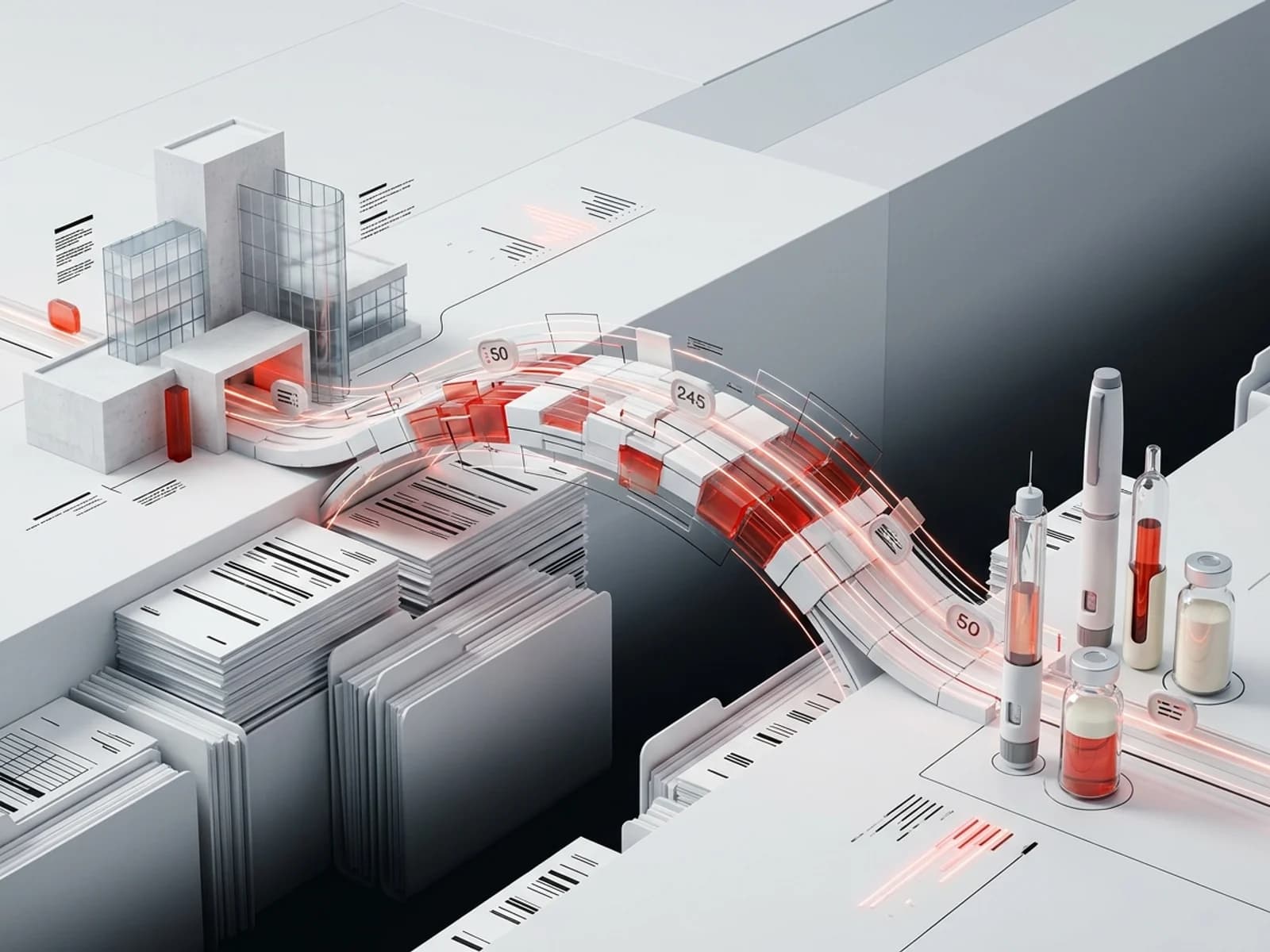
Manufacturers pay CMS back the difference between WAC and the $245 negotiated net price
Both Novo Nordisk (Wegovy) and Eli Lilly (Zepbound, Foundayo) agreed to the $245 net monthly price as part of the Most-Favored Nation pricing framework negotiated with the Trump administration in late 2025. This represents a substantial discount from list prices: Wegovy lists at approximately $1,349/month, Zepbound at approximately $1,060/month, and Foundayo at $299–$349/month (self-pay).
The net result is that CMS bears the difference between $245 and WAC (minus copay) for each claim, then recovers the overage from the manufacturer. CMS has not published a budget projection for the Bridge.
Prior authorization: what the provider submits
The Bridge requires a provider-submitted prior authorization, managed by the central processor (Humana). The PA attests to:
The beneficiary is a Medicare Part D enrollee
The GLP-1 is being prescribed to reduce excess body weight and for ongoing maintenance of weight reduction
The beneficiary meets one of the three clinical criteria (BMI ≥35; BMI ≥27 with comorbidity; or was already on a GLP-1 at initiation with qualifying BMI)
The prescriber is not on the Medicare preclusion list
The patient is participating in a lifestyle modification program
There is no step therapy requirement in the current Bridge design — a patient does not need to have tried and failed another weight-loss therapy before qualifying.
What happened to the BALANCE model
The GLP-1 Bridge was originally designed as a short-term stopgap before the longer-term BALANCE (Better Approaches to Lifestyle and Nutrition for Comprehensive hEalth) model took over in January 2027. On April 21, 2026, CMS announced an indefinite delay of the Part D portion of BALANCE because insufficient Part D plan sponsors signed up by the April 20 deadline.
| Parameter | GLP-1 Bridge (current) | BALANCE Model (delayed) |
|---|---|---|
| Timeline | July 1, 2026 – December 31, 2027 | January 2027 – December 2031 (delayed) |
| Authority | Section 402 demonstration | CMMI model |
| Scope | Obesity only | All medically accepted indications |
| Drugs | Wegovy, Zepbound KwikPen, Foundayo | All of the above plus Ozempic, Mounjaro, Rybelsus |
| Channel | Outside Part D | Inside Part D benefit |
| Copay counts toward OOP cap | No | Yes |
| Plan participation | Automatic, nationwide | Voluntary; required 80% enrollment threshold (not met) |
| Cost sharing | $50/month flat | $125/month (basic) or $50/month (enhanced/employer) |
| Status | Launching July 2026 | Indefinitely delayed for Part D |
The Medicaid portion of BALANCE is proceeding on a rolling basis from May 1, 2026 through January 1, 2027.
The delay means the Bridge will likely operate for longer than originally planned. Avalere Health noted that Part D plan sponsors faced "fundamental challenges in introducing a high-cost, high-demand drug benefit into the Part D program with limited data and significant financial uncertainty" — bids for 2027 plans were due June 1, 2026, but there were no existing claims data for GLP-1 obesity drugs in Medicare to project utilization accurately.
What this means for access teams
For manufacturer teams:
The Bridge creates a new channel for GLP-1 obesity drugs that bypasses traditional Part D formulary negotiations. Products included in the Bridge have nationwide Medicare access without needing individual plan-level formulary wins.
The $245 net price is fixed across all Bridge drugs, which compresses the pricing advantage that lower-cost oral products like Foundayo ($299/month self-pay) might otherwise have over injectables.
Monitor the Bridge utilization data that CMS collects — this will inform the eventual BALANCE model design and could shape long-term GLP-1 coverage policy.
For payer and PBM teams:
The Bridge does not change your Part D formulary obligations for GLP-1s prescribed for diabetes, cardiovascular risk reduction, or other approved non-obesity indications.
The $50 Bridge copay may pull patients out of your Part D GLP-1 claims (for the obesity indication), reducing your GLP-1 spend but also reducing your leverage in manufacturer negotiations.
Watch for CMS guidance on how Bridge utilization data may be used in future Part D bid calculations.
For prescribers and pharmacists:
Pharmacies do not need to opt in to the Bridge. Because it operates outside Part D, network pharmacy restrictions do not apply.
Submit the PA through the central processor (Humana). CMS has not yet published detailed claims submission instructions.
The $50 copay applies regardless of whether the patient picks up the prescription at a retail pharmacy, mail-order pharmacy, or through a direct-to-patient program.
What to monitor next
Bridge launch (July 1, 2026): Watch for CMS's detailed claims processing instructions, pharmacy enrollment procedures, and mail-order access details.
Utilization data: CMS will collect claims data that could inform future coverage decisions. First utilization reports may emerge by Q4 2026.
BALANCE model timeline: CMS may reopen Part D plan enrollment for a future model year. The Medicaid BALANCE rollout will provide early signals.
IRA drug price negotiation cycle 3: The third cycle (prices effective 2028) includes 15 Part B and Part D drugs. GLP-1s could enter negotiation in future cycles if spending thresholds are met.
Congressional action: Several bills (SMART Prices Act, S. 1836) would expand the number of drugs negotiated per year, which could accelerate GLP-1 entry into the IRA negotiation pipeline.
State Medicaid coverage: Watch for state-by-state adoption of the BALANCE Medicaid model, which may establish GLP-1 obesity coverage precedents.
TrumpRx.gov pricing: The direct-to-consumer website offers Wegovy at $199–$399/month, Foundayo at $299–$349/month, and Zepbound KwikPen at up to $699/month for patients not using insurance. These prices set a floor for patient expectations.
Sources
CMS. "Coming soon: CMS to provide $50 monthly access to GLP-1 medications for Medicare beneficiaries." Press release, May 6, 2026. https://www.cms.gov/newsroom/press-releases/coming-soon-cms-provide-50-monthly-access-glp-1-medications-medicare-beneficiaries
CMS. "Medicare GLP-1 Bridge." Program page. https://www.cms.gov/medicare/coverage/prescription-drug-coverage/medicare-glp-1-bridge
KFF. "What to Know About the BALANCE Model for GLP-1s in Medicare and Medicaid." May 2026. https://www.kff.org/medicare/what-to-know-about-the-balance-model-for-glp-1s-in-medicare-and-medicaid
Avalere Health. "Bridging the Gap: The Future of GLP-1 Coverage in Part D." Advisory, 2026. https://advisory.avalerehealth.com/insights/bridging-the-gap-the-future-of-glp-1-coverage-in-part-d
NPR / KFF Health News. "Medicare Bridge GLP-1 Drugs Copay." May 6, 2026. https://www.npr.org/2026/05/06/nx-s1-5812662/medicare-bridge-glp1-drugs-copay
Forbes. "What You Need to Know About the GLP-1 Medicare Bridge $50 Drugs." May 13, 2026. https://www.forbes.com/sites/dianeomdahl/2026/05/13/what-you-need-to-know-about-the-glp-1-medicare-bridge-50-drugs
White House Council of Economic Advisers. "Savings from Most-Favored-Nation Drug Pricing Policy." May 2026. https://www.whitehouse.gov/wp-content/uploads/2026/05/Savings-from-MFN-Drug-Pricing-Policy.pdf
Ophthalmology Advisor / KFF Health News. "CMS Extends Medicare's Short-Term Bridge Program for GLP-1 Obesity Drug Coverage." 2026. https://www.ophthalmologyadvisor.com/news/cms-extends-medicares-short-term-bridge-program-for-glp-1-obesity-drug-coverage
Obesity Medicine Association. "CMS Announces Changes to Medicare Coverage of GLP-1 Medications for 2027." 2026. https://obesitymedicine.org/blog/cms-announces-changes-to-medicare-coverage-of-glp-1-medications-for-2027
Sheppard Mullin. "Medicare's $50 Per Month GLP-1 Bridge: What You Need to Know." 2026. https://www.sheppard.com/insights/blogs/medicares-50-per-month-glp1-bridge-what-you-need-to-know