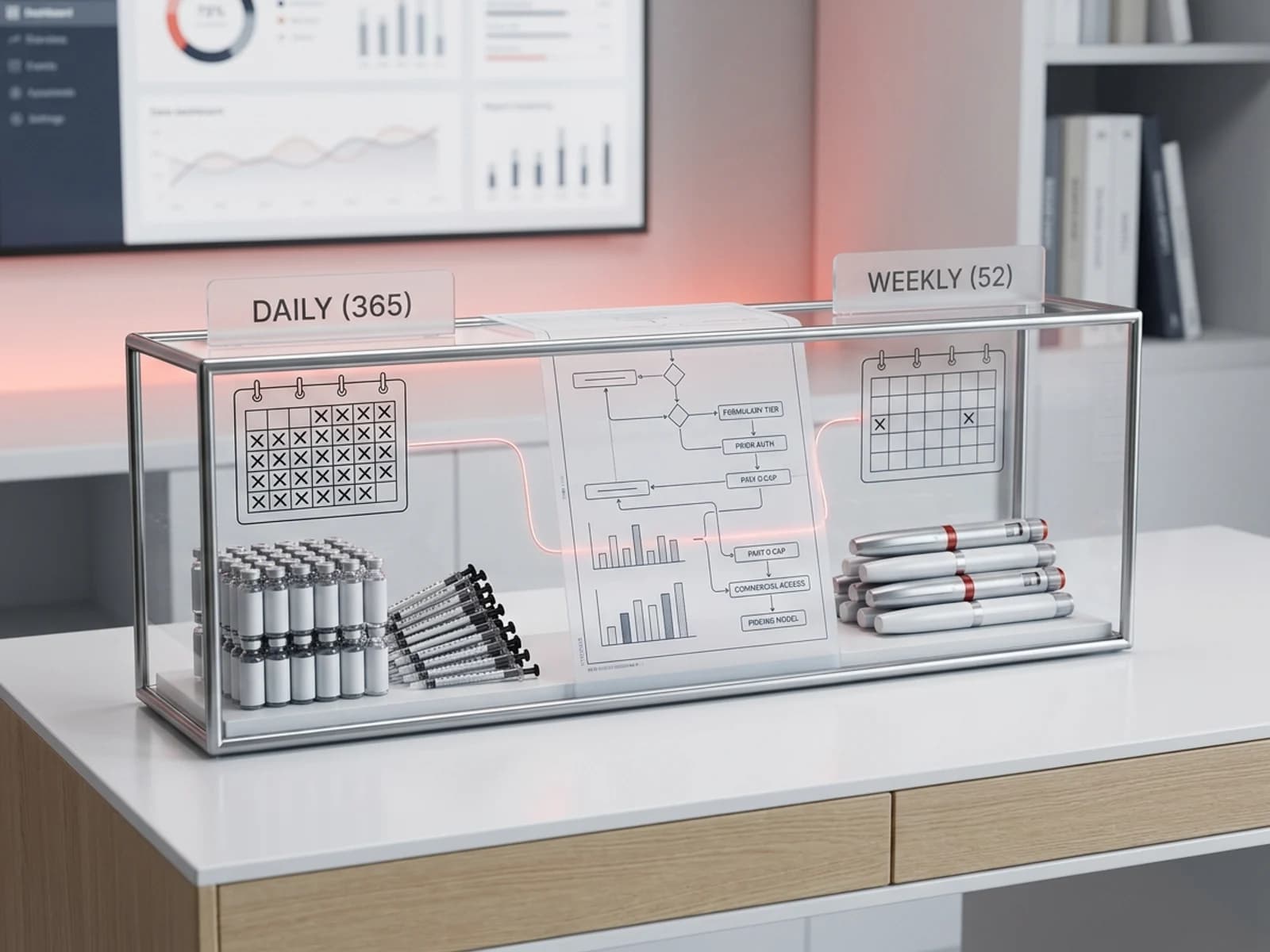
On March 26, 2026, the FDA approved insulin icodec-abae (Awiqli, Novo Nordisk) as the first once-weekly basal insulin for adults with type 2 diabetes. Awiqli is a U-700 (700 units/mL) ultra-long-acting insulin analog administered as a single subcutaneous injection once every seven days, replacing 365 daily injections per year with 52. The approval creates a new category in the insulin landscape and introduces formulary, prior authorization, and benefit-design questions for payers and access teams.
This guide is for market-access professionals, payer strategists, pharmacists, and healthcare providers who need to understand Awiqli's regulatory status, clinical evidence, formulary positioning, prior authorization landscape, and patient affordability pathways.
Short answer
| Parameter | Awiqli (insulin icodec-abae) |
|---|---|
| Generic name | insulin icodec-abae |
| Manufacturer | Novo Nordisk Inc. |
| FDA approval date | March 26, 2026 |
| BLA/NDA | BLA |
| Mechanism | Ultra-long-acting basal insulin analog |
| Indication | Glycemic control in adults with diabetes mellitus (initial approval: type 2 diabetes) |
| Concentration | U-700 (700 units/mL) |
| Dosing frequency | Once weekly (every 7 days) |
| Route | Subcutaneous injection |
| Half-life | ~196 hours (approximately 1 week) |
| Titration | Individualized; based on fasting blood glucose and metabolic needs |
| Conversion from daily basal insulin | Previous daily dose × 7, rounded to nearest 10 units |
| Boxed warning | None specific to Awiqli beyond class insulin warnings (hypoglycemia) |
| Benefit channel | Pharmacy benefit (Part D); may be pharmacy or medical benefit in commercial |
| PA required | Expected yes (most commercial plans and Medicare Advantage) |
| Medicare Part D out-of-pocket cap | $35 per 30-day supply (insulin class cap under IRA) |
| Authorized generic | Not applicable (BLA product, no biosimilar yet) |
How Awiqli differs from existing basal insulins
| Feature | Awiqli (insulin icodec) | Tresiba (insulin degludec) | Lantus (insulin glargine U-100) | Basaglar (insulin glargine biosimilar) |
|---|---|---|---|---|
| Frequency | Once weekly | Once daily | Once daily | Once daily |
| Concentration | U-700 | U-100 or U-200 | U-100 | U-100 |
| Half-life | ~196 hours | ~42 hours | ~12 hours | ~12 hours |
| Injections per year | 52 | 365 | 365 | 365 |
| Type | Novel insulin analog | Long-acting analog | Long-acting analog | Biosimilar to Lantus |
| Biosimilar competition | None | None | Multiple biosimilars | N/A (is a biosimilar) |
| Cost profile | Premium pricing expected | Brand pricing | Low-cost/generic available | Low-cost biosimilar |
The clinical value proposition: Awiqli reduces injection frequency from daily to weekly, which may improve adherence in patients with injection fatigue. The pharmacokinetic profile provides steady insulin activity throughout the week with a ~196-hour half-life.
Clinical evidence basis
FDA approval was based on four clinical trials comprising more than 2,600 participants comparing once-weekly insulin icodec with once-daily basal insulin analogs (insulin glargine and insulin degludec). Key findings:
Non-inferior HbA1c reduction: Across trials, HbA1c reductions with insulin icodec were similar to daily basal insulin analogs.
Diverse patient populations: Participants included insulin-naive patients on non-insulin therapies, patients already on basal insulin, and patients on basal-bolus regimens — all with type 2 diabetes not meeting glycemic targets.
Safety profile: Rates of adverse events, including documented symptomatic hypoglycemia, were comparable between insulin icodec and daily basal insulin comparators.
Dosing conversion: For patients switching from a daily basal insulin, the starting dose of insulin icodec is the previous daily total dose multiplied by 7, rounded to the nearest 10 units. Subsequent dose adjustments are made based on fasting glucose readings.
Key access implication: The conversion protocol is straightforward for prescribers, but payers may require documentation of current basal insulin use, HbA1c levels, and clinical rationale for switching to a weekly product.
Prior authorization requirements
Because Awiqli launched in March 2026, payer policies are still being established. Early data from managed care organizations indicate that most plans will require PA.
Expected PA criteria
Prior authorization for Awiqli is expected to require:
Diagnosis of type 2 diabetes: Confirmed diagnosis in an adult patient (age 18+)
Current basal insulin use or clinical justification: Documentation that the patient is currently on a daily basal insulin (glargine, degludec, detemir) OR clinical rationale for starting a once-weekly product in an insulin-naive patient
HbA1c documentation: Recent HbA1c result showing suboptimal glycemic control (typically ≥7.0% or above individualized target)
Step therapy: Some plans may require a trial of daily basal insulin before approving Awiqli, particularly for insulin-naive patients
Injection fatigue or adherence concern: Some payers may request documentation of difficulty with daily injection adherence as a clinical justification
Exclusion of type 1 diabetes: Awiqli is not yet FDA-approved for type 1 diabetes; the ONWARDS 6 trial for T1D was completed but the FDA advisory panel voted against T1D use in May 2024 due to hypoglycemia concerns
Ambetter and Medicaid early PA policies
According to managed care provider bulletins published in May–June 2026:
Ambetter (Centene): New PA policy for insulin icodec-abae (Awiqli) effective August 1, 2026 (HIM.PA.180). PA criteria are under development.
Medicaid (Centene/state programs): New PA policy for insulin icodec-abae effective June 1, 2026 (CP.PMN.309). Expected to mirror standard basal insulin step therapy requirements.
Other commercial payers and PBMs are expected to issue formulary decisions throughout Q3–Q4 2026.
Medicare Part D coverage
Insulin cost-sharing protections
Under the Inflation Reduction Act, Medicare Part D beneficiaries pay no more than $35 per 30-day supply for any covered insulin product. This cap applies to Awiqli.
| Parameter | Detail |
|---|---|
| Monthly out-of-pocket maximum | $35 per 30-day supply |
| Deductible | Insulins exempt from Part D deductible under IRA |
| Applies to | All Medicare Part D plans and Medicare Advantage drug plans |
| Quantity | Awiqli is dispensed as a weekly injection (4 doses per 30-day supply) |
Part D formulary positioning
Awiqli is expected to be placed on Tier 3 (preferred brand) or Tier 4 (non-preferred brand) on most Medicare Part D formularies initially, with potential movement to a more preferred tier as utilization data accumulates and Novo Nordisk negotiates rebate agreements with PBMs.
Because the $35 insulin cap applies regardless of tier, the tier placement primarily affects plan reimbursement and rebate dynamics rather than patient cost-sharing.
IRA Medicare Drug Price Negotiation
Awiqli was not among the drugs selected for Medicare drug price negotiation in cycles 1–3. As a newly approved product, it would not meet the selection criteria (which target high-expenditure, single-source drugs without generic/biosimilar competition that have been on the market for several years). However, Awiqli could be selected in future cycles as utilization and spending grow.
Commercial insurance coverage
| Factor | Expected approach |
|---|---|
| Formulary tier | Tier 3 (preferred specialty) initially; may move to Tier 2 with negotiated rebates |
| PA requirement | Yes (most plans) |
| Step therapy | Possible: trial of daily basal insulin before Awiqli |
| Quantity limit | 4 injections per 28–30 days (once-weekly dosing) |
| Specialty pharmacy | Likely required by some PBMs; Awiqli is a refrigerated injectable |
| Copay assistance | Novo Nordisk is expected to offer copay savings cards (details pending) |
What to expect from major PBMs
CVS Caremark / Aetna: Will likely add Awiqli to formulary with PA. Watch for formulary updates in Q3 2026.
Express Scripts / Cigna: Similar PA approach. May position Awiqli as a non-preferred basal insulin initially.
OptumRx / UnitedHealthcare: Expected to require step therapy through a daily basal insulin before approving Awiqli.
Medicaid coverage
State Medicaid programs will evaluate Awiqli under their pharmacy and therapeutics (P&T) committees. Key considerations:
Medicaid programs typically cover all FDA-approved insulins, but may impose PA or preferred drug list (PDL) restrictions
Awiqli's higher WAC price (expected to be above daily basal insulins) may result in PDL non-preferred status with PA required
Some state Medicaid programs may require trial of lower-cost basal insulins (generic glargine, Basaglar) before approving Awiqli
The 340B Drug Pricing Program discount applies to Awiqli as a brand-name outpatient drug
Patient affordability and support
Novo Nordisk is expected to offer patient assistance pathways for Awiqli, consistent with its existing insulin affordability programs:
Copay savings card: Expected for commercially insured patients (typically reduces copay to a fixed amount per fill)
Patient assistance program (PAP): For uninsured or underinsured patients meeting income eligibility criteria
$35 insulin guarantee: Novo Nordisk has committed to a $35 monthly out-of-pocket cap for eligible commercially insured patients across its insulin portfolio, which is expected to include Awiqli
Lilly and Sanofi comparison: Note that Novo Nordisk, Eli Lilly, and Sanofi have all committed to voluntary $35 monthly insulin caps for commercial patients
What access teams should do now
Identify conversion-eligible patients: Review your patient population for adults with T2D on daily basal insulin who may benefit from weekly dosing. Prioritize patients with documented injection fatigue or adherence challenges.
Prepare PA documentation: Gather diagnosis codes (ICD-10: E11.x for T2D), current basal insulin dosage, recent HbA1c, and clinical justification for weekly insulin.
Verify formulary status: Check each patient's plan formulary. Awiqli may not yet appear on all formularies as of June 2026.
Understand conversion dosing: The starting Awiqli dose is the previous daily basal insulin total dose × 7, rounded to the nearest 10 units. Monitor fasting glucose closely during the first 4–8 weeks after conversion.
Educate on storage and handling: Awiqli U-700 is a concentrated insulin requiring specific storage instructions. Ensure patients and pharmacies are prepared.
What to monitor next
Type 1 diabetes indication: Novo Nordisk's ONWARDS 6 trial for T1D was completed, but the FDA issued a Complete Response Letter for T1D use in July 2024 due to hypoglycemia concerns. If Novo Nordisk pursues additional T1D data, an expanded indication could broaden the eligible population and payer coverage.
PBM formulary updates: CVS Caremark, Express Scripts, and OptumRx are expected to issue formal formulary decisions for Awiqli in Q3–Q4 2026. Watch for step therapy and PA criteria.
Real-world adherence data: Payers will want to see whether once-weekly dosing translates to measurable adherence improvements compared to daily basal insulin. Expect payers to monitor this data before broadening coverage.
Biosimilar insulin landscape: Insulin glargine biosimilars (Basaglar, Semglee, Rezvoglar) are available at significantly lower cost. Payers may position these as preferred before Awiqli. Watch for head-to-head cost-effectiveness analyses.
GLP-1 displacement effect: As GLP-1 receptor agonists (semaglutide, tirzepatide, orforglipron) delay disease progression and reduce insulin dependence, the addressable insulin market may shrink over time. Awiqli's niche may be patients who still require insulin despite optimized GLP-1 therapy.
Sources
FDA. Awiqli (insulin icodec-abae) prescribing information. March 2026. dailymed.nlm.nih.gov
Novo Nordisk. FDA Approves Awiqli (insulin icodec-abae) Press Release (March 26, 2026). novonordisk.com
UpToDate. What's New in Drug Therapy — Once-Weekly Basal Insulin for Adults with Type 2 Diabetes (April 2026). uptodate.com
ADCES. Insulin Types — Danatech Insulin Medicine Delivery 101. adces.org
ScienceMyHealth. AWIQLI (insulin icodec): The First Once-Weekly Insulin Approved for Diabetes Management (June 4, 2026). sciencemyhealth.com
AJMC. FDA Approves Novel Weekly Basal Insulin for T2D (2026). ajmc.com
Coordinated Care. May 2026 Provider News — Insulin Icodec-abae PA Policies. coordinatedcarehealth.com
CMS. Medicare Part D Insulin Cost-Sharing Under the Inflation Reduction Act. cms.gov