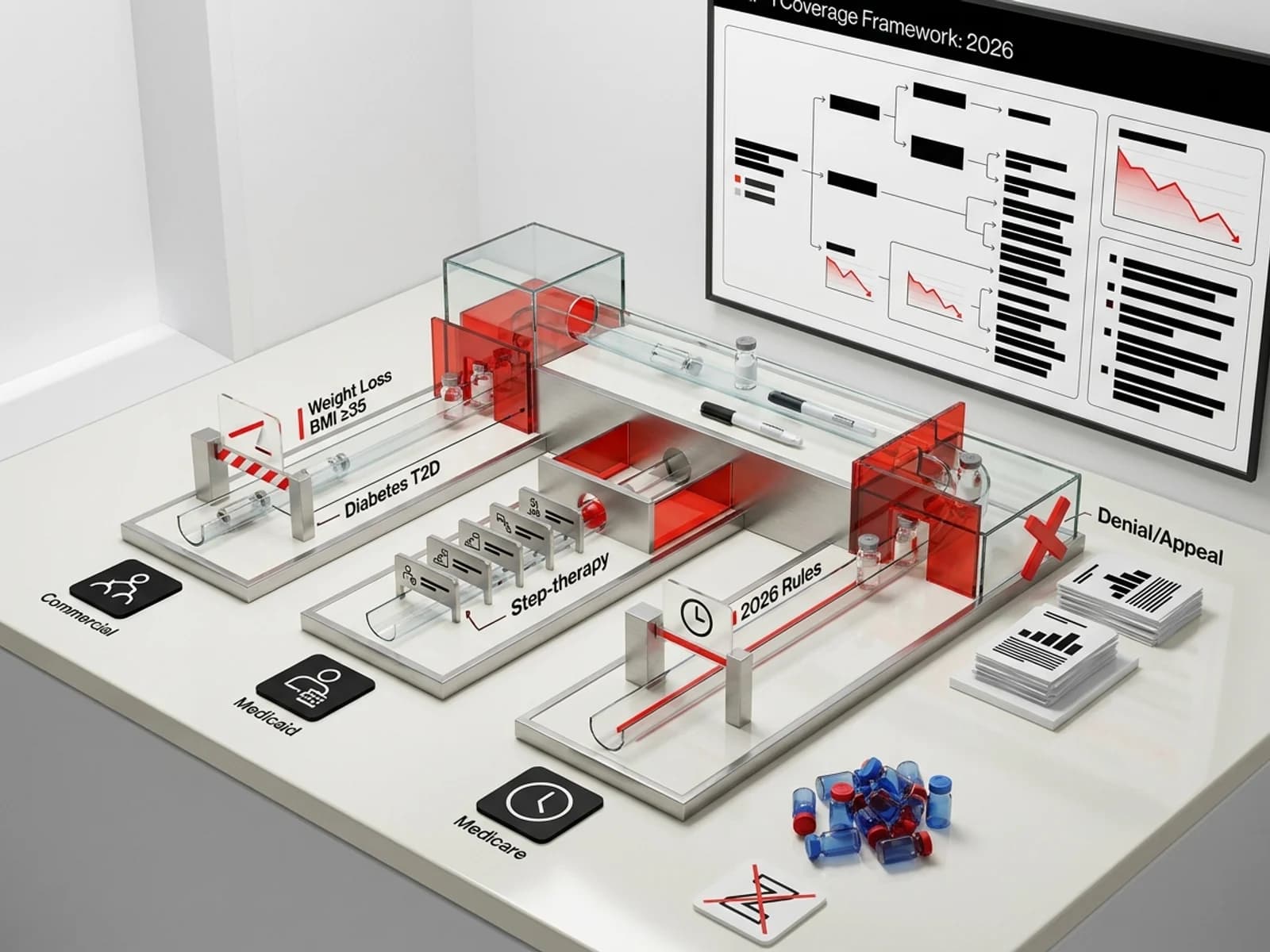
MassHealth — Massachusetts' Medicaid and Children's Health Insurance Program — is one of the most closely watched state Medicaid programs for GLP-1 coverage policy. In January 2024, MassHealth became one of the first state Medicaid programs to cover GLP-1s for weight loss, but effective July 1, 2026, MassHealth will no longer cover any anti-obesity medications for adult members, including all GLP-1 and GIP/GLP-1 agents prescribed for weight loss.
This guide maps which GLP-1 medications MassHealth covers under which diagnoses, explains the July 2026 exclusion policy, details the transition for members currently on therapy, and provides the PA criteria that remain for covered indications. It is independent information and not medical advice or reimbursement guidance for a specific patient or plan.
Quick answer
| GLP-1 Drug | Before July 1, 2026 | After July 1, 2026 (Adults) |
|---|---|---|
| Ozempic (semaglutide injection) | Covered — T2D with PA | Covered — T2D with PA (unchanged) |
| Mounjaro (tirzepatide injection) | Covered — T2D with PA | Covered — T2D with PA (unchanged) |
| Trulicity (dulaglutide) | Covered — T2D with PA | Covered — T2D with PA (unchanged) |
| Rybelsus (semaglutide tablets) | Covered — T2D with PA | Covered — T2D with PA (unchanged) |
| Victoza (liraglutide) | Covered — T2D with PA | Covered — T2D with PA (unchanged) |
| Wegovy (semaglutide) | Covered for weight loss with PA; also covered for CVD, MASH | Covered ONLY for CVD, MASH, and OSA (preferred drug). Weight-loss coverage excluded for adults |
| Zepbound (tirzepatide) | Covered for weight loss with PA; also covered for OSA | Covered ONLY for OSA (non-preferred; step therapy through Wegovy required). Weight-loss coverage excluded for adults |
| Saxenda (liraglutide 3 mg) | Covered for weight loss with PA | Excluded for all indications |
| Oral weight-loss drugs (phentermine, Contrave, Qsymia, etc.) | Covered with PA | Excluded for weight loss |
Key policy dates:
January 1, 2024: MassHealth began covering GLP-1 weight-loss drugs for eligible patients, one of the first state Medicaid programs to do so
February 17, 2026: Cutoff date for prior authorizations submitted before the exclusion announcement — all prior PAs for anti-obesity agents will be end-dated June 30 regardless of indication
July 1, 2026: MassHealth excludes all anti-obesity medications for adults. Wegovy becomes the sole preferred non-diabetic GLP-1 for covered non-weight-loss indications (CVD, MASH, OSA). Zepbound becomes non-preferred requiring step therapy through Wegovy
Ongoing: EPSDT-eligible members under age 21 may continue receiving GLP-1s for weight loss with approved PA
Who this is for
MassHealth fee-for-service members and their prescribers navigating the July 2026 coverage transition
Tufts Health Together (MassHealth ACO) members and providers subject to the same exclusion policy
Mass General Brigham Health Plan ACO members receiving MassHealth coverage
Benefit verification specialists and hub teams handling MassHealth pharmacy claims
Market access teams tracking state Medicaid GLP-1 policy shifts nationwide
Source standard
Every fact in this guide is sourced from MassHealth Pharmacy Facts bulletins, Point32Health/Tufts Health Plan provider communications, Mass General Brigham Health Plan formulary updates, UnitedHealthcare Community Plan of Massachusetts notices, the Massachusetts Health Policy Commission DataPoints reports, and the KFF Medicaid GLP-1 coverage analysis dated 2025–2026. Always verify current coverage by calling MassHealth Customer Service at 1-800-841-2900 or checking the MassHealth Drug List at mass.gov.
MassHealth program structure
MassHealth provides health coverage to approximately 2 million Massachusetts residents through:
MassHealth Standard: Traditional Medicaid for low-income adults, families, and people with disabilities
MassHealth CarePlus: Coverage for low-income adults under the ACA expansion
Tufts Health Together: MassHealth Accountable Care Partnership Plans (ACPPs), Senior Care Options (SCO), and One Care plans, administered by Point32Health
Mass General Brigham Health Plan ACO: MassHealth ACO coverage through Mass General Brigham
UnitedHealthcare Community Plan of Massachusetts: MassHealth managed care plan
All MassHealth plans — fee-for-service and managed care — are subject to the July 2026 anti-obesity medication exclusion.
The July 2026 exclusion: what changed and why
Background
Massachusetts Health Policy Commission data showed that GLP-1 weight-loss prescriptions in MassHealth grew substantially after January 2024 coverage began, with Wegovy accounting for 47.5% of index GLP-1 prescriptions and real-world persistence data showing 79.5% of PA-recertified members still on therapy at recertification.
By 2025, the cost trajectory prompted action. Multiple Massachusetts commercial plans (Blue Cross Blue Shield of Massachusetts, Mass General Brigham Health Plan, Fallon Health, Tufts Health Direct) had already moved to exclude or restrict GLP-1 weight-loss coverage. MassHealth followed with its own exclusion effective July 1, 2026.
What is excluded
Effective July 1, 2026, MassHealth will no longer cover the following anti-obesity agents for adult members:
Weight-loss-specific GLP-1s:
Wegovy (semaglutide) — for weight loss only
Zepbound (tirzepatide) — for weight loss only
Saxenda (liraglutide) — all indications
Oral anti-obesity agents:
Benzphetamine
Diethylpropion, diethylpropion extended-release
Phendimetrazine, phendimetrazine extended-release
Lomaira, Adipex-P (phentermine capsule, tablet)
Contrave (bupropion/naltrexone)
Qsymia (phentermine/topiramate)
Xenical (orlistat)
What stays covered
Diabetes-indicated GLP-1s remain covered with PA:
Ozempic (semaglutide injection) — T2D
Mounjaro (tirzepatide) — T2D
Trulicity (dulaglutide) — T2D
Rybelsus (semaglutide tablets) — T2D
Victoza (liraglutide) — T2D
Byetta, Bydureon — T2D
Wegovy remains the preferred non-diabetic GLP-1 for specific non-weight-loss indications:
Noncirrhotic metabolic dysfunction-associated steatohepatitis (MASH)
Cardiovascular disease (BMI ≥ 27 with established CVD, to reduce risk of major adverse cardiovascular events)
Moderate to severe obstructive sleep apnea (OSA) with BMI ≥ 30
Zepbound remains available but non-preferred:
Requires step therapy through Wegovy first for OSA
Only considered if Wegovy trial fails or is contraindicated
Prior authorization criteria
For type 2 diabetes (unchanged by July 2026)
MassHealth PA criteria for diabetes-indicated GLP-1s require:
Confirmed T2D diagnosis: Documented ICD-10 E11.x diagnosis codes
SmartPA eligibility: Claims for generic liraglutide (Victoza), Mounjaro, Ozempic, and Trulicity within quantity limits will usually process at the pharmacy without a separate PA request if the member has a history of medical claims for T2D — or a history of medical claims for prediabetes AND at least 84 days of paid GLP-1/GIP/GLP-1 therapy within the last 120 days
Polypharmacy requirements: Claims are subject to polypharmacy screening
For Wegovy non-weight-loss indications (new after July 2026)
After July 1, 2026, new PA requests for Wegovy must establish medical necessity for non-weight-loss indications:
MASH: Diagnosis of noncirrhotic metabolic dysfunction-associated steatohepatitis, confirmed by ICD-10 code
Cardiovascular disease: BMI ≥ 27 kg/m² with established CVD diagnosis, to reduce MACE risk
OSA: BMI ≥ 30 kg/m² with moderate to severe OSA confirmed per consensus guidelines (e.g., American Academy of Sleep Medicine)
For Zepbound (non-preferred after July 2026)
Zepbound requires:
Step therapy through Wegovy: Documented trial and failure, contraindication, or intolerance to Wegovy
Approved indication: OSA only
Clinical rationale: Documentation supporting why Wegovy is not appropriate
EPSDT: Members under 21
Under the federal Early and Periodic Screening, Diagnostic, and Treatment (EPSDT) benefit, MassHealth must cover medically necessary services for members under 21, including GLP-1s for weight loss:
PA requests for weight-loss GLP-1s for members under 21 will be reviewed for medical necessity
For members ages 12–21 who are new to GLP-1 therapy, step therapy through phentermine is required first, followed by Wegovy trial
All requests are reviewed individually
Transition timeline for current members
| Date | What happens |
|---|---|
| Before Feb 17, 2026 | All PAs for anti-obesity agents are end-dated June 30 regardless of original expiration |
| Feb 17 – June 30, 2026 | New PAs submitted during this window are reviewed based on submitted indication |
| July 1, 2026 | Weight-loss GLP-1 coverage ends for adults. Members with T2D/prediabetes must switch to diabetic GLP-1. Members with CVD/MASH/OSA need new PA for Wegovy |
| After July 1, 2026 | Only diabetes-indicated GLP-1s and Wegovy/Zepbound for non-weight-loss indications are covered for adults. Under-21 members retain EPSDT access |
Action items for prescribers
Members with T2D or prediabetes on Wegovy/Zepbound for weight loss: Switch to a diabetic GLP-1 (Ozempic, Mounjaro, Trulicity). Submit new PA with T2D/prediabetes diagnosis
Members with CVD, MASH, or OSA: Submit new PA for Wegovy specifying the non-weight-loss indication
Members under 21: Submit PA with EPSDT medical necessity documentation
Members using Zepbound for OSA: Must step through Wegovy first for Tufts Health Together members
Real-world evidence from MassHealth
A University of Massachusetts analysis of 27,462 MassHealth fee-for-service members found:
Wegovy had the highest utilization (47.5% of index prescriptions), followed by Ozempic (21.5%) and Mounjaro (11.7%)
Among PA-recertified members, 79.5% were persistent on therapy and 69.7% were adherent (PDC ≥ 80%)
73.2% of PA-recertified members achieved ≥ 5% weight loss from baseline
Average exposure duration was 186 days across all GLP-1s
Persistence was highest for Victoza (304 days) and Mounjaro (256 days) and lowest for Zepbound (52 days)
Massachusetts commercial context
The MassHealth exclusion follows broader Massachusetts market trends:
Blue Cross Blue Shield of Massachusetts: Excluded Wegovy, Saxenda, and Zepbound for weight loss effective January 1, 2026, upon plan renewal for fully insured commercial members. Large employers (50+ subscribers) may opt in
Mass General Brigham Health Plan: Same exclusion timeline — GLP-1s for weight loss excluded for individual and small group plans; large employer groups may add coverage at renewal
Tufts Health Direct: Excluded all weight-loss drugs effective January 1, 2026, including for cardiovascular and other comorbid conditions
Fallon Health: Excluded weight-loss drugs effective January 1, 2026
Massachusetts Group Insurance Commission (GIC): Voted February 26, 2026 to eliminate GLP-1 coverage for obesity for state employees
What to monitor next
State budget negotiations: The July 2026 exclusion is driven by state budget directives. Future legislative sessions could restore coverage if fiscal conditions change
CMS Medicare GLP-1 Bridge demonstration: If Medicare expands GLP-1 coverage nationally starting July 2026, states may face pressure to maintain Medicaid coverage
Litigation or advocacy: Disability and patient advocacy groups may challenge the exclusion under EPSDT or ADA frameworks
Generic GLP-1 entry: When generic semaglutide or tirzepatide becomes available, cost reduction could enable coverage restoration
New FDA indications: Future Wegovy or Zepbound approvals for additional non-weight-loss indications (e.g., kidney disease, liver disease) may expand the covered indication list
Sources
CMS. "Medicaid Drug Coverage and Rebate Programs." cms.gov. https://www.cms.gov/medicaid/prescription-drugs
FDA. "FDA Approves New Indication for Wegovy (semaglutide) Injection to Reduce Risk of Major Cardiovascular Events." fda.gov, March 8, 2024. https://www.fda.gov/drugs/postmarket-drug-safety-information-patients-and-providers/fda-approves-new-indication-wegovy-semaglutide-injection-reduce-risk-major-cardiovascular-events
Point32Health. "MassHealth coverage change: anti-obesity medications." point32health.org, May 2026. https://www.point32health.org/provider/masshealth-coverage-change-anti-obesity-medications-052026
MassHealth. "Pharmacy Facts 271: Changes to Management of Anti-Obesity Medications." mass.gov, March 12, 2026. https://www.mass.gov/doc/pharmacy-facts-271-march-12-2026-corrected-0/download
Mass General Brigham Health Plan. "GLP-1 Coverage." massgeneralbrighamhealthplan.org, 2026. https://massgeneralbrighamhealthplan.org/glp1-coverage
Mass General Brigham Health Plan. "MassHealth Formulary Updates." May 2026 Newsletter. https://news.massgeneralbrighamhealthplan.org/hubfs/Formulary_Updates_May_2026%20Newsletter_MEDICAID_FINAL.pdf
UnitedHealthcare. "Massachusetts Medicaid: Weight loss and obesity drug coverage update." uhcprovider.com, 2026. https://www.uhcprovider.com/content/provider/en/resource-library/news/2026/ma-medicaid-weight-obesity-drug-coverage.html
Massachusetts Health Policy Commission. "DataPoints Issue 27: Blockbuster GLP-1 Weight-Loss Drugs in Massachusetts." August 23, 2024. https://masshpc.gov/publications/datapoints-series/issue-27-blockbuster-glp-1-weight-loss-drugs-massachusetts
ForHealth Consulting, UMass Chan Medical School. "An Evaluation of Real-World Persistence, Adherence, and Effectiveness of GLP-1 Medications in MassHealth." AMCP 2025 Poster. https://forhealthconsulting.umassmed.edu/wp-content/uploads/2025/03/ForHealthCtg_Poster_CPS_AMCP2025_EvalRealWPAEofGLP1Meds_v2_2025.pdf
KFF. "Medicaid Coverage of and Spending on GLP-1s." kff.org, 2026. https://www.kff.org/medicaid/medicaid-coverage-of-and-spending-on-glp-1s