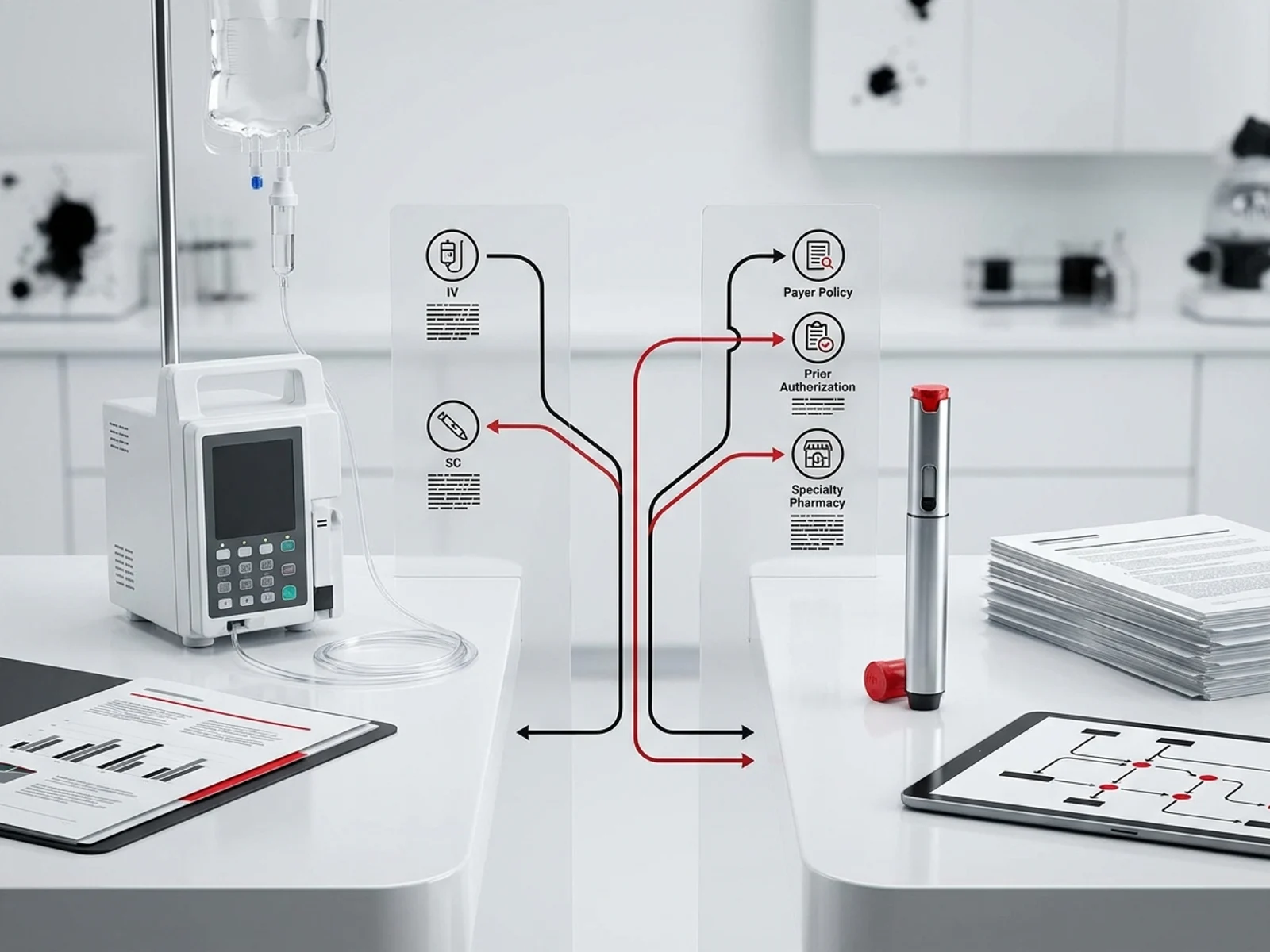
Kesimpta (ofatumumab, Novartis) is a CD20-directed cytolytic antibody approved for relapsing forms of multiple sclerosis (RMS) — including clinically isolated syndrome (CIS), relapsing-remitting disease (RRMS), and active secondary progressive disease (SPMS) — in adults. It is the first and only B-cell therapy designed for patient self-administration, delivered as a once-monthly 20 mg subcutaneous injection via the Sensoready autoinjector pen.
Since its August 2020 FDA approval, Kesimpta has been approved in over 92 countries with more than 150,000 patients treated as of August 2025. Its self-injection model differentiates it from Ocrevus (twice-yearly IV or SC injection by HCP), Briumvi (IV infusion), and oral DMTs — but that differentiation creates distinct pharmacy benefit routing, step-therapy requirements, and PA complexities.
This guide covers Kesimpta's formulary positioning, step-therapy hierarchies, benefit channel, HCPCS coding, and patient support for MS access teams.
Short answer
| Kesimpta (ofatumumab) | |
|---|---|
| Drug class | CD20-directed cytolytic antibody |
| Manufacturer | Novartis Pharmaceuticals Corp. |
| FDA indication | RMS (CIS, RRMS, active SPMS) — adults |
| Administration | SC self-injection via Sensoready pen or prefilled syringe |
| Dosing | 20 mg SC at Weeks 0, 1, 2 (initial), then 20 mg every 4 weeks |
| Injection time | 3–4 seconds (patient self-administration) |
| Benefit channel | Pharmacy benefit (specialty pharmacy required) |
| HCPCS code | J3590 (unclassified biologics) or C9399 (when specified as Kesimpta) |
| WAC list price | ~$7,695 per month (estimated) |
| PA required | Yes, all major commercial and Medicare plans |
| Step therapy | Yes — varies by plan; most require prior DMT failure |
| Reauthorization | 12 months with documented response |
Coverage criteria and step therapy
Typical PA requirements
Across Cigna, Carelon (Elevance), Health Net, BCBS plans, and Prime Therapeutics, Kesimpta PA criteria share a common framework:
Diagnosis: relapsing forms of MS (CIS, RRMS, or active SPMS), confirmed by a neurologist, age 18+
Disease activity documentation: at least two relapses within the previous two years, or one relapse within the past year, or at least one gadolinium-enhancing lesion on MRI within the prior year
Ambulation requirement: Carelon requires documentation that the patient can ambulate without aid or rest for at least 100 meters
HBV screening: negative HBsAg and anti-HBc required before initiation
No concurrent DMTs: Kesimpta must not be combined with other MS disease-modifying therapies — including Aubagio, Avonex, Bafiertam, Betaseron, Briumvi, Copaxone/Glatopa, Extavia, Gilenya, Lemtrada, Mavenclad, Mayzent, Ocrevus, Ocrevus Zunovo, Plegridy, Ponvory, Rebif, Tascenso ODT, Tecfidera, Tyruko, Tysabri, Vumerity, or Zeposia
Step-therapy hierarchies
Step therapy varies significantly by plan:
Cigna National Formulary: Kesimpta is covered as medically necessary when prescribed by or in consultation with a neurologist. The policy focuses on diagnosis confirmation and HBV screening but does not impose a rigid step-therapy ladder for all patients.
Health Net / Centene: For RRMS, Kesimpta requires failure of all of the following at maximally indicated doses unless contraindicated:
Dimethyl fumarate (generic Tecfidera)
Teriflunomide (generic Aubagio)
Fingolimod (Gilenya)
An interferon-beta agent (Avonex, Betaseron/Extavia, Rebif, or Plegridy) or glatiramer (Copaxone, Glatopa)
For CIS, failure or contraindication to one interferon-beta or glatiramer is sufficient. Illinois HIM members are exempt from step therapy as of January 1, 2026, per IL HB 5395.
Carelon (Elevance): Updated step therapy in November 2025 to allow override after a trial of any MS disease-modifying therapy. Initial criteria require relapsing MS diagnosis, ambulation >100 meters, and disease activity documentation.
Blue Cross Blue Shield of North Carolina: Requires trial and failure of at least two prior disease-modifying therapies (3–6 months minimum each) due to lack of efficacy, intolerance, or contraindication. Specific documentation of each treatment trial's duration and reason for discontinuation is required.
Prime Therapeutics / Accord Health: Kesimpta is listed as a target agent in the Multiple Sclerosis PAQL program. Step therapy requires prior use of preferred agents, which vary by client.
Positioning vs Ocrevus / Ocrevus Zunovo
Kesimpta and Ocrevus are both anti-CD20 therapies but differ in administration and benefit routing:
Kesimpta: self-administered SC injection, pharmacy benefit, monthly dosing
Ocrevus IV: HCP-administered IV infusion, medical benefit, twice-yearly dosing
Ocrevus Zunovo SC: HCP-administered SC injection, medical benefit, twice-yearly dosing
Most payers do not require failure of one anti-CD20 before trying another, but some plans position Ocrevus as preferred over Kesimpta (or vice versa) based on contracting. Access teams should check formulary positioning before assuming either can be used first-line.
Positioning vs oral DMTs
Many plans require failure of at least one oral DMT (dimethyl fumarate, teriflunomide, fingolimod, or diroximel fumarate) before Kesimpta — especially for first biologic use. However, patients with highly active or aggressive disease (≥2 relapses/year, MRI activity, early disability accumulation) may qualify for Kesimpta without oral DMT step edits on some plans.
Pharmacy benefit and specialty pharmacy routing
Kesimpta routes exclusively through the pharmacy benefit as a specialty medication. Key operational points:
Specialty pharmacy designation: all major plans require Kesimpta to be dispensed through a contracted specialty pharmacy. Novartis Patient Support can help route prescriptions to the correct specialty pharmacy.
Sensoready pen vs prefilled syringe: both formulations are available. The Sensoready pen is the primary commercial formulation.
First dose training: the initial dose (Week 0) should be performed under the guidance of a healthcare professional. Subsequent doses are self-administered at home.
No medical benefit billing: unlike Ocrevus, Kesimpta does not have an IV or clinic-administered formulation, so medical benefit billing does not apply.
HCPCS coding
Kesimpta does not have a permanent product-specific J-code. It uses unclassified codes:
J3590: Unclassified biologics (when specified as Kesimpta/ofatumumab)
C9399: Unclassified drugs or biologicals (when specified as Kesimpta/ofatumumab) — used primarily for hospital outpatient billing
Because Kesimpta is primarily dispensed through specialty pharmacies under the pharmacy benefit (not buy-and-bill), HCPCS coding is typically only needed for:
Medical benefit exceptions where a plan covers Kesimpta under medical benefit
Claims reconciliation or appeal documentation
ICD-10-CM codes (effective October 2025):
G35.A — Relapsing-remitting multiple sclerosis
G35.C1 — Active secondary progressive multiple sclerosis
G37.9 — Demyelinating disease of central nervous system, unspecified (used for CIS)
2026 payer formulary positioning
Cigna
Kesimpta is covered under Cigna's National Formulary with prior authorization. Requires neurologist involvement, confirmed RMS diagnosis, and HBV screening. No rigid step-therapy hierarchy, but clinical rationale must support the choice.
Carelon (Elevance/BCBS affiliated)
Carelon's Medical Drug Clinical Criteria (CC-0174, revised November 2025) covers Kesimpta for RMS with documented disease activity. Step therapy allows override after trial of any MS DMT. Carelon specifically excludes Kesimpta for use in combination with other MS DMTs.
Health Net / Centene
Health Net (CP.PHAR.306) applies step-therapy requirements that include failure of oral DMTs and injectable platform therapies before Kesimpta for RRMS. CIS has less restrictive step therapy. Illinois HIM exemption applies.
Prime Therapeutics
Prime's MS PAQL programs (covering BCBS Kansas, Accord Health, Boeing, and other clients) list Kesimpta as a target agent. Step therapy requirements are client-specific; preferred product lists vary.
Medicare Part D
Kesimpta is covered under Medicare Part D as a specialty-tier drug. Prior authorization applies. Co-insurance is typically a percentage of the drug cost (not a flat co-pay), making the Kesimpta co-pay assistance program important for Part D patients with affordability gaps.
Novartis Patient Support and patient assistance
Co-pay assistance
Commercially insured patients: $0 out-of-pocket cost for 97% of prescriptions when used with the Kesimpta Access Card
Annual co-pay benefit: up to $18,000 per year for commercially insured patients
Not valid under Medicare, Medicaid, or federal/state programs
Novartis reserves the right to rescind or amend the program
Free drug while pursuing coverage
Patients with commercial insurance who are initially denied coverage may receive free Kesimpta for up to 12 months while seeking coverage
Available through the Kesimpta Together program
Novartis Patient Support program
The comprehensive support program includes:
Patient Access Coordinator: completes benefits verification, informs patient of coverage status and next steps
Dedicated Coordinator: provides injection training and 1-on-1 tailored support for up to 2 years
Access Reimbursement Manager: helps navigate PA and appeals, troubleshoots coverage/reimbursement issues
Alongside KESIMPTA: a platform for submitting PAs, also available through CoverMyMeds
Contact
Novartis Patient Support: 1-855-KESIMPTA (1-855-537-4678), 8:30 AM–8:00 PM ET, Monday–Friday
HCP resources: kesimptahcp.com
Patient resources: kesimpta.com
PA submission: CoverMyMeds.com
Reauthorization documentation
Across major payers, Kesimpta reauthorization every 12 months requires:
Documented clinical benefit — at least one of:
Stabilization or reduction in disease activity on MRI (absence or decrease in gadolinium-enhancing lesions, decrease in new/enlarging T2 lesions)
Reduced relapse rate from baseline
Stabilized or improved EDSS score
Stabilized or improved MS functional composite (MSFC) score
Attenuated brain volume loss
Stabilization or improvement in at least one symptom: motor function, fatigue, vision, bowel/bladder, spasticity, gait, pain/numbness
Prescriber attestation: prescribed by or in consultation with a neurologist or MS specialist
No concurrent DMTs: Kesimpta must not be combined with other disease-modifying MS therapies
Compliance documentation: the patient has been compliant with Kesimpta therapy
Safety monitoring: ongoing monitoring for infections, immunoglobulin levels
Documentation checklist for PA submission
ICD-10-CM codes: G35.A (RRMS), G35.C1 (active SPMS), G37.9 (demyelinating disease/CIS)
Diagnosis documentation: McDonald criteria (2024 revision) fulfillment, MRI findings, clinical relapse history
Disease activity: relapse count and timing (≥2 in prior 2 years, or ≥1 in prior year, or Gd+ lesion on recent MRI)
Ambulation status: documentation of ability to ambulate without aid for >100 meters (required by Carelon)
Prior DMT history: drug name, dose, start/stop dates, duration of trial (3–6 months minimum), and reason for discontinuation for each prior therapy
HBV screening: negative HBsAg and anti-HBc results
Immunoglobulin levels: baseline quantitative serum immunoglobulins (recommended by label)
Specialist attestation: prescribed by or in consultation with a neurologist or MS specialist
Formulary exception letter (if non-preferred): document why preferred alternatives (including Ocrevus, oral DMTs) are not appropriate
Highly active disease criteria (if bypassing step edits): document early onset >40 years, male gender, African American ethnicity, brainstem/spinal cord lesions, >2 relapses in first 2 years with significant sustained disability
Key takeaways for access teams
Kesimpta is the only self-administered anti-CD20 therapy for RMS — differentiate it from Ocrevus and Briumvi in PA submissions by emphasizing patient preference, injection convenience, and monthly vs biannual dosing.
Step therapy often requires prior oral DMT failure: document adequate trials (3–6 months) of dimethyl fumarate, teriflunomide, or fingolimod with specific reasons for discontinuation.
Kesimpta routes through pharmacy benefit only: no medical benefit billing applies. Use specialty pharmacy routing through Novartis Patient Support.
The $0 co-pay Access Card covers 97% of prescriptions: but annual co-pay benefit caps at $18,000 and does not apply to Medicare/Medicaid.
Free drug for up to 12 months is available for commercially insured patients initially denied coverage — a critical bridge while navigating PA and appeals.
Highly active disease can bypass step edits on some plans: document aggressive disease features (early onset, frequent relapses, spinal cord lesions) to support first-line biologic use.
Sources
FDA. Kesimpta (ofatumumab) Prescribing Information. BLA 125326. https://www.accessdata.fda.gov/drugsatfda_docs/nda/2020/125326Orig1s000lbl.pdf
FDA. Drugs@FDA: Kesimpta (ofatumumab). https://www.accessdata.fda.gov/scripts/cder/daf/index.cfm
Novartis. Kesimpta (ofatumumab) Prescribing Information. Revised April 2026. https://dailymed.nlm.nih.gov/dailymed/search.cfm?labeltype=human&query=Ofatumumab
Novartis. Kesimpta HCP Coverage and Support. kesimptahcp.com/starting-patients/coverage-support
Novartis. Kesimpta Patient Site. kesimpta.com
Novartis. Authorization and Appeals Kit. kesimptahcp.com
Cigna. Multiple Sclerosis (Injectable – CD20-Directed Cytolytic Antibody) – Kesimpta Prior Authorization Policy. CNF_389. static.cigna.com
Carelon Rx. Kesimpta (ofatumumab) Medical Drug Clinical Criteria. CC-0174. Revised 11/14/2025. carelonrx.com
Health Net / Centene. Ofatumumab (Arzerra, Kesimpta) Clinical Policy. CP.PHAR.306. healthnet.com
Molina Healthcare. Kesimpta (ofatumumab) Drug and Biologic Coverage Criteria. C21104-A. molinahealthcare.com
Medical Mutual of Ohio. Kesimpta Corporate Drug Policy. CDP-022201. medmutual.com
Oscar Health. Kesimpta (ofatumumab) Clinical Guideline. PG225 v5. assets.ctfassets.net
Prime Therapeutics (BCBS Kansas). MS Agents PAQL Program Summary. Effective 03/01/2026. myprime.com
Prime Therapeutics (Accord Health). Healthcare Administered MS PAQL. Effective 02/01/2026. web.primetherapeutics.com
CounterForce Health. Getting Kesimpta Covered by BCBS NC: Complete PA and Appeal Guide. counterforcehealth.org
Novartis. New Kesimpta Data at ECTRIMS 2025. Press release, September 24, 2025. novartis.com/us-en/news