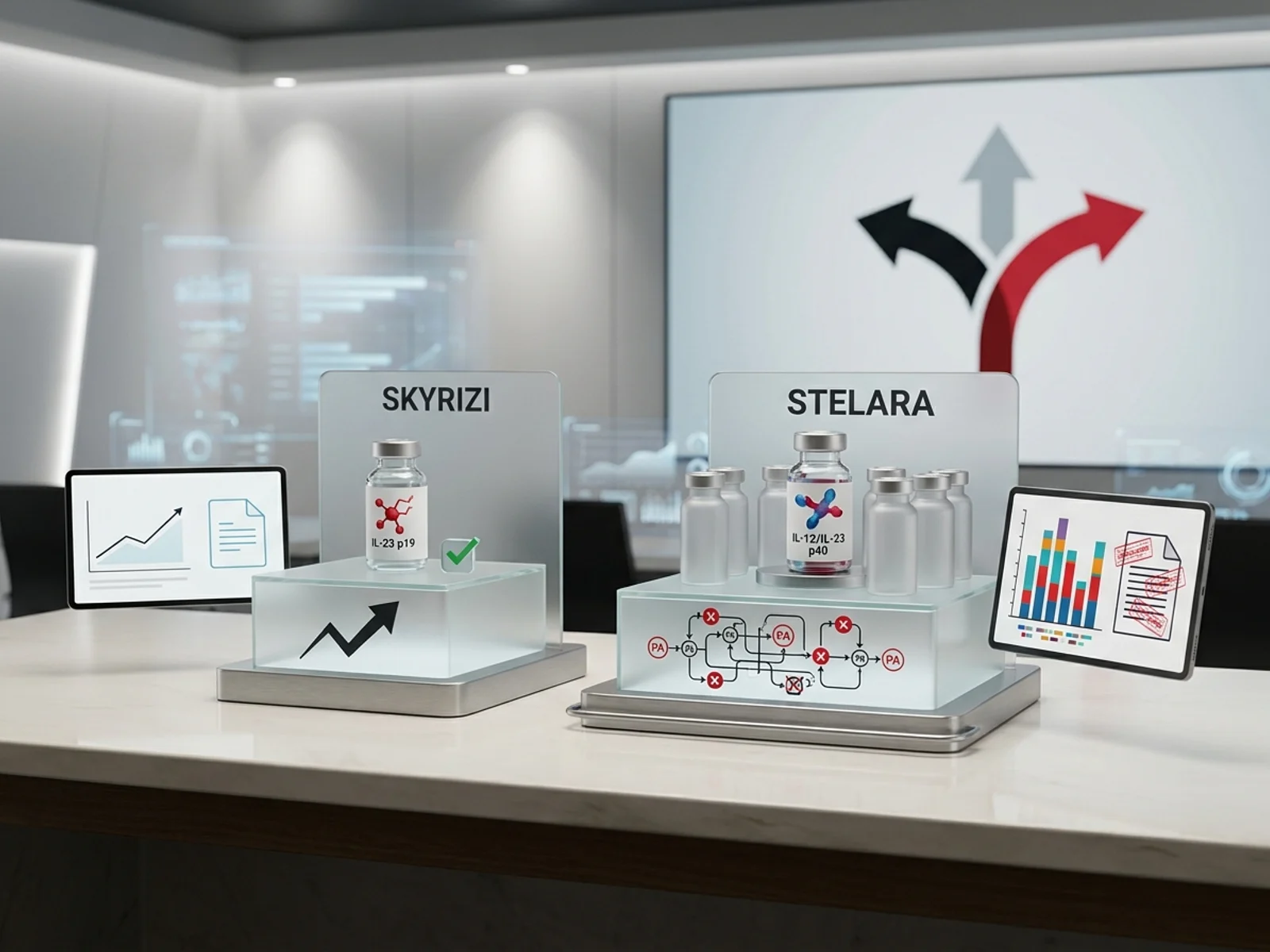
Interleukin-23 (IL-23) inhibitors have become foundational therapies across immune-mediated inflammatory diseases, including plaque psoriasis, psoriatic arthritis, Crohn's disease, and ulcerative colitis. Five IL-23 or IL-12/23 inhibitors are FDA-approved in the US: Skyrizi (risankizumab), Stelara (ustekinumab), Tremfya (guselkumab), Omvoh (mirikizumab), and Ilumya (tildrakizumab). Stelara also has eight biosimilars on the US market — including Wezlana, the first interchangeable biosimilar, and Steqeyma — and Stelara itself is one of the ten drugs with an IRA-negotiated Medicare price effective in 2026.
This landscape guide is for prescribers, access teams, pharmacists, and payer professionals who need a cross-IL-23 view of coverage, prior authorization, biosimilar dynamics, and cost trends.
FDA-approved IL-23 and IL-12/23 inhibitors at a glance
| Parameter | Skyrizi | Stelara | Tremfya | Omvoh | Ilumya |
|---|---|---|---|---|---|
| Generic name | Risankizumab-rzaa | Ustekinumab | Guselkumab | Mirikizumab-mrkz | Tildrakizumab-asmn |
| Manufacturer | AbbVie | Janssen (J&J) | Janssen (J&J) | Eli Lilly | Sun Pharma |
| Mechanism | IL-23 p19 inhibitor | IL-12/23 p40 inhibitor | IL-23 p19 inhibitor | IL-23 p19 inhibitor | IL-23 p19 inhibitor |
| FDA approval | Apr 2019 (PsO) | Sep 2009 (PsO) | Jul 2017 (PsO) | Oct 2023 (UC) | Mar 2018 (PsO) |
| Route | SC, IV | SC, IV | SC, IV | SC, IV | SC |
| Maintenance frequency | Every 8-12 wk | Every 8-12 wk | Every 4-8 wk | Every 4 wk | Every 12 wk |
| Biosimilar available | No | Yes (6+) | No | No | No |
| IRA negotiated price (2026) | No | Yes ($4,695/dose) | No | No | No |
FDA-approved indications
| Indication | Skyrizi | Stelara | Tremfya | Omvoh | Ilumya |
|---|---|---|---|---|---|
| Plaque psoriasis (PsO) | Yes | Yes | Yes | No | Yes |
| Psoriatic arthritis (PsA) | Yes | Yes | Yes | No | No |
| Crohn's disease (CD) | Yes | Yes | Yes | Yes | No |
| Ulcerative colitis (UC) | Yes | Yes | Yes | Yes | No |
| Pediatric PsO (age 6+) | No | Yes | No | No | No |
| Pediatric PsA (age 6+) | No | Yes | No | No | No |
The second-generation p19-selective IL-23 inhibitors (Skyrizi, Tremfya, Omvoh) block only IL-23 signaling while preserving IL-12 pathways. Ustekinumab (Stelara) targets the shared p40 subunit, inhibiting both IL-12 and IL-23. Clinical trials in Crohn's disease and psoriasis have suggested that p19-selective agents may offer superior endoscopic remission and skin clearance rates compared with ustekinumab, though no head-to-head trials in IBD have been completed for all agents.
Formulary placement and prior authorization
IL-23 inhibitors are typically placed on specialty tiers and require prior authorization across most payer types. The formulary landscape is shifting as ustekinumab biosimilars enter the market.
Commercial insurance
Payer policies increasingly differentiate between preferred ustekinumab products (biosimilars and Steqeyma) and non-preferred agents (Skyrizi, Tremfya, Omvoh, Ilumya). A 2026 Connecticut DUR utilization management criteria document illustrates the typical step therapy hierarchy:
| Payer pattern | Preferred (first-line) | Non-preferred (step therapy required) |
|---|---|---|
| CT PDL (2026) | Ustekinumab biosimilars (Steqeyma, Pyzchiva SC, Selarsdi) | Skyrizi, Tremfya, Omvoh, Ilumya, branded Stelara |
| UHC (commercial) | TNF inhibitor or preferred ustekinumab biosimilar first | Skyrizi, Tremfya after TNFi or biosimilar failure |
| Cigna/ESI | Varies by plan; PA required | Step therapy through TNFi commonly required |
| BCBS plans | PA required for all IL-23 agents | TNFi failure documented before approval |
Key PA criteria patterns across payers for PsO and PsA:
Prescribed by or in consultation with a rheumatologist or dermatologist
Documented diagnosis with disease severity assessment (BSA, PASI, or tender/swollen joint count)
Trial and failure of a preferred TNF inhibitor or preferred ustekinumab biosimilar
Not used in combination with another cytokine/CAM antagonist
Authorization typically granted for 6-12 months, then reauthorization with evidence of clinical response
For IBD indications (CD, UC), PA criteria generally require:
Prescribed by or in consultation with a gastroenterologist
Moderate-to-severe disease documented by endoscopic findings or disease activity scoring
Prior failure of conventional therapies (aminosalicylates, corticosteroids, immunomodulators)
Prior biologic failure may be required depending on payer (some require TNFi failure first)
Negative TB screening prior to initiation
Medicare Part D
Stelara (ustekinumab) is one of the ten drugs with an IRA-negotiated Medicare price effective January 1, 2026:
| Drug | 2023 List Price (per dose) | 2026 Negotiated Price (per dose) | Discount | Part D Enrollees (2023) |
|---|---|---|---|---|
| Stelara | $13,836 | $4,695 | 66% | ~23,000 |
Key Medicare access points:
All Medicare Part D and Medicare Advantage drug plans must cover Stelara under the IRA requirement for negotiated drugs
The Part D out-of-pocket cap is $2,100 in 2026
Skyrizi, Tremfya, and Omvoh are covered under Part D but are not subject to IRA-negotiated pricing
Ustekinumab biosimilars may be available at lower tiers depending on plan formulary
For Skyrizi, the AbbVie patient support program reports that most Medicare patients pay $0-$2,100 per year depending on coverage phase, and LIS patients pay $12.65 or less per dose as of January 2026
Medicaid
State Medicaid programs cover IL-23 inhibitors with prior authorization. Common criteria include:
Documented diagnosis with severity scoring
Step therapy through conventional systemic agents and often a TNF inhibitor
Preferred ustekinumab biosimilars are increasingly required as first-line before branded agents
Some states are adopting preferred drug lists that favor biosimilar ustekinumab over Skyrizi and Tremfya for initial therapy
Ustekinumab biosimilar landscape
Stelara's loss of exclusivity has triggered significant biosimilar uptake, reshaping formulary preferences:
| Biosimilar | Manufacturer | Interchangeable | Notable formulary coverage |
|---|---|---|---|
| Wezlana (ustekinumab-auub) | Amgen | Yes | First biosimilar to launch (Jan 2025); Optum Health Solutions / Nuvaila |
| Yesintek (ustekinumab-kfce) | Biocon Biologics | No | Express Scripts, Cigna, UHC, CVS Caremark, Optum Rx (100M+ lives) |
| Steqeyma (ustekinumab-stba) | Samsung Bioepis | No | CT PDL preferred |
| Pyzchiva (ustekinumab-ttwe) | Sandoz | Yes | Multiple major plans |
| Selarsdi (ustekinumab-aekn) | Amneal | No | CT PDL preferred (IV and SC) |
| Otulfi (ustekinumab-aauz) | Fresenius Kabi | No | Varies |
| Imuldosa (ustekinumab-srlf) | ISHI | No | Varies |
| Starjemza (ustekinumab-hmny) | Hangzhou | No | Varies |
Yesintek has secured coverage on formularies covering more than 100 million lives, including Express Scripts, Cigna, UnitedHealthcare, CVS Caremark, and Optum Rx. This is the most significant biosimilar-driven formulary shift in immunology since adalimumab biosimilars entered the market.
The impact on branded IL-23 inhibitors is material: payers are adding step therapy requirements that mandate trial of a preferred ustekinumab biosimilar before covering Skyrizi, Tremfya, or Omvoh for PsO and PsA. This creates access friction for the newer p19-selective agents in their dermatology and rheumatology indications, even though clinical evidence suggests potential superiority in some endpoints.
Prior authorization checklist
When submitting prior authorization for any IL-23 inhibitor, prepare:
Diagnosis documentation: ICD-10 code (L40.0 for plaque psoriasis, L40.50/L40.59 for PsA, K50.x for CD, K51.x for UC)
Disease severity: BSA percentage, PASI score, tender/swollen joint count, or endoscopic findings
Prior therapy: Document failure, intolerance, or contraindication to conventional systemic agents (methotrexate, cyclosporine) and TNF inhibitors or preferred ustekinumab biosimilar
TB screening: Negative tuberculosis test (TST or IGRA) within the past 12 months
Specialist involvement: Prescribed by or in consultation with appropriate specialist (dermatologist, rheumatologist, or gastroenterologist)
Combination therapy check: Confirm patient is not on another biologic, JAK inhibitor, or potent immunosuppressant
Common ICD-10 codes for IL-23 inhibitor PA:
| ICD-10 | Description |
|---|---|
| L40.0 | Plaque psoriasis |
| L40.50, L40.59 | Arthropathic psoriasis |
| K50.00, K50.10, K50.80 | Crohn's disease (various) |
| K51.00, K51.10, K51.80 | Ulcerative colitis (various) |
Cost and copay programs
Commercial copay programs
| Drug | Manufacturer Program | Copay | Notes |
|---|---|---|---|
| Skyrizi | Skyrizi Complete Savings Card | $0 per dose | Commercial insurance only; not for Medicare/Medicaid |
| Stelara | Janssen CarePath | Copay assistance | Income and eligibility requirements |
| Tremfya | Janssen CarePath | Copay assistance | Similar structure to Stelara |
| Omvoh | Lilly | Copay assistance | Commercial only |
| Ilumya | Sun Pharma | Copay assistance | Commercial only |
WAC pricing context
| Drug | WAC per dose | Annual cost estimate | Doses per year |
|---|---|---|---|
| Skyrizi (PsO/PsA) | ~$23,838 | ~$70,000-$90,000+ | 4-6 SC doses |
| Stelara (PsO/PsA) | ~$13,836 (pre-negotiated) | ~$53,000-$83,000 | 4-6 SC doses |
| Tremfya (PsO/PsA) | ~$14,000+ | ~$54,000-$84,000 | 6-7 SC doses |
| Omvoh (UC maintenance) | ~$10,000+ | ~$130,000+ | 13 SC doses |
| Ilumya (PsO) | ~$8,000+ | ~$32,000 | 4 SC doses |
Patient assistance
AbbVie offers a Skyrizi Bridge Program for commercially insured patients aged 63 or younger who have been denied coverage through PA: the program provides Skyrizi at no charge for up to two years while the appeal is processed, requiring submission of an appeal every 180 days. Janssen and Lilly offer similar patient support programs for their respective products.
Clinical differentiation and access implications
The IL-23 inhibitor class has meaningful clinical and access differences that affect payer decision-making:
| Factor | Skyrizi | Stelara | Tremfya | Omvoh |
|---|---|---|---|---|
| Target | p19 (IL-23 only) | p40 (IL-12 + IL-23) | p19 (IL-23 only) | p19 (IL-23 only) |
| SC induction available | Under FDA review (Apr 2026 submission) | No (IV induction for IBD) | Yes (CD) | No (IV induction for IBD) |
| Maintenance interval | Every 8 wk (IBD) or 12 wk (PsO/PsA) | Every 8 wk (IBD) or 12 wk (PsO/PsA) | Every 4 or 8 wk (IBD) | Every 4 wk (IBD) |
| Head-to-head vs ustekinumab | Superior in PsO (not IBD) | Reference product | Superior in PsO (SEQUENCE in CD) | Not studied head-to-head |
| Biosimilar competition | None until ~2035+ | Active (6+ biosimilars) | None until ~2030+ | None until ~2030+ |
| Preferred formulary status | Non-preferred (step therapy common) | Biosimilars preferred | Non-preferred (step therapy common) | Non-preferred (step therapy common) |
For access teams, the key tension is between the clinical advantages of p19-selective agents (Skyrizi, Tremfya) and payer preference for lower-cost ustekinumab biosimilars. This is particularly acute in PsO and PsA, where step therapy through biosimilar ustekinumab is becoming standard before covering newer agents.
In IBD (CD and UC), the access landscape is more favorable for Skyrizi and Tremfya because they are approved for these specific indications and clinical evidence supports their use. However, PA criteria typically still require failure of conventional therapy and often a TNF inhibitor before an IL-23 agent is approved.
What to monitor next
Ustekinumab biosimilar uptake trajectory: As Yesintek and other biosimilars gain formulary share, watch for payer consolidation around preferred biosimilars and potential exclusion of branded Stelara from formularies entirely
Skyrizi subcutaneous induction (CD/UC): AbbVie submitted an FDA application in April 2026 for SC induction in Crohn's disease, which would eliminate the need for IV infusion and potentially simplify site-of-care logistics and payer coverage
Tremfya CD approval: FDA approval for Tremfya in Crohn's disease was granted with both SC and IV induction options, the first IL-23 inhibitor to offer both. Monitor payer uptake and PA criteria for this indication
Omvoh label expansion: Mirikizumab is approved for UC and CD but not PsO or PsA. Watch for potential pipeline expansion
Payer step therapy consolidation: Multiple state Medicaid programs and commercial payers are adopting ustekinumab biosimilar-first policies that may limit Skyrizi and Tremfya access in PsO/PsA
IRA next-cycle negotiations: Additional immunology drugs may be selected for Medicare price negotiation in future cycles, potentially including Skyrizi or Tremfya as spending grows
Disclaimer
This article is for informational purposes only and does not constitute medical advice. Coverage, formulary placement, and prior authorization criteria vary by plan and change frequently. Always verify current requirements with the patient's specific payer.
Sources
CMS. Medicare Drug Price Negotiation Program: Selected Drugs for Initial Price Applicability Year 2026. https://www.cms.gov/files/document/fact-sheet-medicare-selected-drug-negotiation-list-ipay-2026.pdf
ASPE/HHS. Medicare Prices Negotiated for 2026 Compared to List and US Net Prices. https://aspe.hhs.gov/reports/medicare-prices-negotiated-2026
Gainwell Technologies / CT DUR. Interleukin-23 (IL-23) and IL-12/23 Inhibitors Utilization Management Criteria (effective 1/1/2026). https://www.ctdssmap.com/CTPortal/Portals/0/StaticContent/Publications/IL23_1223.pdf
UHC. Tremfya (Guselkumab) Medical Benefit Drug Policy (effective 05/01/2026). https://www.uhcprovider.com/content/dam/provider/docs/public/policies/index/commercial/tremfya-05012026.pdf
UHC. Rinvoq (Upadacitinib) Prior Authorization/Medical Necessity (effective 2/1/2026). https://www.uhcprovider.com/content/dam/provider/docs/public/prior-auth/drugs-pharmacy/commercial/r-z/PA-Med-Nec-Rinvoq-Rinvoq_LQ.pdf
Anthem BCBS. Monoclonal Antibodies to Interleukin-23 Clinical Criteria (Pub 3.18.25). https://files.providernews.anthem.com/6394/CC-0050_Monoclonal-Antibodies-to-Interleukin-23_Pub-3.18.25-(final).pdf
CHPW. IL-12/IL-23 Inhibitor Clinical Coverage Criteria. https://www.chpw.org/wp-content/uploads/content/provider-center/policies/IL-12_IL-23_Inhibitor_Clinical_Coverage_Criteria_PM601.pdf
J&J. FDA Approves Tremfya for Crohn's Disease (press release). https://www.jnj.com/media-center/press-releases/u-s-fda-approves-tremfya-guselkumab-the-first-and-only-il-23-inhibitor-offering-both-subcutaneous-and-intravenous-induction-options-for-adult-patients-with-moderately-to-severely-active-crohns-disease
AbbVie. Skyrizi Prescribing Information. https://www.skyrizihcp.com/dermatology/coverage-access
Managed Healthcare Executive. Stelara Biosimilar Yesintek Gains Coverage on Leading Formularies (May 2025). https://www.managedhealthcareexecutive.com/view/stelara-biosimilar-yesintek-gains-coverage-on-leading-formularies
PMC. Use of Interleukin-23 Inhibitors for the Treatment of Inflammatory Bowel Disease (2025). https://pmc.ncbi.nlm.nih.gov/articles/PMC11920014
FDA. Tremfya (Guselkumab) Prescribing Information (2025). https://www.accessdata.fda.gov/drugsatfda_docs/label/2025/761061s024lbl.pdf
FDA. Omvoh (Mirikizumab-mrkz) Prescribing Information (2025). https://www.accessdata.fda.gov/drugsatfda_docs/label/2025/761279s003lbl.pdf