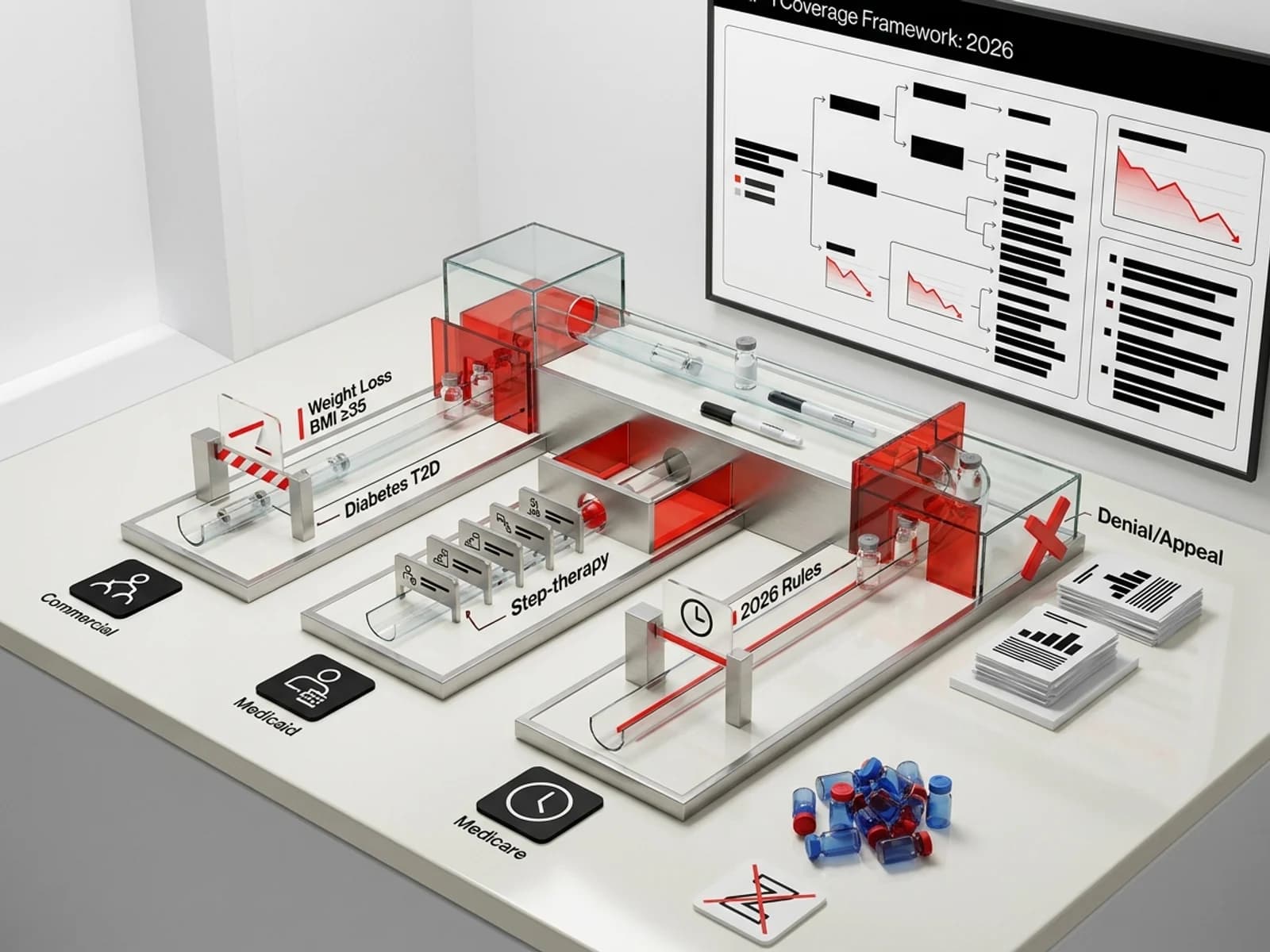
The difference between getting a GLP-1 drug covered for diabetes versus weight loss is often the difference between a routine prior authorization and a flat denial. Insurance plans evaluate GLP-1 coverage based on the FDA-approved indication of the specific drug prescribed, the patient's documented diagnosis, and the plan's benefit design — and in 2026, a growing number of commercial plans are excluding GLP-1 coverage for weight loss entirely.
This guide explains why the indication matters, maps the coverage and PA criteria differences, identifies which plans are tightening weight-loss exclusions, and provides a decision framework for prescribers and benefit verification teams. It is independent information and not medical advice or reimbursement guidance for a specific patient or plan.
Quick answer
| Factor | GLP-1 for Diabetes (T2D) | GLP-1 for Weight Loss |
|---|---|---|
| FDA-approved drugs | Ozempic, Mounjaro, Trulicity, Victoza, Rybelsus, Byetta, Bydureon | Wegovy, Zepbound, Saxenda |
| Coverage status | Widely covered by commercial, Medicare Part D, and Medicaid | Increasingly excluded by commercial plans; excluded from Medicare Part D (statutory); Medicaid coverage varies by state |
| PA criteria | T2D diagnosis + prior therapy documentation | BMI ≥30 or ≥27 + comorbidity + lifestyle modification + sometimes step therapy |
| Formulary tier | Typically Tier 2–3 (preferred brand) | Typically Tier 3–4 (specialty) or excluded |
| Common denial reason | Missing T2D diagnosis code or prior therapy documentation | Benefit exclusion for weight loss, missing BMI documentation, or incomplete lifestyle modification records |
| 2026 trend | Stable coverage | Multiple commercial payers dropping weight-loss GLP-1 coverage |
Who this is for
Prescribers selecting the right GLP-1 drug based on the patient's insurance coverage
Benefit verification and prior authorization specialists submitting GLP-1 PA requests
Pharmacy staff processing GLP-1 claims and handling denials
Market access teams at GLP-1 manufacturers tracking payer coverage trends
Patient assistance program coordinators navigating manufacturer support options
Health plan formulary managers evaluating GLP-1 benefit design
Source standard
Every fact in this guide is sourced from Blue Cross Blue Shield of Massachusetts GLP-1 exclusion FAQs (2026), Medi-Cal Rx GLP-1 coverage changes (2026), Pennsylvania Department of Human Services GLP-1 PA revisions (2026), Mass General Brigham Health Plan GLP-1 coverage updates, Word & Brown carrier-by-carrier coverage summaries, NFP GLP-1 coverage guidance, KFF Medicaid GLP-1 coverage analysis, CMS Medicare Part D guidance, and payer PA policy documents dated 2025–2026. Always verify current coverage with the specific plan.
Why the indication controls coverage
FDA-approved indications drive formulary placement
The FDA approves GLP-1 drugs for specific indications. Insurance plans use these approved indications as the primary basis for coverage decisions:
Ozempic is FDA-approved for type 2 diabetes (and CV/kidney risk reduction in T2D). It is not FDA-approved for weight loss, even though weight loss is a common side effect.
Wegovy is FDA-approved for chronic weight management, cardiovascular risk reduction, and noncirrhotic MASH.
Mounjaro is FDA-approved for T2D. Zepbound is the tirzepatide product FDA-approved for weight management and OSA.
Trulicity, Victoza, Rybelsus, Byetta, Bydureon are FDA-approved for T2D only.
Plans treat the T2D drugs and the weight-loss drugs as distinct products with different coverage rules, even when they share the same active ingredient (semaglutide = Ozempic + Wegovy; tirzepatide = Mounjaro + Zepbound). According to Peterson-KFF analysis of ACA Marketplace plan formularies, Wegovy is included in just 1% of Marketplace plan formularies, while Ozempic — which has the same active ingredient but is approved for diabetes — is included in 82%. This single data point illustrates how completely the indication drives formulary access.
The correct diagnosis code is critical
Submitting a GLP-1 prior authorization with the wrong diagnosis code is one of the most common causes of denial. Based on payer PA data:
For T2D GLP-1s (Ozempic, Mounjaro, Trulicity, etc.): The PA must include a T2D diagnosis code (e.g., E11.9 — Type 2 Diabetes Mellitus without complications). Do not submit with codes for obesity, weight loss, or prediabetes.
For weight-loss GLP-1s (Wegovy, Zepbound, Saxenda): The PA must include the appropriate weight management code (e.g., E66.3 or E66.9) and documented BMI.
For secondary indications: Wegovy prescribed for CVD risk reduction requires a CVD diagnosis code, not a weight-loss code. Zepbound for OSA requires an OSA diagnosis code.
If a patient has both T2D and obesity, the prescriber should submit the PA under the T2D indication with the appropriate drug (Ozempic, not Wegovy) to maximize the chance of approval.
PA criteria: diabetes vs. weight loss
Diabetes indication PA criteria (typical)
| Requirement | Common Standard |
|---|---|
| Diagnosis | Documented T2D diagnosis (ICD-10 E11.x) |
| Prior therapy | Trial of metformin or other first-line diabetes therapy (some plans require step therapy) |
| Lab documentation | HbA1c level above target; some plans require A1c ≥6.5% or above |
| Ongoing therapy | Continued A1c monitoring; dose escalation may require new PA |
| Approval duration | Typically 12 months, renewable with documentation |
Weight-loss indication PA criteria (typical)
| Requirement | Common Standard |
|---|---|
| BMI threshold | BMI ≥30 kg/m², or BMI ≥27 kg/m² with qualifying comorbidity (HTN, dyslipidemia, T2D, sleep apnea, PCOS) |
| Lifestyle modification | Documented participation in a structured lifestyle/behavioral modification program for 3–6 months |
| Prior therapy | Some plans require trial of lower-cost weight-loss medications (Contrave, Qsymia, orlistat) before GLP-1 |
| Comorbidity documentation | If using BMI ≥27 pathway, documented qualifying comorbidity required |
| Weight documentation | Baseline weight and BMI documented at initiation |
| Step therapy | Increasingly common — must fail or be intolerant to formulary alternatives |
| Approval duration | Typically 12 months; reauthorization requires documented weight loss ≥5% |
Stricter criteria emerging in 2026
Some payers have tightened weight-loss GLP-1 PA criteria beyond the standard thresholds:
Independent Health (Western New York): Requires in-person assessment and documentation of a 6-month evidence-based lifestyle program, plus BMI ≥40 with two obesity-related diseases, or BMI ≥30 with additional criteria
Sharp Health Plan: New members starting a GLP-1 for weight loss must have a BMI ≥40 to qualify
Pennsylvania Medicaid: GLP-1 receptor agonists are not covered for overweight or obesity at all, effective January 1, 2026. Only FDA-approved indications other than weight loss are covered with PA
Medi-Cal: Removed Wegovy, Zepbound, and Saxenda from the Contract Drugs List for weight loss, effective January 1, 2026. Coverage continues only for non-weight-loss indications (Wegovy for MASH and CVD; Zepbound for OSA)
Commercial plan weight-loss exclusions in 2026
A significant trend in 2026 is commercial health plans excluding GLP-1 coverage for weight loss:
Plans that have excluded or restricted weight-loss GLP-1 coverage
| Plan | Change | Effective Date | Details |
|---|---|---|---|
| BCBS of Massachusetts | Excluded Wegovy, Saxenda, Zepbound | January 1, 2026 (upon renewal) | T2D GLP-1 coverage unchanged; exclusion is a benefit design change, not appealable |
| Mass General Brigham Health Plan | Excluded GLP-1s for non-T2D indications | January 1, 2026 (individual/small group); upon renewal (large group) | Large employers (50+ subscribers) may add weight-loss GLP-1 coverage as optional rider |
| Medi-Cal (California Medicaid) | Removed weight-loss GLP-1s from CDL | January 1, 2026 | Wegovy covered only for MASH and CVD; Zepbound for OSA; all others for T2D only |
| Pennsylvania Medicaid | Excluded GLP-1 for overweight/obesity | January 1, 2026 | Saxenda not covered for any indication; children under 21 still covered via EPSDT |
| South Carolina Medicaid | Eliminated obesity GLP-1 coverage | Late 2025 | Reflects state budget constraints |
| New Hampshire Medicaid | Eliminated obesity GLP-1 coverage | Late 2025 | Per KFF tracking |
| Anthem BCBS (California) | Reclassified all GLP-1s to Tier 4 specialty, non-formulary | January 2025 | PA required; prior coverage overrides ended October 2024 |
Key pattern
The BCBS of Massachusetts FAQ is representative of the commercial payer approach: "Beginning January 1, 2026, and then upon anniversary, we'll be excluding all GLP-1 indications except for type 2 diabetes." This means even if a patient has a qualifying comorbidity like sleep apnea or CVD, a weight-loss-branded GLP-1 (Wegovy, Zepbound, Saxenda) may still be excluded — unless the patient can access it through a different indication pathway.
Secondary indications: CVD, MASH, and OSA pathways
A growing number of patients who need GLP-1 drugs for obesity can access coverage through secondary (non-weight-loss) FDA-approved indications:
| Secondary Indication | Drug | Coverage Pathway |
|---|---|---|
| CVD risk reduction (established CVD + overweight/obesity) | Wegovy | Covered under Part D and most commercial plans as CVD treatment, not weight loss |
| MASH (noncirrhotic metabolic dysfunction-associated steatohepatitis) | Wegovy | Covered under Part D and many commercial plans as liver disease treatment |
| OSA (moderate-to-severe obstructive sleep apnea + obesity) | Zepbound | Covered under Part D and many commercial plans as sleep apnea treatment |
| CKD/CV death risk reduction in T2D | Ozempic | Covered as kidney/cardiovascular treatment in T2D |
UnitedHealthcare Wegovy CVD coverage criteria (example)
UnitedHealthcare covers Wegovy for cardiovascular risk reduction only (not weight loss) under PA program 2025 P 1445-2 with these criteria:
Patient is age ≥45
BMI ≥27 kg/m²
Established CVD documented (prior MI, stroke, or peripheral artery disease)
No diagnosis of diabetes or HbA1c >6.5%
No NYHA Class IV heart failure
Authorization for 12 months
This is a coverage pathway specifically designed to cover Wegovy for CVD without triggering the weight-loss exclusion.
Decision framework for prescribers
When a patient needs a GLP-1 agonist, use this framework to match the drug to the coverage pathway:
Step 1: Identify all documented diagnoses
Does the patient have T2D? → Prescribe Ozempic, Mounjaro, Trulicity, or Victoza
Does the patient have established CVD + overweight/obesity? → Prescribe Wegovy (CVD indication)
Does the patient have noncirrhotic MASH? → Prescribe Wegovy (MASH indication)
Does the patient have moderate-to-severe OSA + obesity? → Prescribe Zepbound (OSA indication)
Does the patient have CKD + T2D? → Prescribe Ozempic (kidney/CV indication)
Step 2: Check plan-specific coverage
Verify the drug is on the plan's formulary
Confirm the plan does not have a benefit exclusion for the relevant indication
Check whether PA criteria require additional documentation (prior therapies, lifestyle programs, BMI thresholds)
Step 3: Submit PA with the correct diagnosis code
Use the ICD-10 code that matches the FDA-approved indication for the prescribed drug
Do not submit a weight-loss code for a T2D drug, or vice versa
Include all supporting documentation (BMI, labs, prior therapy records, lifestyle program records)
Step 4: If denied, identify the denial reason
Benefit exclusion: The plan does not cover weight-loss GLP-1 drugs. Consider secondary indication pathways or manufacturer assistance programs.
Missing documentation: Resubmit with additional clinical records.
Step therapy not met: Try the required formulary alternative first, or submit a step therapy exception with clinical justification.
Employer coverage trends
According to a KFF 2025 Employer Health Benefits Survey and WTW 2025 Best Practices in Healthcare Survey:
43% of firms with 5,000+ employees covered GLP-1s for weight loss in 2025, up from 28% in 2024 (KFF)
57% of larger employers in the WTW survey sample (averaging ~13,000 covered employees) covered GLP-1s for weight loss in 2025 (WTW)
Large employers are more likely to maintain weight-loss GLP-1 coverage than small employers or individual marketplace plans
Self-funded employer plans can choose to cover weight-loss GLP-1s even when the insurer's standard formulary excludes them
Medicaid coverage by state
KFF analysis as of January 2026 found:
| Coverage Category | States (Examples) | Details |
|---|---|---|
| GLP-1 for obesity | New York, California (pre-2026), Massachusetts, Minnesota, Connecticut | Covered with PA; strict BMI and comorbidity criteria |
| Non-GLP-1 weight loss only | Illinois, Pennsylvania (pre-2026), Ohio, Michigan | Cover Contrave, Qsymia, orlistat but not GLP-1s for obesity |
| No weight loss medication coverage | Texas, Florida, Georgia, Tennessee, Alabama | Exclude all drugs for weight loss |
| Coverage eliminated in 2025–2026 | California, Pennsylvania, South Carolina, New Hampshire | Dropped GLP-1 obesity coverage due to budget constraints (North Carolina eliminated coverage Oct 2025 but reinstated Dec 2025) |
Medicaid coverage of GLP-1s for T2D is federally required and cannot be dropped by states.
What to monitor
Commercial plan exclusions: The BCBS Massachusetts model (exclude weight-loss GLP-1 on plan renewal) may spread to other BCBS plans and commercial carriers. Monitor plan renewal communications for benefit design changes.
Secondary indication approvals: Each new FDA approval for a GLP-1 drug (e.g., kidney disease, additional cardiovascular indications) creates new coverage pathways that bypass the weight-loss exclusion.
Oral GLP-1 drugs: Foundayo (orforglipron) and oral Wegovy may face different formulary placement and PA criteria than injectable GLP-1s. Monitor Part D and commercial formulary additions.
Manufacturer assistance programs: Novo Nordisk (Wegovy, Ozempic) and Eli Lilly (Zepbound, Mounjaro) offer copay assistance, patient assistance programs, and savings cards. These programs have income limits and may not be combinable with government-funded insurance.
Employer plan carve-outs: Self-funded employers may maintain GLP-1 weight-loss coverage even when the carrier's standard formulary excludes it. Benefit verification should check the employer's specific plan documents, not just the carrier's default formulary.
Diagnosis coding scrutiny: Peterson-KFF employer focus groups found that some benefits managers suspect GLP-1 prescriptions for "diabetes" may include patients who do not meet diagnostic criteria. One senior benefits manager reported that 20% of GLP-1 prescriptions in their plan probably did not involve actual diabetes. Some employers have tightened diabetes documentation requirements in response. Prescribers should ensure T2D diagnoses are well-documented, including historical A1c levels — a patient whose A1c was previously ≥6.5% but is now 6.0% on treatment still qualifies for the diabetes indication.
Medicare BALANCE Model: If BALANCE launches in Part D, it would create a permanent coverage pathway for weight-loss GLP-1s in Medicare. Monitor CMS announcements.
Disclaimer
This article is independent information for health care professionals and is not medical advice, reimbursement guidance, or legal counsel for any specific patient or plan. Insurance coverage rules vary by plan, state, and employer group. Always verify current coverage with the specific plan and consult the plan's PA criteria documents.
Sources
Blue Cross Blue Shield of Massachusetts: GLP-1 Coverage FAQ, 2026. bluecrossma.org
CMS.gov: Medicare Part D coverage rules and statutory weight-loss exclusion under Section 1860D-2(e)(2) of the Social Security Act. https://www.cms.gov/newsroom/press-releases/coming-soon-cms-provide-50-monthly-access-glp-1-medications-medicare-beneficiaries
FDA.gov: Wegovy (semaglutide) prescribing information and FDA-approved indications. https://www.accessdata.fda.gov/drugsatfda_docs/label/2024/215256s012s013lbl.pdf
ClinicalTrials.gov: STEP (semaglutide treatment effect in people with obesity) trial program data. https://clinicaltrials.gov/search?cond=Obesity&intr=semaglutide
Medi-Cal Rx: GLP-1 Coverage Considerations, December 2025. medi-calrx.dhcs.ca.gov
Pennsylvania Department of Human Services: GLP-1 Receptor Agonists PA Revisions, Medical Assistance Bulletin, January 2026. pa.gov
Mass General Brigham Health Plan: GLP-1 Coverage Update, 2026. massgeneralbrighamhealthplan.org
Word & Brown: "Weight Loss Drugs (GLP-1) Insurance Coverage Breakdown by Carrier," updated May 2026. wordandbrown.com
NFP: "A Guide to Understanding and Navigating GLP-1 Coverage." nfp.com
KFF: "Medicaid Coverage of and Spending on GLP-1s," updated 2026. kff.org
KFF: "Medicaid Coverage and Prior Authorization for Antiobesity GLP-1 Receptor Agonists," Journal of General Internal Medicine, November 2025.
UnitedHealthcare: Wegovy PA criteria for CVD risk reduction, Program 2025 P 1445-2. uhcprovider.com
Navigate Weight MD: "A Practical Guide to GLP-1 Prior Authorizations (2026)." navigateweightmd.com
Penn LDI: "Patients Face New Barriers for GLP-1 Drugs." ldi.upenn.edu
CMS.gov: Medicare Part D coverage rules and weight-loss exclusion. cms.gov
Peterson-KFF: "Insurer Strategies to Control Costs Associated with Weight Loss Drugs." healthsystemtracker.org
Peterson-KFF: "Perspectives from Employers on the Costs and Issues Associated with Covering GLP-1 Agonists for Weight Loss." healthsystemtracker.org
Healthline: "GLP-1 Insurance Coverage for Weight Loss: 2026 Guide." healthline.com
IntuitionLabs: "The ePA Process for GLP-1 Drugs: A Workflow Guide." intuitionlabs.ai
Independent Health: GLP-1 Medications and Preauthorization, 2025. independenthealth.com