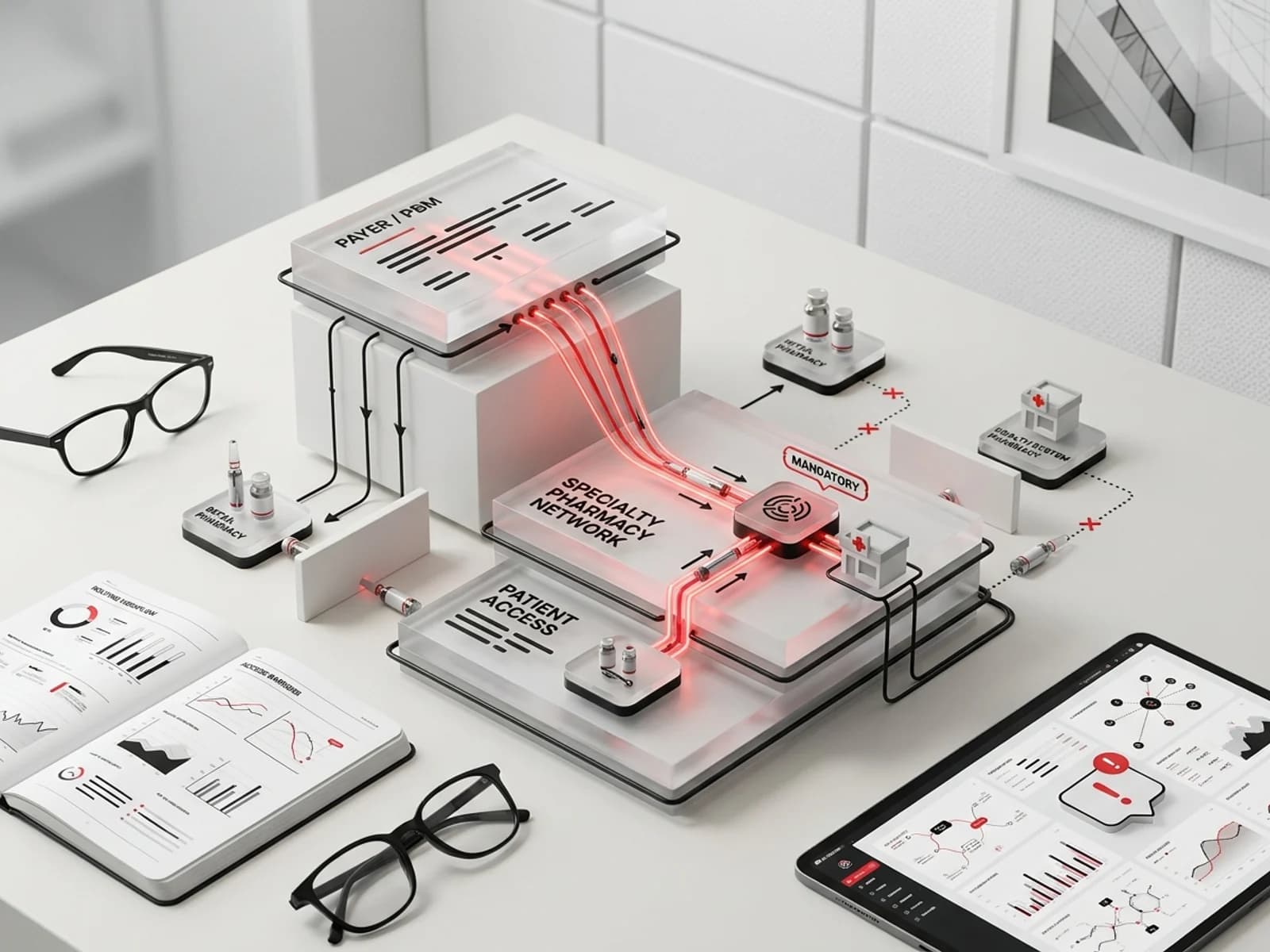
When a GLP-1 prescription is rejected at the pharmacy counter with a message like "must use designated specialty pharmacy" or "drug requires specialty pharmacy dispensing," the problem is not prior authorization and it is not formulary coverage. The problem is mandatory specialty pharmacy routing — a payer policy that requires the prescription to be filled through a specific pharmacy, not the patient's local retail pharmacy. For GLP-1 receptor agonists, mandatory specialty pharmacy routing has become standard practice across most commercial, Medicare, and Medicaid plans, and understanding how it works is essential for getting the medication to the patient without delays.
This guide explains how GLP-1 mandatory specialty pharmacy routing works, maps the major payer-PBM-specialty pharmacy relationships, identifies common access barriers, and provides a workflow for navigating mandatory routing. It is independent information and not medical advice or reimbursement guidance for a specific patient or plan.
Quick answer
| Payer / PBM | Typical Mandatory Specialty Pharmacy | Applies To |
|---|---|---|
| Aetna / CVS Caremark | CVS Specialty | Most Aetna commercial and Medicare plans |
| Cigna / Evernorth | Accredo (Express Scripts subsidiary) | Most Cigna commercial plans |
| Express Scripts | Accredo | Express Scripts-managed plans |
| UnitedHealthcare / OptumRx | Optum Specialty Pharmacy | Most UHC commercial and Medicare plans |
| BCBS (select plans) | AllianceRx Walgreens Prime, or plan-designated specialty pharmacy | Varies by BCBS licensee |
| Prime Therapeutics | AllianceRx Walgreens Prime | Prime-managed BCBS plans |
| Medica | Accredo | Medica commercial plans |
| Medicare Part D (varies by plan) | Plan-designated specialty pharmacy | Varies by Part D plan sponsor |
| State Medicaid (varies) | State-contracted specialty pharmacy or PBM-designated | Varies by state |
| InscriptRx (BILH) | InscriptRx health system specialty pharmacy | BILH employee plan members |
Key facts:
GLP-1 monthly list prices range from approximately $800 to $1,469, placing them in the specialty drug tier on virtually all formularies
Most GLP-1 prescriptions are dispensed through specialty pharmacies, not retail pharmacies
Mandatory routing means the prescription must go to the designated pharmacy — the patient cannot choose an alternative
Health system specialty pharmacies (HSSPs) are increasingly contracting with payers to serve as in-network specialty pharmacy options for GLP-1s
Who this is for
Patients whose GLP-1 prescription was rejected because it was sent to the wrong pharmacy
Prescribers and clinic staff routing GLP-1 prescriptions to the correct specialty pharmacy
Benefit verification specialists and hub teams identifying mandatory specialty pharmacy requirements
Pharmacists navigating GLP-1 dispensing and specialty pharmacy network issues
Market access teams understanding GLP-1 specialty pharmacy channel dynamics
Source standard
Every fact in this guide is sourced from payer formulary documents, PBM specialty pharmacy network listings, manufacturer hub program materials, industry reports from Shields Health Solutions, Truveris, KFF, and CMS publications dated 2025–2026. Specialty pharmacy network requirements vary by plan and employer. Always verify the designated specialty pharmacy by calling the pharmacy benefit number on the patient's insurance card.
How GLP-1 mandatory specialty pharmacy routing works
Why payers mandate specialty pharmacy for GLP-1s
Payers and PBMs require GLP-1 dispensing through specialty pharmacies for several reasons:
Cost management: Specialty pharmacies negotiate with manufacturers for rebates and preferential pricing. Routing all GLP-1 volume through a single specialty pharmacy maximizes the PBM's leverage.
Utilization management: Specialty pharmacies serve as a checkpoint for PA verification, quantity limits, and step therapy compliance before dispensing. The specialty pharmacist confirms that PA was approved and that the prescription matches the approved criteria.
Clinical support: Specialty pharmacies provide patient education on injection technique, titration schedules, side effect management, and adherence monitoring — services that retail pharmacies may not offer for injectable GLP-1s.
Limited distribution agreements (LDAs): Some GLP-1 formulations are available only through specialty pharmacies that have contracted directly with the manufacturer. These limited distribution drugs (LDDs) cannot be obtained from any pharmacy outside the manufacturer's authorized network.
The routing workflow
A GLP-1 prescription follows one of these pathways:
Pathway 1: Payer-mandated specialty pharmacy (most common)
Prescriber writes the prescription
Prescription is routed to the payer-designated specialty pharmacy (identified during benefit investigation)
Specialty pharmacy verifies PA status, patient eligibility, and cost share
Specialty pharmacy contacts the patient for coordination and ships the medication (usually mail-order)
Patient receives the medication at home
Pathway 2: Limited distribution drug (LDD)
Prescriber writes the prescription
Prescription must go to a manufacturer-authorized specialty pharmacy
The manufacturer-authorized specialty pharmacy must also be in-network with the patient's plan
If the plan's mandatory specialty pharmacy and the manufacturer's authorized pharmacy are not the same, the prior authorization process becomes more complex
Pathway 3: Health system specialty pharmacy (HSSP)
Prescriber writes the prescription within a health system that operates its own specialty pharmacy
The HSSP must be in-network with the patient's plan for the specific GLP-1
HSSPs increasingly contract with payers to serve as in-network specialty pharmacy options
HSSPs offer the advantage of integration with the prescribing provider's medical record system
Pathway 4: Retail pharmacy (uncommon for GLP-1s)
Some plans allow GLP-1 dispensing at in-network retail pharmacies, particularly for oral GLP-1s (Rybelsus, Wegovy tablets)
Retail dispensing is the exception, not the rule, for injectable GLP-1s
Even when retail dispensing is allowed, the retail pharmacy must verify PA before dispensing
Payer-specific specialty pharmacy routing
Aetna / CVS Caremark
Aetna (a CVS Health company) routes most GLP-1 prescriptions through CVS Specialty, the PBM's in-house specialty pharmacy. This applies to:
Aetna commercial plans
Aetna Medicare Advantage plans with pharmacy benefits managed by CVS Caremark
Self-funded employer plans using CVS Caremark as PBM
CVS Specialty operates as a mail-order specialty pharmacy with home delivery. Patients can manage prescriptions through the CVS Specialty website or mobile app.
Cigna / Express Scripts (Evernorth)
Cigna and Express Scripts route most GLP-1 prescriptions through Accredo, Express Scripts' specialty pharmacy subsidiary. This applies to:
Cigna commercial plans with Evernorth pharmacy benefits
Express Scripts-managed employer plans
Cigna Medicare plans
Accredo provides dedicated pharmacy teams for specialty medications, patient support programs, and home delivery. Medica, a regional health plan, also uses Accredo as its mandatory specialty pharmacy for most specialty drugs including GLP-1s.
UnitedHealthcare / OptumRx
UHC and OptumRx route GLP-1 prescriptions through Optum Specialty Pharmacy, the in-house specialty pharmacy of UnitedHealth Group. This applies to:
UHC commercial plans
UHC Medicare Advantage plans
OptumRx-managed employer plans
Optum Specialty Pharmacy provides home delivery and clinical support services. The UHC provider portal (UHCprovider.com) includes a PreCheck MyScript tool that identifies the designated specialty pharmacy for a specific GLP-1 on the patient's plan.
BCBS plans / Prime Therapeutics
BCBS plans vary by licensee. Many BCBS plans contract with Prime Therapeutics for PBM services, which routes specialty prescriptions through AllianceRx Walgreens Prime (a joint venture between Prime Therapeutics and Walgreens). Other BCBS plans use different specialty pharmacies depending on the local market and PBM arrangement.
Health system specialty pharmacies
Health system specialty pharmacies (HSSPs) are an emerging channel for GLP-1 dispensing. Shields Health Solutions, a health system specialty pharmacy organization, reports that HSSPs help patients navigate complex GLP-1 coverage requirements, obtain financial assistance, and adhere to prescribed treatments.
InscriptRx (Beth Israel Lahey Health) operates a specialty pharmacy program that includes GLP-1 dispensing for BILH employee plan members, with medication therapy management (MTM) support from weight loss-specialized pharmacists.
HSSPs offer several advantages for GLP-1 patients:
Integration with the prescribing provider's medical record system
Direct coordination with the care team on PA submissions and clinical documentation
Comprehensive medication therapy management, including weight-loss-specific pharmacist consultations
Copay assistance programs that can reduce out-of-pocket costs for qualifying specialty medications
Common access barriers from mandatory routing
1. Prescription sent to wrong pharmacy
The problem: The prescriber sends the GLP-1 prescription to a retail pharmacy or the patient's usual pharmacy. The claim is rejected at point of sale because the plan requires specialty pharmacy dispensing.
The solution: Conduct a benefit investigation before writing the prescription. Identify the designated specialty pharmacy and route the prescription directly. If the prescription has already been sent to the wrong pharmacy, the prescriber or patient must call to have it transferred to the correct specialty pharmacy — but some specialty pharmacies require a new prescription from the prescriber rather than accepting a transfer.
2. Specialty pharmacy out of stock
The problem: The designated specialty pharmacy does not have the specific GLP-1 in stock. Despite the FDA resolving the semaglutide injection shortage in February 2025, localized supply disruptions continue as products move through the supply chain.
The solution: Contact the specialty pharmacy to check inventory and expected restock dates. If the delay will be significant, ask the payer whether a temporary exception can be made to fill the prescription at a different in-network specialty pharmacy or retail pharmacy. For patients already on therapy, a gap in dispensing may trigger reauthorization requirements.
3. Patient lives far from the specialty pharmacy
The problem: Most mandatory specialty pharmacies are mail-order operations that ship to the patient's home. However, some patients may have difficulty receiving mail-order deliveries (e.g., no secure delivery location, rural address issues, temperature-sensitive shipping concerns for injectable GLP-1s).
The solution: Confirm that the specialty pharmacy ships with cold-chain packaging appropriate for the specific GLP-1. All major specialty pharmacies (CVS Specialty, Accredo, Optum Specialty) ship injectable GLP-1s with temperature-controlled packaging. If delivery is a persistent issue, ask the payer about in-network retail pharmacy options or health system specialty pharmacy alternatives.
4. Health system specialty pharmacy not in-network
The problem: The patient's provider practices within a health system that operates its own specialty pharmacy, but that HSSP is not in-network with the patient's plan for GLP-1 dispensing. The prescription must go to the payer-mandated specialty pharmacy instead.
The solution: Some health systems are actively contracting with payers to become in-network specialty pharmacies for GLP-1s. If the HSSP is not in-network, the prescription must be routed to the payer's designated specialty pharmacy. The HSSP may be able to assist with the PA submission and clinical documentation even if it does not dispense the medication.
5. Limited distribution drug conflicts with mandatory pharmacy
The problem: A GLP-1 is designated as a limited distribution drug by the manufacturer, meaning it can only be dispensed through specific authorized pharmacies. However, the patient's plan mandates a different specialty pharmacy. If the two networks don't overlap, the prescription cannot be filled.
The solution: Contact the payer's pharmacy benefit desk and request a network exception based on the manufacturer's LDA. The payer may authorize a one-time or ongoing exception to allow dispensing through the manufacturer-authorized pharmacy. If the payer refuses, contact the manufacturer's hub program for assistance in resolving the conflict.
6. Switching plans and specialty pharmacy networks
The problem: The patient changes insurance plans (e.g., during open enrollment or a job change). The new plan uses a different specialty pharmacy network. The GLP-1 prescription must be re-routed, and the prior authorization may not transfer.
The solution: Under AHIP voluntary pledges (effective January 1, 2026), participating insurers must honor existing PAs for 90 days when patients switch plans. However, the specialty pharmacy network changes immediately. The patient must have the prescription sent to the new plan's designated specialty pharmacy. Begin the benefit investigation and PA transfer process as soon as the plan change is confirmed.
The mandatory routing workflow
Step 1: Benefit investigation — identify the designated specialty pharmacy
Before writing or refilling a GLP-1 prescription, conduct a benefit investigation (see companion article on GLP-1 plan benefit investigation workflow). The critical question: "Which specialty pharmacy does the plan require for this medication?"
Step 2: Route the prescription to the designated pharmacy
Send the prescription directly to the identified specialty pharmacy. Include:
Patient name, DOB, member ID
Drug name, strength, quantity, directions
ICD-10 diagnosis code
PA reference number (if PA was already approved)
Prescriber NPI and contact information
Most specialty pharmacies accept electronic prescriptions, fax, and phone. Some also accept prescriptions through the payer's provider portal.
Step 3: Specialty pharmacy verification
The specialty pharmacy will:
Verify the patient's eligibility and coverage
Confirm PA approval (or initiate PA if not yet submitted)
Check for drug interactions and contraindications
Contact the patient for copay information and delivery scheduling
Ship the medication with cold-chain packaging (for injectable GLP-1s)
Step 4: Patient receives medication
Injectable GLP-1s are shipped with temperature-controlled packaging
Most specialty pharmacies provide tracking information
The patient should receive the medication within 3–7 business days of PA approval
If there are shipping delays, contact the specialty pharmacy for a status update
Step 5: Refill management
Specialty pharmacies typically auto-refill GLP-1 prescriptions based on the fill schedule
The patient or provider must ensure that PA renewals are submitted before the current authorization expires
Some specialty pharmacies will initiate the PA renewal process on behalf of the patient; others require the prescriber to submit the renewal
Impact on GLP-1 adherence
Mandatory specialty pharmacy routing has a measurable impact on GLP-1 adherence. A 2025 report cited by IntuitionLabs found that 63% of patients remained on GLP-1s after one year, up from previous years. However, adherence data from the PMC-published analysis of GLP-1 access strategies shows that only 36% of patients starting Wegovy and 47% starting Ozempic (off-label for weight loss in 2021) were still on therapy at one year. A follow-on three-year study published by Prime Therapeutics in June 2025 showed that only 14.3% of patients on semaglutide (Wegovy) remained on therapy at three years; overall GLP-1 persistence at three years was just 8.1% (1 in 12).
The specialty pharmacy channel can either help or hinder adherence:
How specialty pharmacies help:
Dedicated pharmacist support for injection technique, side effect management, and dose titration
Automatic refill reminders and adherence outreach
Coordination with the prescriber on PA renewals and clinical documentation
Financial assistance navigation, including copay cards and patient assistance programs
How mandatory routing can hinder:
Delays from routing the prescription to the wrong pharmacy and having to re-route
Patients who are unfamiliar with mail-order specialty pharmacies may not complete the enrollment process
Shipping delays or delivery issues can create gaps in therapy
If the patient discontinues the medication for 60 days or more, some plans (e.g., Health Net's Ambetter plans) require re-verification under potentially stricter BMI criteria
Practical tips for navigating mandatory routing
Never send a GLP-1 prescription to a retail pharmacy without first confirming the plan allows retail dispensing. Most plans require specialty pharmacy dispensing for injectable GLP-1s.
Include the PA reference number on the prescription. If PA was already approved, include the approval reference number when routing the prescription to the specialty pharmacy. This speeds up the verification process.
Know the cold-chain shipping details. Injectable GLP-1s (Ozempic, Wegovy, Mounjaro, Zepbound, Trulicity, Saxenda) require refrigeration. Confirm that the specialty pharmacy ships with appropriate cold-chain packaging and that someone will be available to receive the delivery.
Watch for oral GLP-1 dispensing differences. Oral GLP-1s (Rybelsus tablets, Wegovy tablets, Foundayo/orforglipron) may be dispensed through retail pharmacies on some plans, even when the same plan mandates specialty pharmacy for injectable GLP-1s. Check the plan's specific requirements for each formulation.
Prepare for plan changes. If the patient is changing plans, begin the benefit investigation for the new plan before the transition date. Under AHIP pledges, existing PAs transfer for 90 days, but the specialty pharmacy network may change immediately.
Leverage health system specialty pharmacies. If the patient's health system has an in-network specialty pharmacy, it may provide better coordination of care and clinical support than the payer's mail-order specialty pharmacy. Check with the health system's pharmacy department.
Use manufacturer hub programs for direct-to-consumer options. If the patient's plan excludes GLP-1 coverage or the patient is uninsured, NovoCare Pharmacy (Novo Nordisk) and LillyDirect (Eli Lilly) offer direct-to-consumer GLP-1 dispensing at prices significantly below retail list price. NovoCare Pharmacy offers Wegovy tablets at $149/month and Wegovy injection at $199–349/month for self-pay patients. These programs bypass insurance entirely.
Sources
Shields Health Solutions. Addressing GLP-1 Access and Adherence Challenges with Specialty Pharmacy Solutions. 2025. (shieldshealthsolutions.com)
IntuitionLabs. The ePA Process for GLP-1 Drugs: A Workflow Guide. 2025. (intuitionlabs.ai)
IntuitionLabs. Pharmacy vs. Medical Benefit Explained: GLP-1 Coverage. 2025. (intuitionlabs.ai)
Novo Nordisk. NovoCare Pharmacy — Direct-to-Consumer Pricing. 2026. (novocare.com)
KFF. Medicaid Coverage of and Spending on GLP-1s. 2026. (kff.org)
KFF. What to Know About the BALANCE Model for GLP-1s in Medicare and Medicaid. 2026. (kff.org)
UHC Provider. Clinical Pharmacy and Specialty Drugs — Prior Authorization Programs. 2026. (uhcprovider.com)
Medica. Pharmacy Benefits — Specialty Drug Program. 2026. (medica.com)
InscriptRx (BILH). Provider Forms and Resources — Prior Authorization and Specialty Pharmacy. 2026. (inscriptrx.org)
Truveris. How Pharmacy Plans Are Managing GLP-1 Coverage in 2025. (truveris.com)
Mercer. GLP-1 Considerations for 2026: Your Questions Answered. 2026. (mercer.com)
Surescripts. Electronic Benefit Verification and Prior Authorization Automation. 2026. (surescripts.com)
Evernorth / Express Scripts. Prior Authorization Resources — Step Therapy Exception Forms. 2026. (evernorth.com)
FDA. FDA Clarifies Policies for Compounders as National GLP-1 Supply Begins to Stabilize. February 21, 2025. (fda.gov)