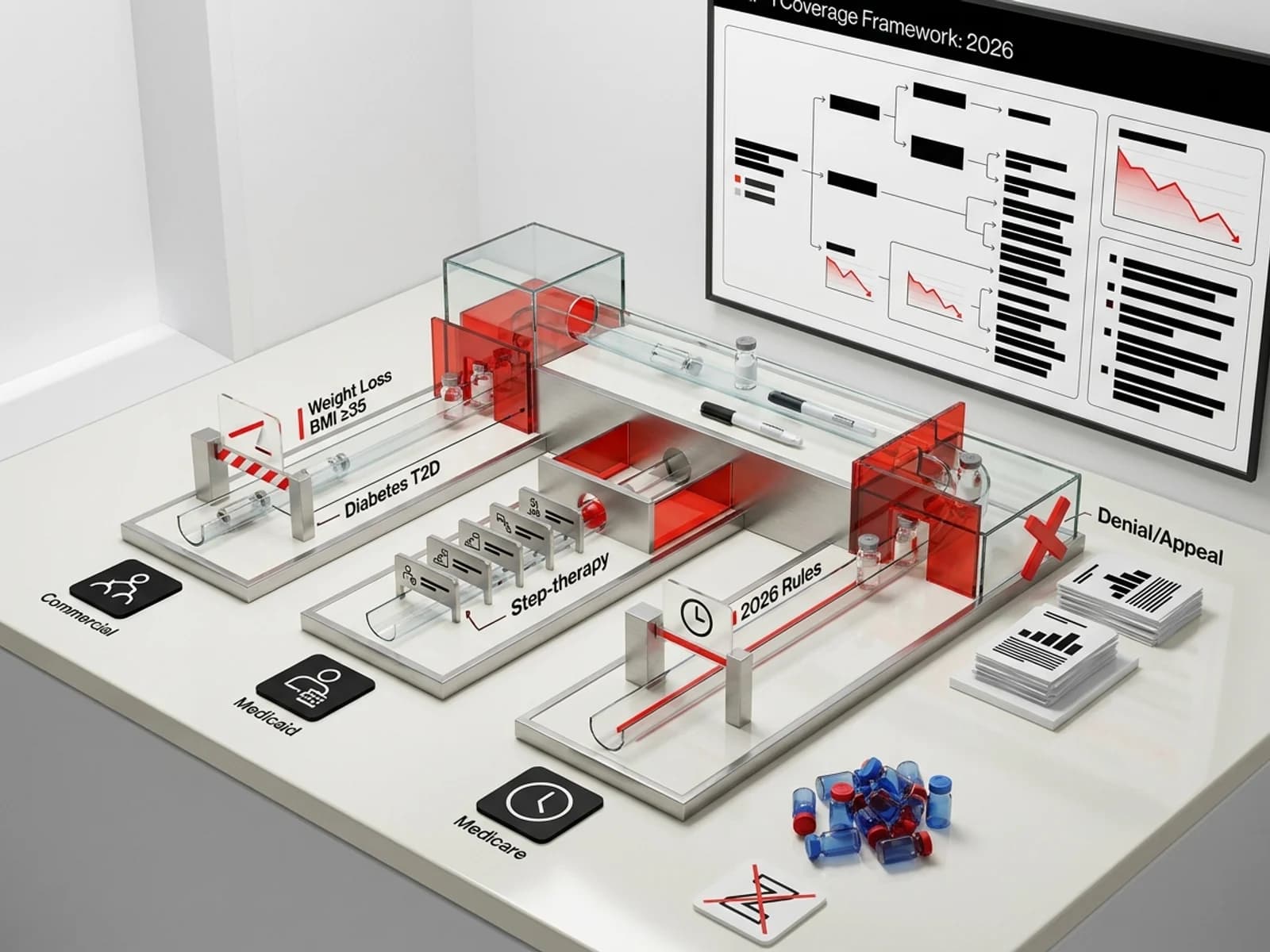
GLP-1 receptor agonists — Ozempic, Wegovy, Mounjaro, Zepbound, Trulicity, Rybelsus, Saxenda — are among the most prescribed and most prior-authorization-intensive drug classes in the United States. For weight management and cardiometabolic indications, nearly every commercial payer, Medicaid program, and Medicare plan requires PA, and approval hinges on a narrow set of documentation requirements: BMI thresholds, comorbidity evidence, weight-loss history, lifestyle-modification records, and prior-therapy failure. A missing weight measurement or an incomplete comorbidity list is often the difference between approval and denial.
This guide maps the PA documentation landscape for GLP-1 medications across major payer segments, identifies the most common denial reasons, and provides a practical documentation checklist. It is independent information and not medical advice or reimbursement guidance for a specific patient or plan.
Quick answer: BMI thresholds by payer segment
| Payer/Segment | BMI Threshold (No Comorbidity) | BMI Threshold (With Comorbidity) | Comorbidities Required |
|---|---|---|---|
| FDA label (Wegovy/Zepbound) | BMI ≥ 30 | BMI ≥ 27 | At least 1 weight-related condition (not specified) |
| Typical commercial (Aetna, Cigna, UHC) | BMI ≥ 30 | BMI ≥ 27 | ≥ 1 comorbidity (HTN, T2D, OSA, CVD, dyslipidemia) |
| Harvard Pilgrim / EncircleRx (2026) | BMI ≥ 32 | BMI ≥ 27 | ≥ 2 comorbidities required at BMI 27–31 |
| Independent Health (commercial) | BMI ≥ 40 | BMI ≥ 30 | ≥ 2 comorbidities at BMI 40+; BMI 30+ with serious CVD (stroke, MI) |
| Western Health Advantage | BMI ≥ 40 | — | — |
| Blue Shield of California | BMI ≥ 40 | — | Cardiac comorbidities may lower threshold |
| NC Medicaid | BMI ≥ 30 | BMI ≥ 27 | ≥ 1 comorbidity (HTN, T2D, OSA, CVD, dyslipidemia) |
| Pennsylvania Medicaid (2026) | Not covered for obesity | — | PA required for diabetes and other FDA indications |
| Medicare GLP-1 Bridge (July 2026) | BMI ≥ 35 | BMI ≥ 27 | ≥ 1 comorbidity (CVD, HF, OSA, dyslipidemia, HTN, prediabetes) |
Documentation requirements for initial PA
CoverMyMeds, the largest electronic PA platform, reports that GLP-1 PA forms consistently demand five categories of documentation. Missing any one is a common denial trigger.
1. BMI and weight history
Baseline BMI must be documented on the PA form, usually measured within 30–45 days of submission.
Weight must be measured (not patient-reported) and recorded with the date.
Some payers request a 3-year weight history chart from the medical record.
For the Medicare GLP-1 Bridge, CMS requires the provider to attest that the beneficiary met the BMI criterion at the time therapy was initiated — not at the time of the PA request. If a patient started GLP-1 therapy with a BMI of 37 in 2024 and has a BMI of 34 at the time of a July 2026 PA request, the provider should document the initiation BMI.
2. Comorbidity documentation
Most payers require documented diagnoses of weight-related comorbidities when BMI is below the standalone threshold. Accepted comorbidities typically include:
Hypertension
Type 2 diabetes or prediabetes
Obstructive sleep apnea
Cardiovascular disease (history of MI, stroke, symptomatic peripheral arterial disease)
Dyslipidemia
Non-alcoholic fatty liver disease / MASH
Polycystic ovarian syndrome (PCOS)
Osteoarthritis of weight-bearing joints
The Penn LDI cross-sectional study of Medicaid PA policies (published November 2025 in the Journal of General Internal Medicine) found that 70% of state Medicaid PA policies specified the comorbid conditions that qualify, while two state policies required at least two comorbidities — more restrictive than the FDA label.
3. Lifestyle modification documentation
Most commercial payers and state Medicaid programs require documentation of participation in a structured lifestyle modification program:
Duration required: Typically 3–6 months of documented participation prior to GLP-1 initiation. Cigna requires at least three months of a structured lifestyle modification program.
Type: Structured nutrition and physical activity program, in-person or virtual. Harvard Pilgrim's 2026 EncircleRx program requires enrollment in the 9amHealth virtual weight management program.
Documentation format: Chart notes, program enrollment records, or attestation from the prescribing provider.
Independent Health requires an in-person assessment and documentation of participation in an evidence-based lifestyle management program for six months.
4. Prior therapy / step therapy failure
Many payers require documentation that the patient has tried and failed lower-cost alternatives:
Metformin or other oral diabetes medications for T2D indications.
Non-incretin weight-loss medications (phentermine, Contrave, Qsymia, orlistat) for obesity indications.
NC Medicaid requires completion of an adequate titration period of 3 to 6 months of the preferred drug before switching to a non-preferred product.
Some payers require documented failure of the maximum FDA-approved dose of the preferred GLP-1 before approving an alternative.
5. Contraindication screening
Most PA forms require attestation that the patient does not have:
Personal or family history of medullary thyroid carcinoma (MTC).
Multiple endocrine neoplasia syndrome type 2 (MEN 2).
History of pancreatitis (some payers).
Pregnancy or planned pregnancy (some payers).
Renewal / reauthorization documentation
GLP-1 PA approvals are time-limited. Renewal requirements are a frequent source of denials because prescribers may not realize the documentation bar changes at renewal.
Approval durations
| Payer Segment | Initial Approval | Renewal Approval |
|---|---|---|
| Typical commercial | 6–12 months | 6–12 months |
| Horizon BCBS NJ (2026) | 3 months (obesity), 6 months (other) | 6 months (all indications) |
| NC Medicaid | 6 months | 12 months |
| Pennsylvania Medicaid | Varies by indication | Varies |
| Medicare GLP-1 Bridge | Per CMS guidance | Per CMS guidance |
Proof-of-benefit criteria
Most payers require documented weight loss at renewal:
5% total body weight loss is the most common threshold for adults (based on the pivotal SELECT and SURMOUNT trial endpoints). NC Medicaid, many commercial payers, and most Medicaid programs use this benchmark.
4% reduction in baseline BMI is typical for adolescents.
Baseline and current weight must both be provided on the PA form.
Failure to document baseline weight at initiation is a leading cause of renewal denial, because the payer has no reference point to calculate percentage weight loss.
Some payers accept a documented "significant reduction from BMI" with prescriber rationale if the percentage threshold is not met.
Medication review at renewal
NC Medicaid and several other payers require documentation at renewal that the prescriber has reviewed the beneficiary's medication list for possible dose reductions or discontinuation of comorbidity medications (e.g., antihypertensives, diabetes medications) that may no longer be needed due to weight reduction effects.
Common denial reasons
The American Hospital Association reports that medical necessity is the most common reason for PA denials across all drug classes. For GLP-1s specifically, CoverMyMeds and pharmacy workflow experts identify these top denial triggers:
1. BMI documentation missing or below threshold
The single most common denial. This includes:
BMI not documented on the PA form.
BMI measurement date outside the allowed window (typically 30–45 days).
Patient BMI below the payer's threshold without qualifying comorbidities documented.
For renewal: baseline BMI at therapy initiation was never recorded, so percentage weight loss cannot be calculated.
2. Plan exclusion of weight-management drugs
Many commercial plans — particularly individual marketplace plans, smaller employer groups, and some Medicare Advantage plans — exclude GLP-1 drugs for weight loss from the formulary entirely. In this case, the PA is denied automatically regardless of clinical documentation. The patient may need to pursue an employer benefit carve-out, a manufacturer assistance program, or pay out of pocket.
3. Insufficient lifestyle modification documentation
Payers that require documented participation in a lifestyle program will deny if the documentation is vague ("patient advised to diet and exercise"), the program duration is too short, or there is no record of enrollment in a structured program.
4. Step therapy not completed
If the payer requires prior trial and failure of lower-cost weight-loss medications (phentermine, Contrave, Qsymia) or diabetes medications (metformin, sulfonylureas), the PA will be denied without documentation of prior therapy, reasons for failure, or documented intolerance.
5. Wrong diagnosis code
Using a weight-loss or obesity diagnosis code on a plan that only covers GLP-1s for diabetes, or conversely, using a diabetes diagnosis code when the patient's primary need is weight management. Matching the correct ICD-10 code to the payer's covered indication is critical.
6. Combination use or therapeutic duplication
Most payers deny PA if there is evidence of concurrent GLP-1 use (e.g., a paid claim for another GLP-1 or a DPP-4 inhibitor in the point-of-sale claims system). Some payers allow transition with documented intent to discontinue one agent.
Payer-specific BMI thresholds: notable variations
While BMI ≥ 30 (or ≥ 27 with comorbidity) is the most common threshold aligned with FDA labeling, several payers have tightened criteria in 2025–2026:
Harvard Pilgrim (EncircleRx, 2026): BMI ≥ 32 standalone, or BMI 27–31 with two documented comorbidities (arthritis of the knee, asthma, COPD, coronary artery disease, heart disease, high blood pressure, high cholesterol, NAFLD, OSA, PCOS, or T2D). The review examines the member's documented BMI at the time they started taking the medication.
Independent Health (2025): BMI ≥ 40 with two obesity-related diseases, or BMI ≥ 30 with serious cardiovascular disease (history of stroke or heart attack). Zepbound is preferred; Wegovy and Saxenda reserved for medical contraindication.
Western Health Advantage: BMI ≥ 40 required; BMI below 40 is not considered medically necessary for weight management.
Blue Shield of California: Changed coverage to require BMI ≥ 40 unless there are cardiac comorbidities.
Pennsylvania Medicaid (January 2026): Does not cover GLP-1s for obesity at all. GLP-1s are covered only for diabetes and other FDA-approved non-obesity indications with PA.
BCBS Massachusetts (Focused formulary, 2026): GLP-1 and GLP-1/GIP medications for obesity and other FDA-approved medical indications are excluded from coverage under the pharmacy benefit, with no exceptions granted.
Documentation checklist for GLP-1 PA submission
Before submitting a GLP-1 PA, confirm the following documentation is assembled:
Current BMI with measurement date (within 30–45 days)
Baseline BMI and weight at therapy initiation (for renewals)
Qualifying comorbidity diagnoses with ICD-10 codes
Structured lifestyle modification program documentation (enrollment, duration, dates)
Prior therapy records (medication names, doses, duration, reason for discontinuation)
Contraindication screening attestation (MTC, MEN 2, pancreatitis, pregnancy)
Correct diagnosis code matching the payer's covered indication
For non-preferred drugs: documentation of preferred drug trial and failure (3–6 months)
For renewals: current weight, percentage weight loss calculation, medication review
Plan formulary verification (confirm GLP-1 for the specific indication is not excluded)
Sources
CoverMyMeds, "Simplify GLP-1 Prior Authorization with CoverMyMeds." https://www.covermymeds.health/articles/provider-insights/simplify-glp-1-prior-authorization-with-covermymeds
IntuitionLabs, "The ePA Process for GLP-1 Drugs: A Workflow Guide." https://intuitionlabs.ai/articles/epa-glp-1-prior-authorization
Penn LDI, "Patients Face New Barriers for GLP-1 Drugs." https://ldi.upenn.edu/our-work/research-updates/patients-face-new-barriers-for-glp-1-drugs-like-wegovy-and-ozempic
Klebanoff MJ, Chetty AK, Doshi J. "Medicaid Coverage and Prior Authorization for Antiobesity GLucagon-Like Peptide-1 Receptor Agonists: A Cross-Sectional Study of State Policies." Journal of General Internal Medicine, November 21, 2025.
Harvard University (Harvie Health), "GLP-1 2026 Clinical Changes and Coverage Requirements FAQs." https://harvie.harvard.edu/sites/g/files/omnuum12046/files/2025-10/GLP1_Clinical_Changes_FAQ.pdf
Independent Health, "GLP-1 Medications and Preauthorization." https://www.independenthealth.com/content/dam/independenthealth/individuals-and-families/my-health/healthy-weight/documents/glp-1-additional-information.pdf
CMS, "Medicare GLP-1 Bridge: Information for Medicare Beneficiaries." https://www.cms.gov/medicare/coverage/prescription-drug-coverage/medicare-glp-1-bridge/information-medicare-beneficiaries
KFF, "What to Know About the BALANCE Model for GLP-1s in Medicare and Medicaid." https://www.kff.org/medicare/what-to-know-about-the-balance-model-for-glp-1s-in-medicare-and-medicaid
ICER, "Affordable Access to GLP-1 Obesity Medications: Strategies to Guide Market Action and Policy Solutions," April 2025. https://icer.org/wp-content/uploads/2025/04/Affordable-Access-to-GLP-1-Obesity-Medications-_-ICER-White-Paper-_-04.09.2025.pdf
NC Medicaid Outpatient Pharmacy Prior Approval Criteria GLP1s for Weight Management, effective August 1, 2024. https://www.nctracks.nc.gov/content/dam/jcr:0e327f54-101e-41be-a89d-e13212b687b0/Weight%20Management-08.01.2024.pdf
Pennsylvania Department of Human Services, "Coverage Change and Prior Authorization of GLP-1 Receptor Agonists," Medical Assistance Bulletin, November 24, 2025 (updated March 2, 2026). https://www.pa.gov/content/dam/copapwp-pagov/en/dhs/documents/docs/publications/documents/forms-and-pubs-omap/mab2026030201.pdf
Pharmacy Times, "Navigating GLP-1 Medications: Prior Authorization Challenges and Solutions." https://www.pharmacytimes.com/view/navigating-glp-1-medications-prior-authorization-challenges-and-solutions