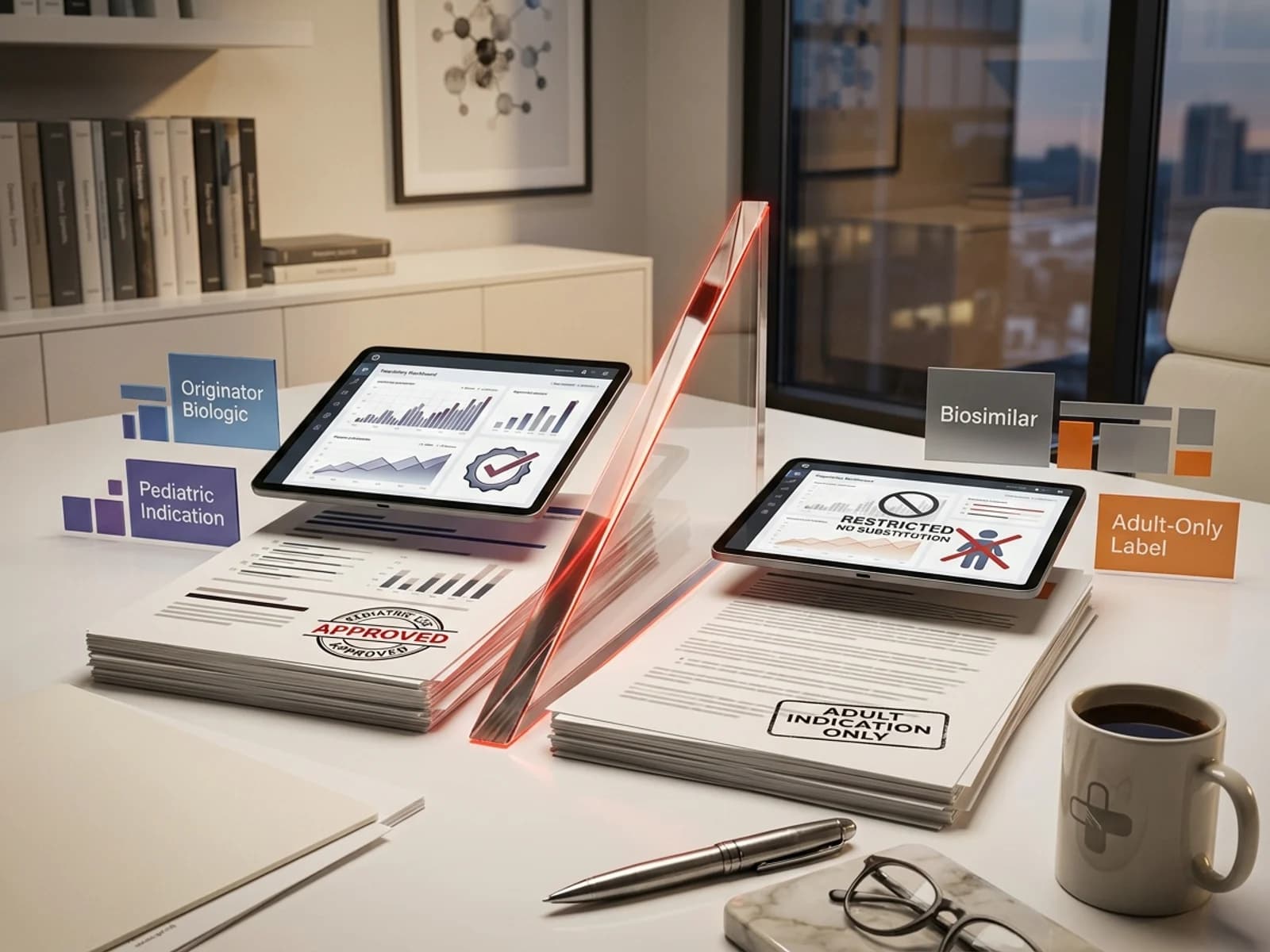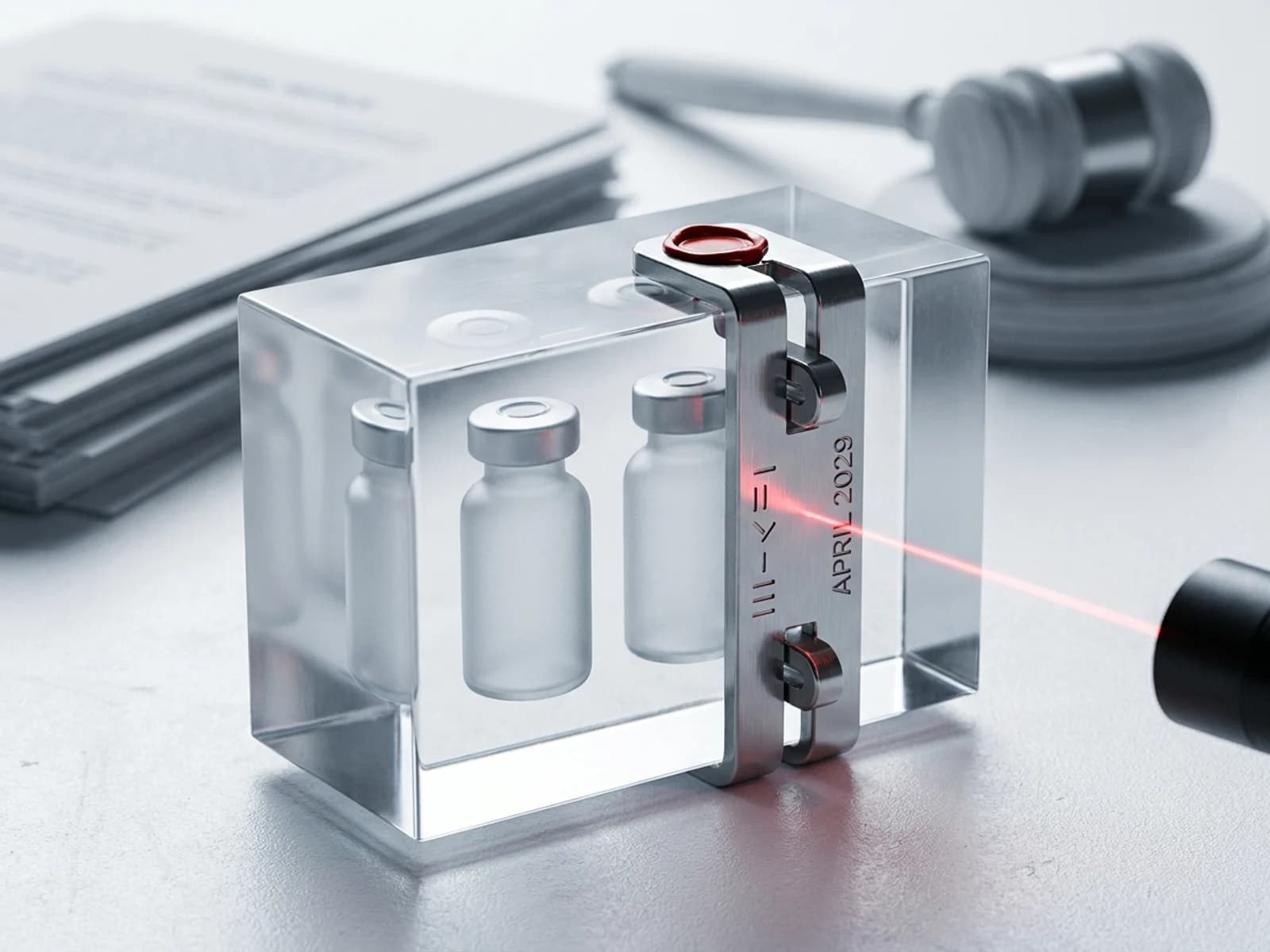
The market for etanercept (Enbrel), one of the earliest and highest-selling tumor necrosis factor (TNF) inhibitors approved in the United States, represents a unique anomaly in biopharma market access. While the FDA approved the first etanercept biosimilar, Erelzi, in August 2016, and a second, Eticovo, in April 2019, neither product is available to U.S. patients. Due to a series of high-stakes patent litigations and subsequent permanent injunctions, these biosimilars are blocked from commercial launch until the expiration of Amgen’s core patents in April 2029.
This article compares the two FDA-approved etanercept biosimilars, details the litigation history that locked the market, and outlines the commercial access implications for payer-policy, health-system, and manufacturer launch teams as they prepare for the 2029 entry.
The etanercept biosimilar registry
| Biosimilar (proprietary name) | Applicant | FDA BLA Type | FDA Approval Date | Reference Product | Expected U.S. Entry |
|---|---|---|---|---|---|
| Erelzi (etanercept-szzs) | Sandoz | 351(k) Biosimilar | August 30, 2016 | Enbrel | April 2029 |
| Eticovo (etanercept-ykro) | Samsung Bioepis | 351(k) Biosimilar | April 25, 2019 | Enbrel | April 2029 |
Data source: FDA Purple Book database; analysis by PharmaDossier.
Erelzi was approved under the 351(k) biosimilar pathway based on analytical, preclinical, and clinical data demonstrating biosimilarity to Enbrel, with no clinically meaningful differences. Eticovo followed in 2019, supported by a Phase 3 study in rheumatoid arthritis showing equivalent efficacy and comparable safety. Samsung Bioepis also sought interchangeable designation for Eticovo, which was granted for specific presentations, though its commercial impact remains delayed alongside the launch.
The legal fortress: how Amgen locked the market
The delay of etanercept biosimilars is the result of a long-standing patent dispute between Amgen—which holds the Enbrel patent estate it acquired from Hoffmann-La Roche in 2004—and biosimilar manufacturers.
Sandoz vs. Amgen (The Erelzi Injunction)
Immediately following Erelzi's approval in 2016, Amgen filed a patent infringement lawsuit in the U.S. District Court for the District of New Jersey. Amgen asserted several patents, most notably U.S. Patent No. 8,063,182 (the etanercept fusion protein, expiring November 22, 2028) and U.S. Patent No. 8,163,522 (a method of manufacturing etanercept, expiring April 24, 2029). Both originated from work licensed by Hoffmann-La Roche to Immunex before Amgen acquired the rights. Sandoz challenged the validity of these patents, arguing they were obvious and improperly extended Enbrel's monopoly.
In August 2019, the District Court ruled in favor of Amgen, upholding the validity of the patents. The Federal Circuit affirmed this decision in July 2020, and in May 2021, the U.S. Supreme Court denied Sandoz’s petition for review. This final legal hurdle solidified a permanent injunction preventing Sandoz from launching Erelzi in the United States until the later-expiring patent (the '522 patent) falls in April 2029.
Samsung Bioepis vs. Amgen (The Eticovo Injunction)
Samsung Bioepis faced similar litigation. Following Eticovo’s approval in 2019, Amgen sought and obtained a permanent injunction under similar terms. In November 2021, a federal court finalized the agreement, preventing the commercialization of Eticovo in the U.S. until the patent estate expires in April 2029.
Recent Antitrust Challenges (2025–2026)
As the patent cliff approached, Sandoz attempted to bypass the injunction by filing antitrust litigation in 2025, alleging that Amgen engaged in unlawful monopolization through "rebate traps" (discounting Enbrel only if payers excluded biosimilars) and a "patent thicket" strategy. However, federal courts have dismissed these challenges, holding that enforcing validly granted patents does not constitute an antitrust violation.
Payer and formulary strategy: the 2029 transition
The delay of etanercept biosimilars has preserved Enbrel’s multi-billion dollar commercial position for over a decade post-biosimilar approval. For commercial payers and pharmacy benefit managers (PBMs), the etanercept category is managed under tight specialty drug controls:
The Preferred Brand Strategy: Payers have capitalized on Amgen's rebate structures, maintaining Enbrel as a preferred brand on commercial formularies. Because no lower-cost biosimilar exists on the market to challenge Enbrel, payers have had no leverage to implement biosimilar-first step therapy, unlike the adalimumab (Humira) or infliximab (Remicade) categories.
IRA Negotiation and Brand Pricing: Enbrel was one of the first 10 Medicare Part D drugs selected for Inflation Reduction Act price negotiation. Its negotiated Maximum Fair Price of roughly $2,355 per 30-day supply took effect January 1, 2026—about 67% below the 2023 list price of $7,106. That discount reshapes Medicare economics but does not by itself introduce biosimilar competition: with no marketed etanercept biosimilar, commercial-payer net costs remain anchored to brand pricing rather than to a biosimilar floor.
The 2029 Launch Roadmap: Market-access teams are already structuring the 2029 formulary roadmaps. Unlike the Humira biosimilar launch in 2023, which saw a rapid introduction of nearly ten biosimilars simultaneously, the etanercept market will launch with at least two well-established, FDA-approved biosimilars (Erelzi and Eticovo) that have already been marketed internationally for years.
Operational readiness: what to monitor next
Biopharma operators and health-system pharmacy directors should monitor several key milestones leading up to 2029:
Label Updates and Subgroup Alignments: Sandoz and Samsung Bioepis must submit labeling supplements to align their biosimilar prescribing information with any recent updates to the reference Enbrel label, including safety warnings or new indications approved since their original clearances.
State-Level Substitution Policies: Pharmacy directors must audit state-specific laws regarding biosimilar and interchangeable substitution. Because interchangeability rules vary by state, whether Eticovo or Erelzi can be automatically substituted at the retail pharmacy counter without a physician's intervention will depend on state registry definitions.
Manufacturing and Supply Continuity: Launching a biologic after a 10+ year delay requires significant technical transfer and supply-chain verification. Sandoz and Samsung Bioepis must validate their manufacturing sites and update their DMF (Drug Master File) letters of authorization to ensure sufficient commercial volume is available for the U.S. market in April 2029.
Sources
US FDA, FDA Purple Book database of licensed biological products, etanercept biosimilarity and interchangeability records. https://purplebooksearch.fda.gov/
US Patent and Trademark Office, U.S. Patent No. 8,063,182 (etanercept fusion protein, expiring November 22, 2028) and U.S. Patent No. 8,163,522 (etanercept manufacturing method, expiring April 24, 2029). https://patents.google.com/patent/US8063182B2/en
CMS, Medicare Drug Price Negotiation Program: Enbrel (etanercept) Maximum Fair Price effective January 1, 2026 (one of the first 10 negotiated Part D drugs; ~67% below the 2023 list price). https://www.cms.gov/inflation-reduction-act-and-medicare/drug-price-negotiation
U.S. Court of Appeals for the Federal Circuit, Amgen Inc. v. Sandoz Inc., No. 2020-1033 (July 1, 2020) (affirming validity of Enbrel patents). https://cafc.uscourts.gov/opinions-orders/
Supreme Court of the United States, Sandoz Inc. v. Amgen Inc., No. 20-1112, certiorari denied May 17, 2021. https://www.supremecourt.gov/search.aspx?filename=/docket/docketfiles/html/public/20-1112.html
Samsung Bioepis, "FDA Approves Samsung Bioepis' Eticovo (Etanercept-ykro)," April 26, 2019. https://www.samsungbioepis.com/en/newsroom/newsroomView.do?idx=108
Sandoz, "Sandoz receives FDA approval for biosimilar Erelzi (etanercept-szzs)," August 30, 2016. https://www.sandoz.com/news/media-releases/