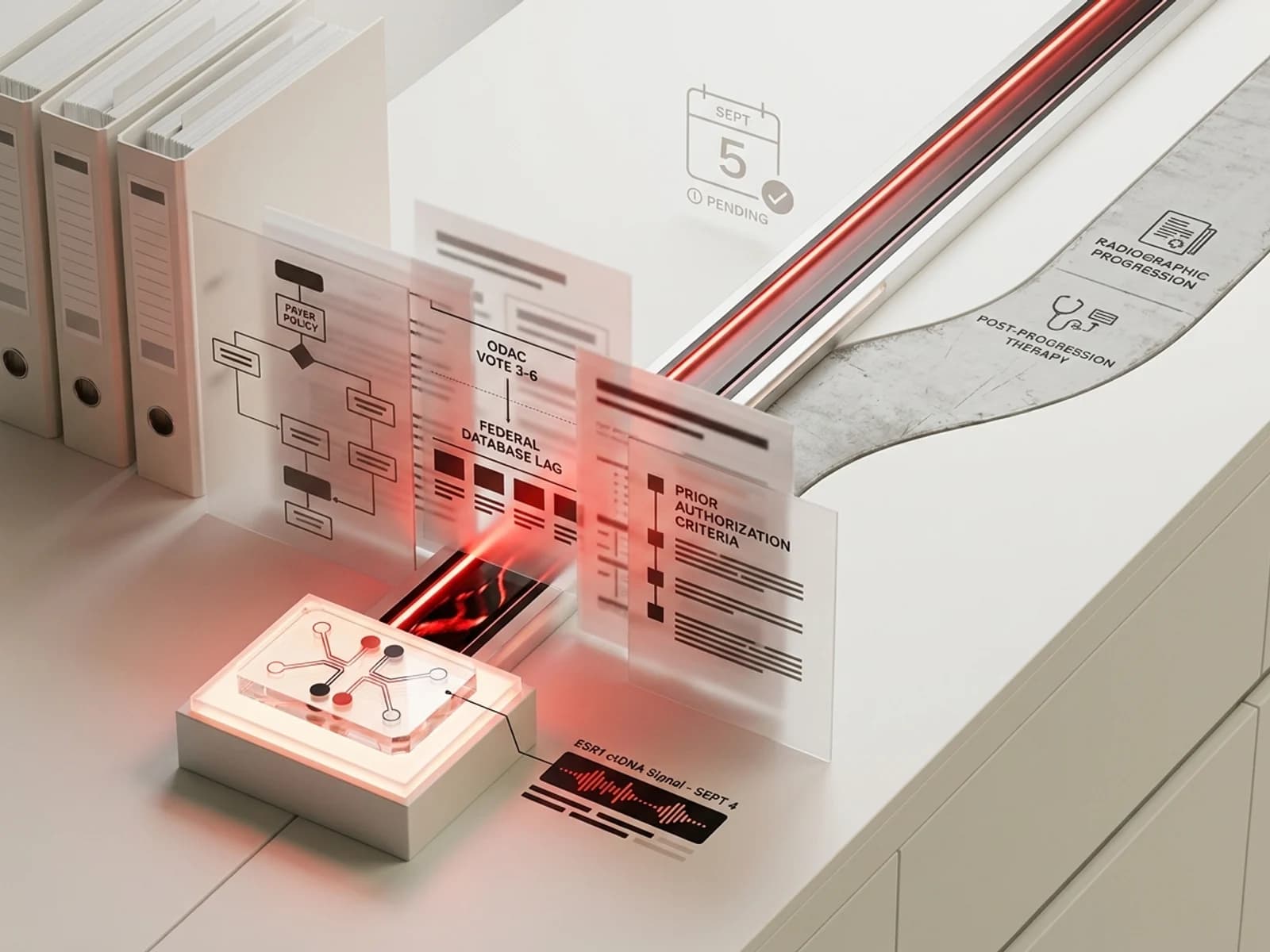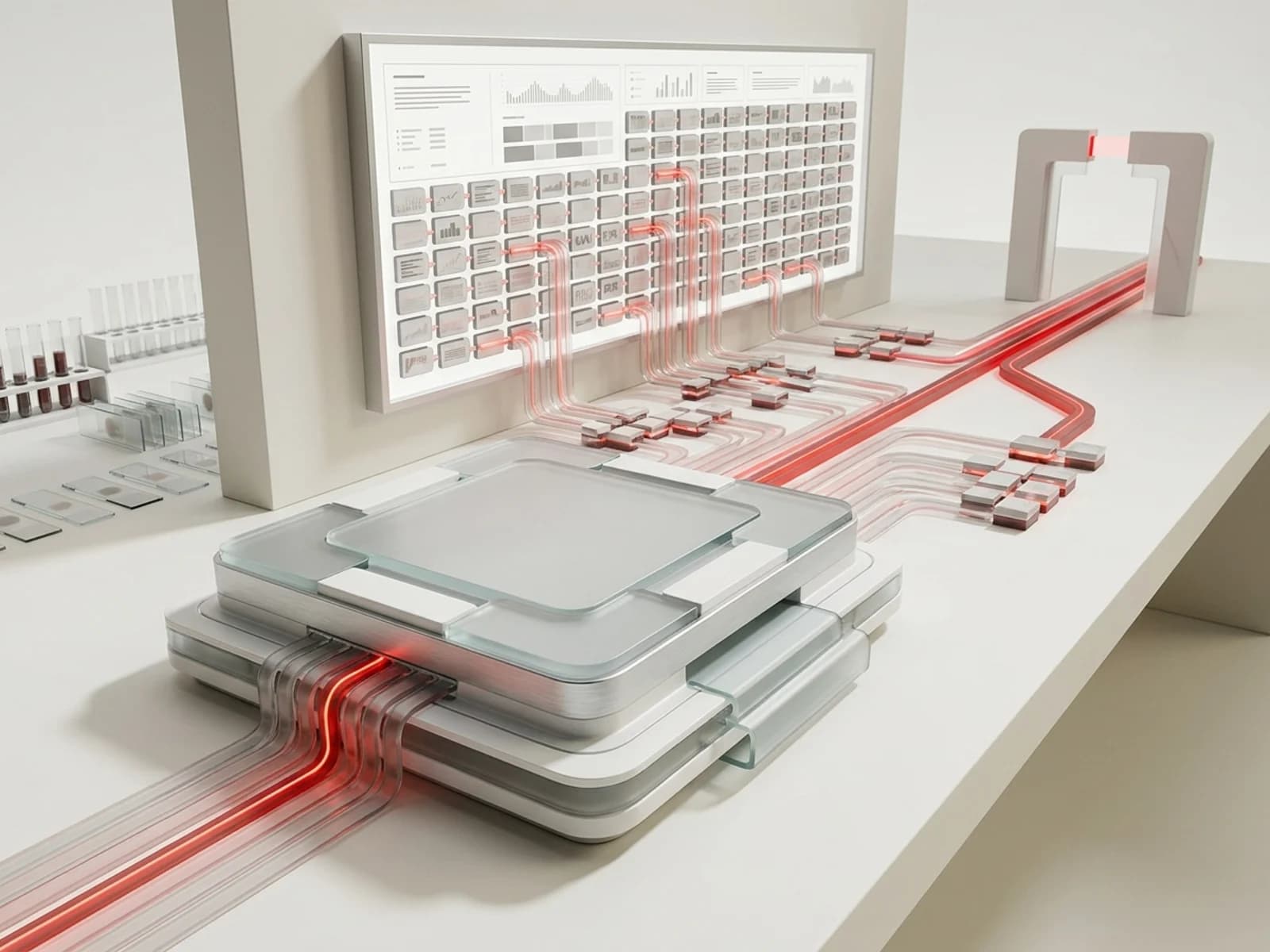
The regulatory gate for precision oncology is not a scattered collection of single-gene tests, but a concentrated ecosystem of premarket approval (PMA) diagnostic platforms. As biopharma pipelines tilt heavily toward biomarker-selected targeted therapies, antibody-drug conjugates (ADCs), and cell therapies, the companion diagnostic (CDx) has evolved from an ancillary laboratory tool into a mandatory co-developed drug access requirement.
Understanding the structural mechanics of the FDA companion diagnostic landscape—how device approvals map to drug indications, how platform PMAs expand through supplements, which manufacturers control the installed base, and how regulatory down-classification will alter competitive dynamics—is essential for IVD regulatory affairs leads, oncology market-access directors, and life science strategy teams.
Direct Answer: The CDx Device vs. Association Landscape
As of July 2026, the FDA list of authorized companion diagnostic devices (cross-referenced with the Memorial Sloan Kettering OncoKB CDx registry mirror) encompasses 43 distinct in vitro diagnostic (IVD) devices supporting 198 biomarker-and-cancer-type-specific drug associations across 71 therapeutic drugs, 42 unique genes/biomarkers, and 25 distinct cancer indications.
The fundamental structural reality of this market is the wide gap between device count (43) and association count (198). Rather than seeking a new original PMA for every single drug approval, IVD manufacturers build broad-platform diagnostic devices that expand iteratively via PMA supplements. A tiny cadre of multi-gene next-generation sequencing (NGS) panels and high-throughput immunohistochemistry (IHC) stainers carries the vast majority of precision oncology indications.
| Landscape Metric | FDA / OncoKB Authorized Baseline (2026) |
|---|---|
| Distinct Authorized CDx Devices | 43 devices |
| Drug-Biomarker-Cancer Associations | 198 associations |
| Unique Targeted Drugs / Biologics Gated | 71 drugs |
| Unique Biomarkers / Genes Tested | 42 genes/biomarkers |
| Cancer Indications Covered | 25 tumor types |
| Top PMA Platform Supplement Count | 59 (FoundationOne CDx, P170019) |
| Dominant Technology Modalities | NGS tissue/liquid, IHC, real-time PCR, ISH |
This architecture creates a steep barrier to entry. Drug developers pairing a targeted therapy with a novel companion diagnostic face a strategic choice: co-develop on an established, widely distributed platform via a PMA supplement, or risk co-developing on a novel platform that requires an original Class III PMA approval and an unproven lab footprint.
FDA CDx Landscape: 43 Devices Gating 198 Drug Associations
Total CDx Associations: 198
| Top Platform PMAs (Supplements) | Single-Analyte / Niche |
|---|---|
| - FoundationOne CDx (59) | - Single PCR assays |
| - PATHWAY HER2 IHC (56) | - FISH probes |
| - PD-L1 22C3 pharmDx (33) | - Single-gene kits |
| - Guardant360 CDx (26) |
How Many FDA Companion Diagnostics Are There, and What Is the Device-vs-Association Distinction?
To evaluate companion diagnostic throughput, industry analysts must distinguish between an authorized CDx device (the cleared or approved IVD instrument, reagent kit, or software pipeline holding an FDA PMA or 510(k) number) and a drug-biomarker association (the specific regulatory claim linking a diagnostic result to a specific drug's safe and effective use in a specific tumor type).
For example, a single diagnostic device like Roche/Ventana's PATHWAY anti-HER-2/neu (4B5) IHC assay holds one original PMA (P990081), but it supports separate drug associations across breast cancer and gastric cancer for trastuzumab (Herceptin), fam-trastuzumab deruxtecan-nxki (Enhertu), and tucatinib (Tukysa). Similarly, Foundation Medicine’s FoundationOne CDx (P170019) holds dozens of specific drug associations spanning EGFR, ALK, ROS1, BRAF, BRCA1/2, NTRK1/2/3, RET, MET, KRAS, and microsatellite instability (MSI-H) across solid tumors.
This distinction explains why the FDA CDx registry lists 198 associations but only 43 underlying devices. The association count grows dynamically with every new drug approval or label expansion that incorporates a biomarker restriction, whereas the device count grows far more slowly due to the high regulatory capital required to clear an original Class III PMA.
Developers navigating diagnostic co-development should evaluate the structural differences between regulatory change control under FDA PMA supplements and European IVDR requirements, as detailed in our analysis of FDA PMA supplement vs. EU IVDR CDx change control.
Which Companies and PMA Platforms Dominate the CDx List?
Commercial concentration in the companion diagnostic space is exceptionally high. Data presented at ISPOR examining a 25-year cohort of FDA companion diagnostic approvals highlights that just four diagnostics conglomerates account for nearly two-thirds of all authorized CDx devices:
Roche / Ventana Medical Systems: ~33% of authorized devices (n=21), led by tissue-based IHC stainers (PATHWAY HER2, VENTANA PD-L1 SP142/SP263, VENTANA ALK D5F3).
Agilent Technologies / Dako: ~13% of authorized devices (n=8), anchored by the IHC pharmDx franchise (PD-L1 IHC 22C3 pharmDx, HER2 pharmDx).
QIAGEN: ~11% of authorized devices (n=7), specializing in real-time PCR panels (therascreen KRAS, EGFR, and PIK3CA RGQ PCR Kits).
Abbott Laboratories / Abbott Molecular: ~8% of authorized devices (n=5), dominating fluorescence in situ hybridization (FISH) probes (Vysis ALK Break Apart FISH, Vysis HER-2 FISH).
Together, the top four manufacturers account for ~64% of all authorized CDx devices, and the top seven manufacturers control nearly 78% of the landscape.
Authoritative CDx Device Manufacturer Share (ISPOR Cohort)
┌─────────────────────────────────────────────────────────┐
│ Roche / Ventana    ██████████████████ 33%                │
│ Agilent / Dako     ███████ 13%                          │
│ QIAGEN             ██████ 11%                           │
│ Abbott Molecular   ████ 8%                              │
│ Others (FMI, etc.) ████████████ 35%                       │
└─────────────────────────────────────────────────────────┘
An examination of the FDA Premarket Approval (PMA) registry reveals the underlying regulatory volume supporting this market. Across the entire FDA medical device database, there are 1,471 original PMAs versus 55,294 approved PMA supplements—a ratio of 37.6 supplements for every 1 original PMA.
Within the IVD advisory committee classification subset (spanning Microbiology, Pathology, Clinical Chemistry, Immunology, Medical Genetics, Hematology, and Clinical Toxicology), the FDA registry records 325 original PMAs and 6,123 supplements (6,448 total PMA records). Top original IVD PMA applicants include Abbott (24 original PMAs), DiaSorin (19), Roche Molecular Systems (15), Ventana Medical Systems (12), Roche Diagnostics (12), Abbott Molecular (11), Siemens Healthcare (10), and Hologic (10).
| Original PMA Applicant (IVD Subset) | Original PMAs | Advisory Committee Focus | Primary Modalities |
|---|---|---|---|
| Abbott Laboratories | 24 | Clinical Chemistry / Medical Genetics | Immunoassay, FISH, PCR |
| DiaSorin | 19 | Immunology / Microbiology | Automated Immunoassays |
| Roche Molecular Systems | 15 | Medical Genetics / Microbiology | Real-Time PCR, Molecular Panels |
| Ventana Medical Systems (Roche) | 12 | Pathology | IHC, ISH Automated Stainers |
| Roche Diagnostics | 12 | Clinical Chemistry / Immunology | Core Lab IVD Systems |
| Abbott Molecular | 11 | Medical Genetics | FISH, Molecular Assays |
| Siemens Healthcare Diagnostics | 10 | Clinical Chemistry / Hematology | Clinical Analyzers, Immunoassays |
| Hologic | 10 | Microbiology / Pathology | Cervical / Molecular Diagnostics |
This applicant concentration reflects the enormous capital expenditure required to establish automated instrument platforms in clinical pathology labs. Once an automated stainer (like Roche Ventana BenchMark) or an NGS analyzer (like Illumina NovaSeq/NextSeq in FMI labs) is installed in thousands of pathology centers, biopharma sponsors naturally prefer co-developing drugs on those existing footprints.
How Are CDx Platforms Expanded, and Why Do a Few PMAs Carry Precision Oncology?
The dominant strategy for CDx lifecycle management is PMA supplement expansion. When an IVD company secures an original PMA for a broad platform device, subsequent drug-biomarker claims are added via 180-day PMA supplements (or panel expansion supplements) rather than brand-new Class III filings.
Analysis of FDA PMA supplement tracking numbers illustrates how a small group of platform PMAs has expanded over time to carry the load of modern precision oncology:
| Platform Device | PMA Number | Original Applicant / Owner | Approval Date | Approved Supplements | Primary Biomarkers & Indication Scope |
|---|---|---|---|---|---|
| FoundationOne CDx (F1CDx) | P170019 | Foundation Medicine | 11/30/2017 | 59 | Comprehensive solid tumor NGS panel (324 genes, MSI, TMB, loss of heterozygosity); gates 30+ drugs (EGFR, ALK, BRAF, BRCA, NTRK, RET, MET, ROS1). |
| PATHWAY anti-HER-2/neu (4B5) | P990081 | Ventana (Roche) | 11/28/2000 | 56 | Semi-quantitative IHC assay for HER2 protein expression in breast and gastric cancer; gates Herceptin, Enhertu, Tukysa. |
| PD-L1 IHC 22C3 pharmDx | P150013 | Agilent Technologies | 10/02/2015 | 33 | Semi-quantitative IHC assay for PD-L1 protein expression; gates Keytruda (pembrolizumab) across NSCLC, head & neck, esophageal, triple-negative breast cancer. |
| Guardant360 CDx | P200010 | Guardant Health | 08/07/2020 | 26 | Liquid biopsy NGS panel (55 genes) using cell-free DNA (cfDNA); gates Tagrisso (EGFR), Rybrevant (EGFR exon 20), Lumakras (KRAS G12C). |
| VENTANA HER2 Dual ISH DNA Probe | P190031 | Ventana (Roche) | 04/10/2020 | 13 | Dual-color chromogenic ISH assay for HER2 gene amplification in breast/gastric tissue. |
| Myriad myChoice CDx | P190014 | Myriad Genetic Laboratories | 10/23/2019 | 11 | NGS assay for Homologous Recombination Deficiency (HRD) status (BRCA1/2 + genomic instability score); gates Lynparza, Zejula. |
| Guardant360 Liquid CDx | P250027 | Guardant Health | 05/19/2026 | 1 | Next-generation plasma-based multi-gene liquid biopsy CDx panel (approved May 2026). |
PMA Supplement Accumulation by CDx Platform (2026)
FoundationOne CDx (P170019)  │ ██████████████████████████████ 59
PATHWAY HER2 IHC (P990081)    │ ████████████████████████████ 56
PD-L1 IHC 22C3 (P150013)      │ ███████████████ 33
Guardant360 CDx (P200010)     │ █████████████ 26
VENTANA HER2 Dual ISH         │ ███████ 13
Myriad myChoice CDx           │ ██████ 11
As shown in the data, FoundationOne CDx (P170019) has accumulated 59 approved PMA supplements since its late-2017 clearance. Each supplement typically represents a major label expansion—such as adding capmatinib (Tabrecta) for MET exon 14 skipping in 2020, infigratinib (Truseltiq) for FGFR2 fusions in 2021, elacestrant (Orserdu) for ESR1 mutations in 2023, or inavolisib (Itovebi) for PIK3CA mutations in May 2026.
This platform model provides immense efficiency to biopharma sponsors: co-developing on F1CDx or Guardant360 allows a drug developer to leverage pre-validated analytical performance, established clinical trial assay protocols, and existing regulatory Master Files (MAF).
Co-Development Operational Workflow: Step-by-Step Drug-CDx Alignment
Biopharma sponsors and diagnostic partners must follow a rigid co-development workflow to align drug and diagnostic regulatory approval timelines:
Drug-CDx Co-Development Regulatory Workflow
┌───────────────────────────────────────────────────────────┐
│ Phase 1: Biomarker Discovery & Clinical Trial Assay (CTA) │
│  - Select diagnostic technology platform (IHC / NGS / PCR)│
│  - Validate CTA analytical performance under CLIA         │
└─────────────────────────────┬─────────────────────────────┘
                              ▼
┌───────────────────────────────────────────────────────────┐
│ Phase 2: IDE / Modular PMA Pre-Submission (FDA CDRH)      │
│  - Submit Investigational Device Exemption (IDE) if risk  │
│  - File Modular PMA Module 1 (Analytical Validation)      │
└─────────────────────────────┬─────────────────────────────┘
                              ▼
┌───────────────────────────────────────────────────────────┐
│ Phase 3: Pivotal Trial Execution & Clinical Validation    │
│  - Enroll biomarker-selected patients using validated CTA │
│  - Demonstrate clinical utility of CDx in drug Phase 3    │
└─────────────────────────────┬─────────────────────────────┘
                              ▼
┌───────────────────────────────────────────────────────────┐
│ Phase 4: Synchronized NDA/BLA & PMA/Supplement Review     │
│  - File Drug NDA/BLA (CDER/CBER) & CDx PMA/Supplement     │
│  - Co-conduct pre-approval inspections (PAI) & joint approval│
└───────────────────────────────────────────────────────────┘
Biomarker Selection & Clinical Trial Assay (CTA) Validation: During Phase 1/2 clinical trials, the sponsor selects an initial CTA to screen patients. The CTA must undergo analytical validation (establishing sensitivity, specificity, limit of detection, and inter-run precision) before patient enrichment begins.
Investigational Device Exemption (IDE) Submission: If the diagnostic assay poses a significant risk to clinical trial participants (e.g., if a false negative excludes a patient from standard-of-care therapy), the diagnostic partner must submit an IDE application to FDA CDRH prior to initiating pivotal Phase 3 trials.
Modular PMA Filing: Diagnostic partners typically utilize the FDA Modular PMA process. Module 1 contains analytical validation data; Module 2 contains manufacturing control data; and Module 3 (submitted concurrently with the drug sponsor’s NDA/BLA) contains clinical validation data derived from the pivotal trial.
Synchronized Approval: FDA regulations require that the companion diagnostic PMA approval and the therapeutic NDA/BLA approval occur simultaneously to ensure that patients do not receive a biomarker-gated drug without access to an authorized diagnostic test.
How Is the CDx Landscape Shifting from Single-Analyte Tests to NGS and Liquid Biopsy?
The diagnostic technology powering precision oncology is undergoing a fundamental generational shift, moving through three distinct phases:
Phase 1: Single-Analyte IHC, PCR, and ISH (2000–2015)
Early companion diagnostics were single-biomarker, single-drug assays. Examples include HER2 IHC stainers (PATHWAY), EGFR single-gene PCR kits (therascreen), and ALK FISH break-apart probes (Vysis). While analytically robust, this paradigm required serial testing: if a lung cancer biopsy yielded insufficient tissue, running three sequential single-gene tests frequently exhausted the sample before an actionable mutation was identified.
Phase 2: Tissue-Based Pan-Cancer NGS Panels (2017–Present)
The approval of FoundationOne CDx (P170019) in 2017 established multi-gene comprehensive genomic profiling (CGP) as a Class III PMA device. A single formalin-fixed paraffin-embedded (FFPE) tissue slice can simultaneously evaluate hundreds of genes, tumor mutational burden (TMB), microsatellite instability (MSI), and loss of heterozygosity (LOH), matching the patient against dozens of potential targeted therapies in parallel.
Phase 3: Plasma-Based Liquid Biopsy and Minimal Residual Disease (2020–Present)
For many patients with advanced non-small cell lung cancer (NSCLC) or metastatic breast cancer, tissue biopsies are invasive, risky, or unavailable. Plasma-based liquid biopsy platforms utilize circulating tumor DNA (ctDNA) extracted from a routine blood draw.
Following the 2020 clearance of Guardant360 CDx (P200010) and FoundationOne Liquid CDx (P190032), the FDA approved Guardant360 Liquid CDx (P250027) on May 19, 2026 as a major new liquid biopsy platform PMA. Liquid biopsy platforms allow rapid turnaround times (often 5 to 7 days versus 14 to 21 days for tissue NGS), enabling immediate treatment decisions in fast-progressing metastatic disease.
Diagnostic Generational Shift in Precision Oncology
┌───────────────────────┐    ┌───────────────────────┐    ┌───────────────────────┐
│ Single-Analyte Assays │ ──►│ Tissue NGS CGP        │ ──►│ Plasma Liquid Biopsy  │
│ (IHC, FISH, RT-PCR)   │    │ (FoundationOne CDx)   │    │ (Guardant360, ctDNA)  │
│ Serial tissue testing │    │ Parallel 300+ genes   │    │ Non-invasive blood draw│
└───────────────────────┘    └───────────────────────┘    └───────────────────────┘
This technological transition directly impacts market access. While single-analyte IHC tests are inexpensive to run at local hospital pathology labs, comprehensive NGS panels incur significant sequencing costs and bioinformatics overhead, triggering payer scrutiny over broad molecular profiling versus narrow target testing.
What Is the FDA Class III-to-II Down-Classification Proposal and What Changes for Developers?
The regulatory barrier for companion diagnostics may be on the verge of a structural reduction. On November 25, 2025, the FDA issued a landmark proposed order to down-classify certain oncology companion diagnostics—specifically nucleic acid–based test systems, which encompass next-generation sequencing (NGS), polymerase chain reaction (PCR), and nucleic acid amplification test (NAAT) assays—from Class III (Premarket Approval / PMA) to Class II (510(k) clearance) with special controls.
The public comment period for this proposed rule closed in January 2026, and the industry is awaiting the publication of the FDA's final order.
Proposed FDA Regulatory Inflection for Oncology CDx
┌───────────────────────────────────────┐      ┌───────────────────────────────────────┐
│ Current Status: Class III PMA         │      │ Proposed Order: Class II 510(k)       │
├───────────────────────────────────────┤ ───► ├───────────────────────────────────────┤
│ • Original PMA / 180-Day Supplement   │      │ • 510(k) Premarket Notification       │
│ • 180-day review clock + User Fees    │      │ • Substantial Equivalence to Predicate│
│ • Mandated Pre-Approval Inspections   │      │ • 90-day review clock + lower fees    │
│ • High regulatory maintenance cost    │      │ • Enforced via Special Controls       │
└───────────────────────────────────────┘      └───────────────────────────────────────┘
Strategic Implications of Down-Classification:
Lower Development Cost and Faster Time-to-Market: Replacing a Class III PMA (which carries a user fee exceeding $500,000 for original PMAs and requires extensive clinical validity dossiers) with a Class II 510(k) (user fee ~$20,000 to $30,000 for small businesses) dramatically lowers financial hurdles for IVD developers.
Predicate-Based Clearing: Under Class II 510(k), developers can claim "substantial equivalence" to an existing predicate device rather than building a standalone PMA safety and effectiveness profile from scratch.
Special Controls as the New Baseline: Down-classification does not mean deregulation. The FDA will enforce strict "Special Controls" guidelines governing analytical sensitivity, specificity, limit of detection (LoD), cross-reactivity, and bioinformatic pipeline validation.
Market De-concentration: By lowering regulatory barriers, the Class III-to-II down-classification could break the commercial stranglehold of top conglomerates (Roche, Agilent, QIAGEN, Abbott, FMI) and encourage specialized diagnostic startups to bring novel CDx kits directly to regional hospital laboratories.
Overall device clearance and approval throughput trends across all medical device categories are tracked in our analysis of FDA 510(k) and PMA throughput by the numbers.
How Do Payers Cover Companion Diagnostics and Where Is the Access Friction?
Even after securing FDA PMA approval and establishing a clear drug-biomarker association, companion diagnostics encounter severe commercial market-access hurdles. Payer coverage for CDx is governed by a complex intersection of medical necessity policies, coding structures, and site-of-care billing rules.
1. Payer Medical Coverage Policies
Commercial health plans (such as UnitedHealthcare Medical Policy 2026T0653G) explicitly maintain coverage lists for FDA-cleared or approved companion diagnostic tests. Under these policies, testing is deemed medically necessary only when the patient meets the specific FDA-approved drug label criteria (e.g., testing HER2 expression in invasive breast cancer prior to Enhertu initiation).
However, coverage policies often restrict broad pan-cancer NGS panels in early-stage disease, reimbursing panel profiling only for stage III/IV metastatic cancers where multiple targeted options exist.
2. The Lab-Developed Test (LDT) Coverage Gap
Many major academic medical centers and commercial reference labs run internally validated Laboratory Developed Tests (LDTs) using local NGS platforms rather than buying official FDA-approved CDx kits.
This creates a serious payer access friction: when a oncologist submits prior authorization for a biomarker-gated targeted therapy using a local LDT result instead of an FDA-authorized CDx result, commercial payers frequently issue technical denials. Payers argue that without the exact FDA-approved companion diagnostic specified on the drug label, the biomarker status has not been legally established.
This dynamic leads to administrative friction, detailed in our study of biomarker documentation mismatches in oncology prior authorizations.
3. Professional (PC) vs. Technical Component (TC) Billing Friction
In hospital outpatient departments (HOPDs) and community oncology clinics, billing for diagnostic tests is split into:
Technical Component (TC): The cost of tissue preparation, staining reagents, sequencing kits, and instrument run time (CPT codes 88360/88361 for IHC, 81445/81455 for NGS).
Professional Component (PC): The pathologist's interpretation and reporting fee (CPT modifier -26).
Under CMS Hospital Outpatient Prospective Payment System (OPPS) packaging rules, diagnostic tests performed during an outpatient visit are often bundled into the hospital ambulatory payment classification (APC) payment rather than reimbursed separately. High-cost NGS CGP panels (which can cost $3,000 to $5,000) face severe hospital margin compression when bundled, leading hospitals to outsource NGS testing to third-party reference labs—which in turn slows down turnaround times.
When prior authorization denials stall patient access to biomarker-gated therapies, medical affairs and access teams can leverage the workflow strategies in our guide to overcoming companion diagnostic prior authorization denials.
CDx Market Access & Billing Bottlenecks
┌───────────────────────────────────────────────────────────┐
│ FDA Approval & Drug Label Gate                            │
└─────────────────────────────┬─────────────────────────────┘
                              ▼
┌───────────────────────────────────────────────────────────┐
│ Payer Coverage Policy (UHC 2026T0653G)                     │
│  - Medically necessary ONLY if matching label indication │
└─────────────────────────────┬─────────────────────────────┘
                              ▼
┌─────────────────────────────┴─────────────────────────────┐
│ Diagnostic Execution Channel                              │
├──────────────────────────────┬────────────────────────────┤
│ Official FDA CDx (F1CDx)     │ Local Hospital LDT Assay   │
│  • High kit cost             │  • Non-FDA-approved kit    │
│  • Outpatient OPPS packaging │  • Payer technical denial  │
│  • 10-14 day turnaround      │  • Biomarker mismatch risk │
└──────────────────────────────┴────────────────────────────┘
Furthermore, when oncologists seek access to targeted drugs based on biomarker findings that fall outside FDA-approved label indications (such as off-label driver mutations supported by NCCN guidelines), access teams face compendia gaps, as analyzed in our review of compendia listing gaps in oncology access.
Frequently Asked Questions (FAQ)
What is the difference between a companion diagnostic (CDx) and a lab-developed test (LDT)?
A companion diagnostic (CDx) is an in vitro diagnostic device that has received explicit FDA clearance or approval (typically via Class III PMA) to provide information that is essential for the safe and effective use of a corresponding therapeutic product. Its clinical validity and utility are proven in prospective clinical trials co-developed with the drug.
A lab-developed test (LDT) is an IVD assay designed, manufactured, and used within a single CLIA-certified laboratory. While LDTs perform similar molecular testing, they traditionally bypass premarket FDA review, creating potential coverage and prior authorization friction when payers require an official FDA-approved CDx result.
How many supplements has FoundationOne CDx received and what does that mean for new drug-CDx pairings?
FoundationOne CDx (P170019, Foundation Medicine) has received 59 approved PMA supplements since its initial FDA clearance in November 2017.
This high supplement volume demonstrates that biopharma companies co-developing targeted therapies prefer adding new drug-biomarker claims to an established, broadly distributed NGS platform via a 180-day PMA supplement rather than developing a standalone Class III device. It allows new drugs to tap into an existing clinical lab testing footprint on day one of commercial approval.
Will the FDA down-classification make it easier to get a CDx cleared, and when is the final rule expected?
The FDA's proposed order to down-classify NGS, PCR, and NAAT oncology companion diagnostics from Class III (PMA) to Class II (510(k)) with Special Controls will significantly reduce regulatory burdens. Developers will be able to seek 510(k) clearance by demonstrating substantial equivalence to a predicate device, shortening review clocks from 180 days to 90 days and cutting FDA user fees by over 90%.
The public comment period closed in January 2026. A final regulatory order is expected from the FDA, which will reshape diagnostic competition by allowing specialized molecular diagnostic labs to bring Class II cleared CDx kits to market more rapidly.
Sources
U.S. Food and Drug Administration (FDA). List of Cleared or Approved Companion Diagnostic Devices (In Vitro and Imaging Tools). Reference Date: July 8, 2026. Available at: https://www.fda.gov/medical-devices/in-vitro-diagnostics/list-fda-authorized-companion-diagnostic-devices-in-vitro-and-imaging-tools
Memorial Sloan Kettering Cancer Center (OncoKB). FDA Cleared or Approved Companion Diagnostic Devices Mirror. Updated May 28, 2026. Available at: https://www.oncokb.org/companion-diagnostic-devices
ISPOR 2026 Annual Meeting. Evolution of FDA Companion Diagnostics: A 25-Year Retrospective on Platform Concentration and Regulatory Pathways. Research Poster Presentation, Philadelphia, PA. Available at: https://www.ispor.org/docs/default-source/cti-meeting-21463-documents/df6d766a-5204-48e9-b861-59e8fefb605e.pdf
MDx CRO Regulatory Intelligence. FDA Companion Diagnostics (CDx): Complete Regulatory Guide and Class III to II Down-Classification Analysis. Published 2026. Available at: https://mdxcro.com/fda-companion-diagnostics
UnitedHealthcare Commercial Medical Policy. FDA-Cleared or Approved Companion Diagnostic Testing. Policy Number: 2026T0653G, Effective January 1, 2026. Available at: https://www.uhcprovider.com/content/dam/provider/docs/public/policies/comm-medical-drug/fda-companion-diagnostic-testing.pdf