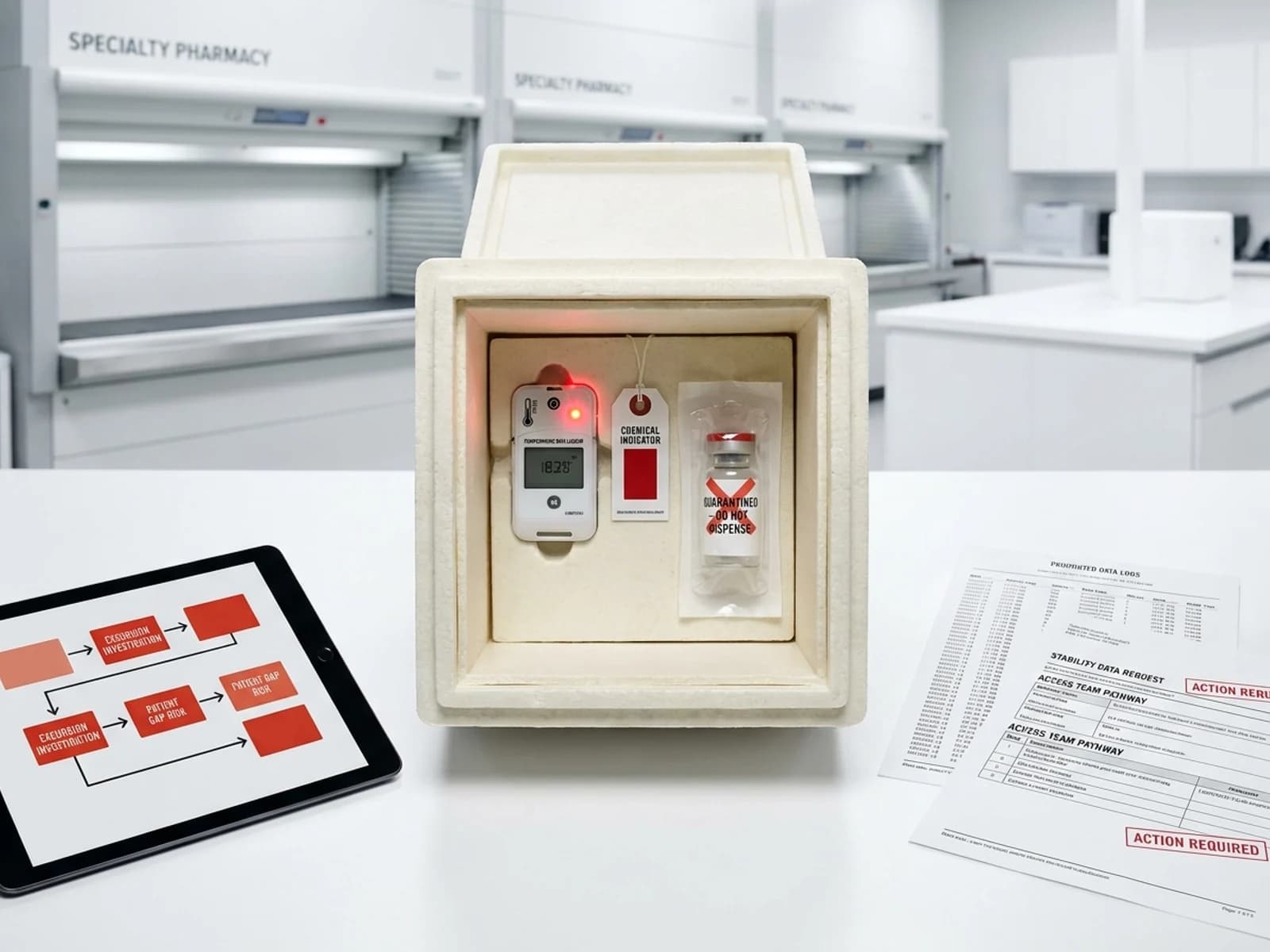
A temperature excursion at a specialty pharmacy — whether during receiving, storage, or shipment to a patient — can render a high-cost biologic unfit for use. The product must be quarantined, investigated against manufacturer stability data, and either returned to use or replaced. For the patient waiting for that dose, the excursion creates a therapy gap that may last days or weeks. For the manufacturer's access team, the excursion triggers a chain of operational questions: Was the drug in transit or on the shelf? Who bears the replacement cost? Does the patient-support program provide a replacement fill, or does the patient re-enter the PA queue?
This article is written for manufacturer hub teams, specialty pharmacy operations managers, reimbursement specialists, and market access professionals who need to understand the cold-chain excursion workflow and its impact on patient access.
How common are cold-chain excursions
The scale of the problem is significant. According to the American Society of Health-System Pharmacists (ASHP), more than 50 percent of health-system pharmacy leaders surveyed reported having to quarantine drug product related to a cold-chain issue, with over half of those events resulting in non-recoverable financial loss. A 2023 analysis found that 43 percent of the 292 new drugs approved between January 2018 and March 2023 required cold-chain storage, and 6 percent required storage at freezing temperatures or below.
Distribution errors in specialty pharmacy are eight times more likely than in conventional drug dispensing, and the cost of a single excursion can be substantial. A shipment of biologics valued at $50 million or more can be lost to an unmitigated temperature excursion. For a single high-cost specialty drug with a wholesale acquisition cost of $100,000 per fill, replacement costs can be two to three times the initial product expense when reverse logistics, investigation, and brand-impact remediation are included.
Cold-chain excursion detection
Excursions are identified through several mechanisms:
Automated monitoring systems: Continuous electronic temperature monitoring with 24-hour alerting via email, SMS, or phone call. These systems log temperature deviations in real time and can alert staff within minutes of an excursion event.
Shipping indicators: Single-use chemical indicators (such as WarmMark and FreezeSafe tags) that change color when temperature thresholds are breached during transit. Smart tags that change color above 8°C are commonly used for biologics.
Data loggers in shipments: Electronic temperature recorders included in cold-chain packaging that provide time-stamped temperature data for the entire transit duration.
Patient or staff reporting: Some excursions are identified at the point of receipt — either by pharmacy staff during the receiving check or by the patient upon home delivery.
The key data points for any excursion investigation are the magnitude of the temperature deviation, the duration of the excursion, and the product's established stability parameters.
Excursion investigation and disposition
Once an excursion is suspected, the pharmacy must:
Quarantine the product: The drug is physically separated from dispensable inventory and flagged in the inventory management system. It cannot be dispensed until the investigation is complete.
Collect excursion data: Gather temperature logs, indicator readings, and time-stamped data. Determine the minimum and maximum temperatures reached and the total duration of exposure.
Consult manufacturer stability data: Contact the drug's manufacturer (often through medical information or a designated quality contact) to obtain excursion guidance. Manufacturers maintain stability data that define acceptable time-out-of-refrigeration windows. These data are not always published in the full prescribing information and may require direct manufacturer consultation.
Apply mean kinetic temperature (MKT) analysis if appropriate: MKT is a single calculated temperature that simulates the degradation effects of varying temperatures over time. It is not a simple arithmetic mean and may be used to assess whether the cumulative thermal stress was within acceptable limits. Application of MKT varies across organizations, and ASHP has noted inconsistent interpretation of USP chapters related to temperature excursion assessment.
Determine disposition: The product is either returned to usable inventory (if the excursion was within acceptable limits) or destroyed (if the stability data show that potency or safety may be compromised).
Who bears the replacement cost
Replacement responsibility depends on where in the supply chain the excursion occurred:
| Excursion location | Typical responsible party | Key considerations |
|---|---|---|
| Manufacturer to wholesaler (inbound) | Manufacturer or carrier, per shipping agreement | Carrier liability insurance may cover transit excursions; freight terms (FOB origin vs FOB destination) determine risk transfer |
| Wholesaler warehouse | Wholesaler | Wholesaler's quality system and insurance cover storage excursions |
| Wholesaler to specialty pharmacy (transit) | Wholesaler or carrier, per distribution agreement | Temperature data from shipping packaging is critical evidence |
| Specialty pharmacy receiving or storage | Specialty pharmacy | Pharmacy's accreditation (URAC, ACHC) requires documented cold-chain SOPs |
| Specialty pharmacy to patient (last mile) | Specialty pharmacy or carrier | Patient delivery confirmation and cold-chain packaging validation required |
| Patient storage (post-delivery) | Typically patient responsibility | Patient education on storage requirements is a pharmacy accreditation standard |
The distribution agreement between the manufacturer and the specialty pharmacy typically specifies who bears the cost of product damaged during transit. For limited-distribution drugs, the manufacturer may have more leverage to negotiate favorable replacement terms. For open-distribution products, the pharmacy's standard purchasing terms apply.
NCQA Specialty Pharmacy Organization accreditation standards require the pharmacy to have a documented process for verifying cold-chain integrity upon receipt, continuous temperature monitoring of storage areas, and protocols in the event of a temperature excursion. These standards apply regardless of where the excursion originated — the pharmacy is responsible for product integrity once it accepts delivery.
Patient therapy gap: the access impact
When a specialty biologic is quarantined due to a cold-chain excursion, the patient's scheduled dose is delayed. The duration of the gap depends on several factors:
Investigation timeline: Excursion investigations can take 24–72 hours or longer if manufacturer consultation is required and the response is delayed.
Replacement product availability: For drugs in limited distribution, replacement inventory may need to be ordered from the manufacturer or a designated wholesaler. If the drug is on allocation or in shortage, replacement can take additional days.
PA and benefits re-adjudication: In some cases, the pharmacy must submit a new claim for the replacement fill. If the drug requires prior authorization, the replacement claim may be rejected by the payer if the PA has expired or if the days-supply edit flags the refill as too early. This creates a double delay: the excursion itself plus the PA re-submission.
Patient scheduling constraints: For patient self-injectables, the patient must be available to receive the new delivery within the cold-chain shipping window. Missed delivery windows can extend the gap by another shipping cycle.
For chronic-disease biologics (such as anti-TNF agents, IL-23 inhibitors, or anti-VEGF therapies), a delay of several days to weeks may not cause immediate clinical harm for most stable patients, but it can trigger disease flares in some, and it always creates anxiety and adherence risk. For oncology supportive-care drugs (such as pegfilgrastim, where timing relative to chemotherapy is critical), an excursion-related delay can miss the therapeutic window entirely.
Manufacturer access-team involvement
The manufacturer's access and patient-support teams become involved in cold-chain excursion events through several pathways:
Pathway 1: Pharmacy contacts the manufacturer for stability data
The most common interaction is the specialty pharmacy calling the manufacturer's medical information line to request excursion guidance for a specific lot. Medical information teams can provide stability data that may allow the product to be returned to use if the excursion was brief and the temperature deviation was modest. This is the fastest resolution — it avoids replacement entirely — but it depends on the manufacturer having and sharing relevant stability data quickly.
Pathway 2: Patient calls the hub reporting a delivery problem
If the patient receives a warm or damaged shipment, they may call the manufacturer's patient-support hub directly. The hub must then coordinate with the specialty pharmacy to determine whether an excursion occurred, whether the product is usable, and whether a replacement shipment is needed. This pathway can be slow if the hub does not have direct visibility into the pharmacy's shipment tracking and temperature data.
Pathway 3: Replacement fill requires PA re-adjudication
If the payer rejects the replacement claim, the specialty pharmacy or hub may need to submit documentation explaining that the original fill was not administered due to a cold-chain excursion. This documentation — typically a letter from the pharmacy's quality team confirming the quarantine and destruction — may satisfy the payer's early-refill edit, but the process adds days to the replacement timeline.
Pathway 4: Patient-assistance program provides replacement
For uninsured or underinsured patients, or for patients whose payer will not cover a replacement fill, the manufacturer's patient-assistance program may provide a replacement supply. This is separate from the commercial bridge program and may have different eligibility criteria. The access team must verify that the patient meets the PAP's financial eligibility requirements, which can delay replacement.
NCQA and accreditation requirements
NCQA's Specialty Pharmacy Organization accreditation standards address cold-chain management explicitly:
Procurement: Contracts with suppliers must specify that the supplier has state or NABP approval for distribution.
Cold-chain verification: The pharmacy must document how it verifies that the cold chain was uninterrupted upon receipt and during stocking.
Continuous monitoring: Drug storage devices and areas require continuous, 24-hour electronic temperature monitoring that notifies staff of temperature deviations outside acceptable ranges. Storage temperature ranges must be based on current USP <659> or manufacturer guidelines.
Excursion protocols: Documented protocols must exist for temperature excursions, including investigation, product disposition, and patient notification.
Back-order and out-of-stock management: The pharmacy must describe alternative pathways for obtaining products and must have a process for notifying patients of delays.
URAC 5.0 accreditation standards similarly require specialty pharmacies to define and implement cold-chain strategies that account for the unique requirements of each medication and geographic factors.
Operational workflow for access teams
When a cold-chain excursion affects a patient's therapy, manufacturer access teams should follow this workflow:
| Step | Action | Owner |
|---|---|---|
| 1 | Confirm excursion details: product, lot, temperature data, duration | Specialty pharmacy quality team |
| 2 | Contact manufacturer medical information for stability guidance | Specialty pharmacy |
| 3 | Determine product disposition (return to use vs. destroy) | Pharmacy + manufacturer quality team |
| 4 | If product must be replaced, check replacement inventory availability | Specialty pharmacy procurement |
| 5 | Submit replacement claim to payer; include excursion documentation if early-refill edit rejects | Specialty pharmacy billing team |
| 6 | If payer denies replacement claim, escalate to PA or appeal; engage manufacturer hub for support documents | Hub access team |
| 7 | If patient is uninsured or PAP-eligible, coordinate replacement through patient-assistance program | Hub access team |
| 8 | Schedule replacement delivery with patient; confirm cold-chain shipping window | Specialty pharmacy logistics |
| 9 | Document the excursion event, root cause, and corrective action in quality system | Specialty pharmacy quality team |
| 10 | Update patient's therapy schedule and next-fill timing to account for the gap | Hub clinical team + pharmacy |
What to monitor
DSCSA tracing requirements: The Drug Supply Chain Security Act requires electronic, interoperable product tracing at the package level. Cold-chain excursions that result in product returns or destruction must be documented in the tracing system. Manufacturers and pharmacies should ensure that excursion-affected products are properly recorded in DSCSA systems to prevent quarantined or destroyed product from re-entering the supply chain.
Ultra-cold storage growth: Gene therapies and cell therapies requiring storage at -80°C or below are entering the market with increasing frequency. These products carry higher excursion risk and higher replacement cost. Access teams should verify that specialty pharmacies in their network have validated ultra-cold storage capacity.
Manufacturer stability data sharing: Some manufacturers are making excursion stability data more accessible through online portals or automated response systems. Access teams should advocate for faster stability-data turnaround to reduce investigation timelines.
AI-powered cold-chain monitoring: Predictive analytics and AI-powered routing are being adopted to reduce excursion rates. ASHP's Cold Chain Management Forum has noted that organizations investing in advanced monitoring technology generate more robust validation data and can make faster, defensible decisions during excursion events.
This article is for informational purposes only and does not constitute medical, legal, or regulatory advice. Cold-chain management requirements vary by product, accreditation body, and jurisdiction. Consult manufacturer stability data, applicable USP chapters, and accreditation standards for authoritative guidance.
Sources
ASHP Executive Forum on Cold Chain Management Resource Guide #1: Pharmaceutical Cold Chain Management in Health Systems. American Society of Health-System Pharmacists, 2022.
ASHP Executive Forum on Cold Chain Management Resource Guide #3: Preparing for the Future of Cold Chain Management. American Society of Health-System Pharmacists, 2023.
NCQA 2022 SPO-1 Standards: Pharmaceutical Chain of Custody. National Committee for Quality Assurance. Available at wpcdn.ncqa.org.
USP General Chapter <659>: Packaging and Storage Requirements. United States Pharmacopeial Convention. https://www.usp.org.
PMC. "Distribution Models for Biologics and Other Specialty Pharmaceutical Products." PMC/NIH, 2012. https://pmc.ncbi.nlm.nih.gov/articles/PMC3411231.
ASHP Executive Forum on Cold Chain Management Resource Guide #2: Cold Chain Excursion Management. American Society of Health-System Pharmacists, 2022. https://www.ashp.org.
VPL. "Three Critical Components of a Specialty Pharmacy Cold-Chain Solution." VPL Insights, 2025.
Sensitech. "Biologic Medications and the Specialty Pharmacy: The Crucial Role of Temperature Monitoring." Sensitech white paper.
Pharmacy Times. "Managing Cold-Chain Products in Specialty." Specialty Pharmacy Times, July/August 2016.
DES Pharma Consulting. "Navigating Pharmaceutical Supply Chain Challenges: 2026 Risk Mitigation Strategies for Biotech Innovators."
IQVIA. "Pharma's Frozen Assets: Cold Chain Medicines." IQVIA white paper.
Drug Channels Institute. "Manufacturer Bridge Programs and Patient Support." Drug Channels, 2022.
PMC. "Distribution Models for Biologics and Other Specialty Pharmaceutical Products." PMC, 2012.