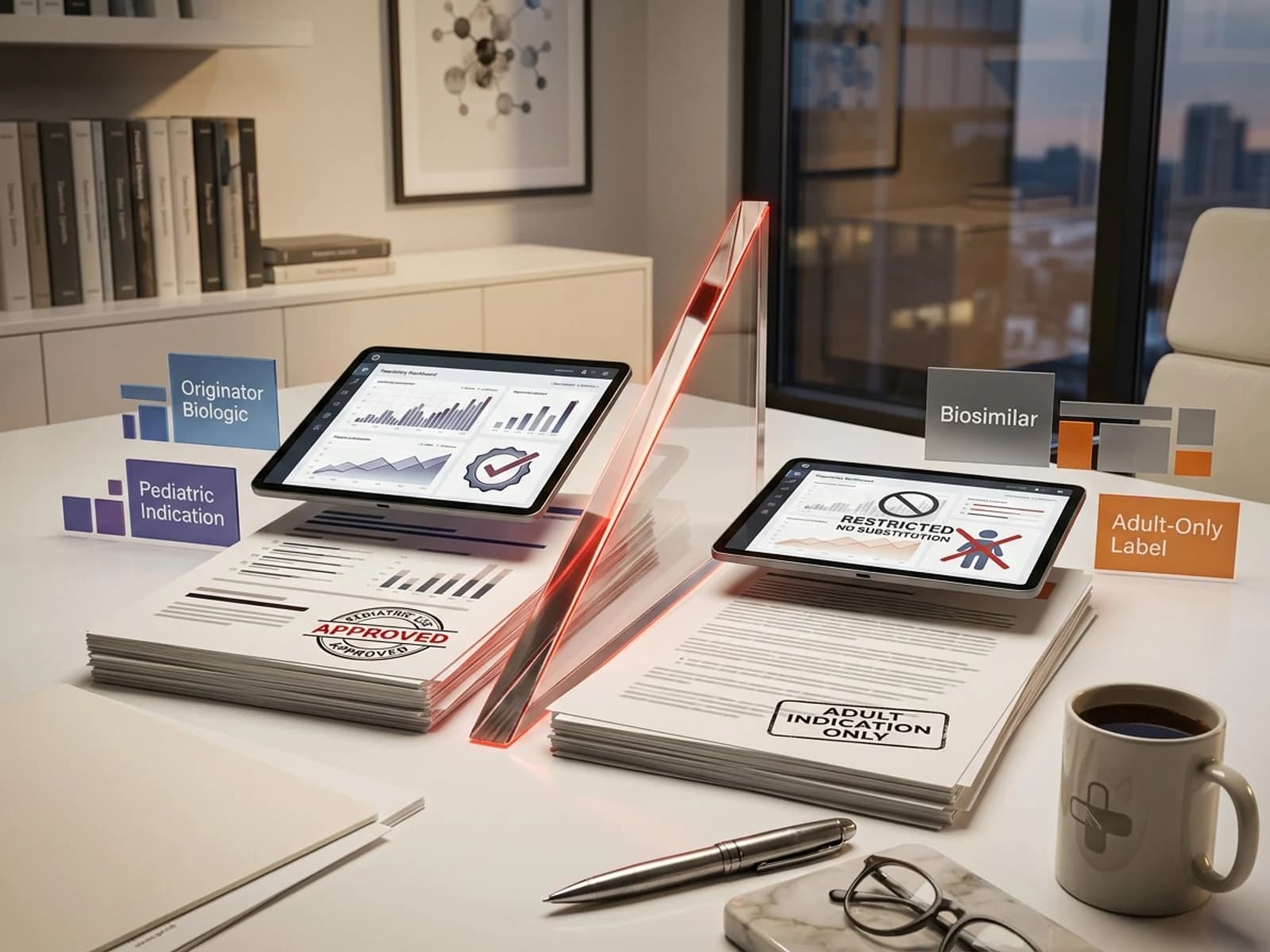
The Invoice Is a Purchase Record; the HCPCS Unit Is a Billing Record
When a specialty-distributor or pharmaceutical wholesaler invoice for a physician-administered biosimilar arrives at a community clinic, hospital outpatient department, or infusion center, four discrete fields must be reconciled before charge capture: the invoice National Drug Code (NDC), the product-specific Healthcare Common Procedure Coding System (HCPCS) code, the package size and container quantity, and the HCPCS billing-unit conversion factor. Treating those four fields as interchangeable is how invoice quantity, NDC units, and HCPCS units get keyed as the same number.
A specialty-distributor invoice is a commercial procurement document. It records an account number, purchase order, catalog description, physical package configuration, quantity shipped, unit of measure (such as each, vial, syringe, box, or case), and commercial acquisition cost (whether Wholesale Acquisition Cost [WAC], group purchasing organization [GPO] contract pricing, or 340B ceiling pricing). In sharp contrast, a Medicare Part B medical claim (submitted via Form CMS-1500 or electronic transaction 837P) is a statutory reimbursement document. It reports a standardized HCPCS procedure code, an integer count of billing service units defined by federal regulation, and—where required by Medicaid or commercial payer policy—an 11-digit NDC with a standardized national unit-of-measure qualifier.
The gap between commercial packaging and medical billing is captured in instructions published by Medicare Administrative Contractor (MAC) Noridian Healthcare Solutions for Jurisdiction E Part B: providers must report units in terms of the dosage specified in the complete HCPCS code descriptor and should not bill units based on the way the drug is packaged, priced, stored, or stocked. An invoice line indicating a quantity of '1' does not mean one billing unit on a claim. A clinic that purchases a 100 mg single-dose vial of an oncology biosimilar and enters '1' into Field 24G of the CMS-1500 claim form will underbill that administration by a factor of ten if the HCPCS descriptor defines one unit as 10 mg.
Federal rules governing claim service units are set forth in the Medicare Claims Processing Manual (Pub. 100-04, Chapter 17, Section 70, Rev. 11427). Under Section 70, where HCPCS is required, units are entered in exact multiples of the units shown in the HCPCS narrative description. If the code narrative specifies 50 mg and 200 mg are administered, the provider must bill 4 units. When the dosage administered is greater than the HCPCS descriptor amount, facilities round up to the nearest whole unit; when less than the descriptor amount, 1 unit is reported as the minimum measure. Furthermore, where an NDC is required on the claim line, units are entered in multiples of the units shown in the NDC label description—a completely different multiplier from the HCPCS unit.
Reading the Six Columns of the CMS ASP NDC-HCPCS Crosswalk
The operational conversion table between a commercial distributor invoice and a Medicare Part B claim is the quarterly CMS ASP NDC-HCPCS Crosswalk, published as part of the Medicare Part B Drug Payment Limit File under Section 1847A of the Social Security Act. In its educational fact sheet, Understanding the Medicare Part B Drug Payment Limit File (published March 2026), CMS clarifies that the payment-limit file includes the HCPCS-level payment limits and the NDC-HCPCS Crosswalk linking each manufacturer-reported package NDC to its corresponding billing code.
CMS emphasizes that only the NDC-HCPCS crosswalk published on the official Medicare Part B ASP website should be referenced for Part B drug payment limits. Other crosswalks available across cms.gov—including the Durable Medical Equipment (DME) NDC-HCPCS crosswalk maintained by the Palmetto GBA Pricing, Data Analysis and Coding (PDAC) contractor—serve separate payment methodologies and pharmacy benefit structures. Using a PDAC DME conversion factor for an 837P professional physician-office claim represents an immediate source-file error.
To translate an invoice line correctly, revenue cycle operators must understand the six structural columns defined in CMS's Frequently Asked Questions: ASP Data Collection guidance:
| Crosswalk Column | CMS Technical Definition | Invoice Counterpart | Operational Function |
|---|---|---|---|
NDC2 | 11-digit hyphenated National Drug Code in 5-4-2 format. | Invoice NDC (often printed in 10-digit format requiring zero-padding). | Primary lookup key linking the purchased package to its regulatory coding record. |
HCPCS Dosage | The amount of drug substance representing exactly 1.0 HCPCS billing unit. | None (derived strictly from the HCPCS Level II code narrative). | The denominator used to convert administered milligrams or micrograms into billable units. |
PKG SIZE | The total quantity of drug substance contained in one individual item or container. | Vial or prefilled syringe labeled strength (e.g., 100 mg, 400 mg). | Establishes total physical volume or mass per single-dose container for wastage tracking. |
PKG QTY | The count of individual items or containers packaged within the NDC2 trade package. | Pack count on invoice (e.g., 1 vial vs. carton of 10 vials). | Distinguishes between a single-container NDC and an outer multi-container carton NDC. |
BILLUNITS | The number of HCPCS billing units contained within one individual item or container. | Calculated multiplier for a single unit of use (PKG SIZE ÷ HCPCS Dosage). | Standard conversion factor applied when administering one complete single-dose vial. |
BILLUNITSPKG | The total number of HCPCS billing units in the complete NDC2 package. | Calculated multiplier for the entire shipped trade package (BILLUNITS × PKG QTY). | Conversion factor required when an invoice line item represents a sealed multi-vial carton. |
CMS illustrates this relationship with a standard calculation: if one HCPCS billing unit represents 10 mg and an NDC package contains 100 mg of drug, the billing units per NDC package equal 10. The ASP data-collection FAQ also explains an important technical rule: partial units are not accepted in Medicare billing or payment files. When CMS constructs the crosswalk, it rounds to the closest billing unit listed in the HCPCS long description. For example, if a manufacturer reports a vial containing 9.8 mg of active drug and the HCPCS descriptor unit is 10 mg, CMS rounds that vial to 1.0 billing unit in the file. Operators must recognize that this is a file-construction rule for payment limits, not permission for billing staff to invent unadministered service units from invoice packaging without reading the complete code narrative.
As of September 11, 2026, the active Medicare Part B payment-limit quarter for dates of service in the third quarter of 2026 is the July 2026 file (final NDC-HCPCS Crosswalk released June 17, 2026 on the CMS ASP pricing-files hub). Fourth-quarter (October 2026) payment files have not yet been posted. When auditing invoices, teams must ensure they verify against the exact crosswalk version corresponding to the patient's date of service, as code assignments and package configurations can shift between quarterly releases.
Finally, two critical regulatory principles govern crosswalk usage: first, presence of an NDC on the crosswalk does not constitute a coverage determination. A product listed on the file remains subject to local coverage determinations (LCDs), national coverage determinations (NCDs), medical necessity criteria, and commercial payer prior authorization rules. Second, absence of an NDC does not signify non-coverage. Because CMS does not publish payment limits for every manufacturer-reported NDC, local MACs retain authority to manually price and adjudicate valid, payable claims for newly launched products not yet cataloged on the current quarter's crosswalk.
Three Distinct Unit Objects: Invoice UOM, NDC UOM, and HCPCS Dosage
To prevent billing errors, practice management systems must maintain clear separation between three fundamentally distinct unit objects that intersect during the buy-and-bill cycle:
Invoice Unit of Measure (Commercial UOM): The commercial inventory metric printed on the distributor invoice (such as 'EA', 'VIAL', 'SYR', 'BOX', or 'CS'). It represents physical packaging for transport, warehousing, and accounts payable reconciliation. It possesses zero legal standing in the determination of Medicare Part B claim reimbursement units.
HIPAA NDC Unit of Measure (National Drug UOM): The standardized unit qualifier mandated under CMS Manual System Transmittal 1401 for electronic claims and the shaded portion of Item 24 on Form CMS-1500. It requires the qualifier 'N4' followed immediately by the 11-digit unhyphenated NDC, accompanied by a numeric quantity and one of four federally recognized unit qualifiers: UN (Units/Each), ML (Milliliters), GR (Grams), or F2 (International Units).
HCPCS Dosage Service Units (Reimbursement Multiplier): The integer entered in Field 24G ('Days or Units') representing the total quantity administered and discarded, calculated strictly as a multiple of the dosage stated in the HCPCS code narrative (such as 10 mg, 1 mcg, or 0.5 mg).
State Medicaid programs make this distinction explicit. For instance, the Commonwealth of Massachusetts (MassHealth) clinician-administered drug billing guidelines instruct providers that NDC units are different from HCPCS code units: HCPCS service units are the reimbursement basis; NDC units are the numeric quantity administered plus a unit-of-measure qualifier. Under MassHealth and numerous commercial payer edits, if a clinician administers three 0.5 mL single-dose vials of a biologic, the NDC quantity line reports 1.5 with qualifier ML, while the HCPCS service unit line reflects the total milligram dosage divided by the HCPCS descriptor amount.
A second layer of friction arises from NDC segment structure. The FDA currently assigns NDCs in 10-digit formats across three configurations: 4-4-2 (4-digit labeler, 4-digit product, 2-digit package), 5-3-2 (5-digit labeler, 3-digit product, 2-digit package), and 5-4-1 (5-digit labeler, 4-digit product, 1-digit package). However, HIPAA electronic standards (ASC X12 837P) and CMS crosswalks require an 11-digit format in a uniform 5-4-2 configuration. Converting an invoice NDC to a billing NDC requires inserting a leading zero into the short segment:
4-4-2 Configuration: Add a leading zero to the 4-digit labeler code (first segment) to yield 5-4-2 (e.g., 1234-5678-90 becomes 01234-5678-90).
5-3-2 Configuration: Add a leading zero to the 3-digit product code (second segment) to yield 5-4-2 (e.g., 12345-678-90 becomes 12345-0678-90).
5-4-1 Configuration: Add a leading zero to the 1-digit package code (third segment) to yield 5-4-2 (e.g., 12345-6789-0 becomes 12345-6789-00).
While the FDA published its final rule establishing a standardized 12-digit format (6-4-2) in March 2026, that rule carries a seven-year implementation transition ending on March 7, 2033. For current operational workflows in 2026, the 11-digit 5-4-2 padded configuration remains the mandatory standard across all Medicare, Medicaid, and commercial claims.
To demonstrate the mathematical interplay between physical dosage and claim units, consider Example 2 in Chapter 17, Section 70 of the Medicare Claims Processing Manual. Code J9355 represents Injection, trastuzumab, 10 mg. If a patient receives an actual dosage of 140 mg, the provider enters 14 in the units field (140 mg divided by 10 mg = 14 units). When the dosage amount is greater than the amount indicated for the HCPCS code, the facility rounds up to determine units. When the dosage amount is less than the amount indicated for the HCPCS code, use 1 as the unit of measure. Chapter 17 Example 3 makes that floor concrete: HCPCS J3100 (tenecteplase, 50 mg) with an actual dose of 40 mg bills 1 unit, even though less than one full unit was furnished. That instruction is a claims-unit rule; it is not the ASP crosswalk's file-construction rounding of a 9.8 mg vial to 1 BILLUNITS.
Biosimilar Codes Are Product-Specific: The Q-Code Versus Reference J-Code Boundary
A compliance error in buy-and-bill administration is billing a biosimilar invoice NDC under the reference biologic's legacy HCPCS J-code. Under federal statute (42 U.S.C. 1395w-3a) and regulation (42 CFR 414.904(j)), Medicare Part B pays for a biosimilar biological product based on the Average Sales Price of the NDCs assigned to that specific biosimilar billing-and-payment code, plus an add-on equal to 6 percent of the amount determined under section 1847A(b)(4) for the reference biological product.
Furthermore, under 42 CFR 414.902 and Section 1847A(b)(8)(B) of the Act, a qualifying biosimilar biological product receives an increased add-on payment of 8 percent of the amount determined under section 1847A(b)(4) for the reference biological during its applicable five-year qualifying period. A qualifying biosimilar is defined as a product whose ASP is less than the reference product's ASP for a calendar quarter during that window. Because payment limits are calculated separately for each biosimilar billing code, assigning an invoice NDC to the reference drug code uses the wrong billing-and-payment code.
To reinforce this boundary, some reference-product HCPCS long descriptors now say 'excludes biosimilar.' The long descriptor for code J1745 reads: Injection, infliximab, excludes biosimilar, 10 mg. A clinic purchasing an infliximab biosimilar (such as Inflectra, Renflexis, or Avsola) cannot bill J1745; the invoice NDC must be mapped strictly to the product-specific Q-code assigned to that manufacturer's BLA.
This product-specific mapping is illustrated by MAC Article A52370 (Billing and Coding: Bevacizumab and biosimilars), which defines the regulatory code structure for bevacizumab and its biosimilar competitors:
| HCPCS Code | Product Name & Nonproprietary Name | Descriptor Dosage Unit | Regulatory Status & Code Effective Date |
|---|---|---|---|
J9035 | Avastin (bevacizumab) | 10 mg | Reference biological; long descriptor is 10 mg. The JW/JZ HCPCS list does not add 'excludes biosimilar' to J9035. |
Q5107 | Mvasi (bevacizumab-awwb) | 10 mg | Product-specific biosimilar billing and payment code (Mvasi). |
Q5118 | Zirabev (bevacizumab-bvzr) | 10 mg | Product-specific biosimilar billing and payment code (Zirabev). |
Q5126 | Alymsys (bevacizumab-maly) | 10 mg | Effective 01/01/2023 (C9142 applied 10/01/2022 through 12/31/2022). |
Q5129 | Vegzelma (bevacizumab-adcd) | 10 mg | Effective 04/01/2023 (J3590 applied 09/27/2022 through 03/31/2023). |
Q5160 | Jobevne (bevacizumab-nwgd) | 10 mg | Effective 01/01/2026 per Article A52370. |
Article A52370 also demonstrates an important clinical and setting-specific exception that revenue cycle teams must never generalize. For approved ophthalmologic indications, the article instructs providers who bill the Part B MAC to submit small-dose bevacizumab and biosimilars using C9142, J9035, Q5107, or Q5118 and to bill one unit per eye. That one-unit-per-eye sentence does not list Q5126, Q5129, or Q5160. HCPCS C9257 (0.25 mg) is used for approved ophthalmologic indications in the ambulatory surgical center setting on that Part B MAC path; for Part A MAC ophthalmologic claims the article points bevacizumab to C9257. An invoice for a 100 mg oncology vial of bevacizumab cannot be billed under the ophthalmology single-unit rule when administered in systemic chemotherapy infusion, nor can an ophthalmic compound be billed under 10 mg oncology descriptor math. Those unit rules are setting- and article-specific.
Purchased Quantity Is Not Billed Quantity: Wastage, Overfill, and Rebate Tracking
Purchasing ten vials of a drug does not automatically translate into billing ten times the container's BILLUNITS value on subsequent patient claims. Reimbursement follows administered dosage plus labeled discard, governed by strict federal rules on discarded drug reporting.
Under Medicare Claims Processing Manual Pub. 100-04, Chapter 17, Section 40 (Rev. 13108) and CMS's JW Modifier and JZ Modifier Policy, Medicare provides separate reimbursement for discarded remainder from a single-dose container (SDC) or single-use package up to the amount indicated on the FDA-approved container label. The discarded amount is defined as the labeled amount minus the administered dose. In accordance with federal policy:
Modifier JW (Drug amount discarded/not administered to any patient): Mandatory on a separate claim line reporting discarded billing units when drug from a single-dose container is discarded and the discarded amount equals or exceeds 1.0 whole HCPCS billing unit.
Modifier JZ (Zero drug amount discarded/not administered to any patient): Mandatory on the administered claim line for single-dose containers when no drug was discarded, or when the discarded amount does not meet the criteria for separate JW reporting.
Crucially, Chapter 17 and the JW/JZ FAQ state that modifier JW is not permitted when the actual dose administered is less than the billing unit. CMS's worked example: one billing unit equals 10 mg in a single-use vial; 7 mg is administered and 3 mg remains. The provider bills 1 unit for the 10 mg labeled amount; a separate JW line for the discarded 3 mg is not permitted because it would result in overpayment. For dates of service beginning July 1, 2023, the JZ modifier is used in that circumstance. That leftover-inside-one-unit rule lives in the discarded-drug policy, not in the Chapter 17 Section 70 round-up instruction.
Commercial acquisition pricing also has zero bearing on billed service units. Whether an invoice reflects a commercial list price, a 340B statutory discount, or a volume rebate, the integer entered in Field 24G is governed entirely by patient clinical dosage and the HCPCS descriptor. However, the physical invoice NDC remains vital after payment because of Medicaid statutory rebate mechanics.
Under 42 CFR 447.520, Federal Financial Participation (FFP) is conditioned on state Medicaid agencies requiring provider claims for physician-administered covered outpatient drugs to identify products by their 11-digit NDC numbers. This collection allows states to invoice pharmaceutical manufacturers for statutory Medicaid rebates. As of November 19, 2024, this federal requirement encompasses all remaining multiple-source clinician-administered drugs under 42 CFR 447.520(a)(3). If clinic billing staff substitute an outer carton NDC, zero-pad an NDC incorrectly, or assign a sibling biosimilar's code, the claim may clear initial HCPCS reimbursement but will subsequently fail state rebate validation, triggering retroactive claim recoupment.
Reconciliation Workflow and Operator Checklist
To establish compliance before claim generation, buy-and-bill practices should implement a standardized intake and charge-capture verification sequence. The following decision flowchart maps the path from invoice arrival to billing submission:
flowchart TD
  Inv[Distributor Invoice Arrives] --> ChkPkg[1. Inspect Line Item: Inner Container vs Outer Carton?]
  ChkPkg --> PadNDC[2. Normalize NDC to 11 Digits: 5-4-2 Format]
  PadNDC --> MatchXwalk[3. Match NDC2 on Current CMS ASP Crosswalk]
  MatchXwalk -->|Found| CheckCode[4. Verify HCPCS Code: Is It Product-Specific Q-Code?]
  MatchXwalk -->|Missing| CheckMAC[Absence is not non-coverage; MAC may still price]
  CheckCode -->|Reference J-Code| RejectCode[Correction: Replace with Product-Specific Q-Code]
  RejectCode --> CheckCode
  CheckCode -->|Product Q-Code| ReadDosage[5. Extract HCPCS Dosage and Container BILLUNITS]
  ReadDosage --> CalcDose[6. Calculate Administered Dose and Labeled Discard]
  CalcDose --> CheckJW{Discard at least 1.0 Billing Unit?}
  CheckJW -->|Yes| BillJW[Line 1: Administered units without JZ<br/>Line 2: Discarded units with JW]
  CheckJW -->|No| BillJZ[Single line: billed units with JZ]
  BillJW --> ValidateMedicaid[7. Attach N4 Qualifier and 11-Digit NDC for Rebate Tracking]
  BillJZ --> ValidateMedicaid
ValidateMedicaid --> ClaimReady[Claim Ready for 837P / CMS-1500 Submission]Revenue cycle and pharmacy operations teams should complete this seven-point verification checklist prior to releasing any clinician-administered biosimilar claim:
Identify Container Level: Confirm whether the invoice line reflects individual vials (PKG QTY = 1) or a multi-pack trade carton (PKG QTY > 1). Determine whether inventory was scanned at the carton or vial level.
Normalize to 11 Digits: Inspect the hyphenated NDC configuration (4-4-2, 5-3-2, or 5-4-1) and insert a leading zero into the short segment to construct the HIPAA-compliant 5-4-2 string.
Match Current Quarterly Crosswalk: Locate the normalized NDC in the NDC2 column of the CMS Part B ASP Crosswalk corresponding to the exact date of service (e.g., July 2026 file for Q3 2026 dates of service).
Confirm Product-Specific HCPCS: Verify that the crosswalk code is the biosimilar's unique Q-code. Confirm that the descriptor does not read 'excludes biosimilar' and does not belong to the reference brand or a sibling biosimilar.
Extract Dosage and BILLUNITS: Read the HCPCS Dosage and single-container BILLUNITS value. Calculate total administered units by dividing patient clinical dose by the descriptor dosage.
Audit Discard and Overfill: For single-dose containers, subtract administered milligrams from labeled milligrams to compute legitimate discard. Exclude overfill. If discard equals or exceeds 1.0 billing unit, split onto a separate JW line; otherwise report modifier JZ on the administered line.
Preserve NDC Rebate Identity: Populate the CMS-1500 Item 24 shaded area with the N4 qualifier, unhyphenated 11-digit NDC, and national unit qualifier (UN, ML, GR, F2) to ensure Medicaid rebate compliance under 42 CFR 447.520.
This sequence classifies the invoice against the current-quarter ASP NDC-HCPCS Crosswalk, the HCPCS long descriptor, and labeled discard rules. It is not coding advice for a named claim, it does not invent BILLUNITS for a specific NDC, and matching the crosswalk is not a coverage determination or a payment guarantee. JW and JZ apply to separately payable Part B single-dose containers read from FDA labeling; they do not apply to multi-dose vials, packaged OPPS or ASC drugs, or FQHC/RHC settings.
Sources
Centers for Medicare & Medicaid Services: Medicare Claims Processing Manual, Pub. 100-04, Chapter 17 — Drugs and Biologicals (Sections 40 and 70, Rev. 11427 / Rev. 13108).
Centers for Medicare & Medicaid Services: Frequently Asked Questions (FAQs): ASP Data Collection (NDC2, PKG SIZE, PKG QTY, BILLUNITS, and BILLUNITSPKG definitions).
Centers for Medicare & Medicaid Services: Understanding the Medicare Part B Drug Payment Limit File (March 2026).
Centers for Medicare & Medicaid Services: Medicare Part B Drug Payment Limit File (ASP pricing files hub) (July 2026 NDC-HCPCS Crosswalk final release 2026-06-17).
Centers for Medicare & Medicaid Services: Part B Drug Payment Limits Overview (March 2026).
Electronic Code of Federal Regulations: 42 CFR 414.904 — Average sales price as the basis for payment.
Electronic Code of Federal Regulations: 42 CFR 414.902 — Definitions (Qualifying biosimilar biological product).
Centers for Medicare & Medicaid Services: Discarded Drugs and Biologicals — JW Modifier and JZ Modifier Policy Frequently Asked Questions.
Centers for Medicare & Medicaid Services: JW Modifier and JZ Modifier Policy HCPCS Codes.
Noridian Healthcare Solutions (JE Part B): Drugs, Biologicals and Injections — JE Part B.
Centers for Medicare & Medicaid Services: Article A52370 — Billing and Coding: Bevacizumab and biosimilars.
U.S. Food and Drug Administration: National Drug Code Format.
Centers for Medicare & Medicaid Services: CMS Manual System Transmittal 1401 — National Drug Codes.
Electronic Code of Federal Regulations: 42 CFR 447.520 — FFP: Conditions relating to physician-administered drugs.
Commonwealth of Massachusetts (MassHealth): Learn about National Drug Code (NDC) requirements.
Centers for Medicare & Medicaid Services: ASP Billing Resources.
Palmetto GBA (PDAC): NDC/HCPCS Crosswalk FAQs and Definitions.