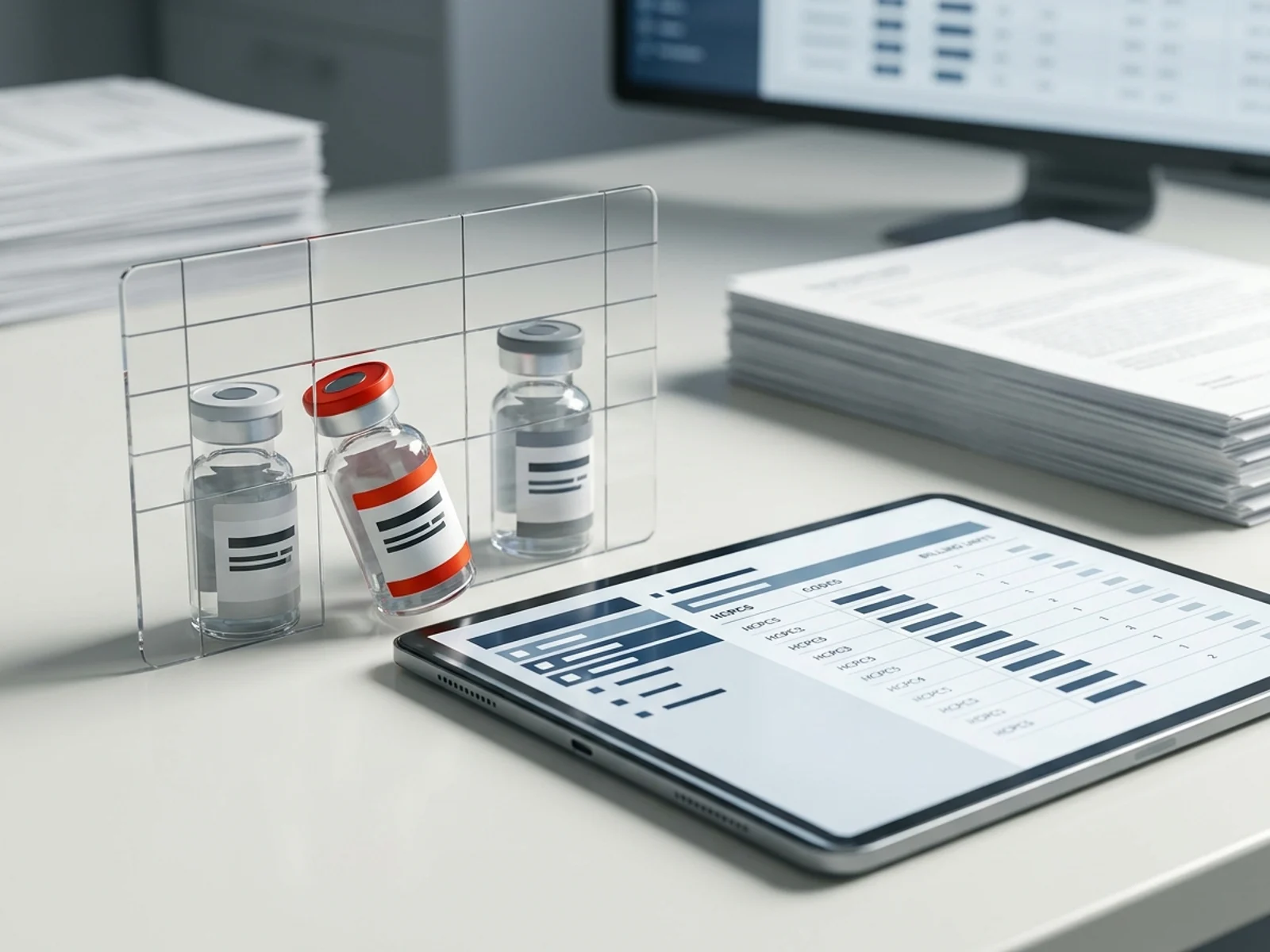
A provider bills a bevacizumab biosimilar infusion using HCPCS code Q5107 (bevacizumab-awwb, MVASI). The claim includes the 11-digit NDC from the vial in the patient's chart. The payer denies it: the NDC on the claim maps to Q5118 (bevacizumab-bvzr, Zirabev) in the CMS ASP crosswalk—not Q5107. The HCPCS code and the NDC do not match. The denial stands.
This type of crosswalk error is one of the most common and least discussed causes of biosimilar claim denials. As the number of biosimilar products grows—each with its own HCPCS code and multiple NDCs—the opportunities for misalignment multiply. CMS added 25 new Q-codes in the 2026 HCPCS update, and several existing codes were deleted or revised. Every quarter, the ASP crosswalk adds new NDC-to-HCPCS mappings that billing systems must track.
This article covers the specific types of HCPCS/NDC crosswalk errors that affect biosimilar claims, how they cause denials, and what billing teams, specialty pharmacies, and manufacturer access teams should verify. It is written for specialty pharmacy billing staff, oncology and infusion center billing teams, manufacturer market access and reimbursement teams, and payer strategy staff who manage biosimilar coding and reimbursement.
How biosimilar HCPCS coding works
Separate Q-codes for each biosimilar
CMS assigns separate HCPCS Level II codes (typically Q-codes) for each biosimilar product. Unlike generic drugs, which share a single J-code when rated as therapeutically equivalent, biosimilars are billed under their own product-specific code. This reflects FDA's position that biosimilars are not generic equivalents and are not automatically substitutable (unless designated interchangeable).
For example, the bevacizumab biosimilar coding landscape in 2026 includes:
| HCPCS code | Product | Effective date |
|---|---|---|
| J9035 | Avastin (bevacizumab reference) | Long-standing |
| Q5107 | MVASI (bevacizumab-awwb) | 2018 |
| Q5118 | Zirabev (bevacizumab-bvzr) | 2020 |
| Q5126 | Alymsys (bevacizumab-maly) | 2023 |
| Q5129 | Vegzelma (bevacizumab-adcd) | 2023 |
| Q5160 | Jobevne (bevacizumab-nwgd) | January 2026 |
Each code describes the same drug substance (bevacizumab, 10 mg) but identifies a different product. Billing the wrong code for the product that was actually administered is a crosswalk error.
The ASP crosswalk
CMS maintains the Average Sales Price (ASP) HCPCS-NDC crosswalk, which maps each NDC to its corresponding HCPCS code for pricing and claims processing. The Pricing Data Analysis and Coding (PDAC) contractor also maintains a separate NDC/HCPCS crosswalk for DMEPOS claims. Both are updated regularly.
When a claim includes both a HCPCS code and an NDC, the payer's adjudication system checks whether the NDC maps to the billed HCPCS code in the crosswalk. If the NDC maps to a different code, the claim is denied.
The 11-digit NDC requirement
NDCs must be submitted in 11-digit format (5-4-2 configuration). Many drug labels display 10-digit NDCs. Converting incorrectly—adding the leading zero to the wrong segment—is a frequent source of claim rejection. Horizon NJ Health's billing guidance states: "The NDC must be the actual number on the container from which the medicine was administered."
The five most common crosswalk error types
1. Wrong Q-code for the product administered
This occurs when the billing system has not been updated with the correct HCPCS code for the biosimilar product that was dispensed. It is especially common when:
A new biosimilar launches and the billing system still maps the product to the reference biologic's J-code
Multiple biosimilars of the same reference product exist and the billing staff selects the wrong Q-code from a dropdown
A Q-code is newly assigned or changed mid-year (e.g., Q5160 for Jobevne effective January 1, 2026)
Example: A practice administers Vegzelma (bevacizumab-adcd) but bills Q5107 (MVASI). The NDC on the claim maps to Q5129 in the crosswalk. The payer denies the claim for HCPCS/NDC mismatch.
2. NDC not in crosswalk
The NDC on the dispensed vial does not appear in the ASP crosswalk for the billed HCPCS code. This can occur when:
A new NDC has been assigned by the manufacturer but has not yet been added to the crosswalk
The NDC has been deactivated or end-dated and removed from the crosswalk
The vial is from a lot with an NDC that was recently reassigned
UnitedHealthcare's J-Code/NDC Mismatch quick reference guide documents specific examples: billing J7040 (normal saline) with an NDC for lidocaine in dextrose that shows "No NDC in Crosswalk." Fidelis Care (Centene) warns: "Claims that do not include an NDC, or that include an NDC that does not match the billed HCPCS code, may be denied and/or not eligible for reimbursement."
3. Billing unit mismatch
HCPCS codes define billing units by drug amount, not by vial. For example, if a Q-code describes "1 mg," and 100 mg is administered, the claim must show 100 units—not one unit of a 100-mg vial.
CMS's Medicare Claims Processing Manual (Chapter 17) states: "Where HCPCS is required, units are entered in multiples of the units shown in the HCPCS narrative description. For example, if the description for the code is 50 mg, and 200 mg are provided, units are shown as 4."
Unit mismatches occur when:
Billing staff calculate units based on vial size rather than the HCPCS descriptor
The NDC unit of measure (each, mL, mg) does not match the HCPCS billing unit
Waste is billed separately instead of included in the total units
4. Deleted or expired HCPCS codes
CMS deletes and replaces HCPCS codes annually and sometimes mid-year. Claims submitted with deleted codes are rejected. The 2026 HCPCS update deleted 101 codes, including several J-codes that were replaced by new permanent codes:
| Deleted code | Description | Replacement |
|---|---|---|
| S0013 | Esketamine nasal spray | J0013 |
| S0189 | Testosterone pellet | J1073 |
| C9174 | Datopotamab deruxtecan | J9011 |
| C9305 | Nipocalimab-aahu | J9256 |
| C9306 | Telisotuzumab vedotin-tllv | J9326 |
Temporary C-codes and S-codes must transition to permanent J-codes following CMS updates. If a provider's charge master still contains the deleted code, claims will be rejected.
5. Biosimilar billed under reference product code
This error occurs when a biosimilar is billed under the reference biologic's J-code rather than its own Q-code. While some payers historically accepted this practice, CMS now requires product-specific coding for biosimilars. A 2026 billing guidance analysis notes: "Biosimilars have distinct HCPCS codes separate from those of their reference biologics. When billed under the wrong product code, reimbursement inaccuracies and ASP calculation conflicts may occur."
CMS's Q1 2026 HCPCS coding determination for new biosimilars illustrates the pattern: each new biosimilar gets its own Q-code (e.g., Q5170 for Eydenzelt, a new aflibercept biosimilar). The ASP crosswalk maps only that product's NDCs to that Q-code.
How crosswalk errors cascade
A single crosswalk error can trigger multiple downstream problems:
Initial claim denial: The payer's adjudication system rejects the HCPCS/NDC combination
Reimbursement delay: The denial must be researched, corrected, and resubmitted—adding 30–60 days to the payment cycle
Incorrect ASP reimbursement: If the wrong code is used, the reimbursement rate may be the reference product's ASP rather than the biosimilar's ASP—either overpaying or underpaying
Audit risk: Pattern of mismatched claims can trigger payer audits or CMS medical review
Patient disruption: If the denial is not resolved before the next treatment cycle, the patient may face a treatment delay
The PDAC crosswalk: what it is and when to use it
The PDAC NDC/HCPCS crosswalk is maintained by the Pricing Data Analysis and Coding contractor (Palmetto GBA). It lists NDCs assigned to Level II HCPCS codes with pricing conversion factors for DMEPOS claims. The crosswalk is updated monthly to add, revise, or delete NDCs.
The PDAC crosswalk is relevant for:
DMEPOS claims processed by DME MACs
Home infusion drugs billed under the DME benefit
Certain retail pharmacy transactions processed through NCPDP standards
For most physician-administered drugs billed to Part B MACs, the relevant crosswalk is the CMS ASP HCPCS-NDC crosswalk, which is updated quarterly. Both crosswalks should be checked when verifying coding accuracy.
Operational checklist: verify before you bill
Before the claim is submitted
Confirm the product: Record the exact product name, manufacturer, and NDC from the vial administered
Look up the HCPCS code: Use the CMS HCPCS quarterly update or the MAC's billing and coding article for the drug class—not a cached or outdated reference
Cross-reference the NDC: Verify that the NDC on the vial maps to the HCPCS code you are billing in the current ASP crosswalk
Calculate billing units: Based on the HCPCS descriptor, not the vial size
Format the NDC: Ensure 11-digit format (5-4-2) with no dashes or spaces
Check for deleted codes: Verify the HCPCS code has not been deleted or replaced in the current update cycle
Route modifier: For J-codes that do not specify route, include JA (intravenous) or JB (subcutaneous) as required
When a denial occurs
Pull the denial reason code: CMS-0062-P will soon require payers to provide specific denial reasons for drug PA, but for claims denials, review the remittance advice for CARC/RARC codes
Check the crosswalk: Verify whether the NDC-to-HCPCS mapping in the claim matches the current ASP crosswalk
Correct and resubmit: If the error is a coding mismatch, correct the HCPCS code or NDC and resubmit. Do not simply rebill with the same information
Document the correction: If audited, the practice must show that the correction was made in good faith based on current coding references
What manufacturer access teams should do
Manufacturer market access and reimbursement teams for biosimilar products should:
Publish coding guides: For each biosimilar product, publish a coding reference that includes the correct HCPCS code, expected NDCs, billing units, route modifiers, and effective dates
Update at every HCPCS cycle: CMS updates HCPCS codes quarterly (January, April, July, October). Coding guides must be updated within 30 days of each cycle
Alert field teams to NDC changes: When new NDCs are assigned (new vial sizes, new manufacturing sites, new packaging), alert field reimbursement specialists and provider contacts immediately
Support denial resolution: Provide coding support when providers call the manufacturer's reimbursement hotline with claim denials related to crosswalk errors
Monitor payer policy updates: MAC billing and coding articles (e.g., CMS Article A52370 for bevacizumab biosimilars) are updated regularly and specify the correct HCPCS codes and effective dates
The biosimilar coding landscape in 2026
The 2026 HCPCS updates include new Q-codes for recently approved biosimilars and code revisions for existing products. Key changes:
Q5160: Bevacizumab-nwgd (Jobevne), biosimilar to Avastin
Q5170: Aflibercept-boav (Eydenzelt), biosimilar to Eylea
New denosumab biosimilar codes: Osvyrti and Jubereq (denosumab-desu) pending Q-code assignment
Multiple ustekinumab biosimilar Q-codes: Q5098 (Imuldosa), Q5099 (Steqeyma), Q5100 (Yesintek), Q9996/Q9997 (Pyzchiva SC/IV), Q9998 (Selarsdi), Q9999 (Otulfi)
Multiple adalimumab biosimilar Q-codes: Q5140 through Q5145 for newly distinguished adalimumab biosimilar products
The proliferation of biosimilar Q-codes means that the coding error surface area is expanding. A class like ustekinumab now has the reference product (Stelara) plus six biosimilars, each with its own Q-code and potentially different NDCs for different vial sizes and presentations. Billing systems must distinguish among them accurately.
What to monitor
Quarterly HCPCS updates: CMS updates HCPCS codes and the ASP crosswalk quarterly. Billing systems and charge masters must be updated within 30 days of each cycle
MAC billing and coding articles: Each Medicare Administrative Contractor publishes billing and coding articles that specify correct HCPCS codes for drug classes including biosimilars
NDC changes: New NDCs are assigned when manufacturers change packaging, vial sizes, manufacturing sites, or labeling. The ASP crosswalk may lag the physical product by one quarter
Payer-specific coding requirements: Some payers require specific HCPCS/NDC combinations that differ from the CMS standard. Always verify the payer's coding requirements before submitting
CMS biosimilar reimbursement policy: CMS pays biosimilars under Part B at ASP + 6% of the reference product's ASP (a temporary add-on), which means the reimbursement rate depends on correct product identification
This article is for informational purposes only and does not constitute medical advice, legal advice, billing advice, or coding guidance for any specific entity. HCPCS codes, NDC mappings, and payer policies change frequently. Always verify current codes and crosswalk data before submitting claims.
Last updated: May 31, 2026.
Sources
CMS. "2026 HCPCS Application Summary, Quarter 1 2026, Drugs and Biologicals." cms.gov
CMS. "Medicare Claims Processing Manual, Chapter 17." cms.gov
CMS. "Billing and Coding: Bevacizumab and Biosimilars (Article A52370)." cms.gov
PDAC. "NDC/HCPCS Crosswalk." 2026. dmepdac.com
UnitedHealthcare. "J-Code/NDC Mismatch Quick Reference Guide." uhcprovider.com
Fidelis Care. "Billing Guidance Reminder: Correct HCPCS Code/NDC Matching for Medical Claims." 2025. fideliscare.org
Horizon NJ Health. "How to Submit Claims with Drug-Related (J or Q) Codes." horizonnjhealth.com
Trellis AI. "NDC-to-HCPCS Crosswalk Guide: Avoid J-Code Errors on Infusion Claims." 2026. runtrellis.com
24/7 Medical Billing Services. "Drug & Infusion Billing Errors in 2026: J-Codes, Modifiers & ASP-NDC Mismatches." 2026. 247medicalbillingservices.com
24/7 Medical Billing Services. "HCPCS 2026 Updates by Section: A, C, G, J, Q, and S Codes Explained." 2026. 247medicalbillingservices.com
AAPC. "CMS Releases 2026 Update to HCPCS Level II." 2026. aapc.com
Bristol Health Care Solutions. "CMS 2026 HCPCS Level II Update: What the Latest Changes Mean for Billing, Compliance, and Reimbursement." 2026. bristolhcs.com
Biologics Prescribers Collaborative. "Physician Groups Urge CMS to Adopt Unique Billing Codes (J-codes) for Each Biosimilar." biologicsprescribers.org
IntuitionLabs. "NDC vs RxNorm & HCPCS J-Codes: A Guide to Drug Coding." intuitionlabs.ai