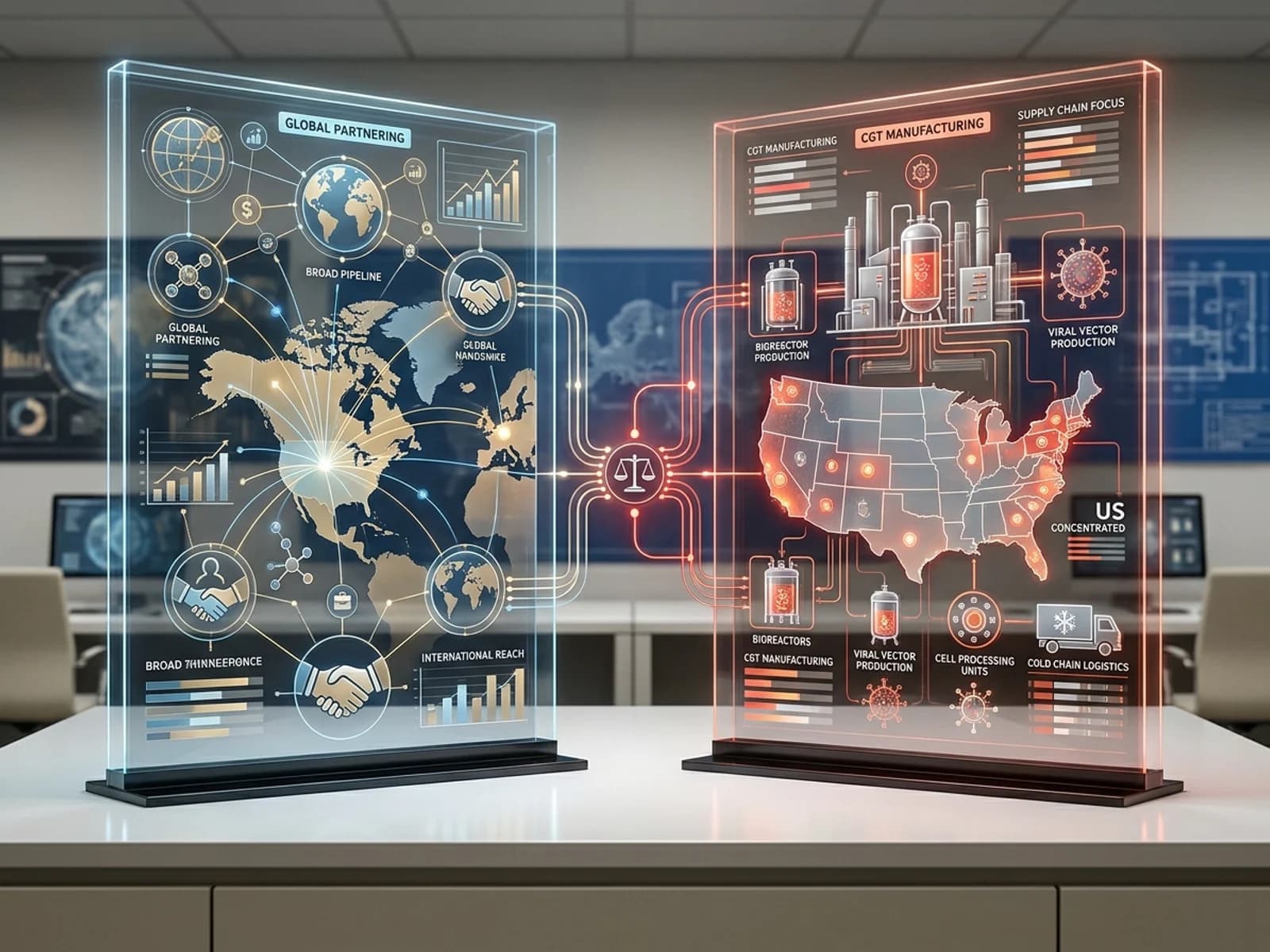
Biotech conference season offers a natural experiment in ecosystem structure. BIO International Convention 2026 (June 22–25, San Diego) and the ASGCT 2026 Annual Meeting (May 11–15, Boston) bookend the calendar with two very different exhibitor profiles — one broad and partnership-driven, the other deep and manufacturing-centric.
An analysis of both exhibitor directories — 375 companies at BIO and 232 at ASGCT — reveals sharp contrasts in geographic reach, company composition, and what each show signals for commercial planning.
Scale and scope
BIO is the larger show by exhibitor count (375 versus 232, a 1.6× difference). But the more important distinction is breadth. BIO covers the full biotech value chain: therapeutic developers, CDMOs and CROs, professional services, government agencies, and supply-chain vendors across all modalities. ASGCT is a specialized show focused on cell and gene therapy — and the exhibitor mix reflects that focus.
| Metric | BIO 2026 | ASGCT 2026 |
|---|---|---|
| Total exhibitors | 375 | 232 |
| Countries represented | 31 | 19 |
| US exhibitors | 216 (57.6%) | 187 (80.6%) |
| International exhibitors | 159 (42.4%) | 45 (19.4%) |
| Companies at both shows | 22 | 22 |
Source: BIO International 2026 and ASGCT 2026 exhibitor directories; analysis by PharmaDossier, run date 2026-06-09.
The geographic split is the headline
BIO is meaningfully more international. Forty-two percent of its exhibitors come from outside the United States, compared with 19% at ASGCT. South Korea (22 exhibitors), the United Kingdom (16), India (14), Canada (16), and China (11) each send double-digit delegations to San Diego.
ASGCT's international presence is thinner. China (8), Canada (6), and the UK (5) lead the non-US contingent, but the total international count is 45 exhibitors across 18 countries. The show's Boston location and its CGT-specific focus both contribute to the US concentration, given that CGT manufacturing capacity is still heavily US-domiciled.
| Region | BIO 2026 | ASGCT 2026 |
|---|---|---|
| United States | 216 (57.6%) | 187 (80.6%) |
| Europe | 54 (14.4%) | 25 (10.8%) |
| Asia-Pacific | 72 (19.2%) | 14 (6.0%) |
| Middle East & Other | 33 (8.8%) | 5 (2.2%) |
Notably, BIO draws exhibitors from countries entirely absent at ASGCT: Saudi Arabia (4), the United Arab Emirates (1), New Zealand (8), Taiwan (6), Poland (3), Brazil (1), Argentina (1), Mexico (1), Turkey (1), Lithuania (1), and Singapore (1). These delegations reflect BIO's role as a global partnering event where economic development agencies, trade ministries, and biotech parks attend alongside companies.
Company composition tells the story
BIO's exhibitor base skews toward therapeutic developers and partnership-driven companies. Among the 375 exhibitors, approximately 111 (30%) are therapeutic developers — biotech and pharma companies with clinical-stage pipelines — while 44 (12%) are CDMOs or CROs. Professional services firms (consultancies, law firms, IP specialists) account for 25 exhibitors (7%), reflecting BIO's strong business-development and partnering track.
ASGCT's composition is different. The show is supply-chain heavy: 40 exhibitors (17%) are CDMOs or CROs, and 86 exhibitors (37%) operate in manufacturing services or supply chain. Therapeutic developers make up a smaller share (14%), and professional-services firms are nearly absent.
| Segment | BIO 2026 | ASGCT 2026 |
|---|---|---|
| Therapeutic developers | ~111 (30%) | ~33 (14%) |
| CDMO/CRO | 44 (12%) | 40 (17%) |
| Manufacturing services | 21 (6%) | 43 (19%) |
| Tools, reagents, equipment | ~5 (1%) | ~18 (8%) |
| Professional services | 25 (7%) | ~4 (2%) |
| Platform/technology | 12 (3%) | ~4 (2%) |
| Academic/government | 9 (2%) | ~6 (3%) |
| Other/unclassified | ~148 (39%) | ~84 (36%) |
The "unclassified" share at BIO is large (39%) because the exhibitor directory does not include descriptions for approximately 72% of companies — many list only a name, country, and website. For ASGCT, the unclassified share (36%) similarly reflects companies without detailed directory profiles.
The 22 companies that attend both
Twenty-two companies exhibited at both ASGCT and BIO. This overlap group is heavily weighted toward CDMOs and manufacturing platforms that serve both the broad biotech market and the CGT niche specifically:
3PBIOVIAN, AGC Biologics, BioCina, Biomay, Bionova Scientific, Catalent, Eurogentec, Forge Biologics, Fujifilm, KACTUS, Kincell Bio, Lonza, MilliporeSigma, Nona Biosciences, Only Orphans Cote, OXB (formerly Oxford Biomedica), Precigenome, Rees Scientific, Repligen, SK Pharmteco, ST Pharm, and Thermo Fisher Scientific.
This overlap is instructive: these are the companies that have invested in CGT-specific manufacturing and also maintain broad biotech service platforms. For drug developers evaluating CDMO partners, this list represents firms that have committed to the CGT modality while retaining the breadth to scale across therapeutic areas.
US state-level concentration at BIO
BIO's US exhibitors (216) come from 33 states plus Puerto Rico. North Carolina leads with 29 exhibitors — reflecting the state's manufacturing corridor and Research Triangle presence — followed by Massachusetts (25), New Jersey (21), California (20), and New York (15).
| State | BIO 2026 exhibitors |
|---|---|
| North Carolina | 29 |
| Massachusetts | 25 |
| New Jersey | 21 |
| California | 20 |
| New York | 15 |
| Pennsylvania | 13 |
| Texas | 11 |
This distribution is more geographically dispersed than ASGCT, where the Boston location naturally concentrates Massachusetts-based exhibitors.
What each show signals for commercial teams
For drug developers selecting a CDMO, ASGCT is the higher-signal show. The density of CGT-specific manufacturing exhibitors — particularly viral vector producers, cell-processing service providers, and GMP-scale CDMOs — makes it the more efficient venue for evaluating supply-chain partners. Thirty AAV-focused exhibitors and 20 lentiviral-focused exhibitors provide a breadth of options that no other show matches.
For market-access and business-development teams, BIO is the higher-value venue. The international delegation (42% of exhibitors), the presence of professional-services firms, and the partnering meeting infrastructure make it the right place to evaluate global licensing opportunities, payer-market entry strategies, and cross-border partnerships.
For companies navigating global launch, the geographic contrast matters. ASGCT's exhibitor base is 81% US-based, which mirrors the current CGT manufacturing reality but understates the global opportunity. BIO's international breadth — including South Korea (22), India (14), and the Middle East — reflects where market-entry partnerships are being built.
Takeaway
BIO and ASGCT are complementary, not competing. BIO maps the biotech ecosystem at large; ASGCT maps the CGT supply chain in depth. For commercial teams, the question is not which show to attend — it is which problem you are solving. CDMO selection and manufacturing strategy point to Boston. Global partnering and market-access planning point to San Diego.
Sources
BIO International 2026 exhibitor directory (bio2026.mapyourshow.com); analysis by PharmaDossier, run date 2026-06-09.
ASGCT 2026 exhibitor directory (asgct2026.smallworldlabs.com); analysis by PharmaDossier, run date 2026-06-09.
BIO International Convention official site: convention.bio.org.
ASGCT Annual Meeting official site: annualmeeting.asgct.org.
FDA, "Chemistry, Manufacturing, and Controls Flexibilities for Developing Human Cellular and Gene Therapy Products for a Biologics License Application," Guidance for Industry (2025). https://www.fda.gov/media/192321/download