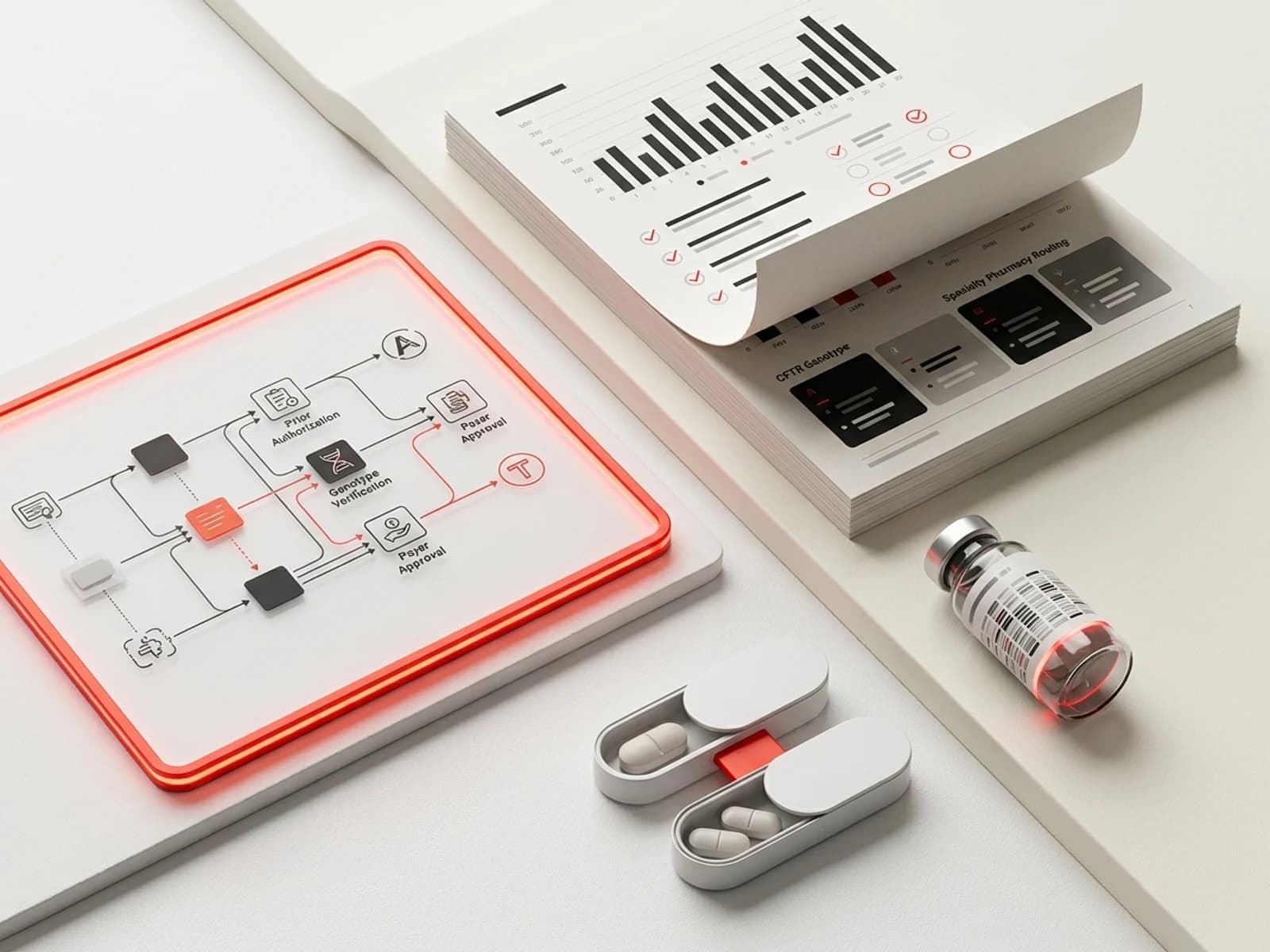
Trikafta (elexacaftor/tezacaftor/ivacaftor and ivacaftor, Vertex Pharmaceuticals) transformed cystic fibrosis treatment when it was approved in October 2019, becoming one of the fastest-launching rare-disease drugs in history. In December 2024, Vertex received FDA approval for Alyftrek (vanzacaftor/tezacaftor/deutivacaftor), a next-generation once-daily triple combination CFTR modulator. On April 1, 2026, the FDA expanded both labels to cover any CFTR gene variant that produces CFTR protein — making approximately 95% of the roughly 40,000 people with CF in the United States eligible for a CFTR modulator, including roughly 800 people newly eligible for the first time.
Access teams face a nuanced landscape where payer policies differ on whether Alyftrek requires prior Trikafta failure, genotype documentation standards vary, and specialty pharmacy routing is tightly controlled. This guide covers the practical access, coverage, and reimbursement issues for both products.
Short answer
| Trikafta | Alyftrek | |
|---|---|---|
| Generic name | elexacaftor/tezacaftor/ivacaftor and ivacaftor | vanzacaftor/tezacaftor/deutivacaftor |
| Manufacturer | Vertex Pharmaceuticals | Vertex Pharmaceuticals |
| FDA approval | October 21, 2019; expanded April 1, 2026 | December 20, 2024; expanded April 1, 2026 |
| Approved ages | 2 years and older | 6 years and older |
| Indication (post-expansion) | CF patients with ≥1 CFTR variant responsive by clinical/in vitro data or that produces CFTR protein | Same |
| Dosing frequency | Twice daily (morning and evening tablets) | Once daily |
| Dosage forms | Oral tablets and granules | Oral tablets (two strengths: 4/20/50 mg and 10/50/125 mg) |
| WAC (per 28-day supply) | ~$27,753 | ~$28,400 |
| Estimated annual cost | ~$370,000 | ~$370,000 |
| Benefit channel | Pharmacy benefit (specialty) | Pharmacy benefit (specialty) |
| PA required | Yes | Yes |
| Copay assistance | Vertex GPS, up to $20,000/year | Vertex GPS, up to $20,000/year |
| Orphan Drug exclusivity | Through March 27, 2033 | Through December 20, 2031 |
April 2026 label expansion
The April 1, 2026 label expansion is the most significant access development for both products. Previously, coverage was limited to patients with at least one F508del mutation or a list of specifically enumerated responsive mutations. The new indication covers any CFTR variant that results in production of CFTR protein, regardless of the variant's location in the protein.
Key implications:
~800 newly eligible patients: patients with rare mutations that produce CFTR protein but were not on the enumerated responsive-mutation lists can now access Trikafta or Alyftrek for the first time.
Genotype documentation: instead of cross-referencing a specific mutation list, providers now need to document that the patient's CFTR variant produces protein. This may require genetic testing reports or lab confirmation of protein production via in vitro data.
Alyftrek covers 46 additional mutations over Trikafta in lab studies, measuring chloride movement in and out of cells. For patients with mutations responsive to Alyftrek but not Trikafta, this creates a direct path to Alyftrek without step therapy.
Genotype documentation for PA
CFTR genotype confirmation is the foundational PA requirement across all payers. The documentation must demonstrate that the patient has at least one CFTR variant that meets the approved indication.
Required documentation
CF diagnosis: clinical diagnosis of cystic fibrosis confirmed by sweat chloride testing, nasal potential difference, or CFTR genetic testing per CFF consensus guidelines
CFTR genotype: confirmed by genetic testing. If the patient's genotype is unknown, an FDA-cleared CF mutation test should be used to detect the presence of a CFTR mutation, followed by verification with bidirectional sequencing when recommended by the test's instructions for use
Mutation-specific responsiveness:
For F508del: direct documentation of at least one F508del allele
For responsive mutations: reference to the product's prescribing information list of responsive mutations
For the expanded indication (post-April 2026): documentation that the variant results in production of CFTR protein, supported by clinical data, in vitro data, or reference to Vertex's mutation database
Age verification: Trikafta for age ≥2 years; Alyftrek for age ≥6 years
Liver function tests: baseline LFTs required before initiation (boxed warning for liver injury). Monitoring: monthly for first 6 months, then every 3 months for the next 12 months, then at least annually
Mutation lookup
Vertex maintains a patient-facing eligibility tool at alyftrek.com/eligibility where patients and providers can enter their two CFTR mutations to check eligibility for both Trikafta and Alyftrek. The tool also handles complex/compound mutations (entered as semicolon-separated values). Access teams should document the mutation pair and the eligibility result.
Payer PA criteria
UnitedHealthcare
Trikafta (Program 2025 P 2180-8, effective 05/01/2025):
Diagnosis of CF confirmed by genetic testing showing at least one F508del mutation or a responsive mutation
Age ≥2 years
Authorization duration: 12 months
Reauthorization: 12-month intervals, no additional clinical criteria beyond ongoing use
UHC may use automated approval based on claims history and diagnosis codes
Alyftrek (Program 2025 P 2363-2, effective 07/01/2025):
Diagnosis of CF, age ≥6 years, confirmed genotype per label
Step therapy — one of three paths:
Documented trial and failure, contraindication, or intolerance to Trikafta; or
Documented CFTR mutation responsive to Alyftrek but not responsive to Trikafta (per Trikafta prescribing information); or
Patient is currently on Alyftrek therapy as documented by claims history (grandfathering for patients started via sample or Vertex GPS support)
UHC explicitly excludes patients who received manufacturer samples or Vertex GPS copay assistance from the "current user" pathway — these patients must meet initial authorization criteria as if new to therapy
Authorization duration: 12 months
Prime Therapeutics / Accord Health
Prime Therapeutics' CFTR PAQL Program (effective 04/01/2025) covers both Trikafta and Alyftrek across its formulary tiers:
Both products listed on Accord Enhanced, Accord Standard, Choice NetR-A Select, Choice NetR-F Performance, and Choice NetR-HIM formularies
Initial authorization requires CF diagnosis, genotype confirmation per label, and age requirement
Reauthorization: 12 months with documentation of continued use
Quantity limits apply per product strength and days supply
CareSource
CareSource covers both Trikafta and Alyftrek under pharmacy benefit with PA requirements:
CF diagnosis with confirmed genotype
Specialist prescribing (pulmonologist or CF center physician)
Reauthorization requires documentation of continued clinical benefit
Medicaid vs commercial differences
Medicaid programs generally follow similar clinical criteria to commercial plans but with notable differences:
More restrictive step therapy: some state Medicaid programs require trial of the least expensive CFTR modulator (e.g., generic or oldest product) before Trikafta or Alyftrek
No copay assistance: Medicaid patients are not eligible for manufacturer copay cards or Vertex GPS copay assistance (federal anti-kickback statute)
EPSDT obligation: for patients under 21, Medicaid's Early and Periodic Screening, Diagnostic, and Treatment (EPSDT) mandate requires coverage of all medically necessary CFTR modulators regardless of formulary position
Prior authorization turnaround: state Medicaid programs may have longer PA processing times than commercial plans, requiring earlier submission
Alyftrek vs Trikafta: when payers allow direct Alyftrek
The key access friction is whether a payer requires Trikafta failure before Alyftrek. Three scenarios:
Mutation responsive to Alyftrek only: if the patient's CFTR mutation is responsive to Alyftrek but not to Trikafta (per each product's mutation list), payers generally allow direct Alyftrek initiation. UHC explicitly provides this pathway in its PA criteria.
Trikafta intolerance or failure: documented adverse reaction (hepatic toxicity, cataracts in pediatric patients, drug interactions) or inadequate clinical response to Trikafta justifies switching to Alyftrek.
Once-daily preference: some payers may accept once-daily adherence as a clinical rationale for Alyftrek, but this is plan-specific and not guaranteed. Document the clinical reason a twice-daily regimen is impractical (adolescent patients, complex regimens, documented missed doses).
Specialty pharmacy routing
Both Trikafta and Alyftrek are dispensed exclusively through specialty pharmacies. Vertex controls distribution through a select group of specialty pharmacies and authorized distributors.
Key specialty pharmacies
Accredo (Express Scripts)
CVS Specialty
AllianceRx Walgreens Prime
BriovaRx (Optum)
Vertex-designated specialty distributors
Routing considerations
Plan-specific SP requirement: most commercial and Medicaid plans designate a single preferred specialty pharmacy. Check the plan's formulary or call the payer to confirm the correct SP before submitting the prescription.
Vertex GPS enrollment: the Vertex GPS Guidance & Patient Support program can coordinate benefits verification and SP routing. The provider or patient enrolls at vertexgpshcp.com or by calling Vertex GPS.
Transfers between SPs: if the patient changes insurance, the prescription may need to be transferred to the new plan's designated SP. This can take 2–4 weeks and should be initiated before the current supply runs out.
Refill timing: 28-day carton for Alyftrek, 28-day supply for Trikafta. Schedule refills to arrive 5–7 days before the current supply is exhausted.
Vertex GPS patient support program
Vertex GPS (Guidance & Patient Support) is the manufacturer support program for all Vertex CF medicines, including Trikafta and Alyftrek.
Benefits verification
Vertex GPS Patient Support Specialists verify insurance coverage and out-of-pocket costs
They contact the patient's healthcare provider to discuss any PA requirements
Typical turnaround: 2–5 business days for benefits verification
Copay assistance
Commercially insured patients may pay as little as $0 per fill
Annual assistance up to $20,000
Not available for patients with government insurance (Medicare, Medicaid, Tricare, VA)
Patients must re-enroll annually
Patient Assistance Program (PAP)
For uninsured or underinsured patients who meet income eligibility criteria
Provides medication at no cost
Vertex GPS coordinates enrollment
Bridge supply
Vertex GPS may provide bridge supply for patients experiencing insurance delays
Available for patients with confirmed prescriptions and pending PA
Reauthorization and renewal
Both products require periodic reauthorization, typically every 12 months:
Continued use documentation: claims history showing ongoing prescriptions filled, or chart notes confirming continued use
Clinical benefit: some plans request documentation of clinical response (stable or improved lung function, reduced exacerbations, maintained or improved BMI). Most major plans (UHC, Prime) approve reauthorization based on continued use without additional clinical evidence.
LFT monitoring: ongoing liver function monitoring per label (monthly for first 6 months, quarterly for next 12 months, then annually)
No contraindications: documentation that no new contraindications have emerged (e.g., new cataract diagnosis in pediatric patient)
Cost and coverage landscape
WAC: Trikafta ~$27,753 per 28-day supply; Alyftrek ~$28,400 per 28-day carton
Annual list price: ~$370,000 for both products
Gross-to-net: Vertex's actual realized prices are significantly lower after rebates, 340B, Medicaid, and Medicare Part D negotiations
Coverage: Vertex reports that >90% of commercially and Medicare insured CF patients have coverage for CFTR modulators
Out-of-pocket: with Vertex GPS copay assistance, commercially insured patients may pay $0 per fill (up to the $20,000 annual cap)
Orphan Drug exclusivity: Trikafta's original F508del exclusivity expires October 21, 2026. The April 2026 expanded indication carries exclusivity through March 27, 2033. Alyftrek exclusivity through December 20, 2031
Documentation checklist for PA submission
ICD-10 code: E84.0 (CF with pulmonary manifestations), E84.1 (CF with intestinal manifestations), E84.8 (CF with other manifestations), E84.9 (CF unspecified)
CF diagnosis documentation: sweat chloride test, nasal potential difference, or genetic testing confirming CF
CFTR genotype report: confirmed by FDA-cleared CF mutation test or bidirectional sequencing
Mutation responsiveness: reference to prescribing information mutation list or documentation of protein production (post-April 2026 expansion)
Age verification: Trikafta ≥2 years; Alyftrek ≥6 years
Baseline LFTs: ALT, AST, bilirubin within acceptable range
Specialist attestation: prescribed by pulmonologist, CF center physician, or pediatric pulmonologist
For Alyftrek step therapy: documented Trikafta trial/failure, mutation not responsive to Trikafta, or current Alyftrek use via claims history
Concurrent medications: list all current CF therapies (dornase alfa, hypertonic saline, TOBI, cayston, etc.)
Vertex GPS enrollment confirmation (optional but expedites SP routing)
Key takeaways for access teams
The April 2026 label expansion means approximately 800 more CF patients are eligible — access teams should proactively identify patients with non-F508del protein-producing variants who were previously denied coverage.
Alyftrek's access path requires navigating step therapy: UHC requires Trikafta failure or a mutation responsive only to Alyftrek. Document the specific rationale before submitting PA.
Genotype documentation is the linchpin: every payer requires confirmed CFTR genotype. Use an FDA-cleared mutation test and keep the full genetic report available for PA submission.
Specialty pharmacy routing is plan-controlled: confirm the designated SP before sending the prescription. Vertex GPS can coordinate but needs the plan information upfront.
Vertex GPS copay assistance covers up to $20,000/year for commercially insured patients — enroll patients early and re-enroll annually. Medicaid and Medicare patients are not eligible for copay cards.
Alyftrek is once-daily; Trikafta is twice-daily: for patients with adherence challenges, document the clinical rationale for the once-daily formulation as part of the PA case.
Sources
FDA. Search Orphan Drug Designations and Approvals: elexacaftor, tezacaftor, and ivacaftor (Trikafta). https://www.accessdata.fda.gov/scripts/opdlisting/oopd/detailedIndex.cfm?cfgridkey=647618
FDA. Alyftrek (vanzacaftor/tezacaftor/deutivacaftor) Prescribing Information. NDA 218730. December 20, 2024. https://www.accessdata.fda.gov/drugsatfda_docs/label/2024/218730s000lbl.pdf
Vertex Pharmaceuticals. FDA Label Extensions for ALYFTREK and TRIKAFTA. Press release. April 1, 2026. https://news.vrtx.com/news-releases/news-release-details/vertex-announces-us-fda-approval-label-extensions-alyftrekr-and
Vertex Pharmaceuticals. Trikafta Prescribing Information. December 2024. https://www.accessdata.fda.gov/drugsatfda_docs/label/2026
UnitedHealthcare. Trikafta PA/Medical Necessity. Program 2025 P 2180-8. Effective 05/01/2025. uhcprovider.com
UnitedHealthcare. Alyftrek PA/Medical Necessity. Program 2025 P 2363-2. Effective 07/01/2025. uhcprovider.com
Prime Therapeutics. CFTR Prior Authorization with Quantity Limit Program Summary. Effective 04/01/2025. primetherapeutics.com
CareSource. CFTR Modulator Pharmacy Policy Statement. caresource.com
Vertex GPS. Guidance & Patient Support Program. vertexgpshcp.com
Alyftrek. Check Your Eligibility. alyftrek.com/eligibility
Cystic Fibrosis Foundation. FDA Expanded Approval for Trikafta and Alyftrek. April 1, 2026. cysticfibrosisfoundation.org
Pharmacy Times. FDA Approves Alyftrek, Once-Daily CFTR Modulator for Cystic Fibrosis. December 2024. pharmacytimes.com
VativoRx. Pharmacy Bulletin: Alyftrek Approval. December 2024/January 2025. vativorx.com