On October 3, 2025, the Colorado Prescription Drug Affordability Board voted unanimously to set the first-ever state upper payment limit (UPL) on a prescription drug. The UPL for Enbrel (etanercept) — $600 per 50 mg/mL unit, approximately $31,200 per year — takes effect January 1, 2027. The average insurance plan in Colorado paid approximately $53,049 per patient per year for Enbrel in 2023, meaning the UPL represents a roughly 41% reduction in the reimbursement ceiling.
Colorado's action is the proof of concept that state PDABs have been building toward since Maryland created the first board in 2019. As of early 2026, ten states have established PDABs or equivalent bodies, four states have UPL authority, and at least eleven additional states have introduced or considered PDAB legislation. For market access teams planning launches or managing the commercial lifecycle of specialty drugs, PDABs are no longer a theoretical policy discussion. They are an active pricing and channel risk.
What PDABs Do and How UPLs Work
A Prescription Drug Affordability Board is a state-level regulatory body charged with identifying prescription drugs that create affordability challenges for the state's healthcare system and consumers. PDAB authority varies by state, but typically includes some combination of:
Drug cost transparency reporting
Affordability reviews of high-cost drugs
Policy recommendations to the legislature
Setting upper payment limits
A UPL is not a price cap on what a manufacturer can charge. It is a reimbursement ceiling: the maximum amount that purchasers and payers within the state can be required to pay for the drug. The National Academy for State Health Policy (NASHP), which developed the model legislation used by most PDAB states, defines a UPL as "the maximum reimbursement rate above which purchasers throughout the state may not pay for prescription drug products."
The practical effect: if a pharmacy's acquisition cost for a drug exceeds the UPL, the pharmacy loses money on every dispense. If a specialty pharmacy cannot negotiate a manufacturer contract that brings its acquisition cost below the UPL, it may stop stocking the drug in that state. Charles River Associates' analysis of UPL implementation notes that "UPLs, by setting a reimbursement limit likely below a drug's acquisition cost, have the potential to disrupt the pharmaceutical supply chain, threatening patient access to treatments."
The Four States with UPL Authority
Colorado — First Mover, Legal Challenges Pending
Colorado's PDAB was established in 2021. The board conducted affordability reviews of five drugs and found three unaffordable: Enbrel, Stelara, and Cosentyx. It selected Enbrel for the first UPL.
Key facts for launch teams:
UPL basis: Medicare Maximum Fair Price (MFP), rounded to the nearest hundred. The Colorado board "contended that [MFP] is a negotiated price that leverages federal research and mechanisms, is significantly lower than other benchmarks, and could lead to savings for payers and consumers."
Scope: All payers for prescription drug purchases made within Colorado, including state agencies, state employee plans, Medicaid, and state-regulated commercial plans. ERISA self-funded plans are exempt.
Effective date: January 1, 2027.
Legal challenge: Amgen filed a second lawsuit on October 30, 2025, asserting federal patent preemption, due process violations, and Dormant Commerce Clause violations. The Congressional Research Service reports that Amgen's second complaint "articulates the harm that Amgen claims it will suffer if the UPL takes effect in January 2027." The outcome of this litigation will determine whether UPLs survive constitutional challenge — and every other state PDAB is watching.
Covered lives impacted: Per Avalere Health's December 2025 analysis, approximately 7.8 million individuals (2.28% of total US covered lives) are enrolled in UPL-eligible markets across PDAB states with UPL authority. Within PDAB states, 30–55% of covered lives are in UPL-eligible markets (state-regulated commercial and Medicaid).
Maryland — Expanding to Commercial Plans
Maryland created the first PDAB in 2019 with limited authority over state and local government purchases. In 2025, the legislature passed SB 357/HB 424, expanding UPL authority to all payers in the state — including commercial plans — contingent on the board first implementing UPLs on two drugs for government entities and maintaining them for one year.
Maryland's board selected six drugs for review: Jardiance, Farxiga, Ozempic, Trulicity, Dupixent, and Skyrizi. As of November 2025:
Jardiance and Farxiga: The board voted to move forward with setting UPLs based on Medicare MFP. For Farxiga, the MFP is $5.95 per unit ($178.50 for a 30-day supply). For Jardiance, the MFP is $6.57 per unit ($197 for a 30-day supply). PDAB staff estimated that a Jardiance UPL at MFP would save state and local governments approximately $4.9 million, though this does not account for existing rebates.
Ozempic and Trulicity: The board identified both as creating affordability challenges and began the policy review process. Trulicity's review noted that the WAC increase substantially exceeded inflation and that total gross spending by state and local governments exceeded 2.27% of gross prescription drug spending.
Dupixent and Skyrizi: Affordability reviews expected in early 2026.
Maryland Matters reported that county executives from Montgomery, Anne Arundel, Charles, and Howard counties testified urging the board to move quickly on UPLs. The board's UPL Action Plan proposes five potential UPL methodologies: MFP (floor — UPL cannot be below MFP), Most Favored Nation pricing referencing UK/Germany/France/Canada list prices, therapeutic class reference pricing, the lowest net price paid by payers in other states, and launch reference pricing if the price increase exceeds inflation.
Commercial plan UPLs could take effect as early as summer 2026, one year after government-entity UPLs are implemented.
Minnesota — MFP Tethered by Statute
Minnesota's PDAB has a unique statutory provision: "When setting an upper payment limit for a drug subject to the Medicare maximum fair price under United States Code, title 42, section 1191(c), the board shall set the upper payment limit at the Medicare maximum fair price." This means that for any drug with an MFP, Minnesota's UPL is locked to the federal negotiated price.
Minnesota's board is newer and spent 2025 building infrastructure for affordability reviews. NASHP's April 2026 presentation to the Minnesota board featured a detailed briefing from the Maryland PDAB on its process, suggesting Minnesota is accelerating its review timeline by learning from Maryland's experience.
Washington — Preparing for Reviews
Washington's PDAB selected Enbrel, Xtandi, Cabometyx, and Humira for affordability reviews in July 2025. However, the board pushed the start of reviews to at least March 2026 to collect and analyze drug data.
Washington has proposed setting UPLs using Medicare MFP or Canadian list prices. The state is prohibited from using Quality-Adjusted Life Years (QALYs) to set UPLs. At its March 2026 meeting, the board discussed UPL methodologies and prepared its 2026 eligible drug list.
States with PDABs but No UPL Authority (Yet)
Oregon
Oregon's PDAB selected 23 drugs for affordability review in 2025. The Governor and legislature authorized the board to extend the 2025 review process into 2026. A final affordability report identifying at least 9 drugs as unaffordable, along with policy recommendations, is expected by March 2026.
Critically, Oregon's PDAB does not currently have UPL authority and notably opted not to include a UPL authority recommendation in its 2025 annual report. However, if other states demonstrate that UPLs survive legal challenge and reduce costs without disrupting access, Oregon's legislature could grant UPL authority in future sessions.
Maine, New Jersey, New Hampshire, Ohio, Massachusetts
These states have established PDABs or similar bodies with varying mandates. Goodwin's 2025 update identifies New Jersey and Ohio as "dormant" — boards exist but have not conducted meaningful affordability reviews. Maine, New Hampshire, and Massachusetts have transparency and reporting mandates but no UPL authority.
States Considering PDAB Legislation
As of early 2026, legislation to create PDABs has been introduced or considered in Arizona, Illinois, Iowa, Kansas, Kentucky, Michigan, Nebraska, Pennsylvania, Rhode Island, South Carolina, Virginia, Vermont, Wisconsin, and West Virginia. Virginia's General Assembly passed PDAB legislation with UPL authority for the second consecutive year in 2025 but was vetoed by Governor Glenn Youngkin, who cited concerns about patient access and medical innovation.
Magnolia Market Access's PDAB tracker lists 30 bills introduced across these states during the 2024–2025 legislative sessions.
How UPLs Interact with the IRA and Medicare MFP
The Inflation Reduction Act's Medicare Drug Price Negotiation Program establishes MFPs for selected drugs. Colorado and Maryland both use MFP as a UPL benchmark. This creates a direct link between federal price negotiation and state-level price ceilings:
If a drug has an MFP, states with MFP-tethered UPLs (Colorado, Minnesota, and potentially Maryland) will set their UPL at or near the MFP. For drugs with MFPs significantly below WAC, the commercial and Medicaid reimbursement ceiling in those states drops to the MFP level — not just for Medicare, but for all state-regulated payers.
If a drug does not have an MFP, PDABs must use alternative benchmarks: international reference pricing, therapeutic class comparisons, or other methodologies. These can produce UPLs that are even lower relative to WAC than MFP-based UPLs.
The MFP floor in Maryland. Maryland's enabling legislation prohibits the PDAB from setting a UPL below the MFP for drugs that have one. This means MFP acts as a floor, not a ceiling, for Maryland UPLs on MFP drugs.
For market access teams, the interaction means that the commercial exposure from IRA price negotiation now extends beyond Medicare into state-regulated commercial and Medicaid markets in PDAB states. The Avalere analysis estimates that 7.8 million covered lives are in UPL-eligible markets — and that number will grow as more states establish PDABs and existing PDABs expand their reviews.
Launch-Risk Assessment Framework
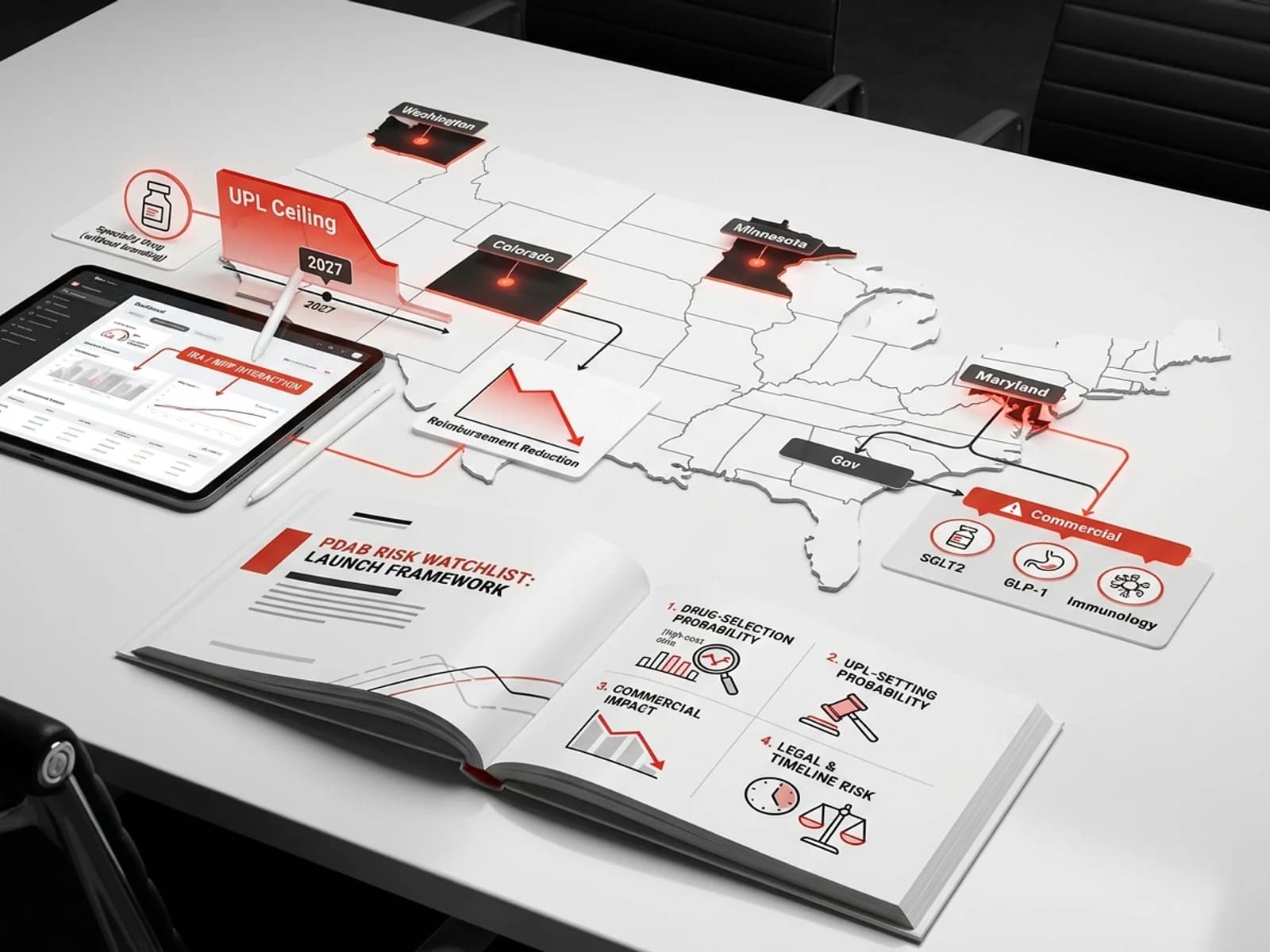
For a product approaching launch, market access teams should assess PDAB exposure across four dimensions:
1. Drug-Selection Probability
PDABs typically focus on high-cost drugs. Common selection criteria include:
WAC of $30,000 or more per year
WAC increases substantially exceeding inflation over the drug's market life
High total spending by state and local governments
Therapeutic alternatives available (relevant for the unaffordability determination)
Colorado found that Enbrel's WAC had increased 1,582% since its 1998 approval — a data point the board used to support its unaffordability determination.
2. UPL-Setting Probability
Even if a drug is selected for review, the PDAB may not set a UPL. Colorado reviewed five drugs, found three unaffordable, but has only set a UPL for Enbrel. The board can choose non-UPL policy recommendations instead — such as WAC inflation penalties, patient navigator programs, or PBM compensation reform.
3. Commercial Impact
Model the revenue exposure by:
Identifying which PDAB states represent significant prescribing volume for the product
Estimating the UPL level (MFP-based, international reference, or other benchmark)
Calculating the gap between the UPL and the product's current net price in each state
Factoring in the percentage of covered lives in UPL-eligible markets (30–55% of total lives in PDAB states, per Avalere)
4. Legal and Timeline Risk
Track Amgen v. Mizner in Colorado. If the court strikes down Colorado's UPL, other states' UPL programs face immediate legal uncertainty.
Model the effective date: most UPLs take 12–18 months from affordability review to implementation.
Account for the expansion trigger in Maryland: UPLs on two drugs for government entities must be in effect for one year before commercial-plan UPLs become possible.
Implications for Specific Drug Classes
Immunology and autoimmune (TNF inhibitors, IL-23 inhibitors): Enbrel, Stelara, Humira, Skyrizi, and Dupixent are all under active PDAB review in one or more states. These drugs combine high WAC, large patient populations, and the availability of biosimilar or therapeutic alternatives — the factors PDABs weigh most heavily.
SGLT2 inhibitors (Jardiance, Farxiga): Under active UPL consideration in Maryland. Both have MFPs from IRA negotiation, giving PDABs a ready-made benchmark.
GLP-1 receptor agonists (Ozempic, Trulicity): Identified as affordability challenges in Maryland. Trulicity's WAC increase and high government spending triggered the preliminary determination. These drugs' high volume and high cost make them inevitable PDAB targets in every state that establishes a board.
Oncology: Xtandi and Cabometyx are under review in Washington. Oncology drugs face a different PDAB dynamic — fewer therapeutic alternatives may make it harder for boards to find a drug "unaffordable" when no equivalent treatment exists.
Sources
Colorado Consumer Health Initiative. Consumer Advocates Praise Prescription Drug Affordability Board's Decision to Set First-in-Nation Upper Payment Limit on Enbrel. October 3, 2025. https://cohealthinitiative.org/media-releases/consumer-advocates-praise-prescription-drug-affordability-boards-decision-to-set-first-in-nation-upper-payment-limit-on-the-expensive-drug-enbrel
Congressional Research Service. Litigation over State Attempts to Lower Drug Costs: Prescription Drug Affordability Boards (PDABs). https://www.everycrsreport.com/reports/LSB11390.html
Avalere Health. PDABs Affect Nearly 8 Million Commercial and Medicaid Lives. December 2025. https://advisory.avalerehealth.com/insights/pdabs-affect-nearly-8-million-commercial-and-medicaid-lives
MultiState. Here's What Prescription Drug Affordability Boards Have Been Doing in 2025. December 15, 2025. https://www.multistate.us/insider/2025/12/15/heres-what-prescription-drug-affordability-boards-have-been-doing-in-2025-upls-affordability-reviews-and-expanded-authority
Charles River Associates. Upper Payment Limits (UPLs) Explained. December 2025. https://media.crai.com/wp-content/uploads/2025/12/15121242/CRA-LS-Upper-Payment-Limits-Explained-December2025.pdf
Maryland PDAB. Annual Report 2025. https://pdab.maryland.gov/Documents/meetings/2025/PDAB%20Annual%20Report%202025%20-%20Final%20Version%20%281%29.pdf
Maryland Matters. Maryland Board Moves to Set Ceiling on What State Will Pay for Jardiance, Farxiga. November 17, 2025. https://marylandmatters.org/2025/11/17/maryland-board-moves-to-set-ceiling-on-what-state-will-pay-for-jardiance-fargixa
Goodwin. Prescription Drug Affordability Review Boards — 2025 Update. June 2025. https://www.goodwinlaw.com/en/insights/publications/2025/06/alerts-lifesciences-prescription-drug-affordability-review-boards
CMS. Medicare Drug Price Negotiation Program. https://www.cms.gov/medicare/coverage/prescription-drug-coverage
NASHP. Q&A on NASHP's Model Act to Reduce the Cost of Prescription Drugs. https://nashp.org/qa-on-nashps-model-act-to-reduce-the-cost-of-prescription-drugs-by-establishing-a-prescription-drug-affordability-board
Magnolia Market Access. Prescription Drug Affordability Boards (PDABs). https://www.magnoliamarketaccess.com/prescription-drug-affordability-boards-pdabs
NASPA. Prescription Drug Affordability Boards: Potential Risks to Pharmacy Reimbursement. https://naspa.us/resource/pdab
Colorado Sun. Colorado Board Sets Historic Price Cap on Prescription Drug Enbrel. October 7, 2025. https://coloradosun.com/2025/10/07/prescription-drug-affordability-board-enbrel-upl
Maryland PDAB Presentation to Minnesota PDAB. April 2026. https://mn.gov/commerce-stat/insurance/pdab/2026/4-14-2026/maryland_pdab_for_minnesota_final.pdf
Washington State Health Care Authority. Prescription Drug Affordability Board. https://www.hca.wa.gov/about-hca/programs-and-initiatives/clinical-collaboration-and-initiatives/prescription-drug-affordability-board
NASHP/NJ Consumer Affairs. PDAB Slideshow. April 2025. https://www.njconsumeraffairs.gov/dau/Documents/NASHP-PDAB-NJPDAC-slideshow-042025.pdf