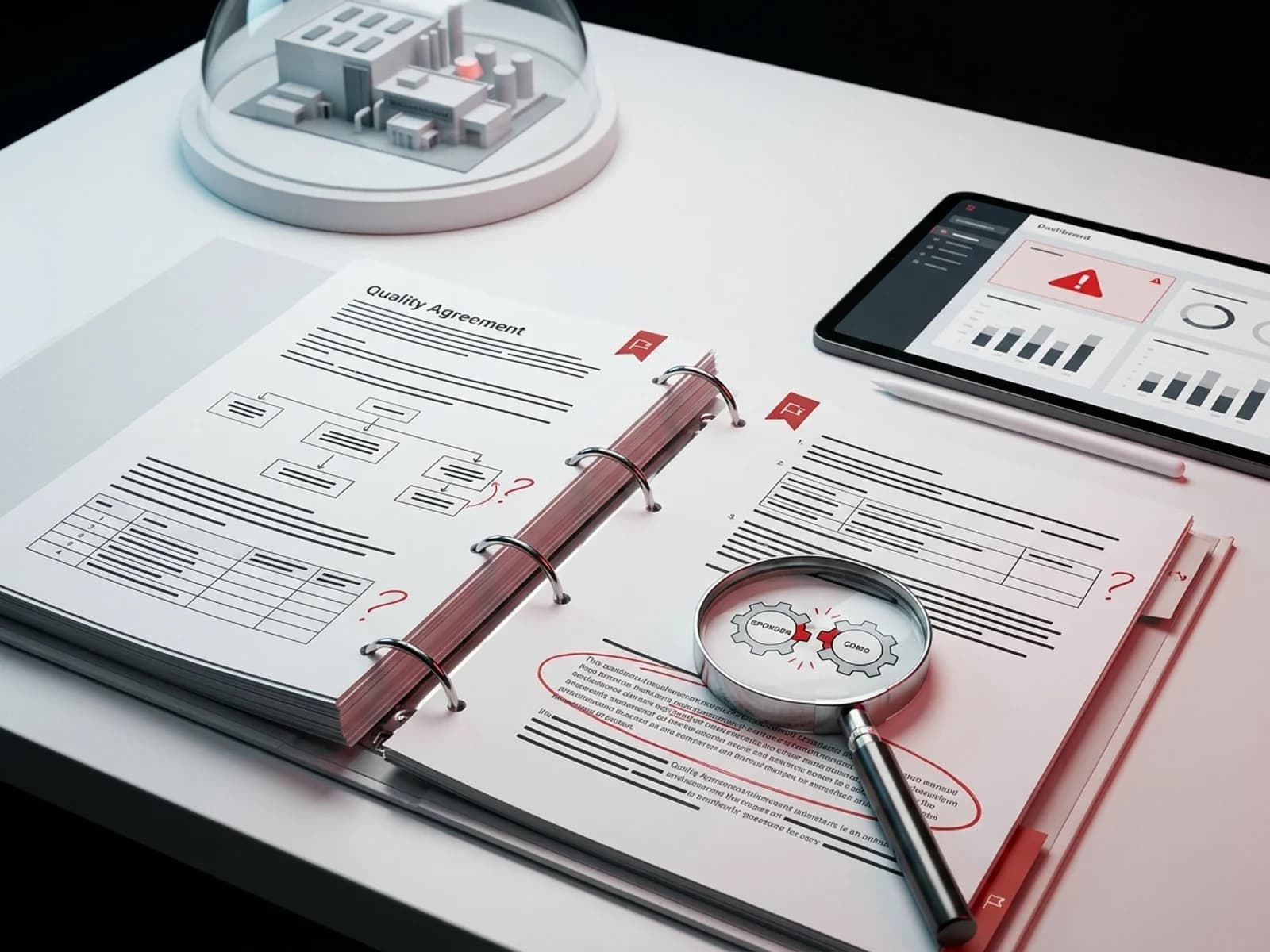
A pre-approval inspection (PAI) is not a routine surveillance visit. It is a product-specific, application-driven evaluation that directly determines whether FDA will approve a new drug or biologic on its PDUFA goal date. Compliance Program 7346.832 defines the inspection objectives, the coverage strategy, and the criteria FDA uses to decide whether a facility passes or fails. For a launch-critical facility—one that must be approved before commercial supply can begin—the PAI is the gate.
This article is for regulatory affairs leads, quality directors, and manufacturing heads preparing a facility for a PAI under time pressure. It maps FDA's inspection framework, the common readiness failures that produce 483 observations, and the preparation timeline that minimizes approval risk.
FDA's PAI program: what drives the inspection
When FDA decides to inspect
FDA does not inspect every facility named in every application. The Office of Regulatory Affairs (ORA) and the reviewing center (CDER or CBER) conduct a facility risk assessment and determine whether a PAI is needed. Compliance Program 7346.832 defines priority criteria that make a PAI more likely:
| Priority criterion | Implication for launch team |
|---|---|
| Facility named for the first time in an NDA, ANDA, or BLA | PAI virtually certain |
| Facility has not been inspected within the past two years for the relevant profile class | PAI likely |
| Previous inspection resulted in an Official Action Indicated (OAI) classification | PAI virtually certain; heightened scrutiny |
| Complex manufacturing process (biologics, sterile products, novel delivery systems) | PAI likely |
| CGMP compliance status is unknown or unfavorable | PAI virtually certain |
For biologics, FDA's updated Compliance Program 7346.832M (effective for pre-license inspections) consolidates coverage under two primary objectives: Application Commitments and CGMP Compliance, and Data Integrity Audit. The biologics version incorporates additional sub-objectives covering production and process controls, laboratory control systems, and packaging and labeling operations.
Timing: when the inspection happens
FDA's goal is to notify the facility at least 60 days in advance for original NDAs, and no later than midcycle. For BLAs and complex biologics, the timeline may be compressed. The inspection typically occurs two to six months before the PDUFA goal date, and lasts three to five days. In May 2025, FDA announced it would expand unannounced inspections of non-U.S. manufacturing sites, eliminating the advance notice that overseas facilities previously relied on for preparation.
What happens if the PAI fails
A failed PAI does not automatically mean the application is rejected. FDA's lead investigator makes a recommendation—No Action Indicated (NAI), Voluntary Action Indicated (VAI), or OAI—to the reviewing center. An OAI recommendation triggers a cascading process: the applicant must respond to Form 483 observations, implement corrective actions, and may face a re-inspection. In practice, significant PAI findings have delayed approvals by six to eighteen months.
The inspection objectives: what FDA evaluates
Objective 1: Readiness for Commercial Manufacturing
This is the core objective for a launch-critical facility. FDA evaluates whether the establishment has a quality system designed to achieve sufficient control over the facility and commercial manufacturing operations. Under the updated CPGM 7346.832, this objective breaks into six sub-objectives:
1a: Manufacturing and laboratory capabilities, changes, deviations, and trends have been adequately evaluated to ensure readiness for manufacturing.
1b: A sound program for sampling, testing, and evaluating components, containers, and closures exists.
1c: Adequate contamination controls are in place (particularly critical for sterile manufacturing).
1d: Production and process controls support commercial manufacturing operations.
1e: The laboratory control system is capable of performing all required testing.
1f: Packaging, labeling, storage, and shipping operations are adequate.
For biologics under CPGM 7346.832M, Objective 1 is titled "Application Commitments and Applicable CGMP Requirements Compliance" and emphasizes conformance to the BLA commitments alongside CGMP compliance.
Objective 2: Conformance to Application
FDA verifies that the formulation, manufacturing methods, and analytical methods in the facility match what is described in the CMC section of the application. Investigators compare batch records, process parameters, and test methods against the submission. Any discrepancy between the application and the actual facility practice is a finding.
Objective 3: Data Integrity Audit
Investigators audit raw data, both hardcopy and electronic, to authenticate the data submitted in the CMC section. They verify completeness: all relevant data were submitted, no data were omitted or selectively reported, and electronic records comply with 21 CFR Part 11 requirements for audit trails, access controls, and data backup.
Objective 4: Commitment to Quality in Pharmaceutical Development
This objective evaluates whether the establishment's pharmaceutical development program is "supported, defined, managed, and continuously assessed for its effectiveness as well as its use in supporting continual improvement" of the pharmaceutical quality system. It is particularly relevant for facilities where development and commercial manufacturing coexist.
The most common readiness failures
Failure 1: Incomplete process validation
Process validation is the single most common PAI gap for launch-critical facilities. FDA expects that commercial-scale process validation will be complete—or at a minimum, the protocol will be approved and execution will be underway—before the PAI. Facilities that have not completed process validation, or that have validation reports with open deviations, are at high risk for a 483 observation citing 21 CFR 211.100(a) (written procedures for production and process control) and 211.110(a) (in-process controls).
FDA's process validation guidance (January 2011) defines three stages: Process Design, Process Qualification, and Continued Process Verification. Stage 2 (Process Qualification) must demonstrate that the commercial manufacturing process, operating within its defined control strategy, can reproducibly produce product meeting its quality attributes.
Failure 2: Data integrity gaps in laboratory systems
Data integrity findings have increased steadily since FDA's 2012 enforcement initiative. In a PAI context, the most common laboratory findings are:
Chromatography data systems with disabled audit trails or shared login credentials
Missing or incomplete out-of-specification investigations
Unreported reprocessing or retesting of samples
Electronic records that do not comply with 21 CFR Part 11
For a launch-critical facility, the laboratory control system is covered under Objective 1e. Investigators will request chromatograms, raw data, and audit trail reports for the batches referenced in the BLA or NDA submission.
Failure 3: Discrepancies between the application and the facility
FDA investigators compare the CMC section of the application against what they observe in the facility. Common discrepancies include:
Equipment described in the application that has been replaced or relocated
Process parameters in batch records that do not match the ranges in the application
Analytical methods that have been modified without a corresponding supplement
Raw material specifications that differ from what was submitted
Any discrepancy is a finding under Objective 2. For biologics, even minor differences in cell culture conditions, purification parameters, or fill-finish operations can trigger questions about whether the product manufactured commercially is the same product that was evaluated in clinical trials.
Failure 4: Quality system gaps in deviation and change control
FDA evaluates the quality system's ability to manage deviations, implement corrective actions, and control changes. Common findings include:
Deviation investigations that attribute root causes to "operator error" without supporting data
CAPA records that are opened but never closed
Change control records that lack impact assessments or regulatory notifications
Annual product reviews that are incomplete or overdue
Under 21 CFR 211.22(a), the quality unit must have sufficient authority and resources to fulfill its responsibilities. A quality system that cannot demonstrate effective oversight of deviations and changes will be cited regardless of whether any specific deviation has caused a product quality issue.
Failure 5: Inadequate training documentation
Investigators will request training records for personnel involved in manufacturing, testing, and quality operations. Training records must demonstrate that each employee has been trained on the specific procedures they perform, that training was completed before they began performing those procedures, and that ongoing training is documented.
The preparation timeline
12-18 months before expected PAI: Mock inspection
Schedule a comprehensive mock PAI led by a team that includes former FDA investigators or experienced compliance consultants. The mock inspection should cover all four objectives and produce a gap report with prioritized remediation actions. Mock inspections conducted 12-18 months in advance allow sufficient time for complex remediation, such as laboratory system upgrades, process validation campaigns, or data integrity program overhauls.
6-12 months before expected PAI: Gap remediation
Execute the remediation plan from the mock inspection. Priority areas:
Complete Stage 2 process validation (minimum three consecutive batches)
Resolve all open deviations and CAPAs
Verify that all electronic systems comply with 21 CFR Part 11
Ensure batch records match the CMC section of the application
Complete training on all procedures for all relevant personnel
3-6 months before expected PAI: Readiness confirmation
Conduct a second, focused readiness assessment. This is not a full mock inspection but a targeted review of the areas most likely to produce findings:
Data integrity controls in the laboratory
Completeness and accuracy of the BLA/NDA-referenced batch records
Currency of standard operating procedures relative to actual practice
Quality system metrics (open deviations, overdue CAPAs, overdue annual reviews)
60 days before expected PAI: Front-room preparation
When FDA provides notification of the inspection (typically 60 days in advance for NDAs), activate the inspection response team:
Assign a designated escort for each investigator
Prepare the "front room" with all requested documents pre-staged
Brief all personnel on communication protocols: answer the question asked, do not volunteer information beyond the scope, and route all requests through the escort
Prepare a facility walkthrough route that demonstrates the manufacturing flow from raw material receipt through finished product release
During the inspection: Daily debriefs
The inspection team should debrief daily, review any observations or requests from the investigators, and prepare responsive documentation overnight. Any potential 483 observations should be identified in real time so that the sponsor can begin preparing responses before the closeout meeting.
After the inspection: 483 response
If FDA issues a Form 483, the sponsor has 15 business days to submit a written response. The response must address each observation individually, describe the root cause investigation, specify corrective actions with completion dates, and provide evidence of implementation where possible. A timely, comprehensive, and well-supported 483 response can prevent an OAI classification and allow the approval to proceed on schedule.
The tightened enforcement landscape
FDA inspection intensity has increased significantly. FY 2025 saw 694 more inspections than FY 2024, and biologics warning letters rose from 15 to 26, a 73% increase. FDA's Quality Management Maturity (QMM) pilot program, which evaluated nine drug manufacturing establishments in 2024, expanded to a third year in February 2026, signaling that oversight will increasingly incorporate systemic measures of facility quality culture beyond the traditional PAI scope.
For sponsors with launch-critical facilities outside the United States, the elimination of advance notice for inspections beginning August 2025 means that continuous readiness is no longer optional. Facilities that previously relied on 60-day notification windows to prepare must now maintain inspection-ready status at all times.
Sources
FDA. Compliance Program 7346.832: Pre-Approval Inspections. https://www.fda.gov/media/121512/download
FDA. Compliance Program 7346.832M: Pre-License and Pre-Approval Inspections for Biologics. https://www.fda.gov/media/191983/download
FDA. Process Validation: General Principles and Practices. January 2011. https://www.fda.gov/media/71021/download
FDA. FDA's Pre-Approval Inspection (PAI) Program and How to Prepare for a Successful Outcome. https://www.fda.gov/files/drugs/published/FDA%E2%80%99s-Pre-Approval-Inspection-%28PAI%29-Program-and-How-to-prepare-for-a-successful-outcome.pdf
FDA. FDA Announces Expanded Use of Unannounced Inspections at Foreign Manufacturing Facilities. May 6, 2025. https://www.fda.gov/news-events/press-announcements/fda-announces-expanded-use-unannounced-inspections-foreign-manufacturing-facilities
IntuitionLabs. FDA Pre-License Inspection (PLI): A Guide for Biologics. 2026. https://intuitionlabs.ai/articles/fda-pre-license-inspection-guide
Spectroscopy Online. Do You Understand the FDA's Updated Approach to Pre-Approval Inspections? https://www.spectroscopyonline.com/view/do-you-understand-fda-s-updated-approach-pre-approval-inspections