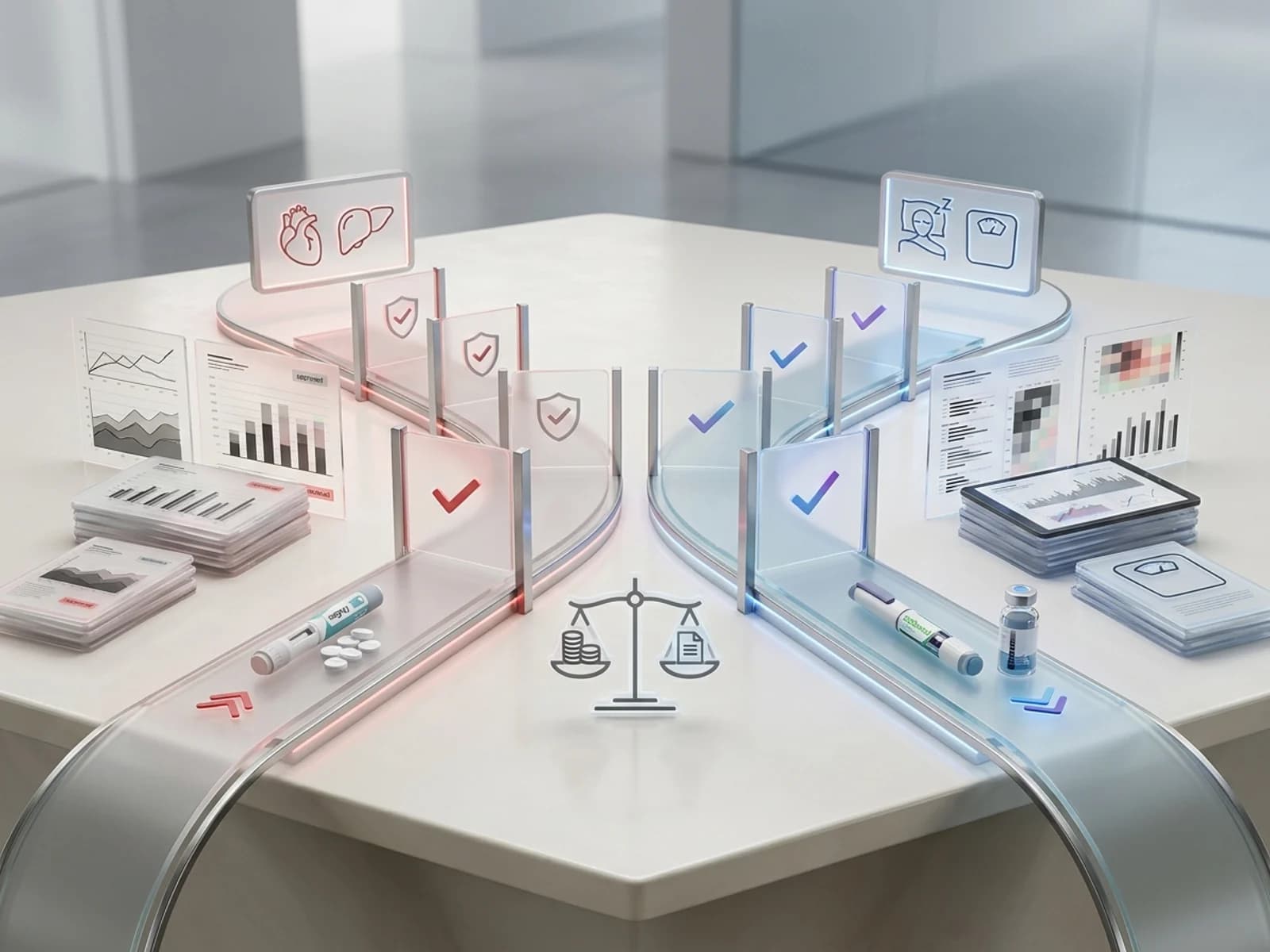
Ozempic (semaglutide) and Mounjaro (tirzepatide) are the two most widely prescribed once-weekly injectable drugs for type 2 diabetes. They are not the same molecule, do not have the same mechanism, and carry meaningfully different FDA indications and payer coverage patterns. Which one a patient receives often depends on their plan's formulary rules, step-therapy requirements, and the specific PA criteria — not just clinical preference.
This comparison is for access teams, prior authorization coordinators, and prescribers who need to understand the practical differences between the two products when navigating coverage.
Short answer
| Ozempic (semaglutide) | Mounjaro (tirzepatide) | |
|---|---|---|
| Manufacturer | Novo Nordisk | Eli Lilly |
| Mechanism | GLP-1 receptor agonist | Dual GIP and GLP-1 receptor agonist |
| FDA indications (injection) | T2D glycemic control; MACE reduction (T2D + CVD); kidney disease risk reduction (T2D + CKD) | T2D glycemic control (adults and pediatric ≥10 years) |
| Max dose | 2 mg weekly | 15 mg weekly |
| Formulations | Prefilled pen (0.25, 0.5, 1, 2 mg) | Prefilled pen and vial (2.5, 5, 7.5, 10, 12.5, 15 mg) |
| Commercial coverage | >80% of plans cover for T2D | Broadly covered for T2D; similar tier placement |
| Medicare Part D | Covered for diabetes/CV/kidney indications | Covered for diabetes indication |
| List price (approx.) | ~$935–$1,000/month | ~$1,023–$1,080/month |
| PA required | Yes (100% of plans) | Yes (100% of plans) |
| CV/kidney outcome indications | Yes (MACE, CKD) | No (no outcomes-level CV or CKD label claims) |
| Pediatric indication | No | Yes (≥10 years with T2D) |
Mechanism and clinical evidence
Mechanism of action
Ozempic is a GLP-1 receptor agonist. It activates the GLP-1 receptor to stimulate insulin secretion, suppress glucagon, and slow gastric emptying.
Mounjaro is a dual GIP and GLP-1 receptor agonist. It activates both the GIP receptor and the GLP-1 receptor, which may enhance insulin sensitivity and reduce food intake beyond what GLP-1 activation alone achieves.
SURPASS-2 head-to-head trial
The SURPASS-2 trial was a 40-week, randomized, open-label Phase 3 study comparing tirzepatide to semaglutide 1 mg in 1,879 adults with type 2 diabetes on background metformin. Key results:
| Endpoint | Tirzepatide 5 mg | Tirzepatide 10 mg | Tirzepatide 15 mg | Semaglutide 1 mg |
|---|---|---|---|---|
| A1C reduction | −2.01% | −2.24% | −2.30% | −1.86% |
| Weight reduction | −7.6 kg | −9.3 kg | −11.2 kg | −5.7 kg |
| A1C <7% achieved | 82% | 86% | 86% | 79% |
| A1C <5.7% achieved | 27% | 40% | 46% | 19% |
Tirzepatide at all doses was noninferior and superior to semaglutide for A1C reduction. Weight reduction was nearly double with tirzepatide 15 mg compared to semaglutide 1 mg. The most common adverse events in both groups were gastrointestinal and primarily mild to moderate.
Cardiovascular and kidney outcomes
This is a critical differentiator. Ozempic carries FDA-approved indications for cardiovascular and kidney risk reduction in specific T2D populations. Mounjaro does not have outcomes-level cardiovascular or kidney indications on its US label as of May 2026.
| Outcome indication | Ozempic | Mounjaro |
|---|---|---|
| MACE reduction in T2D with established CVD | Yes (SUSTAIN-6) | No |
| Kidney disease progression and CV death in T2D with CKD | Yes (FLOW) | No |
| CV risk reduction in non-diabetic CVD | Wegovy indication, not Ozempic | No |
For patients with type 2 diabetes and established cardiovascular disease or chronic kidney disease, Ozempic's additional indications may affect both clinical decisions and coverage. Some plans may favor Ozempic for these populations based on the outcomes data.
FDA-approved indications
Ozempic indications
Glycemic control in adults with type 2 diabetes (SUSTAIN program, approved 2017)
MACE reduction in adults with T2D and established CVD (SUSTAIN-6, approved 2017)
Kidney disease progression and CV death risk reduction in adults with T2D and CKD (FLOW trial, approved January 2025)
Mounjaro indications
Glycemic control in adults and pediatric patients ≥10 years with type 2 diabetes (SURPASS program, approved 2022; pediatric indication approved December 2025)
Neither product is FDA-approved for weight management. The weight management products from the same molecules are Wegovy (semaglutide) and Zepbound (tirzepatide).
Coverage comparison by payer
Commercial insurance
Both Ozempic and Mounjaro are broadly covered for type 2 diabetes. Key differences:
| Factor | Ozempic | Mounjaro |
|---|---|---|
| Formulary breadth | >80% of commercial plans | Broadly available; comparable to Ozempic for T2D |
| Tier placement | Typically Tier 3 (preferred specialty) or Tier 4 | Typically Tier 3 or Tier 4 |
| Step therapy | Often preferred or first-line GLP-1 | May require Ozempic failure first on some plans |
| Copay with savings card | As little as $25/month | As little as $25/month |
| Weight management coverage | Not covered (off-label; Wegovy is the weight product) | Not covered (off-label; Zepbound is the weight product) |
A practical difference: many plans place Ozempic as the preferred GLP-1 and require documented failure or contraindication before approving Mounjaro. This step-therapy hierarchy means patients may need to try and fail Ozempic before their plan covers Mounjaro, even though Mounjaro demonstrated superiority in SURPASS-2.
Medicare Part D
Both products are covered for their FDA-approved diabetes indications under Medicare Part D. Neither is covered for weight loss.
| Factor | Ozempic | Mounjaro |
|---|---|---|
| Part D formulary coverage | 98% of beneficiaries have coverage | Listed on most Part D formularies |
| PA required | Yes | Yes |
| CV/kidney indications | Covered for MACE and CKD risk reduction | N/A (no such indications) |
| IRA negotiation | Selected for Round 2; negotiated price effective 2027 | Not selected for Round 1 or 2 |
Ozempic's IRA negotiated price effective 2027 could significantly reduce Part D costs for semaglutide, which may influence formulary decisions and preferred drug placement.
Medicaid
Both products are covered for T2D in most states with prior authorization. Coverage for weight management is generally excluded.
| Factor | Ozempic | Mounjaro |
|---|---|---|
| State coverage for T2D | Most states with PA | Most states with PA |
| Step therapy hierarchy | Often preferred | May require Ozempic failure first |
| PA criteria | Diabetes diagnosis, prior therapy failure | Diabetes diagnosis, prior therapy failure (some states require Ozempic/Wegovy failure first) |
Pennsylvania Medicaid (effective January 2026) exemplifies the tiered approach: Ozempic is covered with PA, Wegovy requires failure of Ozempic, Mounjaro requires failure of Ozempic and Wegovy, and Zepbound requires failure of all three.
Prior authorization comparison
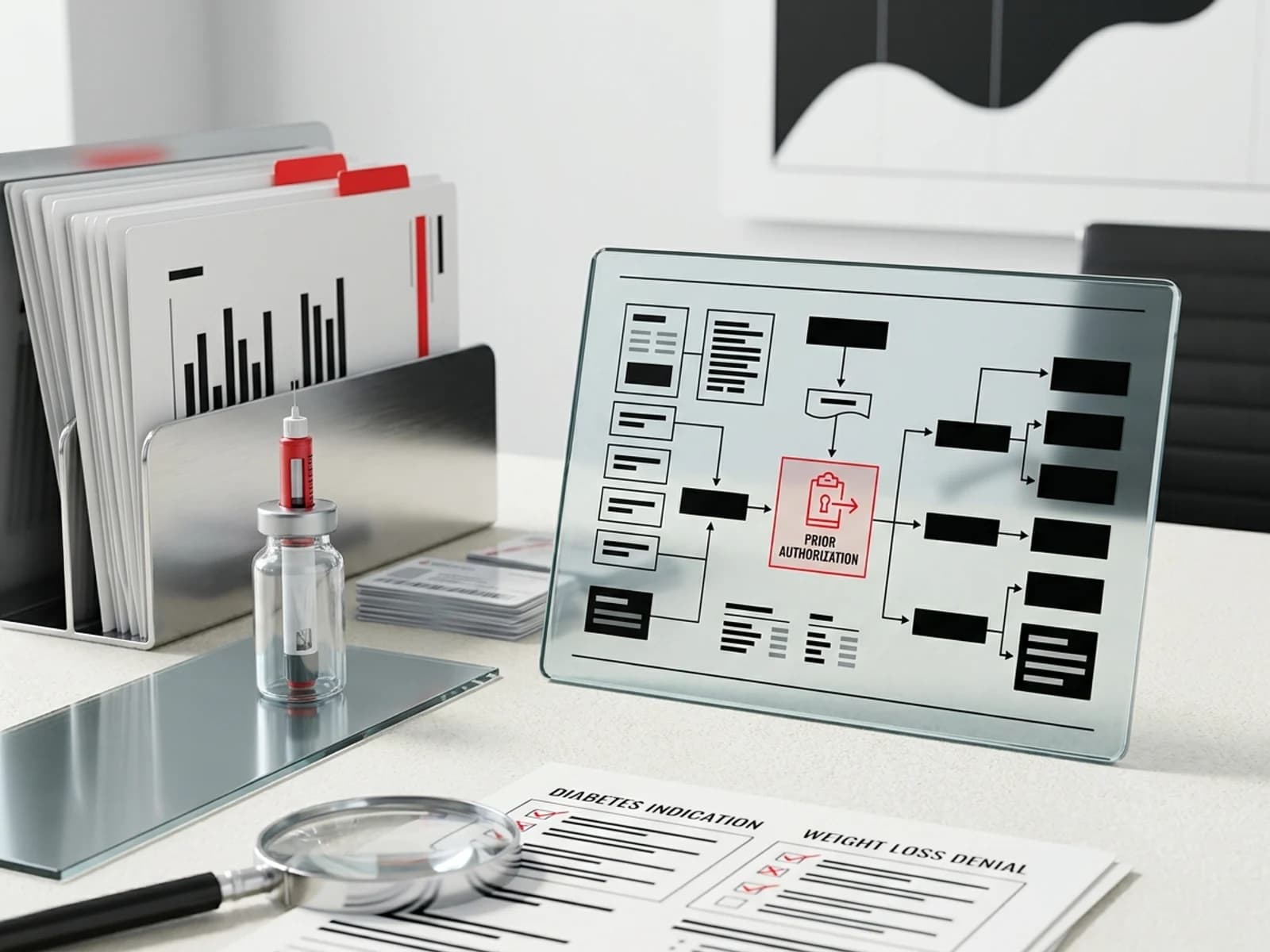
Both products require PA for all plans. The documentation requirements are similar but not identical.
| PA requirement | Ozempic | Mounjaro |
|---|---|---|
| Confirmed T2D diagnosis | Yes (ICD-10 E11.x, A1C ≥6.5%) | Yes (ICD-10 E11.x, A1C ≥6.5%) |
| Step therapy | May require metformin failure first | May require metformin + Ozempic failure first |
| CV/CKD documentation | Additional records for MACE/CKD indications | N/A |
| Quantity limits | 1 pen/month (4 doses) | 1 pen/month (4 doses) |
| Authorization duration | Typically 12 months | Typically 12 months |
Cost comparison
| Cost factor | Ozempic | Mounjaro |
|---|---|---|
| List price (approx.) | ~$935–$1,000/month | ~$1,023–$1,080/month |
| Savings card (commercial) | As little as $25/month (NovoCare) | As little as $25/month (Lilly) |
| Self-pay / cash price | $199–$499/month (NovoCare Pharmacy) | $499/month (LillyDirect) |
| Patient assistance | Novo Nordisk PAP (free for eligible uninsured) | Lilly Cares (free for eligible uninsured) |
Savings and assistance programs
| Program | Ozempic | Mounjaro |
|---|---|---|
| Commercial savings card | NovoCare Savings Card, as little as $25/month | Mounjaro Savings Card, as little as $25/month |
| Self-pay pharmacy | NovoCare Pharmacy: $199–$499/month | LillyDirect: $499/month |
| Patient assistance | Novo Nordisk PAP (free; Medicare Part D excluded 2026) | Lilly Cares (free for eligible uninsured) |
What to monitor
IRA price negotiation: Ozempic and Wegovy were selected for the second round of Medicare drug price negotiations, with negotiated prices effective 2027. This may shift the cost calculus significantly in favor of semaglutide under Part D and could influence commercial formulary decisions.
CVOT for tirzepatide: A cardiovascular outcomes trial for tirzepatide (SURPASS-CVOT) is ongoing. Results could add a CV indication to Mounjaro, changing coverage dynamics.
BALANCE Model: Both manufacturers have agreed to participate in the CMS BALANCE Model. The Medicaid portion is proceeding with a $245 net price per 30-day supply for all model drugs. The Medicare Part D portion has been indefinitely delayed (announced April 2026); the Medicare GLP-1 Bridge has been extended through December 31, 2027.
Formulary shifts: Plans increasingly tier GLP-1s with preferred/non-preferred placement. Monitor whether Ozempic's IRA-negotiated price shifts formulary preference.
Pediatric coverage: Mounjaro's pediatric indication (≥10 years) opens new coverage pathways that Ozempic does not have for this age group.
Sources
FDA, Ozempic prescribing information: https://www.accessdata.fda.gov/drugsatfda_docs/label/2025/209637s035,209637s037lbl.pdf
FDA, Mounjaro prescribing information: https://www.accessdata.fda.gov/drugsatfda_docs/label/2025/215866s039lbl.pdf
NEJM, SURPASS-2 trial (tirzepatide vs semaglutide): https://www.nejm.org/doi/full/10.1056/NEJMoa2107519
Eli Lilly, SURPASS-2 results announcement: https://investor.lilly.com/news-releases/news-release-details/lillys-surpass-2-results-published-new-england-journal-medicine
Pharmacy Times, ADA 2025 tirzepatide advances: https://www.pharmacytimes.com/view/ada-2025-advances-in-type-2-diabetes-management-with-tirzepatide
PMC, Real-world effectiveness of tirzepatide vs semaglutide: https://pmc.ncbi.nlm.nih.gov/articles/PMC12579026/
KFF, BALANCE Model for GLP-1s: https://www.kff.org/medicare/what-to-know-about-the-balance-model-for-glp-1s-in-medicare-and-medicaid/
Medicare Rights Center, Negotiated prices for 2026: https://www.medicarerights.org/medicare-watch/2025/10/09/negotiated-prices-take-effect-for-ten-drugs-in-2026
Pennsylvania DHS, Medical Assistance Bulletin (GLP-1 PA criteria): https://www.pa.gov/content/dam/copapwp-pagov/en/dhs/documents/docs/publications/documents/forms-and-pubs-omap/mab2025112403.pdf
Novo Nordisk, Ozempic cost and savings: https://www.ozempic.com/savings-and-resources/save-on-ozempic.html
Eli Lilly, Mounjaro Prior Authorization Process Tips: https://mounjaro.lilly.com/assets/pdf/prior-authorization-guide.pdf