The Inflation Reduction Act (IRA) of 2022 established the Medicare Drug Price Negotiation Program (MDPNP), authorizing CMS to negotiate maximum fair prices (MFPs) for selected high-cost, single-source drugs. Beginning January 1, 2026, the first 10 negotiated Part D drugs must be available at their MFPs to eligible Medicare beneficiaries.
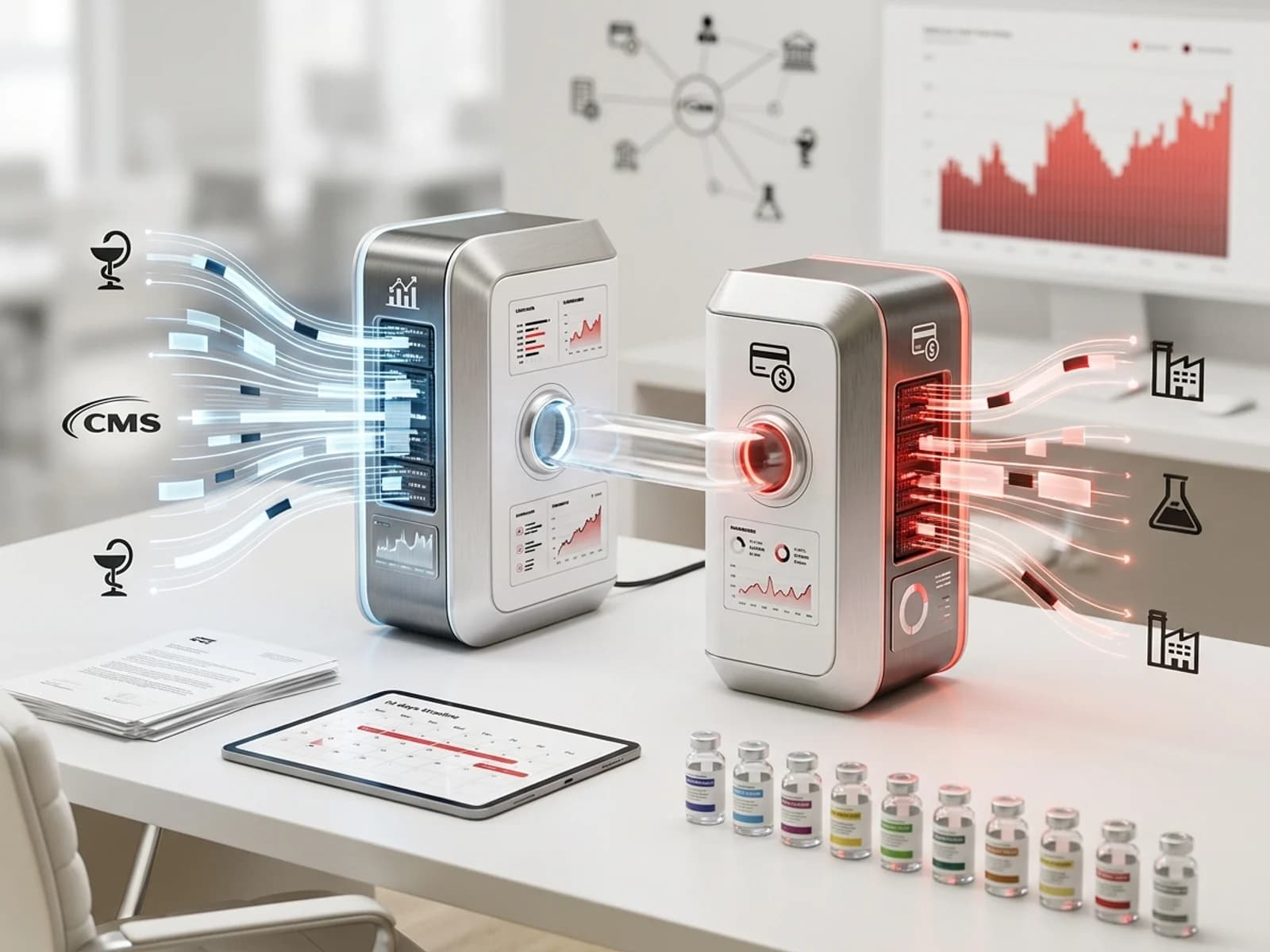
To operationalize these negotiated prices, CMS created the Medicare Transaction Facilitator (MTF) — a two-module system that connects drug manufacturers with dispensing entities (pharmacies, health centers, and other dispensing outlets) to exchange claims data and process MFP refund payments.
The MTF represents a fundamentally new operational layer in the Part D system. It is distinct from 340B non-duplication rules, distinct from the IRA's inflation rebate provisions, and distinct from traditional PBM rebate flows. Manufacturers of MFP-selected drugs must develop an MFP effectuation plan, enroll in the MTF, and manage a claims-data-to-refund pipeline that operates on a 14-day payment cycle.
This guide explains the MTF architecture, enrollment requirements, data exchange workflow, payment mechanics, cash-flow implications, and what manufacturer access teams need to know for 2026 and beyond.
Short answer
| MTF Data Module (DM) | MTF Payment Module (PM) | |
|---|---|---|
| Purpose | Secure data exchange for identifying MFP-eligible claims and transmitting claim-level data | Optional payment facilitation for MFP refund transfers |
| Who must enroll | All dispensing entities participating in Part D networks; manufacturers of selected drugs | Optional for manufacturers; optional for dispensing entities |
| Enrollment deadline | Recommended by November 15, 2025; rolling enrollment ongoing | At manufacturer's discretion |
| Key functions | Claims identification, data transmission to manufacturers, effectuation plan access, dispute portal | Electronic funds transfer or paper check for MFP refunds, credit/debit ledger |
| CMS contact | 877-683-4457 (877-MTF-4HLP); MFPMedicareTransactionFacilitator@cms.hhs.gov | Same |
The 10 selected Part D drugs for 2026
CMS negotiated MFPs for the following 10 drugs, effective January 1, 2026:
| Brand name | Manufacturer | Therapeutic area |
|---|---|---|
| Eliquis | Bristol-Myers Squibb | Anticoagulation (atrial fibrillation, VTE) |
| Enbrel | Amgen | Autoimmune (rheumatoid arthritis, psoriasis) |
| Entresto | Novartis | Heart failure |
| Farxiga | AstraZeneca (and Prasco) | Diabetes, heart failure, CKD |
| Imbruvica | AbbVie | Hematologic malignancies |
| Januvia | Merck | Type 2 diabetes |
| Jardiance | Boehringer Ingelheim/Eli Lilly | Diabetes, heart failure |
| Novolog/FIASP | Novo Nordisk | Type 1 and type 2 diabetes (insulin) |
| Stelara | Johnson & Johnson | Autoimmune (psoriasis, Crohn's, UC) |
| Xarelto | Johnson & Johnson | Anticoagulation |
Manufacturers of these drugs must effectuate MFPs through one of two mechanisms: prospectively selling the drug at the MFP or retrospectively refunding dispensing entities that acquired the drug at a cost exceeding the MFP.
MTF architecture: two modules
Data Module (MTF DM)
The Data Module is the core operational hub. It was launched on June 9, 2025, and serves as the secure platform through which:
Dispensing entities enroll and provide banking preferences for receiving refund payments
CMS transmits claim-level data elements to manufacturers, identifying MFP-eligible prescription drug event (PDE) records
Manufacturers access their MFP effectuation plans and receive claim-level payment elements needed to process refunds
All parties can submit disputes or complaints related to MFP payments
Part D plan sponsors are required by CMS regulations to amend their pharmacy network agreements to mandate MTF DM enrollment for all participating pharmacies. This means enrollment is effectively mandatory for any pharmacy that wants to participate in a Part D network in 2026.
Payment Module (MTF PM)
The Payment Module is an optional service that facilitates the actual transfer of MFP refund payments from manufacturers to dispensing entities via electronic funds transfer (EFT) or paper check. Manufacturers may choose to use the MTF PM for payment processing, or they may process refunds through their own payment mechanisms. If a manufacturer opts out of the PM, it must still transmit payment information through the DM.
All of the initial MFP manufacturers for 2026 have indicated they will use the MTF PM, according to CMS published effectuation plans.
Manufacturer effectuation workflow
Step 1: MFP effectuation plan
Each manufacturer must submit an MFP Effectuation Plan to CMS by September 1, 2025 (for the 2026 price applicability year). The plan must describe:
Whether the manufacturer will use the MTF PM or an alternative payment mechanism
How the manufacturer will process refund payments within the 14-day payment cycle
Strategies for mitigating pharmacy cash-flow issues (for pharmacies that self-identify as having material cash-flow concerns during enrollment)
How the manufacturer will handle claims reversals and corrections
CMS published an MFP Effectuation Plan Form Template on its website. Manufacturers that opted for alternative payment mechanisms must detail these in the plan.
Step 2: Claim identification and data exchange
The data exchange operates on a defined cycle:
PDE submission: Part D plan sponsors submit prescription drug event records to CMS, typically within 7 days for MFP-selected drugs (a faster timeline than the standard submission window)
CMS processes PDEs: CMS identifies claims for MFP-eligible individuals (Medicare Part D or Medicare Advantage Prescription Drug plan beneficiaries) who received a selected drug
MTF DM transmits data: The Data Module sends Manufacturer Remittance Advice (MRA) elements to the manufacturer, including claim-level details needed to calculate refund amounts
Manufacturer calculates refund: The manufacturer determines the difference between what the dispensing entity paid and the MFP, then initiates payment
Step 3: Refund payment
The payment cycle works as follows:
Timeline: Manufacturers must process refund payments within 14 days of receiving complete claim-level detail from the MTF DM
Payment method: If using the MTF PM, payments are sent via EFT or paper check per the dispensing entity's preference (indicated during enrollment)
Credit/debit ledger: The PM includes a ledger system to manage claims revisions, corrections, and offsets. If a claim is later reversed (e.g., due to a PDE correction), the ledger adjusts accordingly
Manufacturer Remittance Report (MRR): The MTF DM sends a confirmation to the manufacturer acknowledging receipt and processing of MRA elements, including payment status and amounts
Step 4: Reconciliation and disputes
The MTF DM provides a centralized portal for dispensing entities to:
Monitor payment status for MFP-eligible claims
Submit disputes if refund amounts are incorrect or payments are missing
Access reports on claim processing status
Pharmacy enrollment: what manufacturers need to understand
Enrollment process
Create CMS Identity Management (CMS IDM) account — unless the user already has one from other CMS programs
Access the MTF DM web portal and complete the standardized enrollment form
Provide entity information: demographics, MTF DM users, third-party support entity (TPSE) relationships (e.g., PSAOs), and banking preferences for refund payments
Self-identify cash-flow concerns — pharmacies expecting material cash-flow issues from the MFP process can flag this during enrollment, which triggers manufacturer obligations to provide mitigation strategies
Enrollment deadline
CMS recommended enrollment by November 15, 2025, to ensure smooth operations when MFPs took effect on January 1, 2026. Enrollment remains open on a rolling basis, but late enrollment risks delayed refund payments.
Key facts for manufacturer access teams
Enrollment is free and does not replace existing Part D dispensing requirements
Pharmacies must enroll even if they do not currently dispense any of the 10 selected drugs — enrollment is required for Part D network participation
TPSEs (such as Pharmacy Services Administrative Organizations) can assist with enrollment on behalf of pharmacy clients
CMS published a User Guide and technical documentation including Interface Control Documents (ICDs) defining the data elements used in claims and payment processing
Cash-flow implications for pharmacies and manufacturers
The cash-flow problem
Under the MTF system, pharmacies may acquire selected drugs at acquisition costs above the MFP. They then must wait for the manufacturer to process a retrospective refund through the MTF. This creates a cash-flow gap:
Pharmacy purchases drug at acquisition cost (often above MFP)
Pharmacy dispenses to Medicare beneficiary at the MFP cost-sharing amount
Part D plan reimburses the pharmacy at a rate that may or may not fully cover the acquisition cost
Manufacturer refunds the difference through the MTF — but this takes up to 14 days after receiving complete claim data
For high-cost drugs like Stelara or Entresto, this gap can be significant. A single Stelara dose may cost thousands of dollars, and the 14-day refund cycle means the pharmacy is carrying that cost on its balance sheet.
CMS mitigation approach
CMS addressed this concern by requiring pharmacies to self-identify as having material cash-flow issues during MTF enrollment. Manufacturers are then required to include cash-flow mitigation strategies in their effectuation plans. However, manufacturers have pushed back, noting that the IRA does not provide a statutory basis for requiring cash-flow mitigation from manufacturers.
Manufacturer strategies
Published effectuation plans from manufacturers like Johnson & Johnson indicate that they will:
Use the MTF PM to expedite refund payments
Process claims within the 14-day window
Provide cash-flow assistance for pharmacies that self-identified concerns
Interaction with 340B
The MTF system does not collect 340B pricing information. Under the IRA's non-duplication provision, manufacturers must offer the lower of the MFP or the 340B price to covered entities. It is the manufacturer's responsibility to determine which price applies and to ensure that 340B entities receive the appropriate discount.
Many manufacturers of 2026 MFP drugs are expected to participate in the 340B Rebate Model Pilot Program, which shifts 340B pricing from an upfront discount to a retrospective rebate. This creates additional complexity for 340B contract pharmacies, which must coordinate with their covered entities and third-party administrators to manage both 340B rebate claims and MTF refund claims.
Launch and access implications for manufacturers
For current MFP-selected products
Manufacturers with 2026 MFP drugs must:
Enroll in the MTF DM and PM
Submit effectuation plans to CMS
Ensure their data systems can ingest MRA elements and process refunds within 14 days
Provide cash-flow mitigation strategies for pharmacies that self-identified concerns
Monitor the credit/debit ledger for claims reversals and corrections
Train field access teams on MFP pricing, pharmacy enrollment status, and dispute resolution
For future MFP-selected products
CMS will add additional drugs in future years. Beginning in 2028, Part B drugs will also be eligible for selection. Manufacturers should:
Monitor CMS announcements for drug selection in future negotiation cycles
Build MTF-compliant data exchange capabilities in advance
Model the financial impact of MFP pricing on buy-and-bill economics (for Part B drugs) and pharmacy acquisition cost flows (for Part D drugs)
Integrate MFP pricing into their access and distribution strategies
For competing products (non-selected)
Products that compete with MFP-selected drugs face indirect effects:
Payers may pressure non-selected products for comparable pricing
Formulary positioning may shift if MFP drugs become preferred due to lower net cost
Access teams should monitor whether MFP status affects formulary tier placement and step-therapy positioning for therapeutic alternatives
What to monitor
MTF operational performance: Track whether the 14-day refund cycle is being met across all 10 manufacturers. Delays will create pharmacy cash-flow problems and may trigger CMS enforcement actions.
Claims accuracy: Early-cycle PDE errors could lead to incorrect refund amounts. Monitor dispute volumes through the MTF DM.
340B rebate model pilot outcomes: If the pilot demonstrates that retrospective rebate models work for 340B, CMS may expand this approach, further complicating the intersection of MFP, 340B, and MTF operations.
Part B drug selection (2028): The first Part B drugs will be eligible for MFP negotiation for price applicability year 2028. Buy-and-bill manufacturers should begin preparing MTF-compatible data exchange and effectuation workflows.
State policy responses: Monitor whether states enact legislation addressing pharmacy cash-flow concerns or imposing additional requirements on MFP effectuation.
Manufacturer effectuation plan updates: CMS requires updated plans for each price applicability year. Track plan changes for new drugs added to the negotiation program.
Sources
CMS. "Medicare Transaction Facilitator General Resources." Available at: https://www.cms.gov/priorities/medicare-prescription-drug-affordability/overview/medicare-drug-price-negotiation-program/medicare-transaction-facilitator-general-resources.
CMS. "Pharmacy and Dispensing Entity Resources." Available at: https://www.cms.gov/priorities/medicare-prescription-drug-affordability/overview/medicare-drug-price-negotiation-program/pharmacy-dispensing-entity-resources.
Duane Morris LLP. "CMS Medicare Transaction Facilitator Data Module System Open for Pharmacy and Manufacturer Enrollment." September 2025. Available at: https://www.duanemorris.com/alerts/cms_medicare_transaction_facilitator_data_module_system_open_pharmacy_manufacturer_0925.html.
Pharmacy Times. "Preparing for the Medicare Transaction Facilitator." Available at: https://www.pharmacytimes.com/view/preparing-for-the-medicare-transaction-facilitator.
Pharmaceutical Strategies Group. "Navigating the Medicare Transaction Facilitator: A Game-Changer for PBMs, Medicare Part D Plans, and Pharmacies." Available at: https://www.psgconsults.com/blog/navigating-the-medicare-transaction-facilitator-a-game-changer-for-pbms-medicare-part-d-plans-and-pharmacies.
USC Schaeffer Center. "Operational and Policy Considerations in the Effectuation of Medicare's Maximum Fair Drug Prices for Part D." October 16, 2025. Available at: https://schaeffer.usc.edu/research/medicare-drug-prices-mfp-effectuation.
Quarles Law Firm. "Part D Pharmacies Required to Enroll in Data Exchange Module to Help Drug Price Negotiation Cash Flow Issue." Available at: https://www.quarles.com/newsroom/publications/part-d-pharmacies-required-to-enroll-in-data-exchange-module-to-help-drug-price-negotiation-cash-flow-issue.
AmerisourceBergen. "Understanding the Medicare Transaction Facilitator for Pharmacies." Available at: https://www.amerisourcebergen.com/-/media/assets/ira/25-pah-10570-ira-mtf-overview-29sep25-fnl.pdf.
NACHC. "Inflation Reduction Act (IRA): Medicare Transaction Facilitator (MTF) 101 and FAQ." October 2025. Available at: https://www.nachc.org/wp-content/uploads/2025/10/IRA-MTF-101.pdf.
NCPA. "MTF Enrollment: What You Need to Know." June 20, 2025. Available at: https://ncpa.org/newsroom/qam/2025/06/20/mtf-enrollment-what-you-need-know.
AMCP Learn. "Medicare Transaction Facilitator (MTF) Enrollment for Dispensing Entities." October 1, 2025. Available at: https://amcplearn.org/content/medicare-transaction-facilitator-mtf-enrollment-dispensing-entities.
Johnson & Johnson. "Maximum Fair Price (MFP) Implementation Plan for iPAY 2026." Available at: https://www.jnj.com/innovativemedicine/us/download/jj-maximum-fair-price-mfp-implementation-plan-for-ipay-2026.pdf.
ASCP. "First Effectuation Plans Shared by Manufacturers and CMS." Available at: https://www.ascp.com/news/710435/First-Effectuation-Plans-Shared-by-Manufacturers-and-CMS.htm.
340B Report. "Pharmacy and Dispensing Entity MTF FAQ." Available at: https://340breport.com/wp-content/uploads/2025/06/pharmacy-and-dispensing-entity-mtf-faq.pdf.