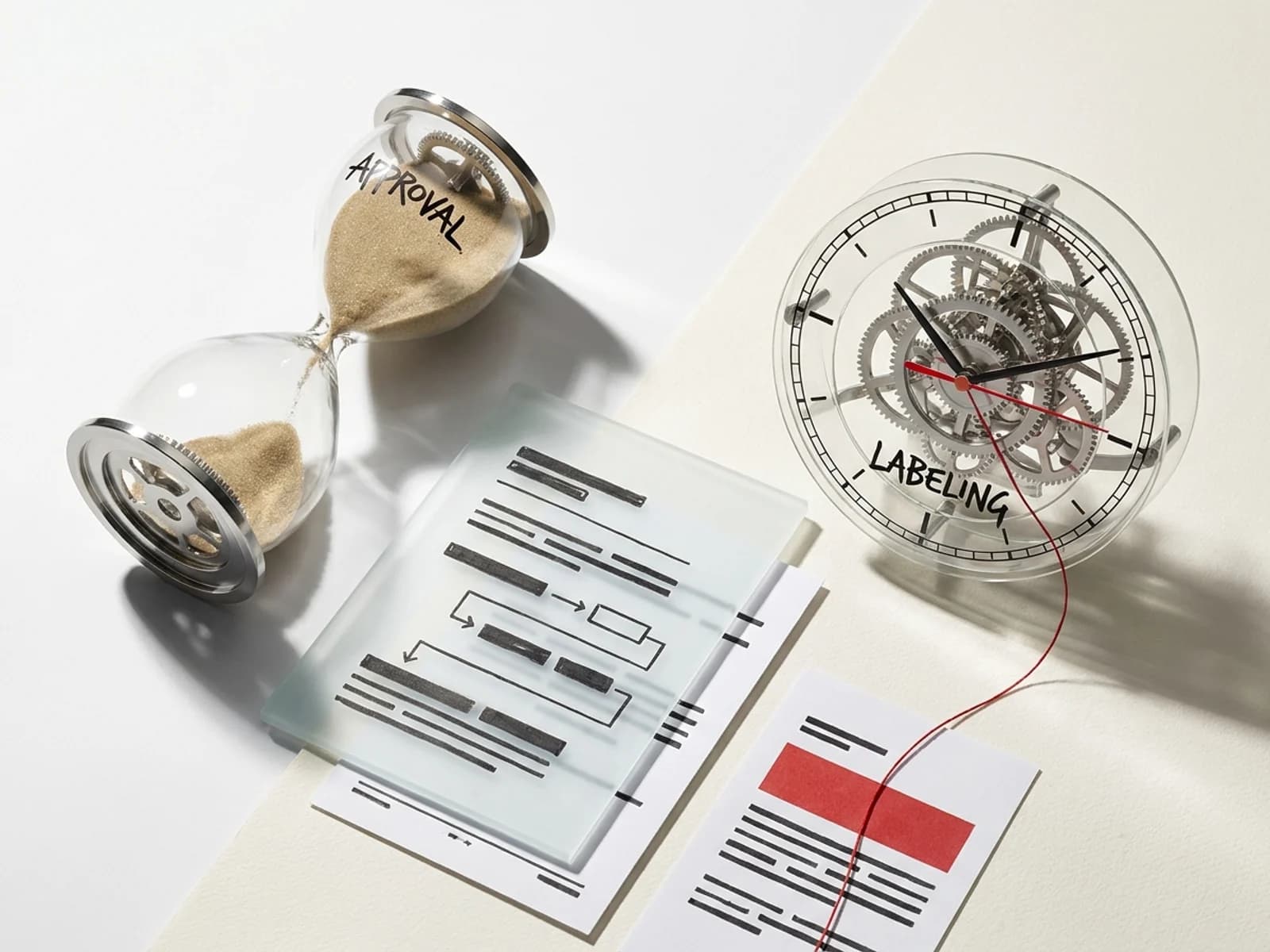
A new indication approval is a commercial milestone, but it is also a regulatory event governed by specific supplement timing rules. Under 21 CFR 314.70, labeling changes associated with new indications and usage must be submitted in a prior approval supplement (PAS). The sponsor cannot distribute product with the new labeling until FDA approves the supplement. However, the relationship between approval date, label-in-effect date, and commercial launch is more complex than most launch teams anticipate.
The core problem: FDA approves the efficacy supplement (the new indication), but the labeling supplement that updates the package insert, Medication Guide, and Highlights section follows a separate review pathway with its own clock. If the labeling supplement is filed late, contains errors, or requires multiple rounds of FDA review, the time between indication approval and label-in-effect date stretches from weeks to months. During that gap, the sponsor can promote the new indication under FDAMA Section 114 and relevant FDA guidance, but the approved labeling that prescribers and pharmacists rely on does not yet reflect the change.
This article is for commercial operations leads, regulatory affairs managers, brand launch teams, and medical affairs professionals responsible for new indication launches. It explains the supplement timing rules, identifies the common failure points, and provides a timeline framework for coordinating regulatory and commercial activities.
The supplement classification for new indication labeling
Labeling changes for new indications are always PAS
Under 21 CFR 314.70(b)(2)(v), labeling changes based on postmarketing study results — including labeling changes associated with new indications and usage — must be submitted in a prior approval supplement. This means FDA must approve the labeling before the sponsor distributes product bearing the new label.
The FDA guidance Changes to an Approved NDA or ANDA lists specific examples of changes that require PAS:
Changes based on postmarketing study results, including labeling changes associated with new indications and usage
Change in, or addition of, pharmacoeconomic claims based on clinical studies
Changes to the clinical pharmacology or clinical study section reflecting new or modified data
Changes based on data from preclinical studies
Review clocks for supplements
FDA's review clocks for supplements are defined by supplement type:
| Supplement type | Review clock | Applies to |
|---|---|---|
| CMC and labeling PAS | 4 months | Manufacturing and labeling changes |
| CMC and labeling CBE-30 and CBE-0 | 6 months | Moderate changes |
| Efficacy supplement (non-priority) | 10 months | New indications, new dosing regimens |
| Efficacy supplement (priority) | 6 months | New indications with priority review |
The efficacy supplement (the one that adds the new indication) and the labeling supplement (the one that updates the prescribing information) may not be on the same clock. The efficacy supplement approval triggers the need for updated labeling, but if the labeling supplement was not filed concurrently, the label update follows the four-month PAS clock from the date of filing.
For BLAs: 21 CFR 601.12
Biologics license applications follow a parallel but distinct regulatory path under 21 CFR 601.12. The supplement categories are the same (PAS, CBE-30, CBE-0, annual report), and labeling changes for new indications similarly require prior approval.
Why launch teams miss the timing
Failure 1: Filing the labeling supplement after efficacy supplement approval
The most common timing failure occurs when the regulatory team files the efficacy supplement (seeking the new indication) but defers the labeling supplement until after FDA approves the efficacy supplement. The logic is sound — why file labeling language that might change during review? — but the consequence is a delay of up to four additional months between indication approval and label-in-effect date.
The recommended approach
File the labeling supplement concurrently with the efficacy supplement, or file it as part of the same submission. FDA's guidance allows sponsors to submit proposed labeling changes as part of the efficacy supplement. The reviewer evaluates both the clinical data supporting the new indication and the proposed labeling language in the same review cycle. If FDA modifies the proposed labeling, the sponsor submits a labeling amendment, but the review clock for the labeling change has already started.
Failure 2: Highlights section changes require separate attention
Under FDA regulations, changes to the Highlights section of the prescribing information are generally classified as major changes requiring a PAS. The FDA final rule on supplemental applications proposing labeling changes (73 FR 63845, October 2008) clarifies that most changes to Highlights require prior approval. If the launch team assumes that Highlights updates are minor editorial changes that can be submitted in a CBE-0 or annual report, the supplement is miscategorized and FDA may return it.
Failure 3: Medication Guide updates
If the product has a Medication Guide under 21 CFR Part 208, any change to the Medication Guide — except for changes in the information specified in 208.20(b)(8)(iii) and (iv) — must be submitted in a prior approval supplement under 21 CFR 314.70(b)(2)(v)(B). Medication Guide updates are frequently overlooked in the labeling supplement strategy for a new indication, particularly if the new indication involves a new patient population, new route of administration, or new safety information.
Failure 4: DailyMed and public labeling repository delays
FDA posts approved labeling to DailyMed, but there is a lag between supplement approval and public availability. The final rule on supplemental applications proposing labeling changes (2008) addressed this by requiring that sponsors submit updated labeling for posting on DailyMed at the time of supplement submission. However, the posting lag means that even after the labeling supplement is approved, prescribers and pharmacists may not see the updated labeling for days or weeks.
Failure 5: Promotional material alignment
Under 21 CFR 314.70, the sponsor must promptly revise all promotional labeling and advertising to make it consistent with any labeling change submitted in a supplemental application. The final rule limited this requirement to labeling changes submitted in supplements (not annual reports), but the operational burden is significant. Launch teams often prepare promotional materials based on the expected labeling language, only to find that FDA modified the approved labeling during review. The promotional materials must then be revised to match the approved language before the new indication can be promoted.
The ANDA conforming labeling obligation
The 30-day clock for generic manufacturers
When FDA approves a labeling change for the reference listed drug (RLD), every ANDA holder that relied on the RLD must submit a CBE-0 supplement with conforming labeling revisions within 30 days of FDA's posting of the approval letter on its website. This requirement was established in the final rule on supplemental applications (73 FR 63845) and applies to safety-related labeling changes specifically.
For new indication approvals, the impact on ANDA holders is indirect: the RLD's labeling changes may affect the therapeutic equivalence evaluations, the ANDA's indication section, or the ANDA's labeling content. ANDA holders must monitor FDA postings and file conforming supplements within the required timeframe.
The misclassification risk
If an ANDA holder incorrectly files a change as a CBE-30 when a PAS was required, FDA may issue a refuse-to-file letter or request that the applicant withdraw the supplement and refile as a PAS. This misclassification risk is particularly high for labeling changes where the reporting category depends on the specific content of the change.
The STAR program and split submissions
Expedited review for efficacy supplements
FDA's PDUFA reauthorization performance goals include the STAR (Split submission, Timely review, Accelerated review) program for certain efficacy supplements. Under STAR:
The sponsor requests an informal pre-submission teleconference with FDA and provides topline trial results and proposed labeling
If FDA agrees that the request meets STAR eligibility criteria, the application is accepted into the program
The sponsor provides the complete application in two parts: Part 1 (initiates FDA's review) and Part 2 (initiates the PDUFA timeline)
The STAR program can reduce the time to efficacy supplement approval, but it does not change the labeling supplement classification or review clock. Launch teams should not assume that STAR participation eliminates the labeling timing gap.
Timeline framework for a new indication launch
Pre-approval phase (6–12 months before PDUFA date)
| Action | Owner | Timing |
|---|---|---|
| Draft proposed labeling for the new indication | Regulatory affairs | 12 months before PDUFA |
| File labeling supplement concurrently with efficacy supplement | Regulatory affairs | At efficacy supplement filing |
| Prepare promotional materials based on proposed labeling | Commercial / Medical affairs | 6 months before PDUFA |
| File proposed Medication Guide updates (if applicable) | Regulatory affairs | At efficacy supplement filing |
| Brief FDA on proposed labeling at pre-sNDA/sBLA meeting | Regulatory affairs | Pre-submission meeting |
Approval phase (0–4 months after PDUFA date)
| Action | Owner | Timing |
|---|---|---|
| Receive FDA approval letter and approved labeling language | Regulatory affairs | Day 0 (PDUFA date) |
| Submit any required labeling amendments if FDA modified proposed language | Regulatory affairs | Within 15 days of approval |
| Confirm labeling supplement approval status | Regulatory affairs | Day 0–30 |
| Revise promotional materials to match approved labeling | Commercial / Medical affairs | Within 30 days of approval |
| Submit updated labeling to DailyMed | Regulatory affairs | At supplement submission |
| Notify ANDA holders if applicable | Regulatory affairs | Upon approval letter posting |
Post-approval phase (1–6 months after approval)
| Action | Owner | Timing |
|---|---|---|
| Confirm DailyMed posting of updated labeling | Regulatory affairs | 1–4 weeks after approval |
| Update all field materials, detail aids, and website content | Commercial | Within 30 days of label approval |
| Monitor for ANDA conforming supplement activity (if RLD) | Regulatory affairs | 30 days after approval letter posting |
| Track safety labeling changes that may be triggered by postmarketing data | Pharmacovigilance | Ongoing |
Checklist: labeling supplement readiness for a new indication
| Element | Completed | Issue identified |
|---|---|---|
| Labeling supplement filed concurrently with efficacy supplement | ||
| Proposed Highlights section included in PAS | ||
| Medication Guide update filed (if applicable) | ||
| Promotional materials drafted based on proposed labeling | ||
| Plan for revising promotional materials if FDA modifies labeling | ||
| DailyMed submission prepared | ||
| eCTD sequence prepared for labeling supplement | ||
| Review clock tracked (4-month PAS for labeling) | ||
| Field team trained on labeling content and timing | ||
| ANDA conforming supplement monitoring plan in place (if RLD) |
What to monitor
Labeling supplement review status: Track the four-month PAS review clock. FDA may issue information requests that require sponsor response, extending the effective timeline.
DailyMed posting: Confirm that updated labeling is posted publicly. Prescribers and pharmacists rely on DailyMed for current prescribing information.
Promotional material alignment: Ensure all promotional materials are revised to match the approved labeling. Mismatched promotional materials are a common FDA advertising and promotion enforcement trigger.
Safety labeling change triggers: Monitor postmarketing safety data for the new indication. Under FD&C Act Section 505(o)(4), FDA can order safety labeling changes, and the sponsor must submit a labeling supplement within 15 days of the order. Non-compliance penalties can reach $250,000 per violation, doubling every 30 days, up to $10 million for all violations.
ANDA conforming supplement activity: If the product is an RLD, monitor whether ANDA holders file conforming supplements within 30 days.
Sources
21 CFR 314.70. Supplements and Other Changes to an Approved Application.
21 CFR 601.12. Supplements and Other Changes to an Approved BLA. https://www.ecfr.gov/current/title-21/chapter-I/subchapter-F/part-601/subpart-G/section-601.12
21 CFR Part 208. Medication Guides. https://www.ecfr.gov/current/title-21/chapter-I/subchapter-C/part-208
21 CFR 314.70. Supplements and Other Changes to an Approved Application. https://www.ecfr.gov/current/title-21/chapter-I/subchapter-D/part-314/subpart-G/section-314.70
U.S. FDA. Changes to an Approved NDA or ANDA. Guidance for Industry. https://www.fda.gov/files/drugs/published/Changes-to-an-Approved-NDA-or-ANDA.pdf
Federal Register. Supplemental Applications Proposing Labeling Changes for Approved Drugs and Biological Products. 73 FR 63845. https://www.federalregister.gov/documents/2008/08/22/E8-19572/supplemental-applications-proposing-labeling-changes-for-approved-drugs-biologics-and-medical
Federal Register. Supplements and Other Changes to an Approved Application. 69 FR 17890. https://www.federalregister.gov/documents/2004/04/08/04-7532/supplements-and-other-changes-to-an-approved-application
U.S. FDA. PDUFA Reauthorization Performance Goals and Procedures. Fiscal Years 2023–2027. https://www.fda.gov/media/151712/download
U.S. FDA. REMS — FDA Guidance for Industry. 2019. https://www.fda.gov/media/128651/download
U.S. FDA. 2025 Biological License Application Supplement Noteworthy Approvals. https://www.fda.gov/vaccines-blood-biologics/development-approval-process-cber/2025-biological-license-application-supplement-noteworthy-approvals
U.S. FDA. Frequently Asked Questions about Labeling for Prescription Medicines. https://www.fda.gov/drugs/fdas-labeling-resources-human-prescription-drugs/frequently-asked-questions-about-labeling-prescription-medicines
U.S. FDA. ANDA Submissions — Prior Approval Supplements Under GDUFA. https://www.fda.gov/media/89263/download
FDLI. Introduction to Drug Law and Regulation — Post-Approval Issues. David Rosen. 2022. https://www.fdli.org/wp-content/uploads/2022/04/Rosen-David.pdf
ProPharma Group. How to File Post-Approval Changes to an NDA or ANDA. June 2021. https://www.propharmagroup.com/thought-leadership/post-approval-changes-nda-anda
Assyro AI. CBE-0 & CBE-30 Supplements: FDA Filing Guide. May 2026. https://assyro.com/blog/cbec-supplement-fda-guide
LGM Pharma. What You Need to Know About Post-Approval Change Pathways. 2025. https://lgmpharma.com/blog/what-you-need-to-know-about-post-approval-change-pathways