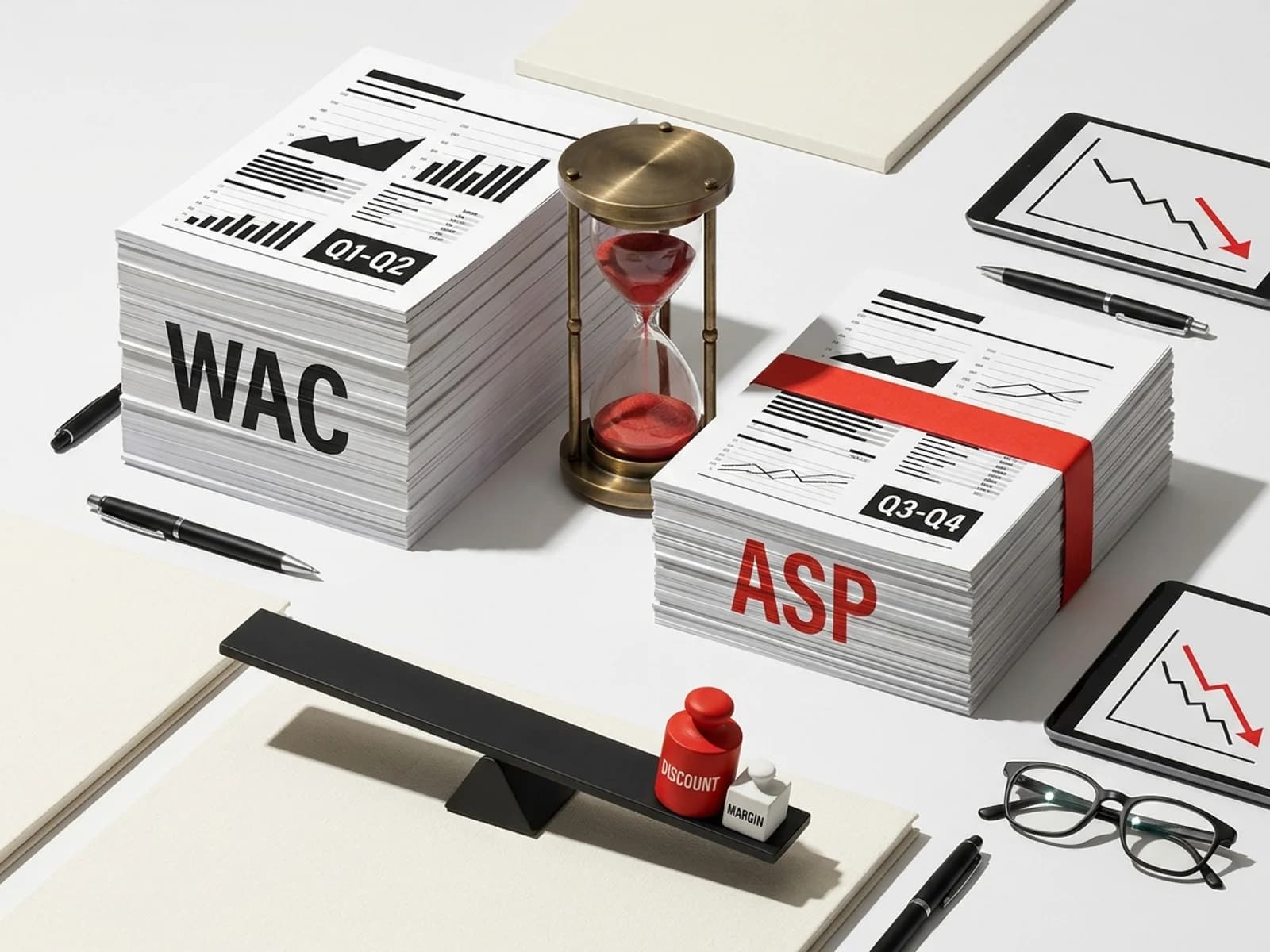
In January 2026, CMS announced the 15 drugs selected for the third cycle of the Inflation Reduction Act's Medicare Drug Price Negotiation Program, with negotiated maximum fair prices (MFPs) taking effect January 1, 2028. For the first time, the selection pool includes drugs payable under Medicare Part B — physician-administered biologics and specialty injectables reimbursed through the buy-and-bill model.
The four Part B drugs on the IPAY 2028 list — Botox (onabotulinumtoxinA), Cimzia (certolizumab pegol), Orencia (abatacept), and Entyvio (vedolizumab) — represent billions in annual Medicare spending. When their MFPs take effect, provider reimbursement will shift from the current ASP + 6% model to MFP + 6%, reducing both the drug-cost reimbursement and the percentage-based add-on payment.
Avalere Health estimated that add-on payments for the first ten negotiated Part B drugs could decrease by over $25 billion across a ten-year window. Milliman projected the total provider reimbursement reduction at $56.3 billion over the same period, factoring in the full ASP-to-MFP transition for all selected products.
This article examines how the Part B MFP transition will work, why the buy-and-bill model is vulnerable, and what manufacturer and provider teams should prepare before the 2028 effectuation date.
Why Part B negotiation is different from Part D
The buy-and-bill reimbursement structure
Medicare Part B covers physician-administered drugs — injectable biologics, infused therapies, and certain specialty drugs that cannot be self-administered. Under the buy-and-bill model, providers purchase the drug, administer it to the patient, and bill Medicare for both the drug cost and a professional-administration fee.
Current Part B reimbursement is calculated as:
Drug cost: 106% of Average Sales Price (ASP) — the manufacturer-reported weighted average of net sales prices across all purchasers
Add-on: 6% of ASP, designed to cover acquisition overhead, inventory carrying costs, and practice-margin requirements
This structure means the add-on payment is a percentage of ASP. When ASP is high, the add-on is proportionally larger. When MFP replaces ASP as the reimbursement basis, both the drug-cost component and the percentage-based add-on shrink.
Part D negotiation was simpler for CMS
The first two IRA negotiation cycles (IPAY 2026 and IPAY 2027) covered only Part D drugs. Part D reimbursement flows through pharmacy benefit managers and plan sponsors, not through individual physician practices. CMS could effectuate MFPs by requiring Part D plan sponsors to apply the negotiated price at the point of sale, with manufacturer discount obligations filling the gap between plan costs and MFP.
Part B effectuation is operationally distinct. CMS must ensure that thousands of individual physician practices, hospital outpatient departments, and ambulatory infusion centers can purchase and bill the selected drug at the MFP without financial loss. The agency's final IPAY 2028 guidance, released September 30, 2025, requires primary manufacturers to establish processes ensuring that Part B providers have access to the MFP, but the operational details — how providers will report MFP-based purchases, how ASP reporting will incorporate MFP-influenced transactions, and how acquisition-cost guarantees will work — remain under development.
The four Part B drugs selected for IPAY 2028
Botox (onabotulinumtoxinA)
Botox, manufactured by AbbVie (Allergan), is approved for multiple neurologic, urologic, and cosmetic indications. Its Medicare utilization spans chronic migraine, overactive bladder, spasticity, and cervical dystonia. Botox's inclusion on the IPAY 2028 list is notable because it is the first neuromuscular-blocking agent selected for negotiation, broadening the program beyond traditional oncology and immunology categories. As a therapeutic-class newcomer to the negotiation list, Botox signals that CMS is not limiting Part B selections to infused biologics.
Cimzia (certolizumab pegol)
Cimzia, also manufactured by AbbVie, is a PEGylated tumor necrosis factor (TNF) inhibitor approved for rheumatoid arthritis, psoriatic arthritis, axial spondyloarthritis, and Crohn's disease. It is administered by subcutaneous injection, which routes it through Part B when physician-administered. Cimzia competes with Humira (adalimumab) biosimilars on the pharmacy benefit, creating a situation where the same therapeutic class has products subject to different negotiation dynamics depending on benefit routing.
Orencia (abatacept)
Orencia, manufactured by Bristol Myers Squibb, is a selective T-cell costimulation modulator approved for rheumatoid arthritis, juvenile idiopathic arthritis, and psoriatic arthritis. The intravenous formulation is physician-administered and Part B–reimbursed. Orencia is one of six immunosuppressant or immunomodulator products on the IPAY 2028 list, making this therapeutic category the most represented in the current selection cohort.
Entyvio (vedolizumab)
Entyvio, manufactured by Takeda, is an integrin receptor antagonist approved for Crohn's disease and ulcerative colitis. The intravenous formulation is administered in infusion centers, typically every eight weeks after the induction phase. Takeda also markets a subcutaneous formulation of vedolizumab under a separate brand presentation, but the Part B selection targets the IV formulation predominantly billed under the buy-and-bill model.
The competitive-category dynamic
Milliman noted that four of the 15 IPAY 2028 selections — Orencia, Cimzia, Entyvio, and Xolair — are competitors within overlapping therapeutic indications. This is the first time an IPAY list includes multiple products from the same therapeutic category, creating new contracting dynamics for both selected manufacturers and unselected competitors. Payer teams should anticipate that MFPs for therapeutic alternatives within the same class will diverge from each other and from prevailing commercial net prices, potentially disrupting existing formulary-tier structures.
The ASP erosion problem
How MFP effectuation compresses ASP
The 2026 Medicare Physician Fee Schedule (MPFS) final rule confirmed that units of negotiated Part B drugs sold at the MFP will be included in the calculation of ASP. CMS also clarified that it will only publish the new payment limit (106% of MFP) in the ASP pricing file — suspending publication of the standalone ASP for negotiated Part B drugs until generics or biosimilars are marketed. Because MFPs are expected to be substantially lower than current ASPs for most selected drugs — the Part D MFPs for IPAY 2026 ranged from 38% to 79% below list price — the inclusion of MFP-level sales in the ASP calculation will drag ASP downward over time.
This creates a cascading effect:
MFP takes effect January 1, 2028, setting the Medicare reimbursement basis at MFP + 6%.
ASP begins incorporating MFP-level transactions, reducing the reported ASP for subsequent quarters.
Commercial payers that reference ASP — an estimated 63% or more of private payers use ASP-based reimbursement for physician-administered drugs — see their reimbursement rates decline as ASP erodes.
Providers lose margin on both Medicare and commercial patients, because the add-on payment shrinks as the underlying drug-cost basis falls.
The 6% add-on is not fixed in dollar terms
A common misconception is that the 6% add-on protects provider margins regardless of the drug's price. In reality, 6% of a smaller number yields a smaller payment. The Avalere illustration is instructive:
| Period | Basis | Drug Cost | Add-on (6%) | Total Reimbursement |
|---|---|---|---|---|
| Q4 2027 | ASP ($1,000) | $1,000 | $60 | $1,060 |
| Q1 2028 | MFP ($400) | $400 | $24 | $424 |
| Change | ($600) | ($36) | ($636) |
In this example, a 60% MFP discount reduces the add-on payment by 60% as well — from $60 to $24 per administration. For a practice administering 200 doses per quarter, that is $7,200 in lost quarterly margin on a single product. Multiplied across the Part B portfolio, the aggregate impact is substantial.
Provider access risk
Which practices are most vulnerable
The financial impact of the ASP-to-MFP shift will be uneven across practice types:
Independent infusion centers and community oncology practices — these groups have limited negotiating power with commercial payers and thin cash-flow buffers. A 50% reduction in add-on payments for a single high-volume Part B drug could render the product line unprofitable.
Rural providers — lower patient volumes mean that fixed overhead costs (drug-storage infrastructure, nursing staff, administrative billing systems) cannot be amortized across as many encounters, making margin compression more immediately threatening.
Hospital outpatient departments — larger systems may be better positioned to absorb margin reductions, but site-of-care payment differentials (already under pressure from proposed CMS site-neutral policies) could compound the financial stress.
A survey conducted by Avalere found that 70% of providers reported that current Medicare Part B reimbursement rates were already insufficient or only sufficient for some drugs after accounting for acquisition costs and overhead. When asked how concerned they would be if add-on payments dropped by 50%, 75% reported moderate or high concern. In a separate provider survey, 92% of providers said they would be somewhat or very likely to stop stocking Part B drugs subject to negotiation, 79% anticipated a moderate or severe impact to patient access, and 98% believed ASP reductions from Part B negotiations would interfere with physician-patient decision-making.
Patient access consequences
If providers scale back their inventory of MFP-eligible drugs — or stop offering them entirely — patients may face:
Referral to alternative sites of care — shifting from community-based infusion to hospital outpatient departments, increasing travel burden and wait times
Switching to non-selected therapeutic alternatives — which may be clinically appropriate for some patients but not all, particularly when the selected drug is chosen for a specific clinical reason
Delays in treatment initiation — while prior authorization for the alternative drug is obtained
Acceleration of buy-and-bill pullback — Avalere's analysis noted that the MFP+6% shift may accelerate provider migration toward white-bagging, specialty-pharmacy distribution, or self-administered alternatives, fundamentally restructuring the physician-administered drug supply chain
The Alliance for Patient Access noted in its July 2025 brief that the mechanics of Part B MFP effectuation — including how manufacturers will ensure providers can purchase at or below MFP, how quickly ASP will reflect MFP transactions, and whether Medicaid best-price rules will further complicate manufacturer pricing — remain unresolved.
What manufacturer teams should prepare
Model the ASP erosion timeline
Manufacturers of IPAY 2028 Part B drugs should model how ASP will decline quarter by quarter after the MFP takes effect. Because ASP is a rolling weighted average of net sales across all channels, the pace of erosion depends on the mix of Medicare, commercial, and other payer volumes. Products with a high Medicare Part B share will see faster ASP compression.
Key modeling inputs:
Current Medicare Part B volume as a percentage of total U.S. sales
Commercial contract pricing relative to ASP and projected MFP
340B Drug Pricing Program volume, which interacts with the nonduplication provision CMS finalized for IPAY 2028
Medicaid best-price implications of MFP-level transactions
Prepare provider-facing communication
Providers will need clear guidance on:
How to purchase at or below MFP — whether through direct manufacturer distribution, specialty distributors, or group purchasing organizations
How to bill Medicare accurately — the HCPCS codes, modifiers, and billing procedures that will apply to MFP-based reimbursement
What happens to acquisition-cost guarantees — whether manufacturers will offer gap programs or alternative pricing arrangements to protect provider margins during the ASP transition period
The Avalere survey found that only 6% of providers considered it "very likely" they could negotiate better commercial reimbursement rates if ASP eroded due to Medicare negotiation. Manufacturer provider-support programs should account for this limited negotiating leverage.
Monitor CMS guidance on Part B effectuation
CMS's IPAY 2028 final guidance established the principle that manufacturers must ensure provider access to the MFP but did not finalize all operational details. Key outstanding questions include:
Whether CMS will create new HCPCS codes or modifiers to distinguish MFP-based transactions from standard ASP-based billing
How the quarterly ASP reporting cycle will incorporate MFP transactions
Whether and how the Direct Member Reimbursement pathway (finalized for Part D in IPAY 2028 guidance) will extend to Part B
CMS is expected to release additional implementation guidance before the MFP effectuation date. Manufacturers should participate in the public comment process and engage with provider-advocacy organizations that are shaping operational policy.
Assess commercial spillover risk
The ASP erosion dynamic means that commercial payers will eventually see lower reference prices for Part B selected drugs. Manufacturers should:
Model commercial contract exposure for each selected Part B drug
Identify payer contracts that reference ASP-based reimbursement and evaluate whether renegotiation will be triggered by ASP declines
Assess whether the commercial net price for a selected drug could fall below the MFP, creating a situation where commercial patients indirectly benefit from Medicare negotiation
The Protecting Patient Access to Cancer and Complex Therapies Act (PACTA) alternative
Congress has considered legislative proposals to modify Part B MFP effectuation. The Protecting Patient Access to Cancer and Complex Therapies Act (PACTA) would maintain provider reimbursement at 106% of ASP and handle the MFP discount as a separate manufacturer-to-government payment, preserving the buy-and-bill add-on. Milliman estimated that PACTA would reduce the provider financial impact from a $56.3 billion loss to a $0.6 billion gain over ten years, while shifting savings from $68.1 billion to $71.3 billion in government savings.
PACTA has not been enacted as of June 2026, but the legislative debate highlights the operational uncertainty surrounding Part B MFP effectuation. Manufacturer government-affairs teams should track the bill's progress and prepare for either implementation scenario.
Sources
CMS, "Medicare Drug Price Negotiation Program: Selected Drugs for Initial Price Applicability Year 2028" — https://www.cms.gov/newsroom/fact-sheets/medicare-drug-price-negotiation-program-selected-drugs-initial-price-applicability-year-2028
CMS, "Medicare Drug Price Negotiation Program Final Guidance for IPAY 2028" — https://www.cms.gov/files/document/ipay-2028-final-guidance.pdf
Avalere Health, "Stakeholder Considerations for MFP Effectuation in Part B" — https://advisory.avalerehealth.com/insights/stakeholder-considerations-for-mfp-effectuation-in-part-b
Milliman, "Medicare Drug Price Negotiation: New Dynamics as the Tide Turns to Medicare Part B" — https://www.milliman.com/en/insight/medicare-drug-price-negotiation-part-b-dynamics
Milliman, "4 Key Takeaways from the Third Round of Drugs Selected for Medicare Drug Price Negotiation" — https://www.milliman.com/en/insight/key-takeaways-third-medicare-drug-price-negotiation
IntegriChain, "Unpacking IPAY 2028: Part B Drugs, New Invoices, and the MFP" — https://www.integrichain.com/resources/unpacking-the-ipay-2028-part-b-drugs-new-invoices-and-the-mfp
Brookings Institution, "Analyzing the Expansion of the Medicare Drug Price Negotiation Program to Part B" — https://www.brookings.edu/articles/analyzing-the-expansion-of-the-medicare-drug-price-negotiation-program-to-part-b
Alliance for Patient Access, "Navigating Medicare Part B Negotiation and Its Unintended Consequences" — https://allianceforpatientaccess.org/wp-content/uploads/2025/07/AfPA_Navigating-Medicare-Part-B-Negotiation-and-Its-Unintended-Consequences-Brief_July2025.pdf
Avalere Health, "2026 MPFS Rule: Part B MFPs Included in ASP, but Questions Remain" — https://advisory.avalerehealth.com/insights/2026-mpfs-rule-part-b-mfps-included-in-asp-but-questions-remain
Avalere Health, "Provider Perspectives on Medicare Drug Price Negotiation" — https://advisory.avalerehealth.com/wp-content/uploads/2025/09/White-Paper_Provider-Perspectives-on-Medicare-Drug-Price-Negotiation-Implications-for-Part-B-Beneficiary-Access-Practice-Operations-and-Reimbursement4.pdf
KFF, "Key Facts About Medicare Drug Price Negotiation" — https://www.kff.org/medicare/key-facts-about-medicare-drug-price-negotiation
Cardinal Health, "IRA Update: CMS Names 15 Drugs for Medicare Price Negotiation Beginning in 2028" — https://www.cardinalhealth.com/en/services/specialty-physician-practice/resources/healthcare-policy/ira-cms-2028-selected-drug-list.html